Defending a Florida Move Over Law Ticket: Your Guide to No Points
Need florida move over law ticket defense? A ticket can mean 3 points and roughly $158 total costs; here’s how lawyers challenge it.
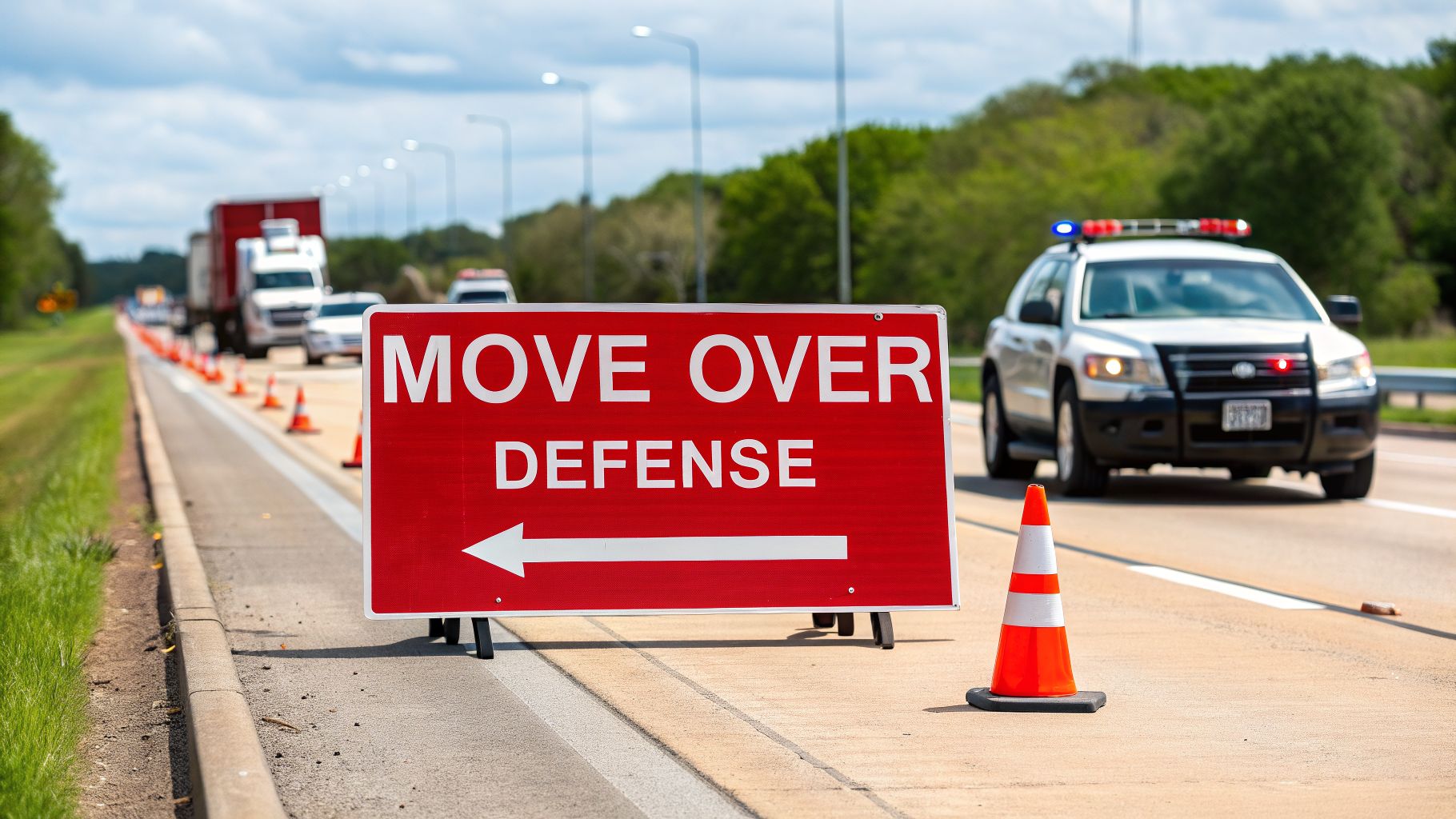
A Florida Move Over Law ticket is a serious moving violation under Statute 316.126. An officer’s claim that you failed to move for an emergency or disabled vehicle is just an accusation. You can, and should, fight it to protect your record from points and insurance hikes.
Do not make the mistake of just paying the fine. That is a guilty plea. It guarantees points on your license and higher insurance rates. You must protect yourself. Your defense starts now.
What is the immediate threat of a Move Over ticket?
The immediate problem is not just the stop itself. It is what happens next if you treat the citation like a parking ticket. In Florida, a Move Over violation is handled as a moving traffic infraction, and paying it is generally an admission of guilt rather than a neutral way to make it go away. Florida clerks and county schedules vary, but the violation is commonly described as carrying a $60 statutory base fine that rises to roughly $158 once mandatory costs and surcharges are added, and it also carries 3 points on your license, as widely reported after the 2024 law expansion by the Miami Herald. Florida county clerk payment pages for moving violations also make clear that paying a citation closes the case as an adjudication unless another disposition applies, which is why the first decision matters so much; see, for example, the Miami-Dade Clerk traffic payment information.

Why is paying the fine a costly mistake?
Paying the citation usually means you are not contesting the officer’s allegation. For most drivers, that creates two categories of cost.
Direct costs: the fine itself, court-related assessments included in the payable amount, and in some cases the separate time and expense of any election you make to address the ticket.
License consequences: 3 points for the violation.
Downstream costs: insurance repricing, employer scrutiny for anyone who drives on the job, and record complications if you are already carrying prior points.
That distinction matters. A driver often focuses on the amount printed on the ticket, but the more expensive part is what happens after the conviction posts to the driving record. If you hold a job that depends on insurability, fleet approval, app-based driving, or a clean MVR, the exposure is often far beyond the clerk’s payment screen. For a complete guide on handling the situation after being cited, see our article on what to do when you get a ticket.
A proper Florida Move Over Law ticket defense forces the State to prove its case. The officer’s opinion is not the final word. A lawyer’s first job is to stop a quick guilty plea, preserve your options, and evaluate whether the citation can be dismissed, reduced, or resolved without points.
What does Florida Statute 316.126 actually require?
The state must prove you failed to follow a specific set of rules. We build your defense by challenging whether you violated Florida Statute 316.126. An officer's feeling is not enough for a conviction. The law has clear requirements. We hold the state accountable for proving every single one.

What are the two core commands of the law?
The statute creates a two-part duty. You must move over for certain vehicles stopped on the roadside with lights flashing. If you cannot move, you must slow down significantly.
Duty #1: Vacate the Lane. On a multi-lane road, you must move out of the lane closest to the stopped vehicle. This must be done safely. The law never requires you to swerve or make a dangerous maneuver.
Duty #2: Slow Down. If you cannot safely move over, you must reduce your speed. The law is crystal clear about how much.
This dual requirement is where many defenses are found. Was it safe to move? Did traffic make it impossible? These are the questions to consider. You can find a breakdown of your responsibilities in our guide on Florida state traffic laws. For readers comparing roadside-law changes more broadly, Flex Electric's guide offers a useful example of how quickly vehicle rules can shift and catch ordinary drivers off guard.
How much do you have to slow down?
If moving over is not possible, the statute commands a precise speed reduction.
You must slow to a speed that is 20 miles per hour less than the posted speed limit. If the speed limit is 20 mph or less, you must slow to 5 mph.
This is a critical detail. For the ticket to stand, the officer must prove you were traveling faster than this specific speed. It is not about what "felt" fast. It is a matter of evidence.
Which vehicles are covered?
The law protects more than just police cars. You are required to move over or slow down for any of these authorized vehicles using their visual signals:
Law enforcement vehicles
Fire department vehicles and ambulances
Wreckers or tow trucks
Sanitation vehicles (garbage trucks)
Utility service vehicles
Road and bridge maintenance or construction vehicles
A major recent change also expands the law. It now includes any disabled vehicle on the side of the road with its hazard lights on. This dramatically increases your risk of getting a ticket.
How did the law expand to put you at risk?
The Move Over Law has changed. Your risk of getting a ticket is now higher than ever. Originally, the law protected official emergency and service vehicles. That has expanded dramatically. This was not a minor tweak. It is a fundamental change to how you must drive in Florida.
What is the new rule you must know?
As of January 1, 2024, the law now requires you to move over or slow down for any disabled vehicle with its hazard lights on.
Any car pulled over on the shoulder with its blinkers on is now a potential ticket trap. The legal shield once reserved for police and tow trucks now extends to every driver with a flat tire or engine trouble.
This change came after a crisis on Florida roads. State and national safety materials now reflect how visible the issue has become: Florida documented 205 crashes and more than 17,500 citations in 2024 alone tied to failures to move over, according to the FHSMV move over campaign materials and the Florida Traffic Safety Team overview. The same source notes that drivers aged 20 to 29 are the group most often cited, which helps explain why so many of these cases involve ordinary commuters rather than habitual offenders.
Why does this put a target on your back?
This update creates a new environment for traffic enforcement. An officer can now pull you over for failing to move for a civilian car. This was not a violation before 2024.
More covered roadside situations: a disabled private vehicle now triggers the same decision-making problem drivers once associated mainly with police, tow trucks, and utility fleets.
More judgment calls: whether a lane change was safe, whether hazard lights were visible soon enough, and whether the driver had enough time to react are all fact questions, not automatic conclusions.
Many responsible drivers are getting snagged by a rule they did not know existed. That alone is not a legal defense, but the surrounding facts often are.
How much is a Florida move over law ticket, and is a lawyer worth it?
For many drivers, the payable amount is around $158 total, although county formatting and add-on costs can vary. The practical statewide takeaway is consistent: this is not a zero-point warning. The offense is generally treated as a moving violation carrying 3 points, and those points can matter more than the fine.
A lawyer is usually worth serious consideration when any of these apply:
you already have points on your record;
you hold a CDL or drive for work;
your insurer is likely to react aggressively to another moving conviction;
the stop happened in a county far from home;
the facts are disputable, especially visibility, traffic conditions, or whether the stopped vehicle qualified under the statute.
If the evidence is weak, counsel may be able to pursue a dismissal. If the facts are mixed, the realistic goal may be an amendment or a withhold that avoids the full damage of a straight guilty finding. If the evidence is strong and the only issue is convenience, legal representation can still make sense because it may spare you a personal court appearance and improve the odds of a cleaner outcome. The right cost comparison is not ticket amount versus attorney fee in isolation; it is ticket amount plus points plus insurance exposure plus time away from work.
What are the most effective defenses against a Move Over ticket?
A move over case is rarely won by arguing that the law is unfair. It is won by forcing the State to prove each factual piece of the citation. A move over law ticket lawyer usually starts by matching the officer’s allegation to the exact duty involved: was the claim that you should have changed lanes, or that you failed to slow down enough when changing lanes was unsafe? Those are different theories and they require different proof.
Getting a citation feels final. It is just the opening move. In these cases, a defense lawyer reviews the statute, the ticket language, the roadway layout, the officer’s vantage point, and any available video to decide whether the case is weak enough for dismissal or better suited for negotiation.
Challenging whether a lane change was actually safe
The statute does not require a dangerous maneuver. That means the State must do more than say you stayed in the lane nearest the stopped vehicle. It has to overcome the possibility that moving over was unsafe because of adjacent traffic, a blocked lane, a vehicle in your blind spot, a curve, limited shoulder space, or road conditions that made a quick lane shift unreasonable.
This is one of the most common attorney-built defenses because it turns the case from a simple accusation into a proof problem. If traffic boxed you in, or if a lane change would have forced another driver to brake hard, the prosecution’s theory weakens immediately.
Testing the officer’s vantage point and ability to observe
Move over tickets often depend on a fast roadside judgment. That makes officer vantage point critical. Where was the officer positioned? Could the officer see your adjacent lane? Was there another vehicle between you and the patrol car? Did the officer have a clear basis to judge whether you had room to change lanes safely?
A good defense does not assume the officer saw the whole event. It looks for visual obstructions, distance problems, nighttime visibility issues, weather, and whether the officer inferred your options instead of observing them. For more information, see fight a traffic ticket in Florida.
Questioning whether the stopped vehicle displayed qualifying lights
The law applies only when the protected vehicle is displaying the required visual signals. In practice, that means the defense should ask whether the emergency lights, warning lights, or hazard lights were activated and visible in time for a driver to respond safely.
For disabled civilian vehicles, this issue matters even more after the 2024 expansion. If hazard lights were dim, obstructed, activated late, or not visible at a reasonable distance, the State may struggle to prove that the statutory duty was triggered when the officer claims it was.
Determining whether the vehicle fell within the statute’s protected categories
Not every roadside stop creates the same duty under every set of facts. A move over attorney will look carefully at what kind of vehicle was stopped, where it was positioned, and whether it fit the statute’s protected categories at the time of the citation. That analysis can matter in cases involving private service vehicles, roadside work activity, or a vehicle the officer assumed was disabled without confirming the facts.
For slow-down allegations, forcing proof of speed
Some citations are really speed-proof cases in disguise. If the allegation is not that you failed to change lanes, but that you failed to slow down enough, the State still needs competent proof that you were traveling above the statutory reduction required by law. That raises practical questions: was there a radar or lidar reading, a paced estimate, dashcam evidence, or just a rough visual impression?
When the exact speed matters, vague testimony can be a problem for the prosecution. The statute sets a measurable standard, so the evidence should be measurable too.
A realistic example of how the same stop can resolve three different ways
Take a driver on I-95 in moderate traffic who passes a disabled SUV on the shoulder with hazard lights on. The officer says the driver should have moved left. The driver says the center lane was occupied and slowing was the only safe option.
If video shows the adjacent lane was blocked, the case may support a dismissal.
If the proof is mixed and the officer had only a partial view, the case may be resolved by an amendment to a nonmoving violation.
If the facts are not ideal but the driver has a clean history, counsel may seek a withhold or other outcome that avoids the full record damage of a straightforward conviction.
The right strategy depends less on slogans and more on evidence.
Issue in Dispute | What the State Must Show | Why It Matters to the Defense |
|---|---|---|
Safe lane change was possible | A reasonable, available opportunity to vacate the nearest lane | If traffic or road conditions made the maneuver unsafe, the core allegation weakens |
Officer had a reliable view | Clear observation of your lane, surrounding traffic, and reaction distance | Obstructed or incomplete observation can undermine the citation |
Protected vehicle was properly signaled | Flashing emergency lights, warning lights, or visible hazard lights as required | If the lights were not visible in time, the statutory duty may not have been triggered |
Vehicle fit the law’s covered categories | The stopped vehicle fell within the statute at the time of the event | Misclassification can create a defense or negotiation leverage |
Speed proof supports a slow-down claim | Evidence you exceeded the reduced speed required by statute | A visual estimate may be too thin where exact speed is central |
Who is most at risk from a Move Over Law ticket?
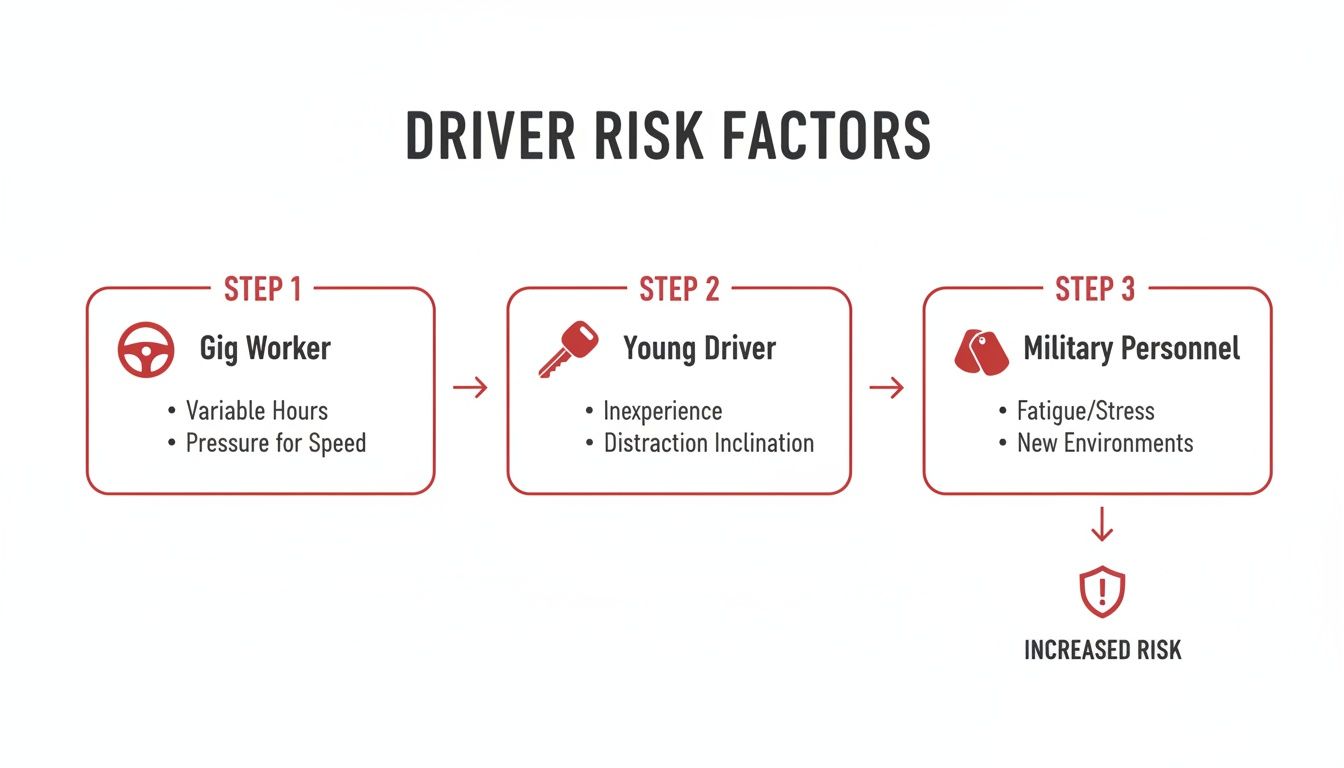
Some drivers can absorb a routine ticket more easily than others. In a move over case, the highest-risk group is not just young drivers or commuters. It is drivers for whom points, travel, or court logistics turn a single citation into a much bigger problem. Florida reporting on move-over enforcement has also emphasized that younger drivers are cited often enough to stand out, and that the law now reaches far more roadside encounters than many motorists expect; see this Florida move-over overview.
When does hiring an attorney matter most?
A lawyer is especially useful when the ticket threatens more than a fine.
CDL holders: even a noncriminal traffic case can have outsized employment consequences.
Drivers with prior points: another 3 points may push the record into a much more serious range.
Out-of-county drivers: returning for hearings can cost more than the ticket itself.
Drivers who cannot appear in court: work schedules, caregiving, military service, or travel limitations often make representation the practical solution.
Fact-dispute cases: if visibility was poor, traffic made a lane change unsafe, or the officer had a weak vantage point, legal analysis matters.
What can a lawyer usually handle remotely?
In many Florida traffic cases, counsel can file the response, enter the plea, review discovery, appear at routine hearings, and negotiate resolution without requiring the client to stand in court personally. That is often the biggest advantage for drivers cited far from home. The specifics depend on county practice and the posture of the case, but remote handling is common enough that it should be part of the early conversation.
What should you gather right after the stop?
If you plan to fight the citation, save evidence immediately while the details are still fresh:
the citation itself;
the exact location, time, and lane position;
weather and traffic conditions;
dashcam footage, if any;
photos or notes about sight lines, curves, congestion, and shoulder conditions;
any reason a lane change would have been unsafe.
If point accumulation is already a concern, review the bigger picture too. Our guide on driving with a suspended license in Florida explains why apparently minor citations can become major license problems.
What is our process for fighting your ticket?
A useful answer here is not “we handle everything.” It is what happens after you decide not to just pay the citation.
Step 1: Respond before the citation deadline
Florida traffic citations come with a response window, and missing it can remove options quickly. The first step is making sure the case is answered on time rather than letting a guilty disposition happen by default. If you contact counsel early, the lawyer can evaluate the allegation before you lock yourself into the wrong choice.
Step 2: Counsel enters the case and preserves your defenses
Once retained, a traffic lawyer typically files the appropriate notice or plea, contests the allegation, and requests that the State prove the violation. This is the point where the case stops being a simple payment matter and becomes a legal file that can be reviewed, challenged, and negotiated.
Step 3: Review the evidence, not just the ticket language
A proper review usually includes the citation, any officer notes, bodycam or dashcam footage if available, location details, lane configuration, and the exact theory of the stop. A move over law attorney is not just arguing generally for mercy; the primary work is testing whether the evidence fits the statutory elements.
Step 4: Determine whether you need to appear
In many routine traffic matters, the client does not need to attend every setting. That is especially important for out-of-county drivers, professionals with inflexible schedules, and anyone trying to avoid losing a day of work over a single citation. Whether a personal appearance is required depends on county practice and how the case develops, but many clients hire counsel precisely to minimize that burden.
Step 5: Pursue the most realistic no-point outcome
“No points” is not one magic result. In Florida traffic practice, it can mean different dispositions depending on the county, the judge, and the proof.
Dismissal: the case is thrown out or dropped because the evidence is insufficient or the State does not proceed.
Amendment: the charge is reduced to something less damaging, often with the goal of avoiding points.
Withhold of adjudication: in the right circumstances, the court may resolve the case without a straight adjudication, which can protect the record better than a simple guilty finding.
That is why a realistic process matters more than marketing language. The goal is not to promise one scripted outcome. It is to identify the best available result under the facts.
This visual shows how certain jobs and ages are hit hardest. To see how a specialist builds these cases, learn about the role of a traffic ticket attorney in Florida.
What are the most frequently asked questions about this law?
When you get a Move Over Law ticket, you have urgent questions. Here are the direct answers you need to understand what is at stake.
Can I get a ticket for passing a car with its hazard lights on?
Yes. This is a critical change. Florida's Move Over Law was expanded under Florida Statute 316.126. It now applies to any disabled vehicle on the roadside displaying its hazard lights. Many drivers are unaware of this change. While ignorance of the law is not a legal excuse, a dedicated attorney can use the circumstances surrounding the stop as part of a strategic defense.
Will a Move Over ticket affect my job as an Uber driver?
Absolutely. A conviction for violating the Move Over Law adds 3 points to your Florida license. For anyone driving for a living—especially for platforms like Uber, Lyft, or DoorDash—this can be devastating. These companies have strict safe driving policies. A single moving violation conviction is often enough for them to permanently deactivate your account. Your income is gone instantly.
What if traffic made it unsafe to move over?
This is one of the most powerful legal defenses. The law is clear: you are only required to move over if you can do so safely. If changing lanes meant cutting someone off, or if a vehicle was in your blind spot, you did the right thing by holding your lane and slowing down. The challenge is proving it. Our attorneys have years of experience building cases that demonstrate your actions were reasonable and safe.
If you are deciding whether to handle the case alone or hire counsel, start with the actual stakes: 3 points, a payable amount that is often around $158, and a record issue that can outlast the fine. National survey data shows most drivers say they comply with move-over rules, yet enforcement remains heavy in Florida, which is one reason these cases keep reaching traffic-defense lawyers; see the AAA Foundation 2025 survey.
Do not let a ticket threaten your job and finances. Ticket Shield, PLLC provides a real lawyer to build your defense. Visit TicketShield.com for a free consultation and start protecting your record today.
Outcome | Paying the Fine (Pleading Guilty) | Hiring Ticket Shield to Defend You |
|---|---|---|
Points on License | Guaranteed 3 points are added to your driving record. | Our goal is No Points. We fight for a dismissal or a "withhold of adjudication." |
Insurance Premiums | A conviction almost always leads to significant rate hikes for 3-5 years. | By avoiding points, you have a high probability of preventing any insurance increase. |
Driving Record | The conviction becomes a permanent mark on your public driving history. | We aim to keep your record clean, protecting you from future employment or background check issues. |
CDL & Career Impact | A conviction can lead to disqualification or job loss for professional drivers. | We work to protect your CDL and your livelihood by fighting the underlying charge. |
Total Cost | The fine is just the start. The long-term cost is thousands in higher insurance. | The attorney fee is a small investment to avoid thousands in future costs and penalties. |