
Florida DUI Second Offense Penalties: Know Your Rights
Facing Florida DUI second offense penalties? Understand mandatory jail time, fines, & 5-year license revocation. Get your rights explained now.
A second Florida DUI can trigger fines from $1,000 to $4,000, jail exposure, license revocation, and immediate danger to your ability to drive. The first deadline is fast. You must move quickly to protect your license and your defense.
You’re probably reading this with bond paperwork on the table, your car situation unresolved, and one question running through your head. How bad is this?
Bad enough that waiting will hurt you.
A second DUI in Florida is not treated like a routine traffic case. Under Florida Statute § 316.193, the state treats a repeat allegation as a serious criminal matter with mandatory consequences if you’re convicted. The court case matters. Your license battle matters just as much. If you miss the early administrative window, you can lose ground before your criminal defense is even fully built.
That’s why florida dui second offense penalties need to be understood in real time, not weeks later when your first court date arrives. You need a plan now, while facts are still fresh and deadlines are still open.
Table of Contents
Your Second DUI Arrest The Clock Is Already Ticking
You walk out of jail after a second DUI arrest thinking the court date is the next thing that matters. It usually is not. The first threat to your life and routine is often your license, and the deadline to protect it starts running the day of the arrest.

The most common mistake after a second DUI arrest is waiting. Waiting to read the paperwork. Waiting to call a lawyer. Waiting because you assume the criminal case controls everything. It does not.
You are already on the clock for more than one deadline, and the shortest one can hit your driving privilege before your criminal case gets any traction. If you need the sequence explained in plain English, read what happens after a DUI arrest in Florida now, then get counsel involved fast.
Why the first days matter
The first few days decide whether you keep options open or hand the state an easy win. People hurt their cases by talking to friends in text messages, missing notices, assuming they can fix the license issue later, or treating the arrest like a problem for next week.
That delay costs real ground.
For many clients, the immediate danger is not a final court sentence. It is losing the ability to drive to work, take children to school, show up for probation requirements, or keep a commercial schedule intact. A second DUI puts pressure on your criminal case and your license at the same time, and those problems need separate action right away.
Here is my advice. Act like every day counts, because it does. Save every document you were given. Do not discuss the stop with anyone except your lawyer. Call a DUI defense firm immediately and make sure the 10-day DHSMV deadline is addressed before it expires.
That is how you stop an arrest from turning into a preventable license loss.
Are You Fighting One Battle or Two
You’re fighting two separate cases. This is often not understood until it’s too late.
One case is criminal. The other is administrative. They move on different tracks, they answer different questions, and one can hurt you even if the other improves.

What happens in criminal court
The criminal case is often the initial focus. That’s the prosecution, the judge, and the penalties tied to a conviction. If your case is in Miami-Dade, you may be dealing with proceedings centered around the Richard E. Gerstein Justice Building.
That court process decides whether the state can prove the DUI charge and what penalties follow if there’s a conviction or negotiated outcome. During this process, the evidence gets tested: The stop. The officer’s observations. The roadside exercises. The breath evidence. The video. The paperwork.
A criminal case can be defended aggressively. But it takes work, fast.
What happens with the DHSMV
The second battle is with the Department of Highway Safety and Motor Vehicles. This is the part that controls your driving privilege. It is not the same as the criminal courtroom.
The key fact is simple. You have a 10-day deadline from the date of arrest to request the administrative hearing that challenges the suspension threat to your license. Miss that deadline, and the suspension can take effect automatically. The practical roadmap for that process is in this guide to the administrative license suspension hearing.
Use this comparison to keep the two tracks straight:
Track | Who controls it | What is at stake |
|---|---|---|
Criminal case | Court | Conviction, jail exposure, fines, probation, other criminal penalties |
Administrative case | DHSMV | Your right to keep driving |
You can improve one track and still lose on the other if you ignore the license side early.
That’s why florida dui second offense penalties can’t be understood as just “what the judge gives me.” The court can punish you. The DHSMV can take away your ability to drive. Those are different threats, and both need immediate attention.
What Are the Mandatory Criminal Penalties
A second DUI conviction puts you in the punishment phase fast, and judges in these cases have limited room to ignore what Florida law requires. You need to know the floor, not just the worst-case ceiling, because mandatory penalties change how we defend the case from the start.
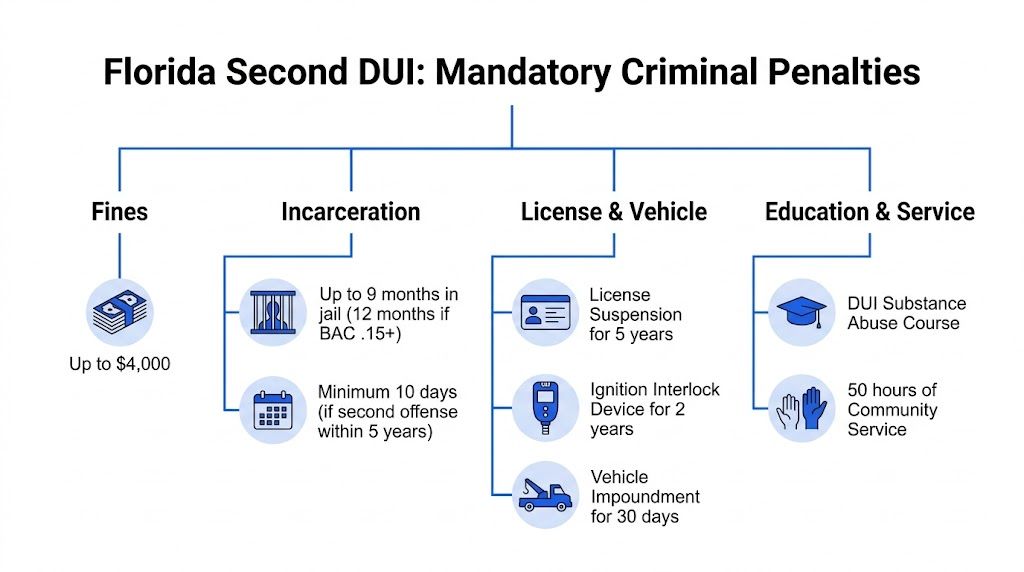
What the statute requires
For a second DUI, the criminal court can impose fines, jail, probation, community service, vehicle impoundment, and ignition interlock requirements. If the prior DUI falls within the 5-year look-back period, jail is not just possible. A minimum jail term comes into play, and that changes the pressure on every stage of the case.
The base fine range for a second conviction is serious. It rises further if the state claims a high breath or blood alcohol level or says a minor was in the vehicle. A broader summary of Florida DUI penalties and sentencing ranges can help with background, but the immediate point is simple. A second offense exposes you to punishment that can affect your freedom, your schedule, your car, and your finances at the same time.
That is why waiting is a mistake. We do not treat a second DUI as a case to “see how it plays out.” We move early to attack the stop, the arrest, the testing, and the paperwork before the prosecution hardens its position.
What a conviction can include besides jail and fines
Jail and fines get the most attention. They are only part of the problem.
A second DUI conviction can also bring:
Probation, with strict reporting and compliance rules
Community service, which takes time you may not have
Vehicle impoundment, which creates immediate transportation and cost problems
Ignition interlock requirements, which follow you every time you drive
The cumulative weight of these penalties creates the most significant disruption.
Clients often focus on one fear, usually jail. That is understandable, but it is incomplete. A second DUI can damage your job, your parenting schedule, your commute, and your insurance costs even if custody is limited. The right strategy is to fight the criminal case aggressively while protecting your license on the separate DHSMV track before that 10-day deadline closes.
How Do Aggravating Factors Increase Your Penalties
Aggravating facts give the prosecutor more room to push for harsher punishment and make your second DUI harder to resolve on favorable terms. In a case that already carries serious exposure, those facts can change the tone of the prosecution from negotiable to aggressive fast.
Two allegations usually cause the biggest jump in risk. A high breath or blood alcohol reading. A minor in the vehicle.
A high BAC gives the state a stronger punishment argument
If the state claims your BAC was over 0.15, you are no longer dealing with a routine second DUI prosecution. You are dealing with a case the prosecutor will present as more dangerous, more reckless, and more deserving of jail, higher fines, and tighter conditions.
That allegation must be attacked early. We look at the traffic stop, the arrest timeline, the breath machine, maintenance records, observation period, calibration history, operator training, and whether the reported number matches what occurred. A high reading can look powerful on paper. It is still evidence. Evidence can be challenged.
Judges also react to that number. Prosecutors know it. So do we. The right move is not to explain it away. The right move is to test whether the number is reliable enough to hold up under pressure.
A child passenger changes how the case is judged
If a minor under 18 was in the vehicle, the state will use that fact to frame you as a danger to others, not just a driver who made a bad decision. That can affect charging posture, plea offers, sentencing demands, and how little room the prosecutor thinks they should give.
Clients often make a costly mistake. They focus only on what happened in court and miss the separate threat to their ability to drive. In a second DUI, aggravating facts can make both fights harder at the same time. The criminal case gets tougher. The DHSMV side becomes even more urgent because any delay puts your license at immediate risk while the court case is still developing.
That is why we build the response on two tracks from the start. We challenge the aggravating allegation itself, and we move immediately to protect your driving privilege before the administrative deadline closes.
If your arrest also involves allegations of serious bodily injury or death, you are outside the usual second-offense analysis and into a far more dangerous category. Read more about Florida DUI manslaughter sentencing issues.
Will You Lose Your License and For How Long
Yes, your license is in danger. In many second DUI cases, that danger arrives before the criminal case is anywhere near finished.
That is why you need to treat this as two separate fights with two separate timelines. Court decides the criminal charge. The DHSMV can take your driving privilege much faster, and the 10-day window to challenge the administrative suspension is often the first deadline that matters.
The criminal case and the license case do not move at the same speed
A second DUI can put your license at risk for a long time if there is a conviction. As noted earlier, the revocation period becomes much harsher when the second offense falls within 5 years of the first. If it falls outside that period, you may still face a lengthy loss of driving privileges.
Clients get blindsided here because they assume the court date controls everything. It does not. You can still be waiting on hearings, evidence review, and negotiations while the administrative side is already threatening your ability to get to work, pick up your kids, or keep medical appointments.
If you miss the DHSMV deadline, you give up options early. That is a bad trade.
What the actual loss of a license can look like
For many people, the worst part of a second DUI is not the fine. It is the loss of mobility.
You may be dealing with:
a hard suspension or revocation period
delay before hardship eligibility
DUI school and related compliance requirements
ignition interlock obligations in some second-offense cases
higher insurance costs and added reinstatement expenses
That combination hits fast. A suspended license can put your job at risk within days, while the criminal case may take months to resolve.
If driving is tied to your income, this becomes an emergency
Commercial pressure is real even if the arrest happened in your personal vehicle. Employers care about whether you can legally drive, report to multiple sites, or remain insurable. Delivery drivers, sales representatives, technicians, nurses with rotating facilities, and parents handling school and childcare schedules feel this immediately.
Protecting your license is not a side issue. It is one of the first jobs your defense lawyer needs to handle.
What we do to protect you
We move on both tracks at once. We challenge the stop, the investigation, and the testing in the criminal case. At the same time, we act fast on the DHSMV side to preserve your chance to fight the suspension and, where available, protect your ability to keep driving lawfully.
That early move can change the pressure on the entire case. It protects your daily life while we build the broader defense.
What Are The First Steps You Must Take
You need to move with discipline. Not panic. Not excuses. Not internet guesses.
Your job right now is to protect evidence, protect your license position, and avoid making the prosecutor’s case easier.
Immediate Steps to Take
Save every document: Keep the citation, bond papers, property receipt, notice of suspension, towing papers, and any temporary permit together. Don’t rely on memory later.
Write down the stop tonight: Record where you were, what you said, what the officer said, whether there was body cam or dash cam, and anything unusual about the stop, testing, or arrest. Small details become defense issues.
Stop talking about the case: Don’t explain it to police, prosecutors, coworkers, or social media. Don’t try to “clear things up.” Those statements can be used against you.
Protect the DHSMV deadline: The administrative side moves fast. If you wait, you can lose your chance to challenge the suspension.
List every witness and location: If someone saw the stop, your condition before driving, or the arrest itself, preserve that information now. Surveillance footage doesn’t stay available forever.
Follow bond conditions exactly: Don’t create a second problem while trying to solve the first one.
Get legal help immediately: A second DUI is not a case to “watch and see.” You need a defense strategy early, especially where jail exposure and license consequences are both in play.
Bring your paperwork to counsel before the memory of the stop gets cleaned up by the police report and before independent evidence disappears.
One more point. Don’t assume your version of events is enough by itself. A defense is built from documents, video, timelines, procedures, and pressure points in the state’s proof. That process starts immediately, not on the eve of court.
How An Experienced DUI Firm Can Protect You
A second DUI case is where weak representation shows fast.
You need a lawyer who knows how Florida DUI prosecutions are built, where the technical faults usually hide, and how to manage both the court case and the license fight without confusing them. That kind of work isn’t automated. It isn’t handled well by intake staff reading scripts. It requires judgment.

What a real defense looks like
A real defense starts by attacking the foundation of the case.
That may include challenging the reason for the stop, examining whether the officer followed proper procedure, testing the reliability of breath evidence, reviewing video against the report, and filing motions to suppress evidence where the law was violated. It also means handling the license crisis at the same time, not treating it as an afterthought.
If your case is pending in Central Florida, that work may play out at the Orange County Courthouse. In Tampa, it may center around the Edgecomb Courthouse. The courthouse changes. The need for fast, strategic action doesn’t.
For a broader look at what attorney-driven DUI representation should involve, review this page on DUI attorneys in Florida.
Why direct attorney access matters
You should be able to speak directly to your lawyer by phone or text. That matters in a DUI case because facts change quickly, deadlines arrive fast, and anxiety gets worse when clients are stuck behind middlemen.
Automated apps and ticket mills don’t build trust. They process volume. That’s not what you need when your license, record, and freedom are exposed.
An experienced lawyer-led defense gives you something much more valuable. Actual judgment. Someone who can tell you what matters, what doesn’t, what gets challenged first, and where the state’s case may be vulnerable.
The right defense doesn’t promise magic. It protects ground early, challenges weak evidence hard, and keeps you from surrendering before the fight begins.
If you’re facing florida dui second offense penalties, act now. Ticket Shield, PLLC is a lawyer-led Florida defense firm where you speak directly with your attorney by phone or text, not a chatbot or a middleman. The goal is simple. Protect your record, protect your license, and pursue the strongest No Points outcome the law allows. Visit Ticket Shield, PLLC now for a free consultation.
