
Fight Florida Driving With Suspended License Charges
Arrested for florida driving with suspended license? Understand penalties & effective defenses. Our experienced attorneys protect your record.
If you were charged with florida driving with suspended license, act fast. A DWLS stop can become a criminal case under Fla. Stat. § 322.34, but the State still has to prove you knew about the suspension. That issue alone can change everything.
You were likely heading to work, picking up your kids, or trying to get through a normal day. Then the lights came on behind you. You handed over your information, waited in that awful silence, and the stop turned into something much more serious than a ticket.
When an officer says you are being charged with driving with a suspended license, panic is normal. So is confusion. Many drivers assume the case is already lost. It is not. But the next steps matter.
Florida prosecutes these cases under Fla. Stat. § 322.34, and the stakes rise fast if you say the wrong thing, plead too quickly, or trust an impersonal service that treats your case like paperwork instead of a defense.
Table of Contents
You’ve Been Pulled Over What Happens Now
The officer walks back to your window with a different tone. That is the moment people start talking too much. They apologize. They explain. They guess. They say they thought it was cleared up.
That can hurt you.
At places like Miami’s Richard E. Gerstein Justice Building, these cases move through court every day because the problem is widespread. In 2022, Miami-Dade County court data showed about 600,000 people were driving with suspended licenses, and two-thirds of those cases came from unpaid fines rather than dangerous driving, according to Local 10’s reporting on Miami-Dade suspended license data.

Why this charge feels sudden
A lot of suspended drivers are not reckless drivers. They are people who missed a notice, failed to appear, fell behind on court debt, or assumed a payment fixed the issue. Then a routine stop becomes a criminal allegation under Fla. Stat. § 322.34.
You need to treat that stop as the start of a criminal defense problem, not a customer service problem.
If this just happened, read this practical guide on what to do when you get a ticket. Then stop talking about your case to anyone except your lawyer.
What the officer is looking for
The officer is not just confirming identity. The officer is gathering statements that may help the prosecutor argue you had knowledge of the suspension. Simple answers can become evidence.
That includes statements like:
“I thought I paid that already.”
“I knew it was suspended, but I had to get to work.”
“They never fixed it at the DMV.”
“I was on my way to take care of it.”
Every one of those statements can make the State’s case easier.
Tip: Be polite. Provide identifying information. Do not explain the suspension. Do not guess. Do not try to talk your way out of the stop.
Right now, your job is simple. Protect the record. Protect your future. And do not hand the prosecutor the one element they may still need.
Why Is Your Florida Driver’s License Suspended
Before you can fight the charge, you need to identify the source of the suspension. Drivers often focus on the stop itself and ignore the administrative trigger behind it. That is a mistake.
Florida suspends an enormous number of licenses for reasons that have little to do with dangerous driving. A James Madison Institute study found that 76% of the 1.7 million license suspensions in Florida in a single year were for non-traffic-safety offenses, affecting one out of every 10 drivers, as discussed in Reason’s analysis of Florida license suspension practices.
Most suspensions are not about dangerous driving
That matters because it changes how you should think about your case. Many DWLS cases start with an administrative problem, not a public safety issue.
Common non-safety reasons include missed court dates, unpaid court costs, collection issues, and other legal obligations that trigger a hold or suspension. If you do not know the exact basis, get the driving record and court information immediately.
This overview of driver’s license suspension in Florida is a useful place to start if you are trying to identify the underlying cause.
The two categories you need to identify
Non-driving related suspensions
These are often the most frustrating because they catch people off guard. You may not have been accused of unsafe driving at all. Instead, the suspension can come from a paperwork or payment issue.
Examples include:
Unpaid fines or court costs
Failure to appear in court
Other court-ordered obligations
Administrative holds that were never fully cleared
These cases often produce the strongest fact patterns for a defense because the paper trail matters. Notice matters. Timing matters.
Driving-related suspensions
Some suspensions do come from conduct on the road or prior violations. These cases still require close review, but the underlying record can be more complicated.
Examples include:
Too many points on your record
Prior serious traffic offenses
DUI-related licensing consequences
Reckless driving or similar conduct
Your lawyer needs to know which category applies because the defense path changes. If the suspension came from a chain of notices, missed hearings, or processing issues, the prosecution may have trouble proving what you knew and when you knew it.
Key takeaway: Do not assume the reason for suspension is obvious. Many drivers are wrong about why their license was suspended. Your defense starts with the record, not with assumptions.
What Are the Criminal Penalties for Driving While Suspended
A DWLS stop can start as a routine traffic stop and turn into a criminal case fast. The prosecutor will try to frame it as simple. You drove. Your license was suspended. You knew. That last point matters more than most drivers realize, because the penalties get serious only when the State can prove knowledge.
Under Fla. Stat. § 322.34, Florida can charge driving while license suspended as a crime, not just a ticket. That is why careless pleas are so dangerous. One conviction can set up the next stop for much harsher treatment.
How Florida escalates DWLS charges
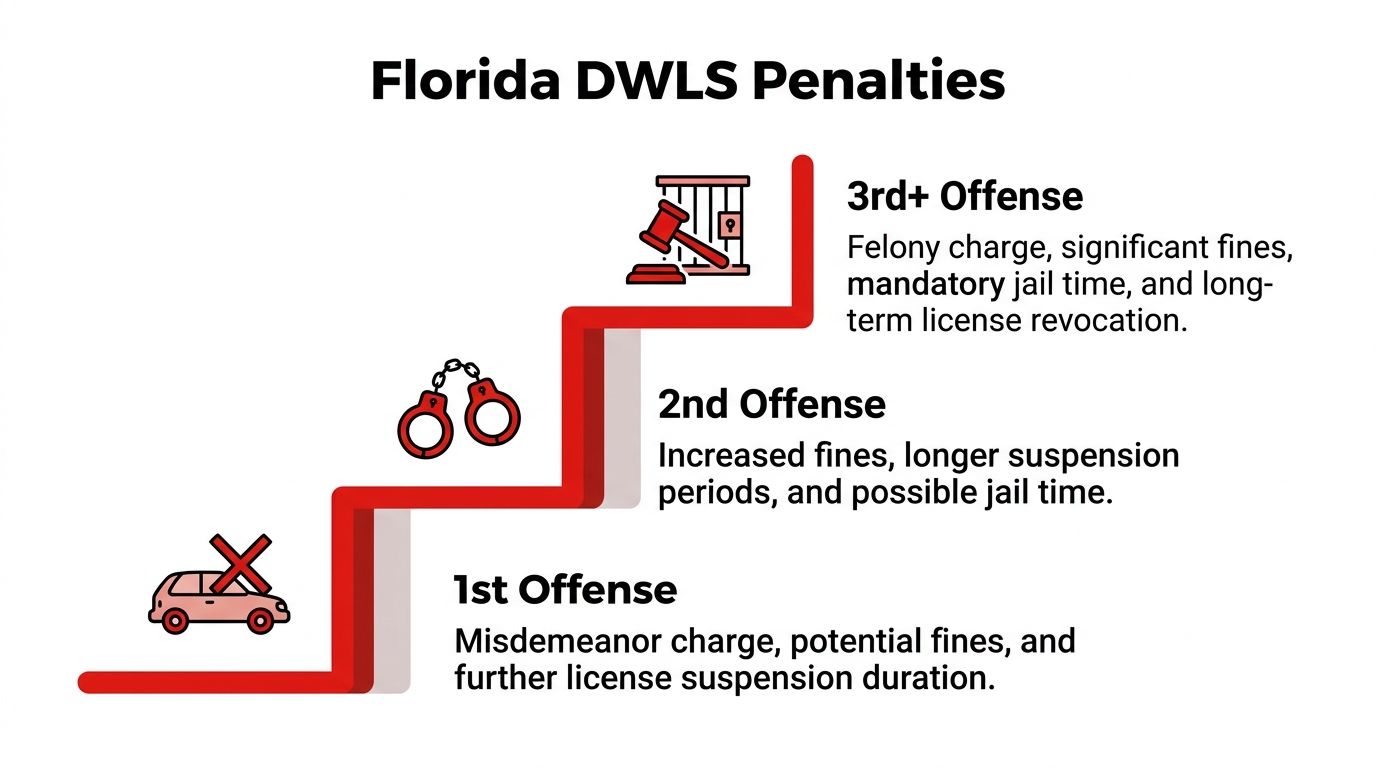
Florida uses a ladder. Each conviction raises the stakes.
First offense: second-degree misdemeanor, with up to 60 days in jail and a $500 fine
Second offense: first-degree misdemeanor, with up to 1 year in jail and a $1,000 fine
Third or subsequent offense: third-degree felony, with up to 5 years in prison and a $5,000 fine
That felony exposure is real. A third DWLS conviction can be charged as a third-degree felony under Fla. Stat. § 322.34, as summarized by CriminalDefenseLawyer’s explanation of Florida suspended license penalties.
If you are trying to understand how a traffic stop can become a criminal case, this guide on when traffic violations are charged as misdemeanors gives the broader context.
The charge is not automatic just because your license was suspended
Many people get misled by clerks, websites, and quick plea offers regarding this point. A suspended license alone does not end the case. In many DWLS prosecutions, the central question is whether the State can prove you knew your license was suspended before you drove.
That issue decides a lot.
If notice was mailed to an old address, if a court payment posted late, if a clearance never reached the driving record, or if the suspension came from an administrative mix-up, the State may have a proof problem. That does not erase the stop. It can change the charge, the plea posture, and the outcome.
Why an early conviction creates long-term risk
Drivers get in trouble when they treat the first case like a paperwork nuisance. They plead guilty, pay the fine, and move on. That decision can hand the State the prior conviction it needs to increase the next case.
Here is the practical exposure:
Offense level | Classification | Exposure |
|---|---|---|
First conviction | Second-degree misdemeanor | Up to 60 days jail and $500 fine |
Second conviction | First-degree misdemeanor | Up to 1 year jail and $1,000 fine |
Third or later conviction | Third-degree felony | Up to 5 years prison and $5,000 fine |
A DWLS conviction can also make reinstatement harder and put you in a worse position with prosecutors and judges later.
Do not let anyone sell you the idea that this case is only about minimizing punishment. The first job is to challenge the State’s ability to prove knowledge. That is how you stop a bad stop from becoming the conviction that follows you into the next one.
What Should You Do Immediately After Being Stopped or Arrested
You do not need a speech. You need a script.
When an officer says your license is suspended, your goal is to avoid making the case worse. This is not the time to explain the backstory, argue about the DMV, or promise that you were going to fix it tomorrow.
What to say and what not to say
You should be respectful. You should comply with lawful instructions. You should not answer investigative questions about what you knew.
Good answers are short:
“I want to remain silent.”
“I do not want to answer questions without a lawyer.”
“I will provide my identifying information.”
Bad answers are the ones people give when they panic:
“I knew it was suspended, but…”
“I got a letter, but I didn’t read it.”
“I missed court because…”
“The clerk told me it was probably okay.”
Those statements do not help you at roadside. They only create evidence.
Immediate steps to take
Stay calm: Angry, scared, and rambling drivers make admissions. Keep your answers short.
Do not argue the law: The side of the road is not where you win a DWLS case.
Do not guess: If you are unsure about your license status, say nothing about what you knew.
Preserve paperwork: Save the citation, booking papers, bond paperwork, and any prior notices you can find.
Write down the facts: As soon as you are safe, note the date, time, location, what the officer said, and what you said.
Check the suspension basis: You need to know whether this came from court debt, failure to appear, prior citations, or another administrative issue.
Contact counsel fast: Delay gives the State more room and gives you less.
If you were arrested, do not discuss the case by text with friends or family in a way that explains your knowledge of the suspension. Those messages can become problems later.
Key takeaway: The most important thing you can do after a DWLS stop is stop talking about the facts before a lawyer reviews them.
How Can You Defend Against a DWLS Charge in Florida
A DWLS arrest is not the end of the case. It is the beginning of the defense.
The biggest mistake drivers make is assuming the prosecutor only needs to show they were driving and the license was suspended. That is not enough for a criminal conviction under Fla. Stat. § 322.34(1) when knowledge is disputed.
The knowledge requirement is the first issue
For a criminal DWLS conviction, Florida Statute § 322.34(1) requires the State to prove you had actual knowledge of the suspension. If the State cannot prove knowledge, the matter is a non-criminal civil infraction instead of a criminal offense, as explained in this discussion of Florida Statute § 322.34 and the knowledge requirement.
That is the issue many lawyers do not explain early enough. It is also the issue many drivers accidentally destroy by talking.
Knowledge can become disputed when:
Notice was mailed to an old address
The suspension was tied to a court event you did not receive notice of
Payment or compliance happened, but the records did not update cleanly
You were confused by overlapping cases or reinstatement steps
This is why a defense starts with records, not excuses. You review the DHSMV history. You review court notices. You review dates. You compare what was mailed, what was returned, what was paid, and what was entered.
A lawyer handling these cases, including through resources like a florida driving with suspended license lawyer page, should be testing the State’s evidence on knowledge immediately.
Other defenses that can change the case
Knowledge is the first pressure point. It is not the only one.
Clerical and administrative errors
Florida’s suspension system depends on notices, entries, and record syncing. That creates room for mistakes. A payment can be misapplied. A clearance can be delayed. A suspension can remain visible after the underlying issue was addressed.
If the record is wrong, the defense should prove it with documents, not arguments.
Improper charging decisions
Some cases are filed criminally when the facts support a civil infraction theory instead. That matters because the difference affects jail exposure, your record, and your work.
Weak proof of notice
The prosecutor still needs reliable proof that you knew. If the notice trail is weak, inconsistent, or incomplete, the case may be vulnerable.
Tip: Your first defense question should be simple. “How will the State prove I knew?” If there is no clean answer, the case is very different from what the citation suggests.
Criminal DWLS vs Civil Infraction What’s the Difference
Factor | Criminal DWLS (With Knowledge) | Civil Infraction (Without Knowledge) |
|---|---|---|
Legal status | Criminal offense | Non-criminal traffic matter |
What the State must prove | That you knew your license was suspended | Lack of criminal knowledge keeps it civil |
Jail exposure | Possible | No jail time |
Criminal record risk | Yes | No criminal record |
Arrest consequences | Can be severe | Much more limited |
Defense focus | Attack knowledge, notice, and record accuracy | Show lack of actual knowledge |
The difference between those two columns is massive. It can determine whether this becomes a criminal stain on your record or a manageable traffic matter.
What Are the Hidden Costs Beyond Fines and Jail Time
Court penalties are only part of the damage. For many drivers, significant harm starts after the court date.

A DWLS conviction can hit your record, your insurance, and your job at the same time. A DWLS conviction adds 3 points to your record, repeat offenses can lead to insurance premium increases of 50-75%, and the total financial burden for a single incident can easily exceed $15,000, according to this breakdown of Florida DWLS penalties and defenses.
The conviction follows you outside the courtroom
If you drive for work, this can become an employment problem fast. Gig drivers face account issues. Professionals with background checks face disclosure problems. Military personnel and others in sensitive roles may face consequences that have nothing to do with the traffic stop itself.
Even when jail is avoided, the fallout can include:
Lost work time
Higher insurance bills
Pressure to pay reinstatement-related costs
Background check complications
Difficulty keeping driving-based income
If your record is already strained, it is worth reviewing practical bad driving record insurance options so you understand the coverage side of the problem while your legal defense is being handled.
Insurance pressure is real
Insurance companies do not care that your suspension may have started with an unpaid fine or a missed hearing. They react to the conviction and the points.
That is why a DWLS case should be treated as a record-protection case from day one. A plea that looks easy in court can cost you much more afterward.
This short video explains why drivers often underestimate those downstream consequences.
The right defense strategy is not just about avoiding a sentence. It is about avoiding a result that keeps charging you long after the case ends.
Key takeaway: If you only calculate the fine, you are not calculating the true cost of a DWLS conviction.
How Ticket Shield Provides a Real Lawyer-Led Defense
When you are charged with florida driving with suspended license, you need legal judgment. Not automation. Not a call center. Not a middleman collecting intake and handing your file off.
At the Broward County Judicial Complex, the Edgecomb Courthouse, the Orange County Courthouse, and courts across Florida, DWLS cases are won or lost on details. Notice details. Record details. Charging details. That means your defense should be handled by a lawyer who reviews those details with you.
Why direct attorney access matters
The difference is simple. In a lawyer-led model, you speak directly with your attorney by phone or text. You ask real questions and get legal answers tied to your facts.
That is not how automated apps or ticket mills operate. Those systems are built for volume. Your case is not volume. It is your license, your record, and possibly your job.
For drivers dealing with a criminal suspended-license charge, Ticket Shield’s suspended license criminal defense service is built around reviewing the suspension basis, examining the notice and driving history, and preparing a defense aimed at dismissal, reduction, or a no-points outcome when the facts support it.
What a strategic DWLS defense looks like
A strategic DWLS defense usually includes:
Reviewing the DHSMV record: Not just reading the citation.
Checking the suspension source: Court debt, failure to appear, points, or another trigger.
Testing the knowledge element: The core issue in many criminal filings.
Looking for notice gaps: Old address, mailing problems, overlapping cases.
Pushing for the right resolution: Dismissal, reduction to a civil matter, or another outcome that protects the record.
That is how you should evaluate any law firm you contact. Ask who reviews the file. Ask whether you will speak with your assigned lawyer. Ask how they analyze knowledge under Fla. Stat. § 322.34. If the answers are vague, move on.
Protect Your License and Your Future Today
You do not fix a DWLS charge by hoping the court understands. You fix it by acting quickly, protecting your statements, and building the defense before the case hardens against you.
A suspended-license case can threaten your freedom, your income, and your insurance. But it can also be challenged. The knowledge issue matters. The records matter. The timing matters.
Do not plead blind. Do not assume you have no options. Move now.
Visit Ticket Shield, PLLC for a free consultation and a direct review of your florida driving with suspended license case. The goal is simple. Protect your record. Protect your license. Fight for a No Points outcome.
