
FL Drivers License Suspension: FL Driver's License
Fl drivers license suspension - Facing a Florida driver's license suspension? Get expert guidance on causes, reinstatement steps, and how an attorney can

A Florida license suspension makes it illegal for you to drive. Your next move is to identify the exact cause, clear every hold in the right order, and avoid a costly mistake that can trigger criminal charges or longer suspension time.
You open the mail, or you get blindsided during a traffic stop, and suddenly your license is suspended. Now work is in danger. School drop-off is in danger. Your insurance, your job, and your record are all on the line.
Treat this like a legal emergency, because that's what it is. In Florida, suspension problems are massive. One analysis found that about 1.7 million driver's licenses were suspended in a single year, affecting roughly 1 in 10 Florida drivers, and about 76% of those suspensions were for non-traffic-safety-related offenses according to Reason's analysis of Florida license suspensions. That should tell you two things. First, you're not alone. Second, the system often punishes people for reasons that have little to do with dangerous driving.
A suspended license is not a paperwork nuisance. It's a legal trap. If you handle it casually, you can turn one problem into three.
Table of Contents
Your Florida License Is Suspended, Now What?
Stop driving until you know exactly where you stand. That advice is blunt because the risk is real. If your privilege is suspended, every trip can expose you to a new criminal problem.
The first job is diagnosis. You need to know whether the suspension is active, what triggered it, and whether there are multiple holds stacked on your record. Many drivers assume there is one issue and one fix. That's wrong. Florida often layers problems together.
If you haven't verified your status yet, start by checking whether your Florida license is suspended. Don't guess. Don't rely on memory. Don't assume a clerk, cop, or old court notice told you the full story.
What needs to happen first
You need a plan in this order:
Confirm the suspension status: Make sure it's active and identify the listed reason.
Get the driving record: That record tells you what the state thinks is wrong.
Match the cause to the remedy: A point suspension, a court debt suspension, and an administrative suspension don't clear the same way.
Protect yourself from a new charge: If you're caught driving while suspended, the problem gets more expensive and more dangerous.
Practical rule: The worst mistake is treating an FL drivers license suspension like a DMV errand. It isn't. It's a legal file with deadlines, conditions, and exposure.
What you should not do
Don't pay random tickets without checking whether payment creates points or closes off defense options. Don't show up at an office with incomplete paperwork and assume they'll tell you everything you need. And don't keep driving because "it's only to work." Florida doesn't give you a free pass for necessity.
Florida traffic law under Chapter 316 works hand in hand with the licensing consequences that can flow from citations and traffic cases. A ticket under Chapter 316 may look minor at first. It can still lead you straight into suspension trouble if it's mishandled.
Your goal isn't just to get legal again. Your goal is to get legal again without adding points, costs, or criminal exposure you could have avoided.
What Exactly Is a Driver's License Suspension?
A Florida driver's license suspension is a formal loss of your legal driving privilege. It is not a warning. It is not a suggestion. Once it takes effect, driving becomes unlawful.
That matters because drivers often use the wrong language. They say, "I just need to clear up a ticket." Maybe. But if your license is already suspended, the issue is bigger than the ticket. You are now dealing with a status offense that can lead to a charge for driving while license suspended under Florida law, and the state won't excuse confusion.
Why the legal label matters
Under Florida Statute 322.34, driving while your license is suspended is its own legal problem. That means a suspended status can turn an ordinary traffic stop into a criminal case. It also means timing matters. If you wait and keep driving, you make the state's case stronger.
Chapter 316 still matters here too. Many suspensions begin with moving violations, crashes, or other traffic allegations prosecuted under that chapter. What starts as one citation can expand fast.
A suspension doesn't just remove plastic from your wallet. It changes your legal status on the road.
Which suspension are you dealing with
Florida uses different suspension mechanisms, and the source matters. As explained in Ticket Shield's breakdown of Florida driver's license suspension types, an administrative suspension can be imposed directly by the DHSMV, while a court-ordered suspension is entered as part of a judicial sentence. The trigger source changes the remedy path. Some cases require administrative compliance. Others require you to satisfy court conditions first.
Here is the simple version:
Suspension type | Who triggers it | What usually matters most |
|---|---|---|
Administrative suspension | DHSMV | Agency deadlines, compliance steps, supporting documents |
Court-ordered suspension | Judge or court process | Satisfying the sentence, court costs, case-specific conditions |
That distinction changes everything. If the suspension is administrative, you may need to deal directly with DHSMV procedures. If it's court-ordered, you may need court clearance before DHSMV will do anything for you.
For drivers near the Orange County Courthouse in Orlando or any other Florida courthouse, people often get lost. They go to the wrong office first, bring the wrong paperwork, or pay the wrong thing. Then they assume the state "didn't update the system." Usually the issue is simpler. They took the wrong remedy path.
Why Was Your Florida License Suspended?
You do not fix a suspension by guessing. You fix it by identifying the exact legal trigger and choosing the right response before you make it worse.
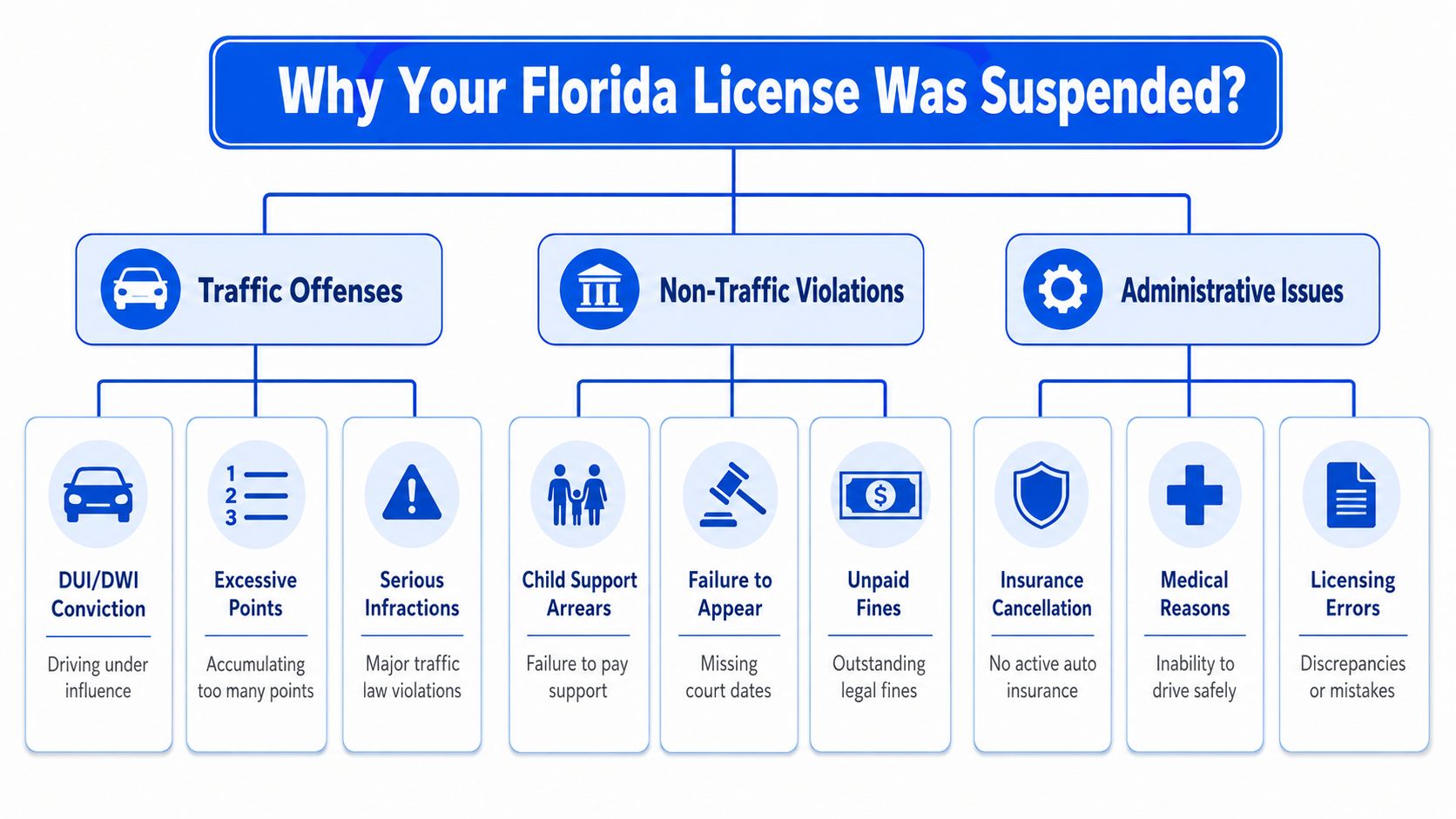
A lot of drivers make the same mistake. They assume any suspension has one simple fix, usually paying something online. That is how people plead to the wrong ticket, miss a challenge deadline, or clear one hold while three others stay active. A suspended license is a legal minefield. Treat it like one.
Were you suspended because of points
Point suspensions are mechanical, but the mistake that triggers them is often strategic. Florida counts moving violations across rolling time periods. According to this explanation of Florida suspension point thresholds, 12 points in 12 months triggers a 30-day suspension, 18 points in 18 months triggers 3 months, and 24 points in 36 months triggers 1 year.
One more ticket can be enough.
If points are in play, review how many points suspend a Florida license before you pay or plead to any open citation. In Florida, paying a ticket is often an admission that adds points. Drivers hurt themselves every day by trying to "take care of it" fast.
Was the suspension tied to money or court noncompliance
A suspension often has little to do with unsafe driving. It can come from unpaid court obligations, a missed court date, failure to complete traffic school, failure to carry required insurance, or failure to comply with a case condition the court or DHSMV entered into the system.
That changes the strategy. The core issue is removing the legal obstacle in the right order. Sometimes payment is part of the answer. Sometimes payment is wasted because the actual hold requires a court compliance document, proof of completion, or correction of an old clerk entry. If you do not know which office created the hold, you are still guessing.
Did an underlying incident create a separate risk
Some suspensions are tied to a larger legal problem, including DUI-related events, leaving the scene, crash investigations, or a pending criminal traffic charge. In those cases, your license status is only one piece of the danger. What you say, what you file, and what you admit can affect the underlying case.
If your suspension traces back to a crash-related allegation, read this Florida hit and run victim's guide for context on how these cases develop and why the fallout can spread beyond the initial incident.
Your notice may give you a category. Your driving record usually gives you the code. What matters is knowing which problem can be challenged, which one must be cured, and which quick fix will backfire.
What Are the Immediate Consequences of a Suspension?
The consequences start immediately. Not next month. Not after a hearing. Right away.

You can lose the ability to commute legally. You can jeopardize your work if you drive for a living. Insurance problems can follow. And if you keep driving without fixing the status, you invite a separate prosecution.
For many drivers, a significant danger is that the suspension doesn't clear quickly on its own. A county-level review covering 2016 through 2018 found that 77.12% of debt-based suspensions issued in 2016 were still active at the end of 2018, according to the Driving on Empty case study PDF. That's the part people underestimate. An old suspension can linger and keep punishing you long after the original case faded from memory.
What should you do today
Take these steps in order:
Stop driving: Don't risk a new charge while you're still sorting out the record.
Pull your official record: You need every active hold, not just the one you already know about.
List each requirement separately: Court debt, classes, waiting periods, insurance filings, and reinstatement steps often stack.
Preserve hearing rights: If your matter involves an administrative suspension, review whether a fast response is needed through an administrative license suspension hearing process.
Get legal review before you pay or plead: One rushed decision can make the record worse.
The state doesn't care that you still need to get to work tomorrow. If the privilege is suspended, the exposure is yours.
A quick explainer is below if you need a plain-English overview before you act.
Why delay makes this worse
Delay creates new risk in three ways.
First, you might keep driving and turn a licensing issue into a criminal file. Second, unresolved holds can block reinstatement even after you solve one piece of the problem. Third, old cases become harder to reconstruct because records, receipts, and notices get harder to track down.
If your daily life depends on driving, don't let this drift. A suspension can choke off work, rideshare income, delivery income, childcare logistics, and court options all at once.
How Do You Get Your Florida License Reinstated?
You walk into the DMV expecting to pay a fee and walk out legal. Instead, the clerk tells you there is still a hold on your record. That is how Florida drivers lose more time, more money, and sometimes their chance to fix the case the right way.
Reinstatement is a legal process with an order to it. Treating it like a paperwork errand is how people make expensive mistakes.

Many Florida suspensions grow out of unpaid fines, fees, missed court obligations, or unresolved case conditions, as noted earlier. That matters because reinstatement usually fails when a driver fixes only the obvious problem and misses the one still blocking the record.
Follow the right order
Use this sequence.
Pull the actual driving record
Do not rely on memory, a warning letter, or what a clerk says over the counter. The driving record shows what is active, what court or agency placed the hold, and whether you are dealing with one suspension or several.
Match each hold to its exact fix
Every suspension has its own cure. You may need to pay a court balance, complete a class, serve a revocation period, file proof of insurance, or close out an old failure-to-appear. One fix does not clear everything.
Handle insurance requirements only if they apply
SR-22 and FR-44 filings are case-specific. Ordering the wrong filing wastes money. Skipping a required one keeps you suspended. Verify the requirement from the record before you buy any policy.
Pay reinstatement fees after the underlying issue is cleared
A frequent error leads to complications. Paying a ticket or court balance does not automatically restore your license. Florida often requires a separate reinstatement step with DHSMV after the original problem is resolved.
Confirm the license status changed before you drive
Do not guess. Do not assume the system updated. Check that your status is valid before you get behind the wheel.
If you want the step-by-step version before dealing with DHSMV, review how to reinstate a suspended Florida license in Florida.
What about hardship or limited driving privileges?
Some drivers can qualify for restricted privileges. Many cannot. Eligibility depends on why the license was suspended, whether revocation periods apply, and whether the driver has already damaged the case by pleading, paying, or ignoring deadlines.
Use this framework:
Situation | Smart approach |
|---|---|
The suspension may be legally challengeable | Get the case reviewed before you admit anything or start paying everything |
The suspension is valid and the fix is clear | Complete each condition in the right order and document every step |
You need to drive to keep your job or care for family | Check whether hardship privileges are available and file correctly |
Good strategy saves licenses: Sometimes reinstatement means paying and filing. Sometimes it means removing the legal block that should not be there in the first place.
For drivers dealing with hearings or paperwork around the Edgecomb Courthouse, the rule is simple. Get the file straight before you spend a dollar. If you do not know every active hold and the exact path to clear each one, you are not ready to reinstate.
Can You Fight a License Suspension?
Yes. In many cases, you should at least examine that option before you surrender and start paying everything in sight.
A suspension isn't always untouchable. Sometimes the strongest move is to challenge the underlying ticket, the administrative action, or the legal basis for the hold itself. That is especially true when the suspension grew out of a citation that could have been reduced, dismissed, or prevented from adding points in the first place.
When fighting makes more sense than compliance
Fight when one of these is true:
The underlying ticket is defensible: If the citation can be beaten or amended, the suspension risk may disappear or shrink.
The suspension source is questionable: Administrative actions have procedures, and procedure matters.
Multiple old holds don't make sense: Record errors and stale issues happen more often than drivers think.
You're about to make an irreversible mistake: Paying, pleading, or missing a deadline can close off better outcomes.
Here, Florida Statute Chapter 316 becomes more than background law. The validity of the traffic allegation often drives the point consequences that triggered the suspension. If you attack the root, you may avoid the branch.
Where these fights actually happen
These are real hearings, real filings, and real deadlines. They are not customer service requests.

In South Florida, that can mean navigating proceedings tied to places like the Richard E. Gerstein Justice Building in Miami. If your case touches an administrative suspension, the timing can be brutal. If it stems from a pending court matter, your defense may depend on what gets filed or argued before the suspension hardens into a longer-term problem.
If there is a hearing right available, treat the deadline like a fire. Once it passes, your leverage can disappear.
This is not the moment for DIY lawyering based on a forum post or an app checklist. A suspension fight is technical. The facts matter. The sequence matters more.
Why You Need an Attorney, Not an App
An app can remind you to upload a document. It can't give legal judgment. It can't spot when a payment will trigger points. It can't stand in court. It can't cross-examine an officer. It can't tell you whether your fastest path is reinstatement, challenge, or both.
That is why an FL drivers license suspension should not be delegated to automation. These cases look administrative on the surface, but the underlying risk is legal. One wrong click, one missed hearing, one casual plea, and you can make the record worse.
A lawyer-led defense changes the process. You need someone who can read the driving history, identify which holds are administrative and which are court-based, decide whether the underlying Chapter 316 allegation should be fought, and give you a strategy that fits your actual risk. That includes protecting against points whenever possible.
One available option is Ticket Shield, PLLC, a Florida law firm that handles suspended license defense and lets clients communicate directly with their attorney by phone or text rather than through middlemen, automated apps, or ticket-mill workflows. That's the difference that matters. You need legal advice tied to your record, not generic prompts from a chatbot.
If your license is on the line, demand actual counsel. Not intake staff. Not automation. Not a bulk system built for speed instead of strategy.
Protect your license and fight for a No Points outcome. Visit TicketShield.com now for a free consultation.
