
Florida Excessive Speeding Ticket: What You Must Know
Charged with an excessive speeding ticket in Florida? Understand the severe penalties under FL law and how our experienced attorneys can protect your license.

If you got a Florida excessive speeding ticket, act fast. At 30 mph or more over the limit under Florida Statute § 316.183, this stops being a routine citation and becomes a mandatory court case that can threaten your license, record, and insurance.
You saw the lights. Your stomach dropped. The officer walked up, said your speed out loud, and now you're staring at a citation that feels much bigger than a normal ticket.
You're right to take it seriously.
An excessive speeding ticket in Florida isn't the kind of ticket you should casually pay online and forget. Law enforcement and courts treat high-speed cases harshly because speeding is tied to real crash risk. In U.S. crash data, NHTSA reported that in 2021, speeding-related crashes accounted for 29% of all traffic fatalities, representing 12,330 deaths, and it was the highest level since 2007 (NHTSA crash data publication).
That doesn't mean you're doomed. It means you need to handle this correctly from the start.
The first goal is simple. Avoid points if possible. Avoid a suspension trigger. Avoid turning a bad stop into a long-term insurance problem. If you want a practical overview of how these cases are challenged, review this guide on disputing speeding tickets in Florida.
Table of Contents
Your Guide to Fighting an Excessive Speeding Ticket
If an officer wrote you for extreme speed in Florida, your case needs strategy, not panic. The issue isn't just the fine. It's the court appearance, the points risk, the insurance fallout, and the chance the officer tries to frame your driving as something worse.
A lot of drivers make the same mistake in the first day. They assume a higher speed just means a bigger payment. That's wrong. Once your speed reaches the line Florida treats as excessive, the case changes.
What this kind of ticket really means
Florida traffic law takes posted speeds seriously under Chapter 316, and the key statute in these cases is Florida Statute § 316.183, which governs unlawful speed. When your alleged speed crosses the high-end threshold, you're no longer dealing with an ordinary errand-level mistake in the eyes of the court.
Practical rule: If the ticket says you were 30 mph or more over the posted limit, don't treat it like a bill. Treat it like a case.
That distinction affects how you respond, how quickly you act, and whether you protect your record before the damage is locked in.
Why you should slow down and stop guessing
Right now, your job isn't to argue with the citation on your own. Your job is to avoid making the case harder.
That means you shouldn't admit anything, shouldn't pay anything blindly, and shouldn't assume the officer's reading is untouchable. Speed cases often look simple on paper. They rarely are.
What Legally Defines an Excessive Speeding Ticket in Florida
Under Florida Statute § 316.183, the legal danger point is straightforward. In Florida, an excessive speeding ticket generally refers to a citation alleging you drove 30 mph or more over the posted speed limit. That allegation triggers a mandatory court appearance.

Where the legal line is crossed
Florida's system uses a threshold. That matters. Traffic law often gets much harsher once a driver crosses a specific speed line, rather than just going "a little more" over. That threshold-based approach is common in U.S. traffic enforcement. For example, Colorado treats driving 25 mph or more over the posted limit as a Class 2 misdemeanor traffic offense, which shows how quickly legal classification can escalate once a driver crosses a set speed threshold (Colorado speeding penalty chart).
Florida has its own rules, but the principle is the same. Once the allegation hits that higher band, the state stops treating it like a routine payable ticket.
If you need context on how Florida speed laws work generally, including posted limits and baseline speed rules, this primer on prima facie speed limits in Florida is useful.
Why a mandatory court appearance matters
A mandatory court appearance means exactly what it sounds like. You don't just click "pay now" and move on. The case has to be addressed through the court process, and in a place like the Orange County Courthouse in Orlando, judges see high-speed allegations regularly.
That changes the pressure on you in three ways:
You lose the easy exit: This isn't designed for quiet online payment.
The court gets direct control: A judge can review the allegation and your record.
The stakes become layered: Record impact, points, and downstream consequences all move together.
A mandatory appearance ticket tells you the state sees the allegation as more than ordinary noncompliance.
If you're tempted to minimize it because no crash happened, don't. The court focuses on the charged speed and the risk the state says it created.
What Are the Penalties for Excessive Speeding
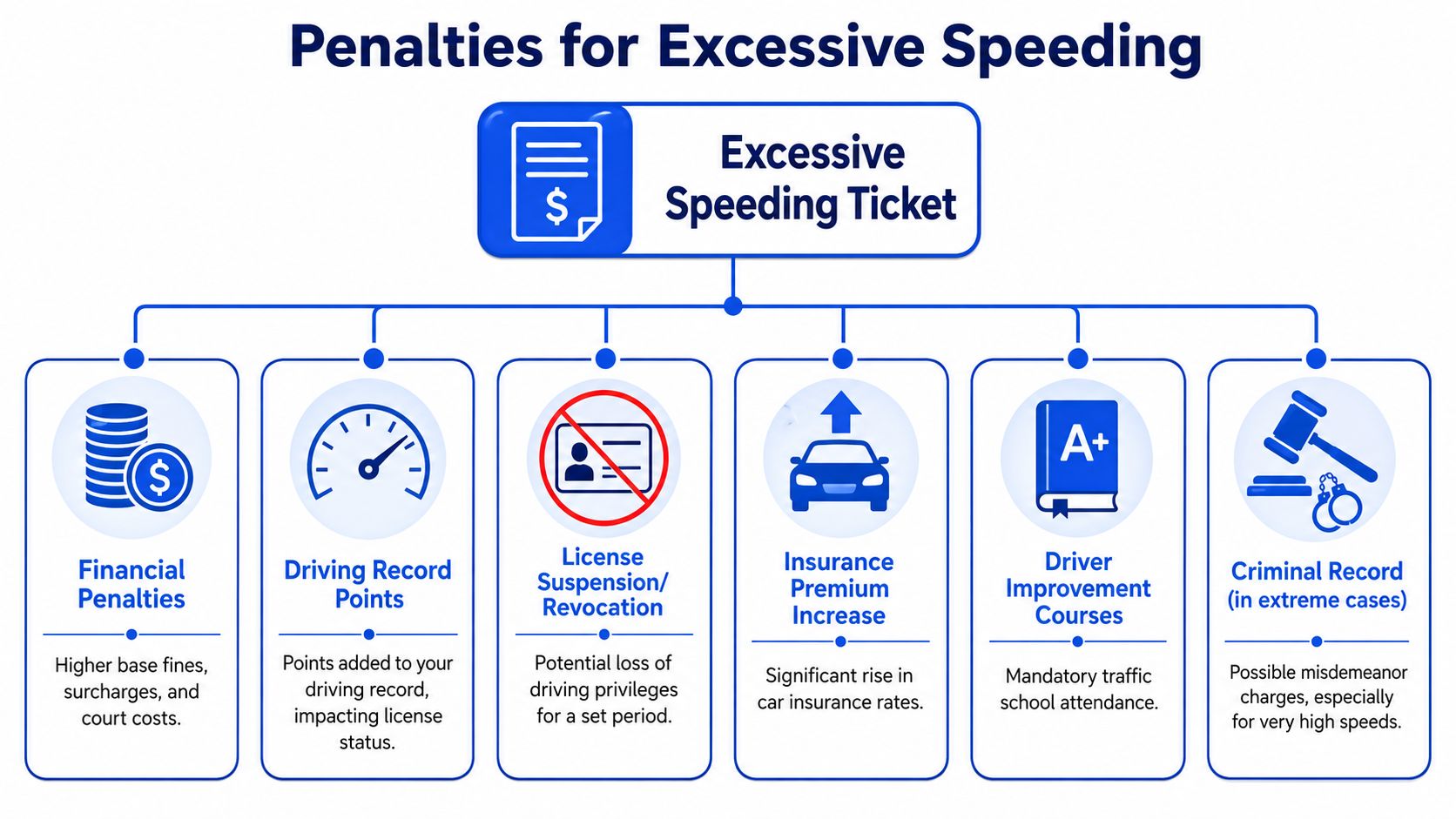
The ticket itself is only the front end of the problem. The primary damage usually comes after the court date. Your driving record, your insurance profile, and your license status are all in play.
The immediate damage
For a Florida excessive speeding allegation, you should expect the court to treat the matter more aggressively than a lower-speed citation. Drivers usually focus on the fine first. That's understandable, but it isn't the biggest problem.
The bigger concerns are usually these:
License points: A serious speeding case can add points that stay with your record.
Insurance consequences: Carriers often react sharply to high-speed violations.
Suspension exposure: If you already have points, one more ticket can put you in dangerous territory.
Employment fallout: Delivery drivers, CDL holders, rideshare drivers, and people with employer driving policies can feel the hit immediately.
For a broader consumer explanation of why insurers keep raising premiums after driving issues, InsureHunt's auto insurance guide gives helpful context.
For Florida-specific point exposure, review this guide on speeding ticket points in Florida.
Why points are the real danger
Points are the technical issue you need to watch. Not the argument you had with the officer. Not whether you felt the stop was unfair. Points.
Other state point systems make the logic obvious. Utah assigns 35 points for speeding 1 to 10 mph over, 55 points for 11 to 20 mph over, and 75 points for 21 mph over (Utah driver point schedule). The lesson is clear even outside Florida. As speed rises, the risk doesn't just increase. It can jump.
Its practical significance is as follows:
Risk area | Why it matters |
|---|---|
Prior record | If you already have points, another speeding case can move you closer to suspension review. |
Work driving | Employers often care more about high-speed violations than minor moving tickets. |
Insurance underwriting | A high-speed entry can affect how an insurer views you for years. |
Bottom line: The goal in an excessive speeding ticket case isn't to "handle the fine." The goal is to protect the record.
If you drive for work, hold a professional license, or have family obligations that depend on you staying on the road, this isn't optional. You need a plan built around minimizing record damage, not just ending the case quickly.
How Is This Different From Reckless Driving
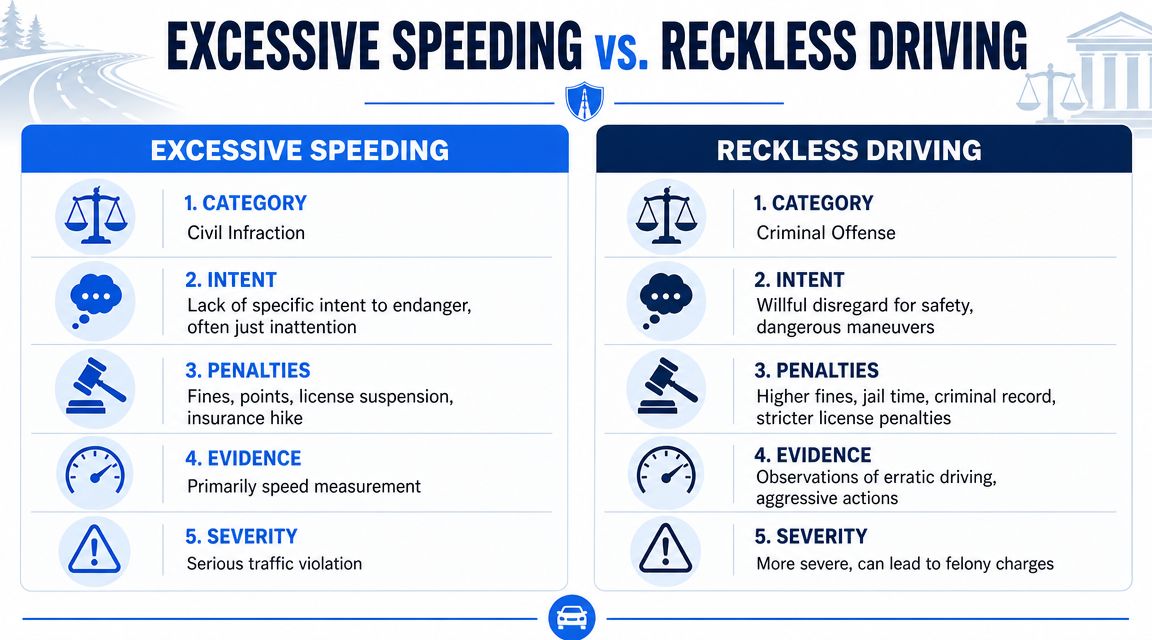
A Florida excessive speeding ticket is serious. But it is not automatically the same thing as reckless driving. That distinction matters because reckless driving under Florida Statute § 316.192 is a criminal offense, not just a traffic infraction.
A civil ticket is serious
An excessive speeding allegation usually focuses on the claimed speed itself. The state says you drove so far over the limit that the case requires court handling and higher scrutiny.
That still leaves room to fight. The defense may challenge the speed reading, the officer's observations, the stop details, or the way the allegation is framed.
A criminal charge is worse
Reckless driving is different because the issue becomes your manner of driving and whether the officer claims you acted with willful or wanton disregard for safety. In practice, high speed can become part of that argument. Public materials from outside Florida illustrate the same legal leap. New Jersey guidance notes a separate high-speed category and also explains that officers may treat speed as reckless driving, adding a much harsher layer of exposure (New Jersey speeding and reckless driving discussion).
That same danger exists conceptually in Florida. If the officer says you weren't just fast but aggressive, weaving, tailgating, racing, or endangering others, the case can move into criminal territory.
At the Broward County Judicial Complex in Fort Lauderdale, prosecutors and judges deal with that distinction all the time. The line is often built from facts like:
Traffic behavior: lane changes, following distance, passing pattern
Road conditions: congestion, weather, visibility
Officer narrative: whether the report describes danger, not just speed
If you need the criminal-law side of that comparison, review this explanation of reckless driving charges in Florida.
A high-speed ticket can still be contained. A reckless driving case can change your record in a completely different way.
That is why you fight early. You don't want the facts drifting upward into something the state can try to characterize as criminal.
What Are Your Immediate Next Steps and Defense Options
The next few moves matter. A bad first response can remove options you still have.
Immediate steps to take
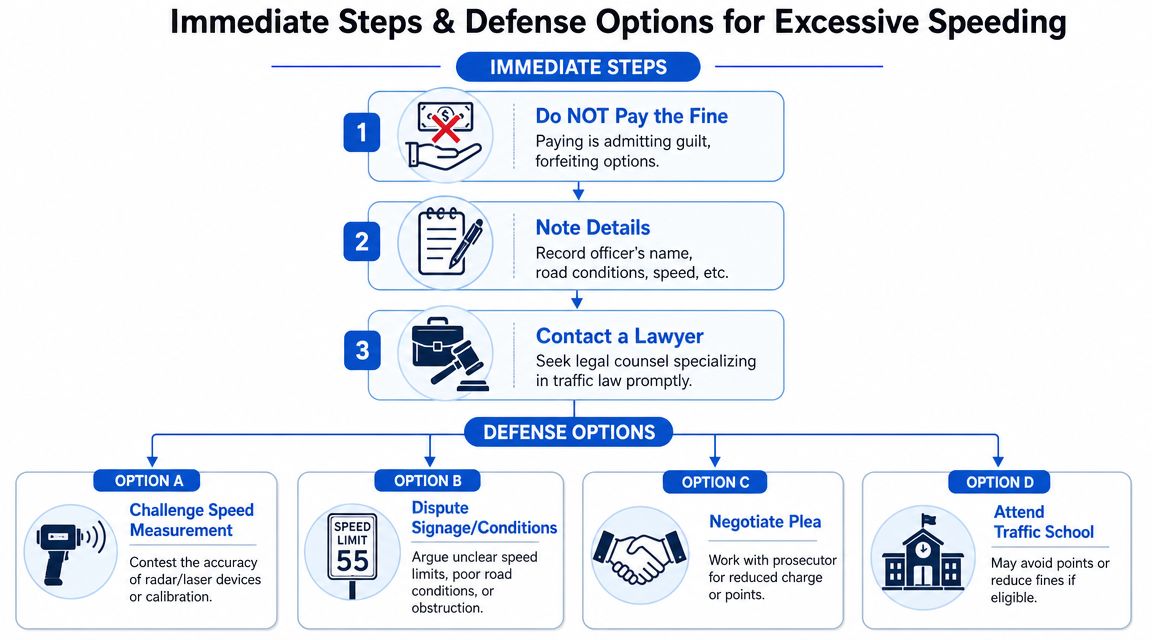
Do not pay the ticket: Payment can function like an admission and may close off better outcomes.
Read the citation carefully: Confirm the alleged speed, the posted speed, the statute cited, the county, and the court instructions.
Write down the facts now: Note traffic volume, weather, visibility, where the officer was positioned, and what the officer said about radar, laser, pacing, or visual estimate.
Preserve documents: Keep the citation, any court notice, and any dashcam or phone location data you have.
Get legal advice quickly: High-speed allegations often depend on technical details that are easier to investigate early.
This video gives a practical overview of what drivers should think about in Florida traffic cases:
How a real defense is built
A useful defense doesn't rely on wishful thinking. It looks at how the speed was measured and whether the evidence will hold up.
A key issue in many high-speed cases is that the evidence may not be radar or laser at all. Some cases depend on visual estimation or pacing, and those methods create openings for challenge. Consumer-facing guidance on this issue stresses the importance of asking about the officer's training, certification, and whether pace or radar was used (video discussion of visual estimation and pacing challenges).
That means a serious review often looks at:
Measurement method: Was it radar, laser, pacing, aircraft, or visual estimate?
Officer qualifications: What training supports the method used?
Equipment records: If a device was involved, was it checked and documented properly?
Road conditions: Curves, traffic, interference, and positioning can matter.
Narrative accuracy: Does the written report match what happened?
If the officer can't clearly support how your speed was measured, the case may be weaker than the ticket makes it look.
At the Edgecomb Courthouse in Tampa, these are the details that separate a quick plea from a strategic defense. The point isn't to tell a dramatic story. It's to force the state to prove its case cleanly.
How Does Ticket Shield Provide a Lawyer-Led Defense
If you're facing an excessive speeding ticket, you need direct legal access. Not a chatbot. Not a call-center script. Not a ticket mill where your questions get filtered through staff who don't appear in court.
Direct attorney access matters
At a courthouse like the Richard E. Gerstein Justice Building in Miami, details move fast. Court dates, prosecutor positions, filing issues, and record concerns don't wait while a middleman relays messages.
A lawyer-led model matters because you can ask direct questions and get direct answers about your exposure, your options, and your likely strategy. That's especially important if your case touches your CDL, your rideshare eligibility, your employer policy, or a prior driving history.
Why that changes the defense
Ticket Shield, PLLC handles Florida traffic defense with direct attorney communication by phone or text, rather than routing clients through automated apps or non-lawyer intake layers. If you want to compare service details for this kind of case, review the firm's Florida speeding ticket lawyer page.
That model is useful for one reason. Speed cases aren't static. Facts matter. Timing matters. And the goal in a serious speeding case is usually very specific. No points if possible. No unnecessary court trouble. No avoidable record damage.
Frequently Asked Questions About Florida Excessive Speeding
Can I just pay the fine for a 30-plus mph ticket
Usually, that's the wrong move. In Florida, a 30 mph or more over speeding allegation under § 316.183 is treated as a mandatory court appearance matter. That means you shouldn't assume there's a simple online payment option that resolves everything cleanly.
Even when payment is technically possible in some procedural posture, it may still be a bad decision because it can lock in consequences you should have fought.
Can I go to jail for excessive speeding
For the excessive speeding infraction itself, the bigger concern is usually court handling, points, and record damage. But the situation becomes much more serious if the state or officer treats the driving as reckless driving under § 316.192.
If the allegation includes dangerous conduct beyond raw speed, the case can move toward criminal exposure. That's when you need defense counsel involved immediately.
What if I have a CDL
Then this case is more dangerous for you than it is for the average driver.
A commercial driver often faces professional fallout long before a regular motorist would. Employer review, fleet policies, background screening, and insurance eligibility can all become problems. If driving is how you make your living, you should treat an excessive speeding ticket as a threat to income, not just a traffic inconvenience.
Don't gamble on a quick payment because you want the problem gone. For CDL holders, that shortcut can be the most expensive choice available.
If you want a lawyer to review your Florida excessive speeding ticket and focus on the No Points goal, visit Ticket Shield, PLLC for a free consultation.
