DUI Second Offense Florida: Protect Your Future
Understand severe penalties for a dui second offense florida. Get urgent steps to defend your license and freedom against severe consequences. Act now!

You're probably reading this while your car is still impounded, your phone is full of missed calls, and you're trying to figure out whether a second DUI in Florida just wrecked your license, job, and future. The fear is real. So is the urgency.
A second DUI charge is not the time to guess, wait, or trust an automated app that funnels you to a middleman. You need a real Florida lawyer who can move on the criminal case and the license crisis at the same time. That's where people make irreversible mistakes in the first days.
Table of Contents
Your Second Florida DUI Arrest Is a Crisis You Cannot Ignore
A second DUI in Florida can trigger fines of $1,000 to $2,000, up to 9 months in jail, and at least 1 year of ignition interlock. If it falls within 5 years, your license risk becomes far harsher, including a minimum 5-year revocation.
You likely haven't slept. You're replaying the stop, the roadside questions, the breath request, and the moment you realized this wasn't being treated like a first offense. That reaction is normal. But panic causes bad decisions, and bad decisions in the first days can do more damage than the arrest itself.
Florida treats repeat DUI allegations aggressively because repeat cases are common enough to matter to courts and prosecutors. One Florida DUI statistics summary reported 55,722 DUI citations and 33,625 DUI convictions, with about 60% of cited drivers ultimately convicted, and in that same dataset 2nd DUI offenses accounted for 3,154 cases, or 18.53% of the offense breakdown shown in that sample (Florida DUI statistics summary). That's why your second case won't be treated casually.
Practical rule: Your arrest is not your conviction. But if you handle it casually, the state will.
You need a plan that protects your license, challenges the evidence, and avoids unforced errors. Start by understanding the consequences for DUI in Florida, then act fast. Waiting for the court date is one of the worst mistakes I see.
What Are the First Three Steps You Must Take Immediately
The first 10 days after a dui second offense Florida arrest are where people either protect themselves or lose ground they can't recover. This is not paperwork you can put off until next week.
Why the first 10 days matter
Your criminal case and your driving privilege start moving right away. If you miss key deadlines, you surrender an advantage before your defense is even built.
That's why the first call should be to a lawyer, not to friends, not to your boss, and not to anyone fishing for details.
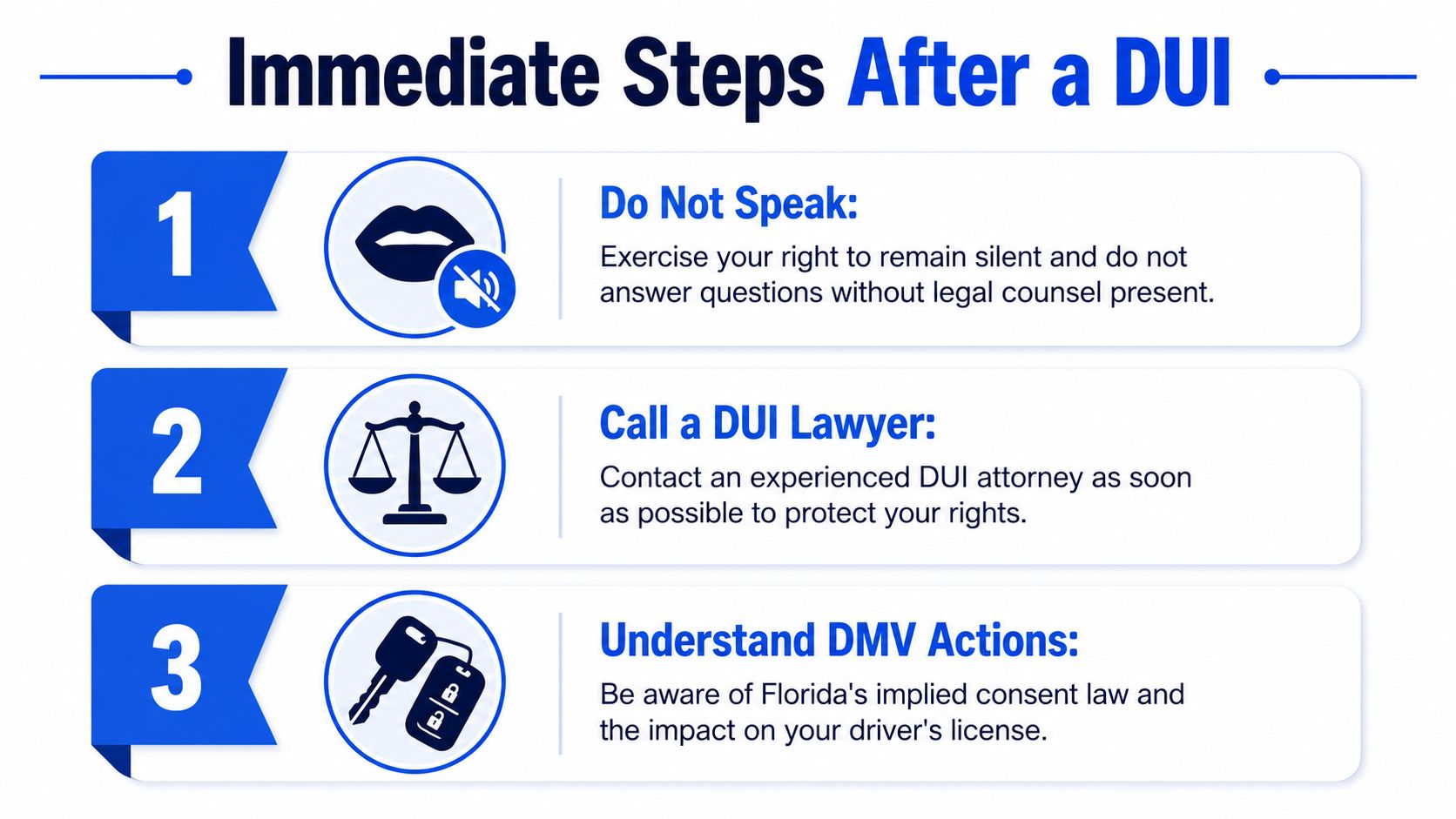
The three moves that protect you now
Write down everything while it's fresh.
Record the time of the stop, where the officer first saw you, what you were asked, what you said, whether field exercises were done, whether a breath, blood, or urine test was requested, and anything unusual about the stop. Memory fades fast. Small details often decide whether a stop, arrest, or test challenge is viable.Stop talking about the case.
Don't try to explain yourself to police, court staff, your insurance company, or people in your circle who “know a guy.” Don't post online. Don't text a long apology. Every statement creates evidence. Silence is protection.Get a Florida DUI lawyer involved immediately to address the DMV deadline.
The license side of the case moves on its own track. If you wait, the suspension issue can harden before your lawyer ever gets a chance to fight it. Read what happens after a DUI arrest, then let counsel take over fast.
Missing the DMV window is one of the most expensive mistakes in a second DUI case because it can damage your mobility before the criminal case is resolved.
What you should gather today
Bring these to your attorney as soon as possible:
Your paperwork from the arrest: Citation, notice of suspension, bond papers, towing paperwork, and any property receipt.
Your timeline: Where you were, when you drove, what you consumed, and who saw you before the stop.
Your practical risks: Work schedule, caregiving duties, business travel, commercial driving concerns, or professional licensing issues.
What not to do this week
Don't miss court notices: Even if you plan to hire counsel, keep every document.
Don't assume refusal helped you: In some cases it limits evidence. In others it creates a second problem.
Don't trust volume-based “ticket mills”: A second DUI isn't a routine citation. You need legal judgment, not intake staff and canned messages.
If you want a blunt recommendation, here it is. Act like the first 10 days are the most important part of your case, because they often are.
What Legally Counts as a Second DUI Offense in Florida
A second DUI charge is governed by Florida Statute 316.193, the core DUI statute in Chapter 316. The key issue is not just that you were arrested again. The key issue is how Florida classifies the prior case.
Why the conviction date matters
For penalty purposes, Florida focuses on the prior conviction, not just the prior arrest. That distinction matters. If your current case is treated as a second conviction within 5 years of the earlier conviction, the sentencing structure gets much harsher under Florida DUI law.
That's why your lawyer must verify dates, certified records, and the exact disposition of the prior case. People often assume they know where they fall, and they're wrong.
The five-year question is not a technicality. It can shape the entire plea strategy from day one.
What Florida Statute 316.193 controls
Florida Statute 316.193 sets the framework for DUI penalties and enhancements, including second-offense punishment. If you want the statute-level breakdown, review Florida DUI statutes.
A few legal realities matter right away:
A prior conviction changes exposure: The state will use the prior to argue for enhanced punishment.
Timing drives severity: Whether the second conviction falls within 5 years is critical.
BAC can change the sentencing range: A higher tested alcohol level can increase both fines and jail exposure.
The label matters less than the proof: The prosecutor still has to prove the current case.
If you had a prior case outside Florida, that has to be analyzed carefully. The state may try to use it as a prior, but your lawyer should confirm exactly how it fits the Florida framework before conceding anything.
What Are the Penalties for a Second DUI Conviction
If you're convicted, the penalty jump from a first case is serious. In courtrooms like Tampa's Edgecomb Courthouse, judges see second DUI cases every week, and the sentencing exposure is built into the statute. This is why a weak defense early can cost you far more later.
Under Florida DUI law, a second conviction typically carries $1,000 to $2,000 in fines, up to 9 months in jail, and mandatory ignition interlock installation for at least 1 year at your expense. If the second conviction occurs within 5 years of the prior conviction, the penalties become much harsher, including a minimum 5-year revocation and mandatory jail described in Florida legal summaries (Florida second DUI penalties overview).
Florida second DUI penalties at a glance
Penalty | 2nd Offense Outside 5 Years | 2nd Offense Within 5 Years |
|---|---|---|
Fine | $1,000 to $2,000 | $1,000 to $2,000 |
Jail exposure | Up to 9 months | Up to 9 months, with a mandatory jail component described in Florida legal summaries |
License consequence | Serious suspension or revocation issues may apply | Minimum 5-year revocation |
Ignition interlock | At least 1 year | At least 1 year |
Why high BAC changes the case
If the breath or blood alcohol concentration is 0.15 or higher, Florida's second-offense structure becomes even tougher. The ordinary second-offense jail cap of 9 months increases to 12 months, and the normal fine range of $1,000 to $2,000 increases to $2,000 to $4,000 (second DUI punishments and high-BAC enhancements).
That means your BAC result is not just a lab number. It directly affects how prosecutors value the case and how much room there is in negotiation.
What these penalties mean in real life
A second DUI sentence is more than a courtroom event. It can interrupt work, childcare, commuting, business travel, and any job that depends on a valid license or a clean background.
Fines are only the start: The court amount may be manageable on paper, but the surrounding costs usually hit harder.
Interlock changes daily life: If you drive regularly, the device requirement becomes part of your routine.
Revocation shifts your advantage: Once your ability to drive is under long pressure, employment pressure follows.
If you need the full penalty framework in one place, review the Florida penalty for DUI. Then treat your case like what it is. A protect-your-future emergency.
How Do You Fight the DMV and the Criminal Court at Once
A second DUI case is really two cases moving at the same time. Individuals often don't understand that until they've already hurt one of them.
One track is administrative. The other is criminal. They overlap, but they are not the same.

The DMV case is about your ability to drive
The DMV side focuses on your driving privilege. It moves fast. It doesn't wait for the criminal case to finish. If your lawyer doesn't engage that process early, you can lose practical mobility long before guilt or innocence is decided in court.
That matters because much of the damage often starts outside the courtroom. Beyond court-ordered fines of $1,000 to $4,000, a second DUI can also bring lost employment, punishing insurance consequences, and the heavy burden of long-term ignition interlock and mobility restrictions under Florida's DUI framework (Florida Statute 316.193).
A license problem becomes a work problem fast. Then it becomes a money problem.
If your job depends on travel, deliveries, service calls, caregiving, or a fixed daily commute, the DMV case may be the part that hurts first. Learn how the administrative license suspension hearing fits into your defense before you miss your chance to act.
The criminal case is about your record and freedom
The court case decides criminal penalties. That includes the risk to your record, the possibility of jail, and the long-term consequences of a conviction. In Miami, those cases move through places like the Richard E. Gerstein Justice Building, where prosecutors and judges expect repeat DUI cases to be handled seriously from the start.
A strong defense has to account for both tracks at once:
What helps in one forum can affect the other: Timing and statements matter.
Plea decisions must be strategic: You can't evaluate an offer only by looking at the courtroom penalty.
Mobility often drives negotiation: When driving restrictions threaten your livelihood, strategy has to reflect that reality.
Why one coordinated strategy matters
You do not want one person “handling the court part” and another person vaguely advising on the license side. That split approach causes missed deadlines, inconsistent positions, and bad advice.
You need one defense plan, one legal brain, and one point of contact who sees the whole field. That's how you protect your strategic advantage instead of reacting to damage after it's done.
What Are Your Options for a Strategic DUI Defense
The state still has to prove this case. A second arrest is serious, but it is not automatic guilt. Good defense work starts with facts, records, video, timelines, and whether law enforcement followed the law.

In places like the Broward County Judicial Complex, strategy matters more than slogans. This is exactly why a second DUI should never be routed through an automated app, intake clerk, or volume-based ticket operation. You need direct access to the attorney handling your case by phone or text so decisions get made in real time. One Florida option for that model is Ticket Shield, PLLC, a lawyer-led firm that handles traffic and DUI defense without middlemen.
Where a second DUI case can be challenged
A real defense usually looks at several pressure points at once.
The traffic stop: If the officer lacked a lawful basis to stop you, the rest of the case can weaken dramatically.
Field sobriety exercises: These are often attacked based on instructions, conditions, physical limitations, or how the officer interpreted them.
Chemical testing: Breath and blood evidence must be handled correctly. Maintenance, procedure, and timing matter.
Officer observations: Video sometimes tells a different story than the report.
Good DUI defense is not guesswork. It is record-by-record, minute-by-minute analysis.
If treatment or mitigation may become part of a broader case strategy, it can help to understand how programs are discussed in practice. This overview of addiction treatment for DUI diversion is useful background for people exploring what rehabilitation-related options may look like.
Why refusal cases need separate attention
Many drivers think refusing a breath test simplified the case. Sometimes it changed the evidence. But it may also have created another criminal problem.
Florida treats refusal to provide a breath, blood, or urine sample as a separate first-degree misdemeanor under § 316.1939 in the right circumstances, which means you may be defending the DUI charge and a refusal case at the same time (second DUI refusal charge explanation).
That changes plea strategy. It also changes how your lawyer should evaluate risk.
Here's a short explanation of how defense strategy often gets built in DUI cases:
A second DUI defense has to be personal, fast, and coordinated. If your lawyer isn't reviewing the stop, the testing, the refusal issues, the DMV timeline, and your real-life mobility needs together, your defense is incomplete.
Frequently Asked Questions About a Second DUI Charge
Can you get a hardship license after a second DUI conviction
Sometimes, but timing matters. If your second conviction is within the five-year framework discussed earlier, the revocation consequences are much harsher. That means you should not assume you'll be driving for work right away. This is one of the reasons the first days after arrest matter so much.
What is an ignition interlock device
It's a breath-testing device installed in a vehicle that prevents operation if alcohol is detected. For a second conviction in Florida, installation is mandatory for at least 1 year at the offender's expense, based on Florida DUI penalty summaries already discussed earlier. In real life, that means planning around installation, monitoring, service, and daily compliance.
Will a second DUI make you a felon
A standard second DUI is generally prosecuted as a serious misdemeanor offense, not automatically as a felony. But that does not make it minor. A second DUI can still damage employment, licensing, insurance, and professional reputation in ways that feel every bit as serious.
Should you just plead quickly and move on
Usually not. Quick pleas often ignore license consequences, refusal issues, BAC challenges, and bargaining power. In courthouses like the Orange County Courthouse, what looks like the fastest resolution can become the most expensive long-term outcome if nobody built a strategy first.
Does a lawyer really need to handle both the court and DMV sides
Yes. If those decisions are made separately, people miss opportunities and make inconsistent choices. A second DUI is not a paperwork problem. It is a coordinated defense problem.
If you were arrested for a second DUI in Florida, don't wait for the state to define your future for you. Get a lawyer-led plan focused on protecting your license, your record, and your No Points goal. Visit Ticket Shield, PLLC for a free consultation.