DUI Lawyer Miami Dade County: Protect Your Rights
Arrested for DUI in Miami-Dade County? A top DUI lawyer Miami Dade County explains penalties, 10-day rule, & how to protect your license. Free consult.

You’re probably reading this with a bond receipt in your pocket, your car still sitting where the stop happened, and your phone blowing up with questions you can’t answer yet. Slow down. A DUI arrest in Miami-Dade doesn’t just threaten one court date. It threatens your license, your record, your job, and your standing from the first day forward.
If you’re searching for a dui lawyer miami dade county, you need strategy immediately. Not an app. Not a call center. Not a middleman collecting your information and passing it around. You need a real lawyer who knows how DUI cases move through Miami-Dade and how to attack both the administrative and criminal sides before the State gets comfortable with your case.
Table of Contents
What Happens Immediately After a DUI Arrest in Miami?
A DUI arrest in Miami-Dade County starts two clocks: a 10-day deadline to save your license and a separate criminal case. You need a DUI lawyer to fight both battles. The wrong move now could cost you your freedom and driving privileges.
The first hours after an arrest feel blurred. You remember the lights, the questions, the roadside instructions, maybe a breath test request, and then booking. By the time you’re released, the State already has a head start and you’re expected to make smart decisions while exhausted and scared.
That’s why your first move matters so much. Florida DUI law under Florida Statute 316.193 is technical. Prosecutors lean heavily on officer observations, testing procedures, and anything you said. If you hand them extra evidence after the arrest, you make their job easier.
What should you do in the first 24 hours
Stop talking about the case: Don’t explain the stop to friends, coworkers, family group chats, or social media. The only safe place to discuss details is with your attorney.
Write down everything you remember: Do it while it’s fresh. Note where you were, why the officer said you were stopped, what was asked, what tests were requested, what you said, and what happened during booking.
Preserve documents immediately: Keep the citation, bond paperwork, temporary permit, tow information, and any property receipt. Small details in those papers often matter later.
Protect your phone from your own panic: Don’t send apology texts, don’t message passengers, and don’t post about being “set up” or “fine.” Prosecutors love carelessness.
Act on the license issue now: Don’t assume the criminal court date protects your ability to drive. It doesn’t. You need legal action right away.
Practical rule: After a DUI arrest, silence is protection. Memory fades fast. Paperwork gets misplaced faster.
A lot of people make the same mistake. They think the actual case starts when they go to court. It doesn’t. It starts the moment the arrest paperwork is created, and your position is strongest before deadlines pass and narratives harden.
If you want a fuller breakdown of the post-arrest timeline, read what happens after a DUI arrest in Florida.
Where your case may move next
Miami-Dade DUI cases often move through the Richard E. Gerstein Justice Building. That’s where local procedure, scheduling, prosecutor practices, and defense timing start to matter. A lawyer who regularly handles DUI litigation in this courthouse will look at your file differently than a volume-based service that treats your arrest like a generic intake form.
Your arrest is not your conviction. But this is the moment when people either protect their case or weaken it.
Why Do You Face Two Separate Battles After a DUI?
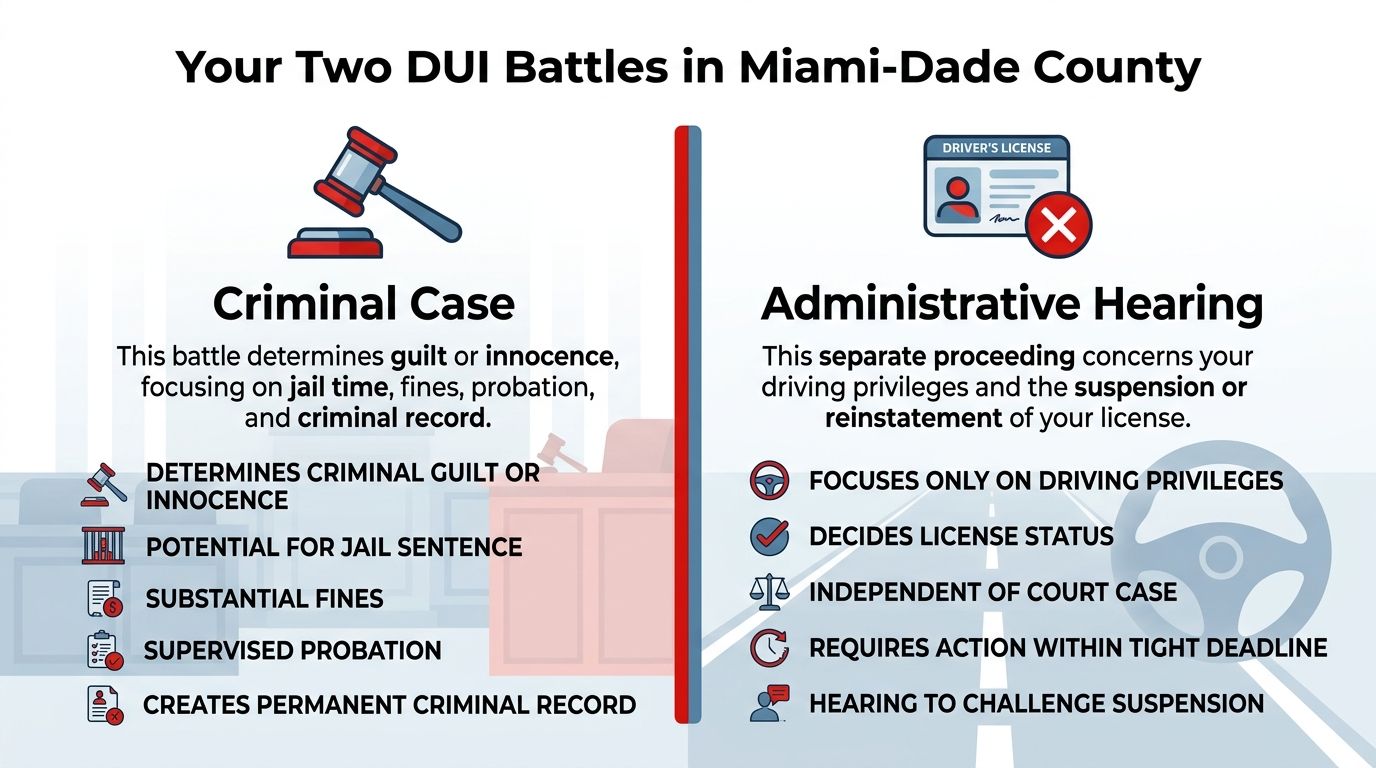
Most drivers think a DUI means one case. That’s wrong. You’re dealing with two separate proceedings, and they move on different tracks for different purposes.
One track is the criminal case. That’s the part tied to guilt, penalties, and what happens in court. The other is the administrative license case with the Florida Department of Highway Safety and Motor Vehicles. That second fight is about whether you keep driving.
Why the license fight comes first
In Miami-Dade County, a DUI arrest triggers a 10-day deadline to request a formal review hearing with DHSMV. If you miss it, your license faces an automatic suspension for 6 to 18 months, and that process is independent from the criminal case, as described by this Florida DUI license suspension overview.
That deadline is the most urgent part of your case.
If you drive for work, this isn’t abstract. It hits rideshare drivers, delivery drivers, sales professionals, contractors, healthcare workers, and anyone who has to physically get somewhere to earn a living. The court case may take time. Your ability to drive can be damaged almost immediately.
For a focused explanation of that process, review Florida DUI license suspension rules.
The criminal judge doesn’t control the DHSMV process. Waiting for court won’t save your license.
What each battle is trying to do
Here’s the cleanest way to understand it:
Proceeding | Main issue | What’s at risk |
|---|---|---|
Criminal case | Whether the State can prove a violation under Florida Statute 316.193 | Jail, fines, probation, conviction, record |
Administrative hearing | Whether your driving privilege is suspended | Your license and your ability to keep driving |
These tracks influence each other strategically, but they are not the same proceeding. That distinction is where many people lose ground. They hire the wrong kind of help, focus only on the court date, and let the administrative side collapse by default.
Why a lawyer uses the two-track system strategically
A skilled DUI lawyer doesn’t treat the DHSMV hearing as a side issue. It can become a pressure point. The administrative hearing creates an early opportunity to challenge the stop, the basis for the arrest, the testing process, and the paperwork supporting suspension.
That matters because early pressure changes negotiations. If the defense identifies weaknesses fast, the prosecution knows the case may not be as clean as the arrest report suggests.
Miami-Dade drivers need to think about this as a war on two fronts. If one front is ignored, the damage spreads. If both are attacked quickly and intelligently, your position improves.
For someone searching dui lawyer miami dade county, this is the dividing line between generic representation and real defense. A real defense starts before the first courtroom appearance.
What Are the Penalties for a Miami-Dade DUI?
You need to know exactly what you’re up against. Not the watered-down version. The actual one.
Florida handles DUI penalties under Florida Statute 316.193, and the penalties escalate fast depending on alcohol level, prior history, and aggravating facts. In Miami-Dade County, a standard first DUI at .08 BAC or higher can carry up to 6 months in jail and a $1,000 fine as an unclassified misdemeanor, according to this summary of Miami-Dade DUI penalties under Florida law.

That’s the entry point. It gets worse quickly.
How fast the penalties escalate
A first DUI with a .15 BAC or higher, or a first DUI involving a minor under 18 in the vehicle, can carry up to 9 months in jail and a $2,000 fine.
A second DUI at .08+ BAC can bring 9 months in jail and a $2,000 fine. A second DUI at .15+ BAC can mean up to 1 year in jail and a $4,000 fine.
If the incident involves property damage, the charge can be treated as a first-degree misdemeanor with up to 1 year in jail and a $1,000 fine.
Third offenses carry even more danger. A third DUI more than 10 years after a prior can mean 1 year in jail and a $5,000 fine. A third DUI within 10 years becomes a third-degree felony, punishable by up to 5 years in prison and a $5,000 fine.
Why the charge level matters immediately
Many drivers often make a bad decision. They hear “first offense” and assume the case is manageable without aggressive counsel. That assumption ignores how prosecutors build pressure.
Your BAC allegation changes exposure. The presence of a child changes exposure. Prior history changes exposure. Property damage changes exposure. Once those facts are baked into the charging theory, the defense has to do more work to break the State’s momentum.
Below is a simple way to view the structure:
Scenario | Maximum jail exposure | Maximum fine |
|---|---|---|
First DUI at .08+ | 6 months | $1,000 |
First DUI at .15+ or minor under 18 in vehicle | 9 months | $2,000 |
Second DUI at .08+ | 9 months | $2,000 |
Second DUI at .15+ | 1 year | $4,000 |
Third DUI within 10 years | 5 years prison | $5,000 |
You should also understand the practical point. The penalty chart tells you the outside limits. It doesn’t tell you what can be challenged. A charge that looks strong on paper can still have flaws in the stop, the testing, the officer’s observations, or the arrest procedure.
This overview of Florida DUI penalties and exposure helps put the legal stakes in context.
Here’s a brief video explanation worth watching before you decide how to respond:
How Can a Dedicated DUI Lawyer Defend You?
A DUI case is won by attacking the details. Not by making broad excuses. Not by hoping the prosecutor “understands.” A dedicated lawyer looks for legal weaknesses the State would rather you miss.
Miami-Dade has a specialized defense market. Attorneys in this space often bring 20 to 40+ years of experience and use local knowledge of prosecutors and DHSMV hearing officers to shape strategy, as noted in this Miami DUI defense market overview. That same source explains that these lawyers often challenge BAC testing methods and police procedures under Florida Statute 316.193.

What your lawyer should examine first
Your lawyer should start at the beginning, not the breath number.
The stop itself: Why were you pulled over? If the stop was weak or unlawful, that issue can affect the entire case.
Officer observations: DUI reports often rely on phrases that sound strong until they’re examined closely. Slurred speech, bloodshot eyes, odor, balance issues, and admissions all need context.
Field sobriety testing: These exercises are not foolproof. Road conditions, footwear, nerves, fatigue, injury, weather, and the officer’s instructions all matter.
Breath or blood procedure: Machines, maintenance, administration, timing, and paperwork matter. Technical errors can open real defenses.
Video evidence: Body camera, dash footage, booking video, and jail video may support or contradict the officer’s narrative.
A DUI arrest report is the State’s first draft. Your lawyer’s job is to test every line of it.
A serious attorney also looks for suppression issues. If police violated procedure or obtained evidence unlawfully, the defense may file motions aimed at keeping that evidence out. If you want to understand that part of the process, read how a motion to suppress evidence works in Florida traffic and criminal cases.
Why local Miami-Dade knowledge matters
DUI defense isn’t just about statutes. It’s also about venue, habits, timing, and credibility. Cases in the Richard E. Gerstein Justice Building move through a real system with real personalities. Lawyers who work there regularly know how prosecutors evaluate certain facts, which arguments get traction, and when to press or hold.
That local familiarity matters in hearings and negotiations. It also matters in administrative proceedings, where timing and presentation can shape whether your driving privileges are protected while the criminal case moves forward.
Direct attorney access proves important. A lawyer-led model gives you faster strategy and cleaner communication. At Ticket Shield, PLLC, clients communicate directly with their attorney by phone or text rather than through a chatbot or intake middleman. For DUI defense, that structure is practical. Fast questions need fast legal answers, especially early.
What a good defense is trying to achieve
Not every defense ends the same way. Sometimes the goal is suppression. Sometimes it’s reduction. Sometimes it’s protecting your license while pressuring the State’s proof. Sometimes it’s preparing the case for trial because the allegations don’t hold up.
The point is simple. An arrest is an allegation. A dedicated lawyer turns the case from a one-sided report into a contested record.
How Do You Choose the Right Firm in Miami?
Don’t hire based on convenience alone. A DUI case is not a speeding ticket workflow. If the service feels automated, impersonal, or scripted, that’s a warning sign.
The legal market in Miami-Dade makes one thing clear. Representation quality matters. Court data shows a meaningful gap in outcomes between private counsel and overloaded public defense in Miami-Dade DUI cases, including better dismissal results for private attorney clients, according to Miami-Dade DUI counsel outcome data.
That doesn’t mean every private lawyer is the right lawyer. It means you should take your hiring decision seriously.
What to ask before you hire anyone
Ask direct questions. If the answers are vague, move on.
Will I speak directly with my lawyer? If the firm routes you through intake staff, case managers, or automated messages, expect delays and diluted strategy.
Who handles the DHSMV side? A DUI defense that ignores the administrative fight is incomplete.
How do you evaluate the stop, tests, and suppression issues? You want a legal answer, not a sales answer.
Do you regularly handle DUI cases in Miami-Dade? Local court familiarity matters more than polished advertising.
Who appears for me in court and hearings? Some firms sell the case one way and staff it another.
If a firm sounds like a processing center, it will probably handle your case like a processing center.
The biggest mistake I see is this: people shop for a DUI lawyer the way they shop for a phone plan. Lowest friction. Lowest upfront commitment. Fastest signup. That approach can cost you your license and weaken your criminal defense before it starts.
A lawyer-led firm gives you something automated services can’t. Judgment. Real-time judgment. That matters when facts shift, paperwork arrives, a hearing is set, or the prosecutor makes an offer that sounds harmless but isn’t.
What to avoid
Use this short filter before you hire:
Warning sign | Why it matters |
|---|---|
You can’t reach the lawyer directly | Delays hurt strategy in time-sensitive DUI cases |
The intake sounds scripted | Your case may be treated like a volume file |
They focus only on court | You may lose ground on the license issue |
They promise easy outcomes | Serious DUI defense requires file-specific analysis |
If you’re hiring a dui lawyer miami dade county, choose one who treats your case like a legal emergency, not a transaction.
What Does a Strong DUI Defense Cost?
Start with the honest answer. Strong DUI defense costs money. But the wrong comparison is lawyer fee versus no lawyer fee. A better comparison is lawyer fee versus the long-term cost of mishandling a DUI.
A conviction can affect your license, mobility, work options, and insurance exposure. If your income depends on driving, the financial risk compounds quickly. If your profession depends on a clean record or reliable transportation, the case reaches beyond court.
What you’re really paying to protect
You’re not paying only for appearances. You’re paying for legal analysis, deadline control, evidence review, motion practice, negotiation strategy, and protection against avoidable damage.
That’s why flat, transparent pricing usually makes more sense for drivers than open-ended billing. Clarity helps you make decisions fast. Unclear billing often slows clients down at the exact moment they need to move.
If you want a practical overview of how DUI fee structures work, read what goes into a Florida DUI attorney fee.
A value-driven DUI defense should account for the full problem, not just the next hearing. That means asking whether the representation includes administrative action on the license, court handling, negotiation, and evidence-based case review. If it doesn’t, the “lower” fee may not buy the protection you need.
Why pleading out fast can cost more
Some drivers think the lowest-cost move is to resolve the case quickly and move on. That can be a very expensive shortcut.
A fast plea may close the court file. It doesn’t erase the full consequences tied to driving, employment, and future exposure. Once you give up your advantage, it’s hard to get it back.
The better question is not “What’s the cheapest way out?” The better question is “What protects my record, license, and future most effectively?”
Frequently Asked Questions about Miami DUI Cases
Can a DUI conviction in Florida be sealed or expunged?
You need individualized legal advice on that question. In general, a conviction creates a very different record problem than an arrest that doesn’t end in conviction. The outcome of your case matters enormously, which is one more reason not to treat the early stages casually.
Do I have to tell my employer about my DUI arrest?
That depends on your job, your contract, your licensing obligations, and whether driving is part of your position. Some employers may never ask until a background check or driving issue arises. Others require immediate disclosure. Don’t guess. Have a lawyer review the practical risk before you report anything beyond what your employment rules require.
The right answer for your job depends on your role, your duties, and your employer’s reporting rules.
What if I was arrested in Miami but live in another state?
Florida still controls the case because the arrest happened here. You can’t safely ignore it because you live elsewhere. Out-of-state drivers often face added confusion because the criminal case is in Florida while the license consequences can affect home-state driving status too. You need Florida counsel who handles the case where it was filed.
My job involves driving. What are my options?
You need immediate legal action. A 2025 Miami-Dade PD report noted a 25% rise in DUI arrests among gig and delivery workers, and platforms like Uber often suspend drivers immediately upon a DUI charge, as summarized in this Miami-Dade DUI market page discussing gig-driver risk.
If you drive for rideshare, delivery, sales, field service, or any employer that monitors license status, your defense has to account for more than court. It has to address driving privilege and practical employment consequences right away.
Should I use an automated service for a DUI case?
No. A DUI is too technical and too personal for a chatbot workflow or a volume-driven intake system. You need legal judgment, direct communication, and someone who can respond when facts change quickly. Automated services may work for simple administrative tasks. A criminal traffic case with license consequences is not one of them.
If you’ve been arrested, act like time matters, because it does. Waiting usually helps the State, not you.
If you want direct lawyer guidance, not an automated handoff, contact Ticket Shield, PLLC for a free consultation. Your goal should be clear from the start: protect your license, protect your record, and fight for the No Points outcome wherever the law allows.