Understanding the Consequences of a DUI in Florida
Facing a DUI? Explore the serious consequences of a DUI in Florida, from license suspension to long-term career impact. Learn what to expect next.
The consequences of a DUI in Florida hit hard and fast, launching you into two separate battles at the same time: one in criminal court and another with the DHSMV over your license. A first-time offense can mean fines between $500 and $1,000, a driver's license suspension for 6 months to 1 year, and even up to 6 months in jail. And that's just the starting point—the penalties climb sharply for repeat offenses or with factors like a high BAC.
The Dual Battle After a Florida DUI Arrest

From the moment you're arrested for DUI in Florida, you’re fighting on two fronts. This isn't just a single case that goes to court. It's a parallel process run by two different government bodies, each playing by its own set of rules and, most importantly, its own deadlines. Getting a handle on this dual-track system is the first critical step to building a defense.
One battle is fought in the criminal justice system. This is what most people picture when they think of a DUI—a courtroom where a prosecutor tries to prove you were driving under the influence. This is where things like jail time, steep fines, probation, and community service are decided.
At the exact same time, you're up against an administrative challenge from the Florida Department of Highway Safety and Motor Vehicles (DHSMV). This process has nothing to do with the criminal court and is focused on one thing only: your privilege to drive.
Attorney Advertisement. Office in Broward. Past results do not guarantee future outcomes. Our goal is to protect your license and record.
The Criminal Court Process
Your criminal case kicks off with the arrest and booking. A state prosecutor will dig into the police reports, your breath or blood test results, and any video evidence before formally charging you. The journey then winds through court appearances like an arraignment (where you enter your plea), pre-trial hearings, and possibly a trial.
The penalties handed down by a criminal court can be significant and often include:
Mandatory Fines: If you're convicted, you will be ordered to pay a fine.
Probation: A period of court-ordered supervision that comes with strict conditions.
Jail Time: Even a first offense can lead to time behind bars for up to six months.
A Permanent Criminal Record: A DUI conviction creates a record that can follow you for years, affecting everything from job applications to housing.
To give you a clearer picture, here’s a quick rundown of what a standard first-time DUI conviction looks like in Florida.
Florida First-Time DUI Penalties at a Glance
This table breaks down the typical penalties for a standard first-offense DUI where the driver's BAC was between .08 and .149. Keep in mind, these penalties can become more severe if there are aggravating factors involved.
Penalty Type | Standard First Offense (BAC .08 to .149) |
|---|---|
Fines | $500 to $1,000 |
Jail Time | Up to 6 months |
Probation | Up to 1 year |
License Suspension | 180 days to 1 year |
Community Service | 50 hours (mandatory) |
Vehicle Impoundment | 10 days (mandatory) |
DUI School | Level I (12 hours) |
Ignition Interlock Device | Discretionary, up to 6 months |
These aren't just possibilities; many of these penalties, like the community service and vehicle impoundment, are mandatory upon conviction.
The Administrative License Suspension
While the criminal case slowly makes its way through the system, the DHSMV moves with lightning speed to suspend your driver's license. This is a purely administrative action, not a criminal one. If you had a breath test result over the legal limit of .08 or if you refused to take a test, your license is suspended automatically, on the spot.
Here’s the most critical part: you have an incredibly short window—just 10 days from your arrest—to challenge this administrative suspension. If you miss that deadline, you lose your right to challenge it, and the suspension stays, no matter what happens in your criminal case. You can learn more by reading about what happens after a DUI arrest.
This two-track system is a common point of confusion. It's entirely possible for the criminal case to be resolved favorably, but you could still have a suspended license because the DHSMV process wasn't handled in time. Both battles demand your immediate and full attention.
Decoding Criminal Court Penalties for a Florida DUI
Beyond the immediate headache of an administrative license suspension, a DUI arrest kicks off a formal criminal case that unfolds in a Florida courtroom. The penalties handed down by a judge aren't just suggestions; they're often mandatory consequences designed to punish and deter.
It's a two-front battle. While the DHSMV deals with your license separately, the criminal courts impose their own set of sanctions. These penalties get significantly more severe with each offense and can be increased even higher by certain "aggravating" factors. Understanding what the court can do is the first step in facing the charges ahead.
First DUI Offense Penalties
For a standard, first-time DUI conviction, Florida law lays out a clear roadmap of minimum and maximum penalties. A judge has some discretion, but certain consequences are locked in with a guilty verdict. For many, this first brush with the criminal justice system is a jarring and expensive wake-up call.
Make no mistake, this is a widespread issue. In 2023 alone, Florida law enforcement agencies made 44,185 DUI arrests, a number that shows just how seriously the state takes impaired driving. For a first offense, you’re facing a potential six-month driver's license suspension, fines between $500 to $1,000, mandatory DUI school, and a substance abuse evaluation. Jail time is also on the table, even for a first conviction. You can explore more detailed Florida DUI statistics to see the full scope of enforcement.
Attorney Advertisement. Office in Broward. Submitting information via our forms does not create an attorney-client relationship. All information is kept confidential.
Escalating Consequences for Repeat Offenses
Florida law comes down much harder on repeat DUI offenders. The critical detail here is the "lookback period"—the timeframe in which a prior DUI conviction counts against you. A second offense within five years of the first, for example, triggers mandatory jail time.
Second DUI Offense (within 5 years): A conviction here means a mandatory jail sentence of at least 10 days. Fines jump to a range of $1,000 to $2,000, your vehicle will be impounded for 30 days, and you'll be required to install an Ignition Interlock Device (IID) on your car for at least one year.
Third DUI Offense (within 10 years): This is a massive turning point. A third conviction within a decade is a third-degree felony. You are no longer just a repeat offender; you could now be a convicted felon, a label that follows you for life. The penalties include a mandatory minimum of 30 days in jail, fines up to $5,000, and a driver's license revocation for a minimum of 10 years.
A fourth DUI at any point in your life is also a third-degree felony, carrying severe penalties that can include up to five years in state prison. The system is intentionally designed to get stricter and more punitive with every conviction.
Aggravating Factors That Increase Penalties
Certain situations surrounding a DUI arrest can immediately make a bad situation much worse. Prosecutors and judges see these "aggravating factors" as a sign of heightened danger to the public, and they will enhance the penalties accordingly—even if it's your very first offense.
One of the most common is a high Blood Alcohol Content (BAC). If your breath or blood test comes back at .15 or higher, the standard penalties are immediately increased:
Increased Fines: For a first offense, the fine range doubles to $1,000 to $2,000.
Longer Potential Jail Sentences: The maximum jail time for a first offense climbs from six months to nine months.
Mandatory Ignition Interlock: An IID becomes required for at least six months upon conviction.
Other serious factors include having a child under 18 in the car or causing an accident. A DUI with property damage is a first-degree misdemeanor, while a DUI causing serious bodily injury to someone else is a third-degree felony. The most severe outcome, DUI Manslaughter, is a second-degree felony that can result in a prison sentence of up to 15 years.
These enhancements show just how serious the consequences of a DUI in Florida can become when other risk factors are involved. You can take a closer look at the full range of DUI penalties in Florida in our detailed guide.
Protecting Your Driving Privileges from Administrative Suspension
While the criminal court case is a huge worry, the most immediate threat after a DUI arrest in Florida is to your driver's license. This isn't handled by a judge in a courtroom; it's an entirely separate process managed by the Florida Department of Highway Safety and Motor Vehicles (DHSMV). And it moves fast.
The moment you're arrested for DUI and either have a BAC over the legal limit of .08 BAC or refuse the test, the state kicks off an automatic administrative suspension of your license. This isn't a potential penalty down the road—it’s an immediate action that catches many people completely off guard.
Addressing this administrative battle is crucial. You have an extremely tight window to act. If you miss it, you could lose your license for months or even a year, regardless of what happens in your criminal case.
The Critical 10-Day Window
Once you're arrested, a clock starts ticking. You have exactly 10 days to challenge the automatic suspension of your license. This is, without a doubt, one of the most critical deadlines in the entire DUI process, and it's where far too many people make a costly mistake by not taking action.
Within this 10-day period, you have to make a choice between two very different paths. Each one has major consequences for your ability to drive, so you need to understand them before you decide.
Your Two Choices: A Formal Review or a Hardship Waiver
Your first option is to challenge the suspension by requesting a Formal Review Hearing. Think of this as a mini-trial with the DHSMV where you or your legal counsel can challenge the suspension. The goal is to show there wasn't a legal basis for it by questioning the evidence or the officer's procedures. If you are successful, the suspension gets thrown out, and you get your full license back while the criminal case proceeds.
Your second option is to give up your right to that hearing and instead apply for a Business Purposes Only (BPO) hardship license. This would let you drive for essential reasons—like getting to work, school, or the doctor. But be warned: choosing this path means you are accepting the administrative suspension, and it will be a permanent part of your driving record.
Attorney Advertisement. Office in Broward. Past results do not guarantee future outcomes. Our goal is to protect your license and record.
As you can see, the penalties get much worse with each offense, impacting both the criminal and administrative sides of your case.
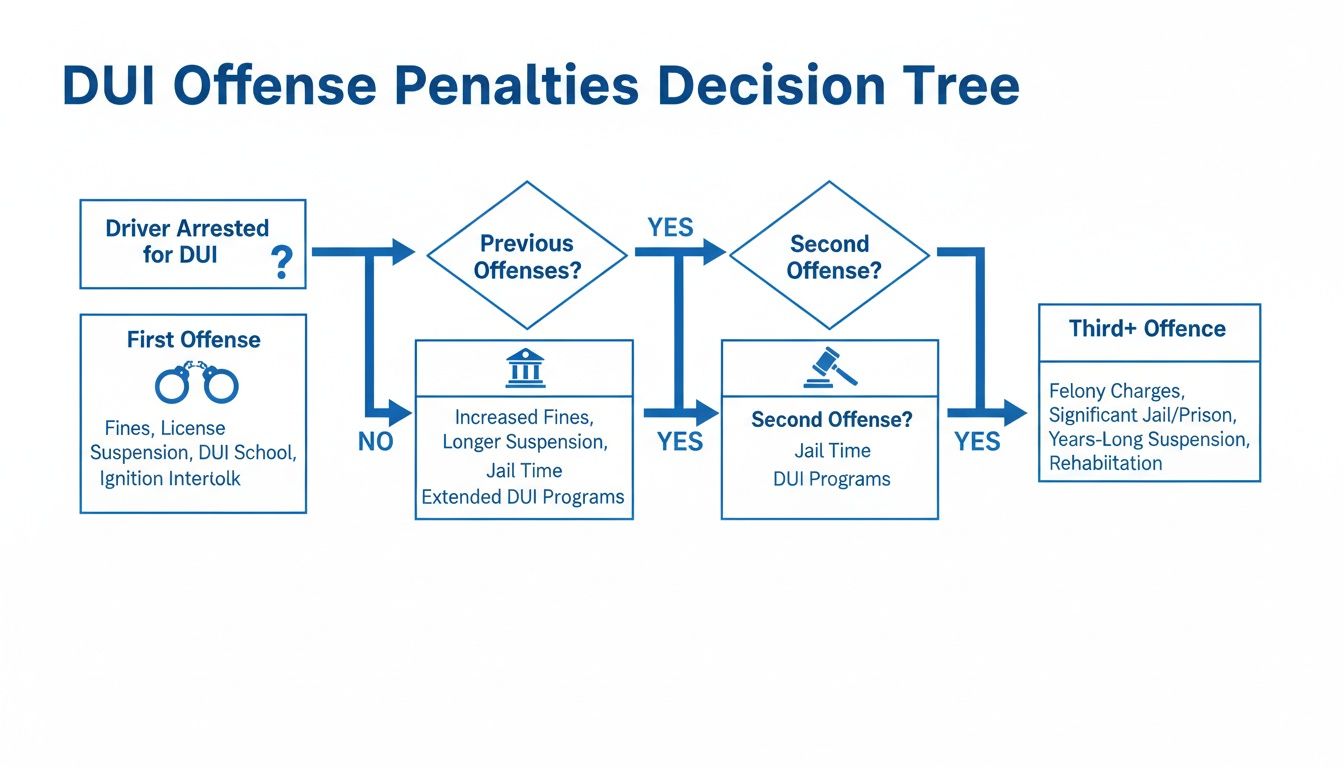
This decision tree shows just how quickly the stakes get higher, especially when it comes to how long you could lose your license.
Suspension Periods Based on Your Situation
How long your license is suspended for depends entirely on the details of your arrest—specifically, whether you took the breath test and if you have any prior DUIs.
First Offense with a BAC over .08: You're looking at a 6-month license suspension.
First Refusal to Submit to Testing: The penalty is harsher—a full 12-month license suspension.
Second or Subsequent Refusal: The consequences jump significantly to an 18-month suspension. On top of that, the refusal itself can be charged as a separate first-degree misdemeanor.
It's vital to understand that refusing a breath, blood, or urine test triggers its own set of serious penalties. Under Florida's "implied consent" law, just by driving on Florida roads, you've already agreed to submit to testing if lawfully arrested for DUI. When you refuse, you break that agreement, and the state imposes these separate, tougher suspensions. You can learn more about how this works in our detailed guide to Florida DUI license suspensions.
The True Financial Cost of a DUI in Miami-Dade County
The penalties you hear about in court—the fines and probation—are just the tip of the iceberg. The real financial impact from a DUI in Florida, especially in a high-cost area like Miami-Dade County, sends ripples through your budget for years.
It’s a long-lasting economic burden that starts the moment you're arrested and sticks around long after the court case is closed. Understanding the full scope of these expenses is the only way to grasp the total impact of a DUI charge.
The Immediate Out-of-Pocket Expenses
Before you even step foot in a courtroom, a DUI arrest starts draining your bank account. These initial costs are almost impossible to avoid and they add up fast, creating immediate financial stress.
Towing and Impound Fees: When you’re arrested, your car doesn't just wait for you. It gets towed, and you're on the hook for the towing bill plus daily storage fees. Before you can even get your vehicle back, this can easily run into hundreds of dollars.
Bail or Bond: To get out of jail after your arrest, you will likely need to post bail. The amount varies widely based on the specifics of your case, but it's often anywhere from $150 to over $1,000.
These upfront costs are just the first hit in what becomes a long and expensive journey.
Attorney Advertisement. Office in Broward. Past results do not guarantee future outcomes. Our goal is to protect your license and record.
Court-Mandated Costs and Program Fees
If you're convicted, the court will hand down a list of mandatory fees and programs you have to complete. Every single one comes with its own price tag, adding to the financial weight of the conviction.
The fines are just the starting point. You'll also be responsible for court costs and surcharges that can dramatically increase what you owe. On top of that, all the required programs are your financial responsibility.
DUI School: You will have to enroll in and pay for a state-approved DUI program. Level I DUI school typically costs between $300 and $500.
Substance Abuse Evaluation and Treatment: A mandatory evaluation will determine if you need further counseling or treatment, which you have to pay for out-of-pocket.
Ignition Interlock Device (IID): If the court orders an IID, you'll pay for the installation (around $100-$200) plus a monthly monitoring fee (about $70-$100) for the entire required period.
To give you a clearer picture, here is a breakdown of the typical direct and indirect costs you might face for a first-time DUI conviction in Florida, not including what you’ll pay for a legal defense.
Estimated Financial Costs of a First-Time Florida DUI
Expense Category | Estimated Cost Range |
|---|---|
Court Fines and Surcharges | $500 – $2,000 |
Towing and Impound Fees | $150 – $400 |
Bail or Bond | $150 – $1,500 |
DUI School (Level I) | $300 – $500 |
License Reinstatement Fees | $150 – $500 |
Ignition Interlock Device (6 months) | $520 – $800 |
Increased Insurance Premiums (3 years) | $4,500 – $7,500+ |
Total Estimated Cost Range | $6,270 – $13,200+ |
As you can see, the expenses go far beyond the initial court fine, with insurance hikes representing the most significant long-term financial penalty.
Long-Term Financial Damage
The most punishing financial consequences of a DUI in Florida often hit long after the court case is over. These costs can impact your budget and financial stability for years, making it incredibly difficult to fully recover.
The single biggest long-term expense is almost always the spike in your auto insurance premiums. A DUI conviction immediately labels you a high-risk driver, and insurers will raise your rates dramatically. You can expect your premiums to double, triple, or even quadruple—an increase that can last for three to five years.
Over that time, this could cost you thousands of extra dollars. Of course, finding an attorney is a critical part of the process, and understanding that financial piece is key. You can learn more about the average DUI lawyer fees in our comprehensive article to better prepare for this necessary expense.
How a DUI Conviction Can Impact Your Career and Future
A DUI conviction in Florida leaves a permanent mark that goes far beyond court fines and a temporary license suspension. It creates a criminal record that follows you indefinitely, casting a long shadow over your professional life and personal opportunities for years to come.
This is one of the most serious long-term consequences of a DUI—a single mistake that can become a persistent barrier to future success.
The hard truth is that a DUI conviction is public record. It will show up on background checks run by potential employers, landlords, and even banks. As a criminal record, a DUI conviction will almost certainly appear on these checks, so it's critical to understand what shows up on employment background checks.
Employment and Professional Licensing Hurdles
For many Floridians, the most damaging fallout from a DUI conviction is the hit to their career. In a competitive job market, an applicant with a criminal record is often at a huge disadvantage, especially when other candidates have clean backgrounds.
Certain professions are particularly vulnerable. Individuals who hold state-issued professional licenses are often required to report any criminal conviction to their governing boards, which can trigger disciplinary action.
Licensed Professionals: Nurses, doctors, pilots, lawyers, teachers, and real estate agents may find themselves under investigation by their licensing boards. This can lead to sanctions, suspension, or even the revocation of their license to practice.
Commercial Drivers (CDL): For truck drivers and others with a Commercial Driver's License, a DUI conviction is often a career-ending event. Federal and state laws impose a mandatory one-year CDL disqualification for a first offense and a lifetime ban for a second.
Government and Military Roles: Jobs that require security clearances or positions of public trust often automatically disqualify candidates with a DUI on their record.
Attorney Advertisement. Office in Broward. Past results do not guarantee future outcomes. Our goal is to protect your license and record.
Lasting Personal and Financial Consequences
The reach of a DUI conviction extends into many other corners of your life, creating obstacles that can be both frustrating and expensive. These "collateral consequences" can make it tough to move forward long after you've completed all the court's requirements.
Securing housing can become a major challenge. Many landlords and property management companies run background checks on all applicants, and a criminal conviction may lead them to deny your rental application, viewing you as a higher-risk tenant.
Similarly, getting a loan for a car, home, or small business can become more difficult. Some lenders may see a DUI as a sign of poor judgment or financial instability, making you a less attractive borrower.
Restrictions on Your Freedom and Future
Beyond financial and professional roadblocks, a DUI conviction can limit your personal freedoms in ways you might not expect. These restrictions can significantly alter your life plans and opportunities.
One of the most surprising consequences for many is the impact on international travel. While you can still visit many countries, some nations have very strict entry policies regarding criminal convictions.
International Travel Restrictions
Canada: Our northern neighbor is notoriously strict and considers a DUI a serious criminal offense. You may be deemed "criminally inadmissible" and denied entry at the border, even for a simple vacation or business trip.
Other Countries: Nations like Mexico, Japan, and parts of Europe may also deny entry to individuals with recent or serious criminal records, including a DUI.
These lasting consequences underscore why a DUI is so much more than just a traffic offense. It's a life-altering event with the power to close doors both professionally and personally. For those seeking a fresh start, it's important to understand the process and challenges involved. You can learn more about whether it's possible to get a DUI off your record in our detailed guide.
Common Questions After a Florida DUI Arrest
After the shock of a DUI arrest wears off, a flood of questions takes its place. The situation is confusing, your mind is racing, and the stakes feel impossibly high. Getting straight answers is the very first step toward getting some control back and figuring out what to do next.
This is not legal advice, but it's a breakdown of the most urgent questions people have right after a DUI charge in Florida. The goal is to give you a clear roadmap for this critical early stage.
What Is the 10-Day Rule and Why Is It So Important?
The 10-day rule is probably the single most important deadline you're facing right now. From the day you were arrested, you have exactly 10 calendar days to challenge the automatic suspension of your driver's license with the Florida Department of Highway Safety and Motor Vehicles (DHSMV).
If you miss this deadline, you automatically lose your right to fight the suspension. That means your license is gone for anywhere from six to 18 months, no matter what happens with your criminal case down the road. Even if the DUI charge is eventually dropped or you're found not guilty, that administrative suspension will stick to your driving record if you don't act within those 10 days.
Should I Fight the License Suspension or Just Get a Hardship License?
Inside that 10-day window, you have a major decision to make. You can either:
Request a Formal Review Hearing: This is your only shot at fighting the administrative suspension. It’s a formal hearing where you or your legal counsel can challenge the officer's procedures and the evidence from your arrest, arguing there was no legal basis to take your license. If you are successful, the suspension is wiped out.
Waive the Hearing and Apply for a Hardship License: If you're eligible—usually on a first DUI with no prior refusals—you can skip the fight and immediately apply for a "Business Purposes Only" (BPO) license. This lets you drive for the essentials, like getting to work, school, or the doctor.
But here’s the catch: choosing the hardship license means you're accepting the suspension. It becomes a permanent mark on your driving record. An attorney who handles DUI cases can walk you through the pros and cons based on the facts of your case, helping you decide which path makes more sense.
What Is the Difference Between the Criminal Case and the DMV Hearing?
Most people are surprised to learn they're actually fighting on two separate fronts at the same time. These two battles are completely independent of each other, with different rules, goals, and consequences.
The Criminal Case: This is what happens in a county court. The State Attorney's Office is trying to prove you're guilty of the crime of DUI. A conviction here can mean fines, probation, jail time, and a criminal record that follows you for life.
The DMV Administrative Hearing: This is a civil matter handled by the DHSMV, and it's all about one thing: your privilege to drive. The hearing officer only needs to decide if the officer had probable cause for the arrest and if you either refused a chemical test or had a BAC of .08 or higher.
It's entirely possible to win your criminal case but lose your license at the DMV hearing, or the other way around. Each front requires its own unique strategy.
Do I Really Need an Attorney for a First-Time DUI?
While you have the right to represent yourself, stepping into this arena without an experienced legal professional is incredibly risky. The legal system is a maze, and the prosecutor has one job: to secure a conviction.
An attorney whose practice focuses on DUI and traffic defense knows the science behind breath and blood tests, the exact procedures an officer must follow, and how to spot the weaknesses in the state's case. They handle every deadline, represent you in both the criminal and DMV proceedings, and work to protect your record. Their entire job is to navigate this process for you and pursue a favorable outcome.
Attorney Advertisement. Office in Broward. Past results do not guarantee future outcomes. Our goal is to protect your license and record.
A DUI charge can throw your entire life into chaos, but you don't have to go through it alone. The team at Ticket Shield, PLLC is dedicated to defending drivers across all 67 counties in Florida. Our practice focuses on criminal traffic matters, handling everything from that critical 10-day license hearing to the final resolution of your criminal case. Our goal is to protect your license, your record, and your future. For a free, confidential consultation to discuss your case, visit us at https://www.ticketshield.com.