An Attorney For Driving With A Suspended License In Florida
Facing a DWLS charge? An attorney for driving with a suspended license can protect your record. Learn about your defense options in Florida today.
An attorney for driving with a suspended license in Florida isn't a luxury—it's essential. What might look like a simple ticket is actually a serious charge with consequences that stack up fast. A conviction can mean hefty fines, an even longer suspension, and possibly jail time, especially if it's not your first offense. The most important first step you can take is to get legal advice to understand your rights and start building a defense.
The Critical First Step After a DWLS Charge in Florida
Getting pulled over and cited for Driving With a Suspended License (DWLS) in Florida is more than just a traffic ticket; it's a major legal red flag that demands your immediate attention. This situation can escalate quickly, turning a civil matter into a criminal one, with each offense triggering louder alarms within the legal system.
The seriousness of your charge often boils down to one critical detail: whether you were driving "With Knowledge" or "Without Knowledge" of your suspension. This distinction is the pivot point that determines how severe the penalties you're facing will be.
The Importance of "Knowledge" in a DWLS Case
For the state to secure a criminal conviction, they have to prove you had "knowledge" of your suspension. If they can't, the charge is DWLS Without Knowledge, which is a civil moving violation. It still comes with penalties like fines and points, but it isn't a crime.
However, a DWLS With Knowledge charge is a criminal offense. A first-time conviction is a second-degree misdemeanor, and later offenses can ramp up to a first-degree misdemeanor or even a felony. The penalties get harsher each time, which is why handling that first charge correctly is so vital. When you speak with a lawyer, your conversation is protected by attorney-client privilege rules, allowing you to be completely open.
A DWLS charge isn't just a ticket—it's a legal warning. How you respond can protect your driving privileges, your record, and your freedom. Consulting an attorney immediately is your most important next move.
The problem of license suspensions for non-driving issues is massive. Across the country, an estimated 11 million people are living without valid licenses simply because of unpaid fines, fees, or missed court dates.
In Florida, the consequences are particularly harsh. If you have knowledge of your suspension and get a third citation, the offense can be charged as a third-degree felony. These staggering numbers are exactly why getting legal help is so crucial for any Florida driver facing this issue.
If you're not sure about your license status, you need to find out right away. You can learn exactly how to check if your license is suspended in our detailed guide.
To give you a clearer picture, here’s a quick breakdown of the potential penalties you could be facing for a DWLS charge in Florida.
Florida DWLS Penalties At A Glance
Offense Type | Knowledge Status | Potential Penalties |
|---|---|---|
First Offense | Without Knowledge | Civil infraction, fines, 3 points on your license. |
First Offense | With Knowledge | 2nd-degree misdemeanor, up to $500 fine, up to 60 days in jail. |
Second Offense | With Knowledge | 1st-degree misdemeanor, up to $1,000 fine, up to 1 year in jail. |
Third Offense | With Knowledge | 3rd-degree felony, up to $5,000 fine, up to 5 years in prison. |
As you can see, the penalties escalate quickly, underscoring the importance of addressing even a first-time offense with the seriousness it deserves.
Attorney Advertisement. Office in Broward. Past results do not guarantee future outcomes. Our goal is to protect your license and record.
Uncovering The Root Cause Of Your License Suspension
Figuring out exactly why your license was suspended is the critical first step to getting it back. So many drivers are shocked to learn that the reason often has nothing to do with dangerous driving. More often than not, it’s an administrative issue that, left untouched, snowballs into a major legal headache.
Think of it like a row of dominoes. That first domino might be a single, unpaid traffic ticket. You forget about it, the court notifies the Florida Department of Highway Safety and Motor Vehicles (FLHSMV), and a suspension is quietly placed on your license. If you're unaware and get pulled over, you're suddenly facing a DWLS charge—a much more serious problem than the original ticket ever was.
This chain reaction can start from a lot of different places, not just an old citation.
Common Triggers for a Florida License Suspension
A license suspension isn't always tied to something that just happened. The real problem could be an event from months or even years ago. For any attorney, digging up that original issue is priority number one to clear your record and get you back on the road legally.
Here are some of the most frequent reasons we see for a suspension:
Unpaid Traffic Tickets or Court Fines: This is, without a doubt, one of the leading causes. Failing to pay a fine or court cost on time triggers an automatic suspension.
Failure to Appear in Court: If you miss a mandatory court date for a traffic violation, the court can order the FLHSMV to suspend your license until the matter is resolved.
Accumulating Too Many Points: Florida’s point system keeps a running tab on infractions. Rack up 12 points in 12 months, and you’re looking at a 30-day suspension. The suspension periods get longer as you accumulate more points over time.
Non-Driving Related Issues: Your license can be suspended for reasons completely unrelated to your driving, like failing to pay child support or a drug conviction.
In a busy area like Hillsborough County, it's incredibly easy for court or agency notifications to get delayed or mailed to an old address. This is how so many drivers end up completely unaware their license is suspended, turning a fixable administrative problem into a criminal charge. An experienced attorney knows how to dig into your record, find that first domino, and start working to reverse the chain reaction.
Why Pinpointing the Cause Is So Important
You can't fix a problem until you know exactly what it is. Just paying the fine for your new DWLS ticket does absolutely nothing to address the underlying suspension. The original issue will still be there, your license will remain suspended, and you'll be at risk for another, even more severe DWLS charge the next time you're behind the wheel.
The root cause of your suspension is the key that unlocks your path to reinstatement. Without addressing it, you remain trapped in a cycle of unresolved legal issues and increasing penalties.
An attorney’s first move is always to pull your complete driving history to diagnose the problem. Was it one unpaid ticket? A missed court date from two years back? A failure to complete traffic school? Once the specific cause is nailed down, a targeted strategy can be built.
This isn't just about reading a document; it's about understanding the unique procedures of the court system where the problem started. An attorney who is familiar with the local practices in places like Hillsborough County can navigate the bureaucracy efficiently to resolve that core issue—which is the only way to even begin the license reinstatement process. To get a deeper understanding of this topic, you can learn more about what leads to a driver's license suspension in Florida in our comprehensive article.
By uncovering the true root cause, you and your attorney can create a clear roadmap to not only fight the current DWLS charge but also get your license validly reinstated for good.
How DWLS Penalties Increase With Each Conviction
The consequences for a Driving With a Suspended License (DWLS) conviction in Florida aren’t a one-and-done deal. Think of it like a staircase—each time you’re convicted of driving with knowledge of your suspension, you take a step up to a much harsher reality. What starts as a serious misdemeanor can quickly escalate into felony territory, bringing with it penalties that can change your life.
An attorney for driving with a suspended license understands this dangerous progression. The goal is to stop you from taking another step up that staircase, preventing a conviction that pushes you deeper into a system where the stakes get incredibly high. This is especially true on the congested roads and in the busy courtrooms of places like Hillsborough County, where a routine traffic stop can have consequences that last for years.
A conviction does more than just stain your legal record. It can slam doors shut in your personal and professional life, impacting everything from your job prospects to your cost of living.
From Misdemeanor To Felony
The legal seriousness of a DWLS "With Knowledge" charge is tied directly to your driving history. Florida law is structured to penalize repeat offenses with increasing severity, which is why fighting every single charge is so critical.
Here’s how that staircase of penalties is built:
First Conviction: A first-time offense is a second-degree misdemeanor. This is a serious criminal charge that can lead to up to 60 days in jail and a fine of up to $500. While it's the lowest step, it lays the foundation for much worse to come.
Second Conviction: A second offense bumps the charge up to a first-degree misdemeanor. The potential penalties double, with a maximum of one year in jail and a fine reaching $1,000.
Third or Subsequent Conviction: This is where the floor drops out. A third conviction is classified as a third-degree felony, a charge that carries a potential prison sentence of up to five years and a staggering fine of up to $5,000.
This hierarchy makes it painfully clear how important it is to tackle a DWLS charge from the very beginning. That first misdemeanor conviction is the building block for future felony charges. You can get a more detailed look at the consequences by reading our guide on the penalties for driving with a suspended license.
This infographic breaks down the primary consequences that flow from a license suspension, including fines, points, and other administrative headaches.
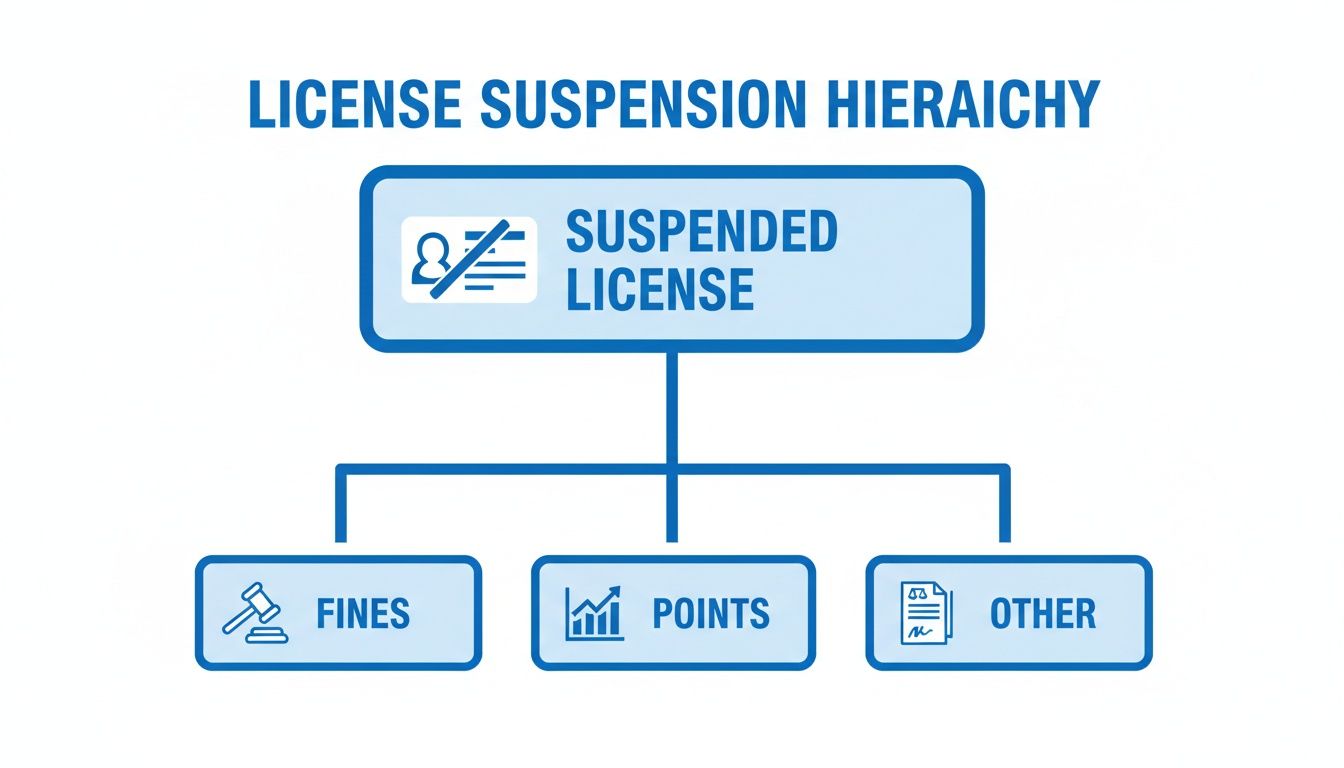
The image shows how a single suspension can trigger a chain reaction of negative outcomes, highlighting why it's so vital to address the root of the problem with professional legal help.
The Lasting Impact Beyond Fines and Jail
The penalties handed down by the court are only one part of the story. A criminal conviction, especially a felony, is a shadow that follows you long after you’ve paid the fines or finished probation. This "collateral damage" can be just as punishing as the sentence itself.
A criminal record throws up roadblocks in nearly every area of your life. Employers run background checks, and a DWLS conviction can be a major red flag that costs you a job opportunity. Landlords can deny housing applications based on your criminal history, making it tough to find a place to live.
A DWLS conviction is more than a legal penalty; it's a long-term anchor on your financial and professional mobility. Our goal is to protect your license and record to prevent these far-reaching consequences.
Perhaps the most immediate financial gut punch comes from your auto insurance. A conviction for driving on a suspended license will cause your premiums to skyrocket, as insurers will now see you as a high-risk driver. That steep increase can last for years, creating a massive financial burden long after the court case is a memory. Avoiding a conviction in the first place is the only way to stop this domino effect before it starts.
Strategic Defenses a Traffic Attorney Can Use
A charge is not a conviction. When you're facing a Driving With a Suspended License (DWLS) accusation, it's easy to feel like the case is already a done deal, but that’s rarely true. A skilled traffic attorney has multiple ways to challenge the state's case against you, shifting the focus from simply accepting penalties to actively defending your record and driving privileges.
The entire prosecution’s case hangs on their ability to prove specific elements of the crime beyond a reasonable doubt. An attorney's job is to pick apart every single one of those elements, searching for weaknesses, procedural mistakes, or shaky evidence. This methodical approach can uncover powerful defenses that may lead to reduced charges or even a full dismissal.
Challenging The Element of Knowledge
For a DWLS charge to stick as a criminal offense, the prosecutor has to prove you had actual knowledge of your license suspension. This is often the most vulnerable part of their case and the first place a defense attorney will look. Simply put, if you didn't know your license was suspended, you can't be found guilty of knowingly driving on it.
This defense isn't about claiming ignorance after you've been pulled over; it's about forcing the state to provide hard proof that you were properly notified. An attorney can build a strong defense around this by:
Verifying Proper Notice: The Florida Highway Safety and Motor Vehicles (FLHSMV) is required to send a suspension notice to the address on your driver's license. Did it go to an old address? Was there a clerical error? If the notice was returned as undeliverable, it creates a powerful argument that you never received it.
Investigating In-Person Notifications: Sometimes, a judge or clerk might tell you about a suspension in court. Your attorney can pull court transcripts and records to confirm whether this notification actually happened and if it was documented correctly.
Analyzing Digital Records: A lawyer can subpoena records to see if the state has any other proof of notification, like an email or delivery confirmation, which they often don't have.
A DWLS case often stands or falls on the state's ability to prove you knew about the suspension. If an attorney can introduce reasonable doubt about whether you were properly notified, the foundation of the criminal charge can crumble, potentially leading to a reduction to a less serious civil infraction.
Contesting The Validity of The Traffic Stop
Every DWLS charge starts with a traffic stop. But police officers can't pull you over just because they have a hunch. The Fourth Amendment protects you from unreasonable searches and seizures, which means the officer must have a valid legal reason—what the law calls "reasonable suspicion"—to initiate the stop in the first place.
An experienced attorney will meticulously examine the circumstances of your stop to see if your constitutional rights were violated. For instance, was the stop based on a vague feeling or a discriminatory profile? Did the officer claim you committed a traffic violation that you didn't actually commit?
If the initial stop was unlawful, any evidence gathered because of it—including the fact that your license was suspended—can be suppressed. This legal move, known as the "fruit of the poisonous tree" doctrine, often leads to the entire case getting dismissed. To learn more about how a lawyer can challenge evidence and procedures, check out our guide on how to fight a traffic ticket in Florida.
Identifying Procedural and Clerical Errors
The legal system is a complicated machine, and sometimes, mistakes happen. From the moment a citation is written to the time the case is filed with the court, there are countless procedural steps that must be followed perfectly. An attorney is trained to spot these errors, which can be surprisingly effective defense tools.
These errors might include things like:
Incorrect Information on the Citation: Was your name, driver's license number, or the statute you were cited for written down incorrectly? Significant errors can sometimes be grounds for dismissal.
Missed Filing Deadlines: The state has a limited amount of time to file formal charges. If they miss this deadline, your attorney can file a motion to have the case thrown out.
Improper Evidence Handling: Were the records of your suspension properly maintained and authenticated? If not, their admissibility in court can be challenged.
While these might seem like small technicalities, in the world of law, they can be powerful weapons. A successful defense is often built by carefully dismantling the prosecution's case, piece by piece, until it can no longer stand on its own.
Your Action Plan After A Florida DWLS Ticket
Getting a citation for Driving With a Suspended License (DWLS) can feel like a punch to the gut. It's disorienting, stressful, and easy to feel overwhelmed in that moment. But the steps you take right after are critical. A clear, deliberate plan can keep a bad situation from getting worse and give you the best possible shot at a solid defense.

Think of the following steps as a kind of legal first aid. Each one is designed to protect your rights, hang onto crucial evidence, and stop the problem from spiraling. These are the absolute basics every driver should follow, especially when dealing with the notoriously complex court systems in places like Hillsborough County.
Step 1 Stop Driving Immediately
This is the single most important—and non-negotiable—step you must take. Continuing to drive after a DWLS citation is the fastest way to dig a deeper legal hole. If you get pulled over again, you’re facing a new, more severe charge that’s much tougher to defend.
Finding other ways to get around might be a pain, but it's absolutely essential. A second or third DWLS offense escalates the penalties from a misdemeanor to a potential felony, which comes with the risk of serious jail time and fines in the thousands.
Step 2 Organize All Your Paperwork
Your next job is to pull together every single document related to your case. This means the new traffic citation, any old tickets you can find, court notices, and any letters you might have from the Florida Highway Safety and Motor Vehicles (FLHSMV).
These documents are the puzzle pieces that tell the story of your situation. They're vital for an attorney to diagnose what caused your suspension in the first place. Small details on these papers can point to procedural mistakes or offer the first clues for a defense strategy.
Your paperwork is the evidence your attorney will use to piece together your case. Keeping it organized and accessible is the first step in building a strong, fact-based defense strategy.
Step 3 Confirm Your Court Date
A DWLS "With Knowledge" charge is a criminal offense, which almost always means you have a mandatory court appearance. The date should be printed right on your citation, but it’s crucial that you double-check it with the clerk of court in the county where you were ticketed, such as the Hillsborough County Clerk of Courts.
Missing your court date will trigger a warrant for your arrest and another license suspension. Verifying the date and location ensures you don't accidentally make things much worse. The good news is that in many cases, an attorney for driving with a suspended license can appear in court for you, so you might not even have to go.
Step 4 Consult A Traffic Attorney Without Delay
Time is not on your side after a DWLS charge. The sooner you talk to a traffic defense attorney, the more time they have to investigate your case, pull evidence, and build a defense. Waiting until the last minute severely limits your options and puts you on the back foot.
A quick consultation allows a lawyer to get to work right away:
Pull Your Complete Driving Record: This is essential to find the root cause of the suspension.
File Necessary Motions: An attorney can file a notice of appearance and other legal documents to formally protect your rights.
Communicate with the Prosecutor: Early negotiations can sometimes lead to a much better outcome before the case ever gets to a hearing.
Taking these four steps methodically can turn a chaotic, stressful situation into a manageable one. It shows the court you're taking this seriously and gives your legal team the tools they need to protect your record and your driving privileges.
Attorney Advertisement. Office in Broward. Submitting information via our forms does not create an attorney-client relationship. Our goal is to protect your license and record.
How Our Firm Handles DWLS Cases in Hillsborough County and Across Florida
Getting hit with a Driving With a Suspended License (DWLS) charge is a stressful, often confusing experience. Our practice focuses on traffic and criminal traffic cases, providing legal help to drivers in Hillsborough County and all 67 counties across Florida. We’ve designed our entire process to be simple, easy to access, and aimed at reaching a favorable outcome.
When you work with our firm, you talk directly to an attorney. We cut out the intermediaries so you can get clear answers and straight talk about your case. This way, you always know what’s happening and what our strategy is.
Our Approach to Your Defense
Our mission is to protect your driving record and your freedom to be on the road. We know a DWLS conviction is way more than just a fine—it can affect your job, send your insurance rates through the roof, and create long-term difficulties.
Our defense strategy is built around a few key objectives:
Seek a Dismissal: We dig into every single detail of your case, from the reason for the traffic stop to the fine print on the suspension notice. We’re hunting for procedural mistakes or weak spots in the state's evidence that could get the whole thing thrown out.
Negotiate to Reduce the Charge: If a full dismissal isn't an option, we work to get the charge knocked down from a criminal offense to a much less serious civil infraction. This is a significant win because it can keep a criminal conviction off your record and help you avoid jail time.
Avoid Points and Convictions: Every move we make is aimed at keeping points off your license and preventing a conviction that would make any future ticket a much bigger problem.
Our goal is to protect your license and record. We focus on creating a defense strategy aimed at minimizing penalties and safeguarding your driving privileges. Past results do not guarantee future outcomes.
Getting Started with a Free Consultation
Taking the first step is easy and completely confidential. We offer a free consultation to go over the details of your DWLS ticket. During our chat, we’ll listen to what happened, look at your citation, and give you an honest take on where you stand and what your options are.
You can get the ball rolling by giving our office a call or filling out our secure online form. It’s important to know that submitting information via our forms does not create an attorney-client relationship—it’s simply the first step toward getting the professional help you need. For more details, you can learn how a dedicated attorney for driving with a suspended license can help you.
We're here to be your partner in getting this sorted out, offering experienced guidance every step of the way.
Attorney Advertisement. Office in Broward.
Common Questions About Driving With A Suspended License
Getting pulled over and finding out your license is suspended is a stressful, confusing experience. It’s natural to have a million questions running through your head. Getting clear, straightforward answers is the first step toward finding a way out of this mess. Below are some of the most common questions we hear from drivers all across Florida.
Just a heads-up: This information is for educational purposes and shouldn't be taken as legal advice. Every situation is different, and the right move is always to talk to a licensed attorney about your specific case.
Could I Really Go To Jail For a First-Time DWLS?
Yes, it's possible. If the state charges you with driving "With Knowledge" of your suspension, even a first offense is classified as a second-degree misdemeanor. That’s a criminal charge, and it carries potential penalties of up to 60 days in jail and a fine of up to $500.
While not every first-time offender ends up behind bars, the threat is very real. This is exactly why getting legal help from an attorney for driving with a suspended license is so critical—your freedom and your permanent record are on the line.
What's The Difference Between A Suspended And A Revoked License?
The main difference comes down to how you get your driving privileges back. Think of a suspension as a temporary timeout. Your license is put on hold for a set period, and once you meet certain requirements—like paying a fine or finishing traffic school—it can be reinstated.
A revocation, on the other hand, is the complete cancellation of your license. It's not something you can just wait out. To legally drive again, you have to apply for a brand new license after a designated waiting period, and the Florida HSMV might make you go through a formal hearing to decide if you’re even eligible. Revocations are usually reserved for much more serious offenses.
Knowing whether your license is suspended or revoked is the key to figuring out the right game plan. A suspension is a temporary pause, but a revocation is a full stop that requires you to start the entire licensing process over from scratch.
How Can I Find Out Why My Florida License Is Suspended?
The only surefire way to know the exact reason for your suspension is to get a copy of your official driving record from the Florida Highway Safety and Motor Vehicles (FLHSMV).
An experienced traffic attorney can pull this record for you instantly. More importantly, they can interpret all the confusing codes and notes to pinpoint the root cause, whether it's an old unpaid ticket, a missed court date, or something else you weren't even aware of.
Is A DWLS Conviction Going To Make My Car Insurance More Expensive?
Almost certainly, yes. A conviction for driving with a suspended license puts a massive red flag on your record for insurance companies, labeling you as a high-risk driver.
This typically leads to a major hike in your auto insurance premiums that can stick around for several years. Over time, this could easily cost you thousands of extra dollars. That financial hit alone makes fighting the charge to avoid a conviction a smart investment.
It's also worth noting that these laws don't always affect everyone equally. Studies have shown that license suspensions for non-driving issues are seven times more common in lower-income communities, and there are significant racial disparities in traffic-related arrests. You can learn more about the research on these enforcement disparities. This data just reinforces why having strong legal representation is so essential for anyone facing these charges in Florida.
A DWLS charge is a serious problem that can follow you for years. At Ticket Shield, PLLC, our entire focus is on protecting your license and your record. We offer a free consultation to go over your case and lay out your options. Don't wait to get the help you need. Contact us today at https://www.ticketshield.com.