
Are License Plate Covers Illegal in Florida: 2026 Laws
Are license plate covers illegal in Florida? Learn 2026 FL statutes, penalties, & what makes a cover illegal to avoid tickets.

Yes, most license plate covers are illegal in Florida if they obscure any part of the plate number or registration sticker, and they can lead to criminal charges. If you're driving with one now, stop treating it like a harmless accessory, because under Florida law the risk is real.
You might think you're just protecting your plate from dirt or giving your car a cleaner look. Florida now treats that choice much more harshly when the cover, frame, tint, or shield interferes with what police need to read.
Table of Contents
That Plate Cover Could Cost You More Than a Fine
You bought the cover to keep your tag clean. Maybe you liked the look. Maybe the dealer put the frame on and you never thought twice about it. That casual decision can turn into a traffic stop, then a criminal citation, then a record you did not plan on carrying.
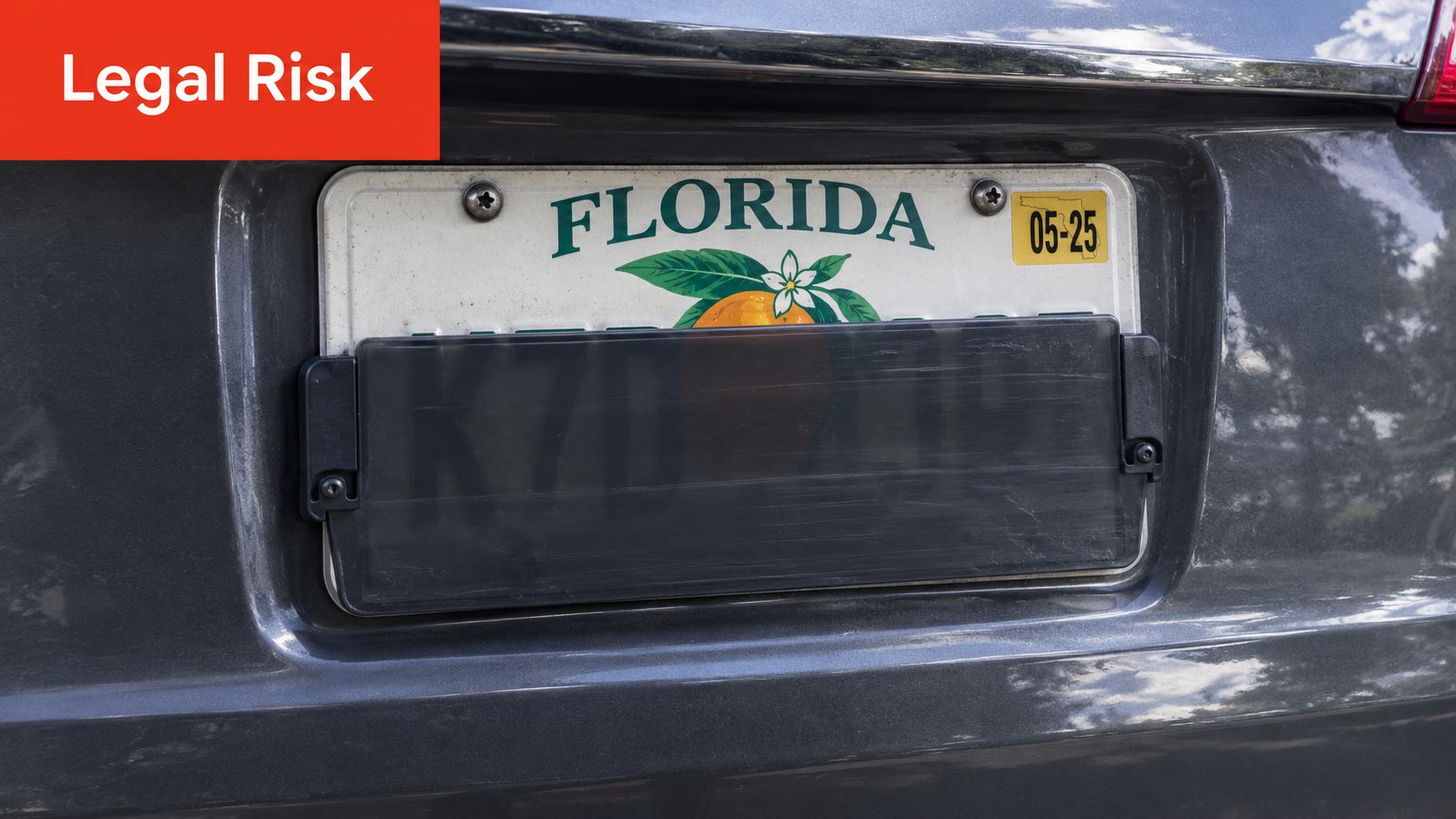
Florida's position is not soft anymore. The state's enforcement focus is on whether the plate can be read, identified, and recorded without interference, and that means the accessory itself can become the problem, not just how it looks from a distance. Under the current statute, the risk is no longer limited to a minor equipment issue. It can become a criminal matter fast, especially if the plate is obscured in a way that looks deliberate.
If a cover changes how the plate reads to the eye or a camera, assume it is a problem until proven otherwise.
That is the practical rule you should use. Tinted shields, smoked plastics, and even some decorative frames can create the kind of obstruction officers rely on for a stop. Florida's updated law is aimed at the device and the concealment, not your intention to “keep it nice.” The safest move is blunt, remove anything that blocks the plate number or validation decal.
If you want the statute context in plain language, review Florida traffic law guidance before you assume your frame is harmless.
The Law You Must Know Florida Statute 316.061
Florida Statute §316.061 is the backbone here, and it is broader than most drivers realize. It makes it unlawful to attach any substance, reflective matter, illuminated device, spray, coating, covering, or other material onto or around a license plate if it interferes with the plate's legibility, angular visibility, or detectability. That means the law is not limited to obvious blackout covers. It reaches anything that reduces the plate's usefulness to an officer, toll camera, or plate reader.
The key is simple. If the plate can't be read cleanly, the accessory is the problem. If a frame, shield, film, or spray makes the characters harder to see, harder to detect from an angle, or harder for a camera to record, you are inside the danger zone. A knowing violation is a second-degree misdemeanor under Florida law, which is a more serious consequence than commonly assumed for a “plate cover” issue.
That is why guessing is dangerous. You should not ask whether the cover looks subtle or whether it worked fine in daylight once. You should ask whether it blocks visibility in any way. The statute is written to protect readability, not style.
For the legal text itself, read the official version of Florida Statute 316.061. If you are trying to decide whether your setup is worth the risk, compare it against the statute, not social media advice.
The plate has to stay readable, not merely visible.
Compliant Frames vs Illegal Covers A Visual Guide
A frame is not automatically illegal in Florida. A cover often is. The difference comes down to whether the accessory leaves the alphanumeric identifier and validation sticker fully visible. Florida enforcement guidance also makes clear that the lower text on the plate is not treated as a primary feature, so a frame that only clips the bottom wording can still be lawful if the number and sticker remain readable.
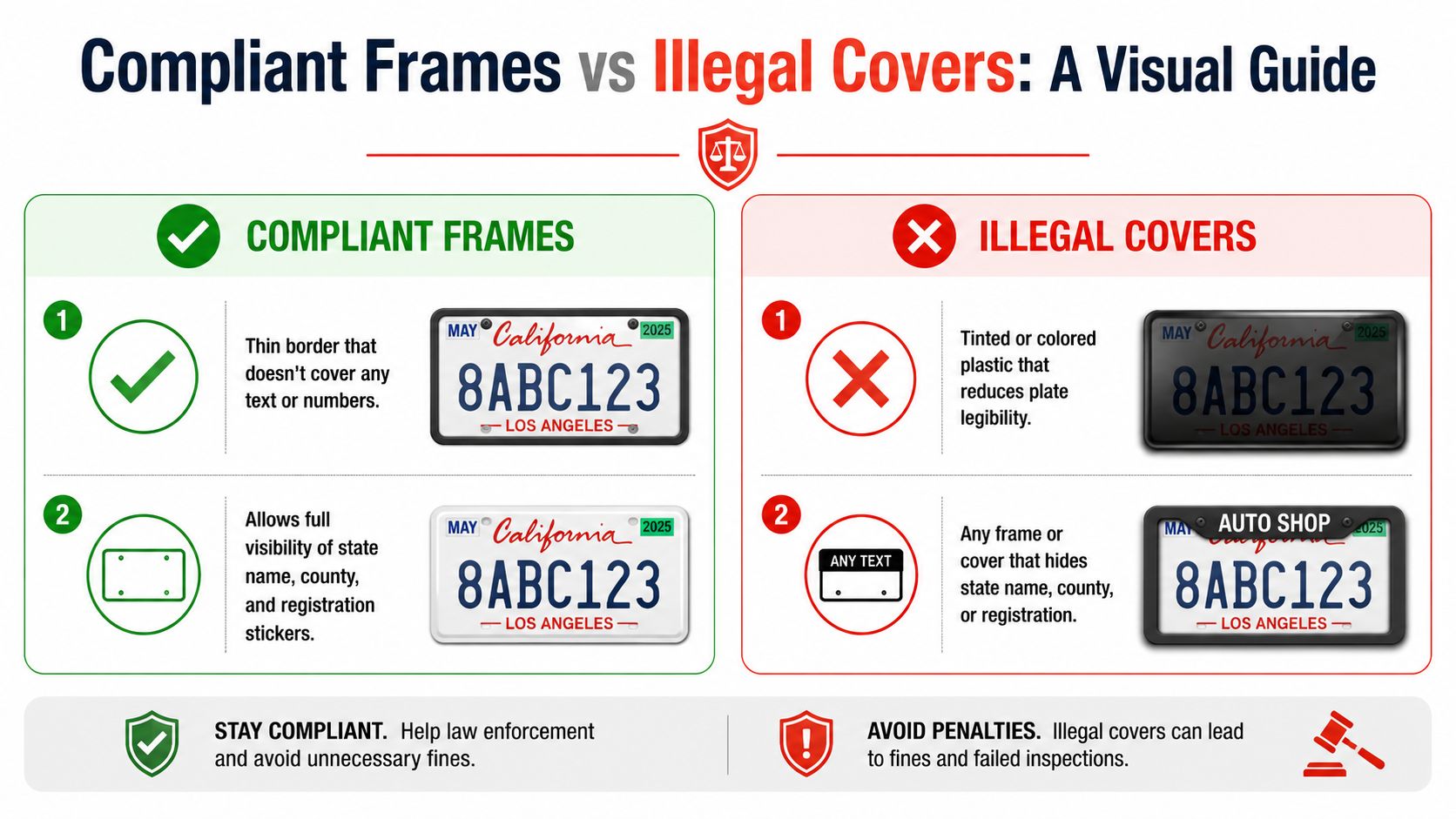
Here is the clean way to think about it.
Compliant frame, thin border only: It surrounds the plate without covering text, numbers, or the decal.
Compliant frame, bottom wording only: It may cover lower plate wording if the identifying features stay visible.
Illegal tinted or smoked cover: It reduces legibility, even if you can still “sort of” see the plate.
Illegal clear shield with glare: It can still fail if reflection or distortion hurts visibility.
Illegal decorative frame: It becomes a problem the moment it hides the number, letters, or registration sticker.
Florida authorities in 2025 said the updated law targets tinted, smoked, or clear plastic covers, decorative frames, reflective sprays, and LED attachments when they obscure readable plate details, with the base offense treated as a second-degree misdemeanor punishable by up to 60 days in jail and a $500 fine CBS12 reporting on banned plate accessories. That is the line you need to respect.
If you want a practical rule for a dealer frame, use this test. Stand behind the car and make sure the number and the registration sticker are fully visible without squinting or shifting angles. Then check whether a camera would still have a clean shot. A frame that passes that test may be lawful, while a cover that blocks the plate in any meaningful way is not.
For a related breakdown of simple citations, review what counts as a non-moving traffic violation, but do not let that language make you underestimate the legal exposure here.
The Shocking Penalties For An Obscured Plate
The law carries surprising penalties for drivers. Under Florida Statute 320.262, effective October 1, 2025, merely purchasing or possessing a license plate obscuring device is a second-degree misdemeanor, while manufacturing, selling, or distributing one is a first-degree misdemeanor Florida Statute 320.262. If the device is used to help commit or escape from a crime, the offense can rise to a third-degree felony.

That means the problem is not just the ticket. The problem is the criminal classification. News coverage of the new law says drivers can face up to 60 days in jail and a $500 fine for knowingly driving with an obscured plate, and the felony enhancement can carry up to five years in prison. Once you understand that, the choice becomes obvious. Do not shrug off a plate cover citation.
The criminal exposure gets worse if the plate device is tied to a broader offense. Florida did not write this law to punish innocent style choices. It wrote the law to target concealment tools. If the state argues that your cover was part of an effort to hide identity, avoid detection, or assist a crime, the consequences can jump sharply.
A lot of drivers still think in old categories, like “it's just a non-moving issue.” That mindset is outdated and dangerous. If you were stopped under this law, your first question should be whether the plate was obscured under the statute, not whether you can pay and move on.
If you need to understand the criminal citation angle, read how a no-registration criminal citation can escalate. Then take the charge seriously.
How Police Enforce This Law And Your Defense Options
Florida enforcement is practical, not theoretical. Officers look for whether the plate number and validation decal are plainly visible, and the statewide visibility standard still matters. Florida guidance says a plate must remain readable from 100 feet in normal daylight, and that creates an easy enforcement trigger when a cover, frame, or shield makes the tag harder to see.
The stop often begins with a simple observation. If an officer thinks the plate is partially blocked, the officer can treat that as grounds to investigate further. A frame that only trims the border may be lawful, but a tinted or clear cover that degrades visibility or camera readability can still trigger a second-degree misdemeanor charge under the current enforcement approach local reporting on FLHSMV guidance.
Practical rule: If the plate looks even slightly compromised, remove the accessory before an officer makes the call for you.
Your defense starts with evidence. The plate photo, bodycam footage, dashcam footage, and the exact placement of the frame all matter. If the number and sticker were visible, the State has a weaker case. If the officer overreached on a standard frame, that issue can matter too.
For legal strategy on a traffic stop, use a focused traffic-ticket defense approach instead of paying first and asking questions later. Paying can close the door on a real defense. That is the mistake people make when they assume a plate case is too small to fight.
Protect Your Record With A Real Attorney Not An App
A plate-cover charge is not the place for an app, a chatbot, or a call center. You need a lawyer who understands Florida traffic law, criminal exposure, and how to attack a stop that was built on an improper plate-obstruction claim. A machine can collect your information. It cannot defend your license, your record, or your future.
Ticket Shield, PLLC is lawyer-led, and that matters when the charge has criminal consequences. You speak directly with your attorney by phone or text, not through layers of middlemen. That direct access is the difference between getting generic instructions and getting a defense strategy customized to the stop, the plate, and the officer's report.
Florida guidance also makes one point clear, not every frame is illegal. The issue is whether it blocks the alphanumeric identifier and validation sticker, while the bottom text is not treated as a primary feature and may be covered if the plate remains readable from 100 feet Florida license plate clarification. That means your case may turn on details that an automated service will never bother to analyze correctly.
Use why a local lawyer beats an app if you want to understand the contrast. A lawyer spots the weak point in the stop. An app usually just processes the citation.
Visit TicketShield.com now for a free consultation so you can fight for No Points on your license.
