Infracciones de tránsito de Miami Dade: Guía de defensa
¿Se enfrenta a citaciones de tráfico en Miami-Dade? Conozca cómo los tribunales locales procesan las multas, comprenda sus opciones de declaración y descubra cómo proteger su licencia de conducir.

You're driving through Miami-Dade when an officer pulls you over. Your day stops, a citation is placed in your hand, and the easiest option appears to be paying it online and moving on. That decision can affect your license record long after the traffic stop is over.
Miami-Dade traffic is already demanding. Greater Miami ranked as the second most congested major U.S. metro area in 2025, with average trips taking nearly 50% longer than in free-flow conditions and rush-hour speeds around 19 miles per hour, according to TomTom-based reporting from the Miami Herald. A citation adds a separate legal problem to an already difficult driving environment. You need to treat it as a legal matter, not as an ordinary bill.
Table of Contents
The Hidden Cost of Miami Dade Traffic Tickets
Paying a Miami-Dade traffic ticket may feel like the fastest way to remove stress. It can also mean accepting the consequences attached to the citation without examining whether the charge can be challenged, reduced, or resolved without points.
The immediate payment is only one part of the decision. A moving violation can affect your driving record, create point exposure, and make future license issues more difficult to manage. The Miami-Dade Clerk's explanation of civil traffic infractions confirms that moving violations normally assess points against a driver license, while non-moving violations generally do not.
Protective rule: Don't measure a ticket only by the amount due today. Measure it by what the outcome does to your record.
Why a quick payment can be the wrong strategy
A ticket is not merely an invoice. Florida classifies traffic infractions and assigns consequences through statewide law, including point assessments and moving-violation treatment. Once you choose a resolution that leaves points on your license, you may have fewer options to protect your record from the next citation.
That matters especially if you drive for work, regularly travel through busy corridors, share a vehicle with family members, or already have prior traffic history. A driver with a clean record has a different legal position from a driver who is close to a license consequence. The same citation can carry very different practical risks depending on what already appears on the license.
Insurance companies also review driving histories when evaluating risk. You shouldn't assume that paying a citation ends the financial impact. The precise effect depends on the violation, your record, the insurer, and the policy. The point is simple: you cannot make a responsible decision until you know whether the resolution places points on your license.
Miami-Dade traffic is also a safety problem
Delay gets most of the attention in Miami-Dade traffic discussions. Safety deserves equal attention. Florida pedestrian-crash analysis reported 1,883 pedestrian crashes and 83 fatalities in Miami-Dade in 2025, more than the other four large counties combined in that dataset, as reported by USA Today's Florida pedestrian-crash analysis.
The county's broader transportation safety reporting uses a rolling five-year average. For 2019 through 2023, Miami-Dade reported a fatality rate of 1.63 per 100 million vehicle miles traveled and an annual average of 1,375.2 serious injuries, according to the Miami-Dade Transportation Planning Organization safety performance resolution. Those figures explain why speed management, access control, and pedestrian and bicycle separation matter on major roads.
A citation involving speed or aggressive driving can therefore have consequences beyond your personal record. Miami-Dade's Red Speed program issues notices during the school day when a vehicle exceeds the posted limit by more than 10 miles per hour, and county data listed 34,351 speed and aggressive-driving notices in 2025, according to the Miami-Dade Red Speed initiative.
Do not surrender your legal position just because the payment portal is convenient. Review the charge, identify the point consequences, and get advice before you decide.
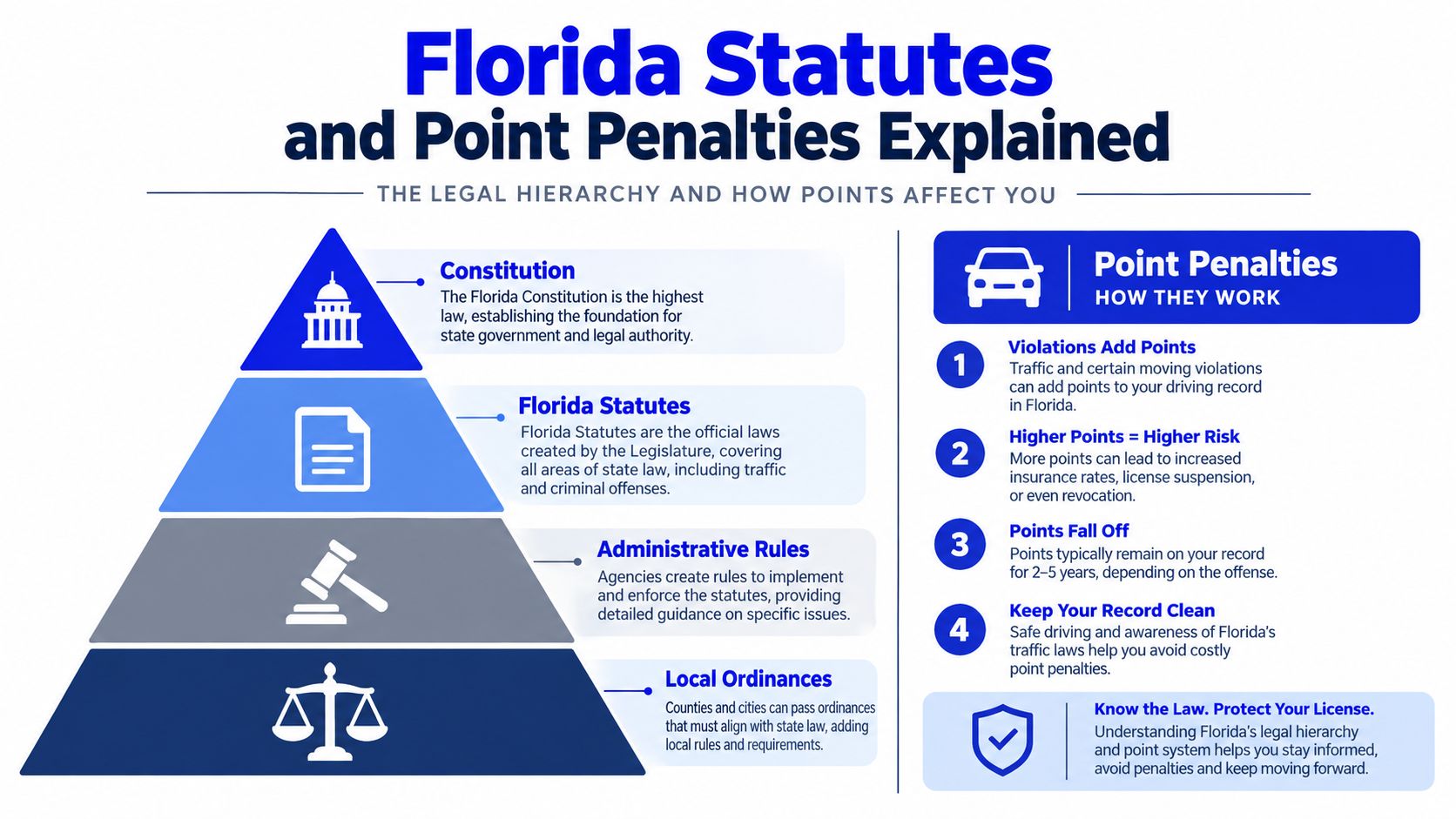
Florida Statutes and Point Penalties Explained
A driver who pays a Miami-Dade citation online may close the payment task while leaving the legal consequences untouched. Local clerks process the case, but Florida law controls the violation's classification, available penalties, and effect on the driver record. Read those rules before choosing payment, traffic school, or a contested hearing.
Florida Statute 316.650 requires traffic citations to follow state traffic court rules and procedures. It also directs the Florida Department of Highway Safety and Motor Vehicles to distribute a reference guide identifying each infraction's class, penalty, and points assessed against a driver record. The statutory framework appears in the Florida Legislature's text of Section 316.650.
Speed limits and moving violations
Florida's Chapter 316 speed law generally sets the maximum speed at 30 miles per hour in business or residence districts and 55 miles per hour at other locations. Certain residential streets may receive a 20- or 25-mile-per-hour limit after a local investigation. Speed-limit violations are moving violations punishable under Chapter 318. Review the statutory language in the Florida Senate's Chapter 316 text.
That classification changes the stakes. A moving violation can affect the license record, while a non-moving administrative issue is treated differently. The fine shown on the citation does not fully describe the exposure.
Florida's published point schedule assigns 3 points for speeding and 3 points for driving too fast for conditions. Certain violations under Sections 316.183(2), 316.187, or 316.189 receive 4 points when the speed is more than 50 miles per hour, according to the Florida Highway Safety and Motor Vehicles point schedule. Two 3-point speeding tickets within 12 months place a driver at 6 points, closer to the 12-point suspension threshold described in that schedule.
The fine range is not the whole case
Florida's standard penalty schedule states that speeding 1 to 5 miles per hour over the limit is warning only, while 6 to 9 miles per hour over carries a $25 penalty, 10 to 14 miles per hour carries $100, and 15 to 19 miles per hour carries $150. The statutory citation framework is available through the Florida Legislature's text of Section 316.650.
A payment decision should follow legal review, not convenience. A lawyer can examine the alleged speed, statutory section, evidence, and available resolution before you accept points or other record consequences. Automated ticket apps and mills may process transactions, but they do not replace a lawyer's case-specific strategy.
For a plain-language explanation, read this Florida traffic ticket point system guide. Identify the statutory classification before choosing payment or contesting the citation.
Navigating the Local Court System and Deadlines
A Miami-Dade civil traffic infraction has a deadline. The county clerk states that a person who receives a civil infraction citation has 30 days from the date of issuance to satisfy the obligation. That deadline is not a suggestion. If you let it pass, you may lose the ability to choose the resolution that best protects your record.
Start with the citation itself. Confirm the issue date, alleged violation, court or clerk instructions, and the options listed for that case type. Save a clear copy of every page. If the citation is damaged, incomplete, or difficult to read, obtain a legible copy before relying on the information.
A practical response sequence
Record the deadline. Put the 30-day date in your calendar immediately. Use a second reminder before the deadline so the citation doesn't disappear under work, family, or travel obligations.
Classify the citation. Determine whether it is a moving or non-moving infraction. The clerk explains that moving violations normally assess points, while non-moving violations generally do not.
Check the available options. Miami-Dade's clerk identifies resolution choices and notes that some options do not apply to every case type. The listed option does not apply to tag, registration, driver license, PIP insurance, toll, or camera-based citation matters.
Avoid making an uninformed election. Paying may close the administrative task while leaving you with a result you didn't intend. Contesting requires timely action and a clear understanding of what happens next.
Keep proof of every submission. Save confirmation pages, receipts, emails, and copies of any documents delivered to the clerk or court.
Practical rule: A deadline you can't prove you met is a problem. Keep the confirmation, not just the intention to act.
Technology can help organize dates, particularly for lawyers and legal teams managing multiple matters. Resources on court deadline automation tools can explain how deadline tracking works, but automation is not a substitute for legal judgment. A calendar can remind you that action is due. It cannot decide whether a hearing request, negotiated resolution, or contested defense is appropriate.
If you're evaluating a speeding citation, review this guide on how to fight a speeding ticket in Miami-Dade County court. Then act before the deadline, not after it.
Pleading Guilty Versus Contesting Your Citation
You generally face a strategic choice. You can resolve the citation in a way that accepts its consequences, or you can contest it and seek a result that protects your license. The right decision depends on the citation, your record, the evidence, and the available legal options.
Paying may look efficient. Contesting may require more attention at the start, but it gives you an opportunity to challenge the allegation and pursue a different outcome. You shouldn't choose based only on the fine printed on the citation.
Paying the Fine vs. Contesting the Ticket
Factor | Paying the Fine (Pleading Guilty) | Contesting with Legal Representation |
|---|---|---|
Immediate effort | Resolves the payment task quickly | Requires timely review and case handling |
License record | May result in points for a moving violation | Seeks a resolution that avoids points when legally available |
Evidence review | You generally don't receive a strategic review before accepting the outcome | An attorney can examine the citation, allegations, and available evidence |
Officer testimony | You give up the opportunity to challenge the allegation through the contest process | Counsel can prepare to address testimony and inconsistencies |
Procedural issues | Errors may go unexamined | Counsel can identify defects or procedural concerns |
Long-term protection | Prioritizes immediate closure | Prioritizes the driving record and available legal defenses |
A lawyer can examine whether the citation accurately identifies the alleged violation, whether the facts support the charge, and whether the state can prove the required elements. Depending on the case, the defense may focus on officer observations, documentation, timing, signage, road conditions, or procedural compliance. You should never assume that a citation is impossible to challenge because it was issued by an officer.
What representation changes
Direct representation also changes the burden on you. Instead of trying to interpret court instructions while managing work and transportation, you can have counsel handle the legal process and communicate the strategy in plain language. The precise result can never be promised, but representation gives your case a deliberate review rather than an automatic payment.
A lawyer may pursue dismissal, a reduced charge, or another resolution that avoids points when the facts and local procedure support it. That is different from accepting the citation without asking what alternatives exist.
Read this explanation of what happens if you plead guilty before paying. If you've already paid or missed a deadline, get legal advice promptly. Your options may depend on the current status of the case, and delay rarely improves your position.
Your record matters more than the convenience of a payment screen. Choose the path after reviewing the legal consequences, not before.
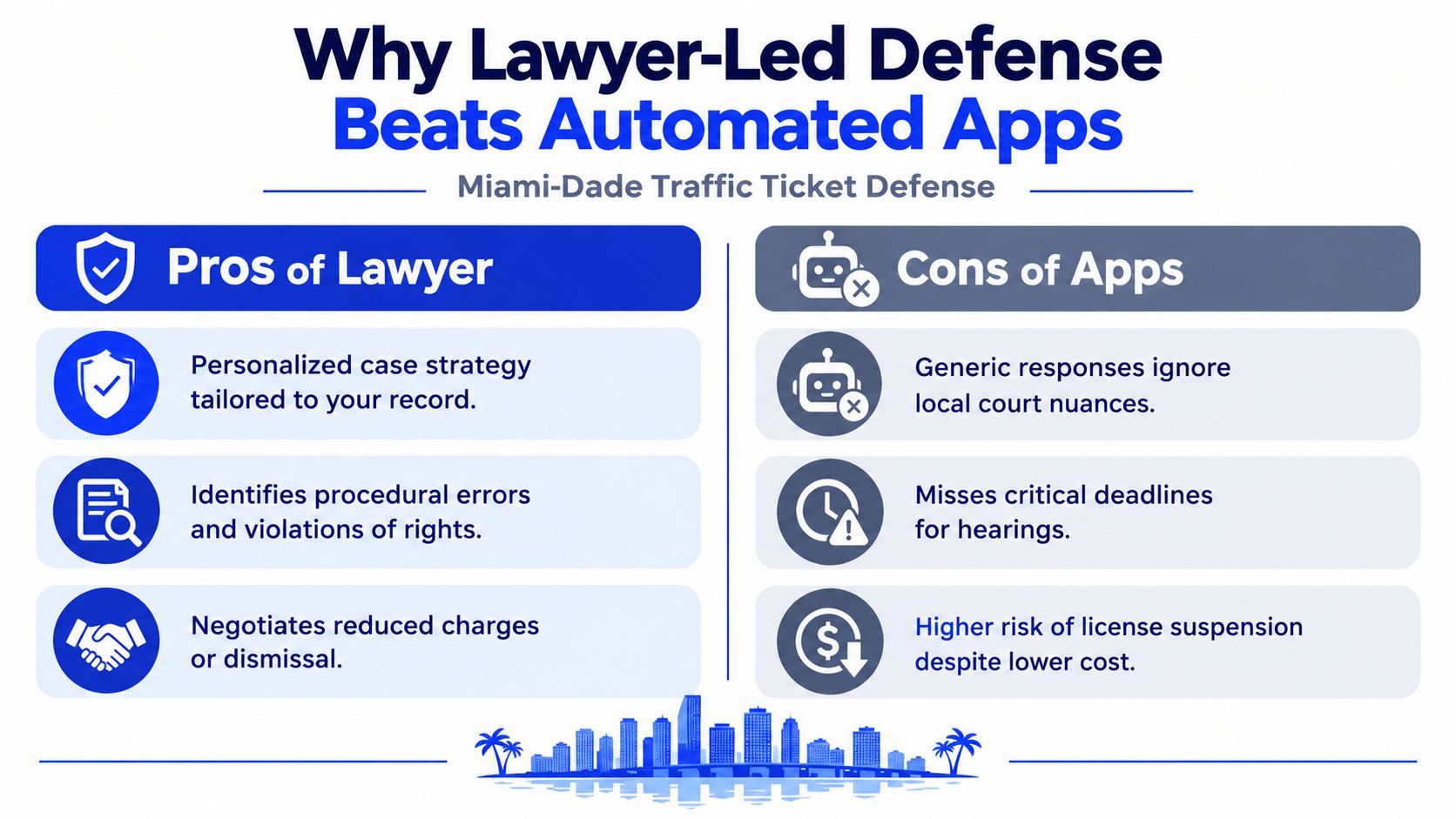
Why Lawyer-Led Defense Beats Automated Apps
Automated apps make traffic defense look like a software transaction. Upload a citation, answer a few questions, and wait for a status update. That approach can be inadequate when the case requires local judgment, evidence analysis, direct negotiation, or a response to an unexpected court development.
Your citation isn't a software bug. It's a legal matter tied to a specific statute, a specific allegation, a specific deadline, and your individual driving history.
What direct communication gives you
A lawyer-led firm should let you communicate with the attorney responsible for your matter by phone or text. That direct line matters when you need to explain what happened, provide photographs or documents, clarify a deadline, or understand a proposed resolution.
Corporate answering services and automated chatbots can collect information. They don't replace an attorney's case assessment. A middleman may not understand why a particular statutory subsection matters, how an officer's account affects the defense, or why a seemingly minor resolution could create point exposure.
Ticket Shield, PLLC offers lawyer-led Florida traffic defense with direct attorney communication by phone or text. That model is different from a high-volume ticket mill that routes you through generic forms, scripted responses, or staff who cannot provide legal advice.
Watch the embedded overview for another perspective on the distinction between automated processing and legal representation:
The firm's operating model matters more than a polished app interface. Ask who reviews your citation, who makes legal decisions, who answers your questions, and who responds if the case doesn't follow the expected path.
Questions to ask before hiring anyone
Who is my attorney? You should know whether a lawyer is assigned to the matter.
Can I speak with that lawyer? Direct phone or text communication is a meaningful service distinction.
What outcome are you pursuing? Ask whether the strategy focuses on dismissal, reduction, or a no-points resolution when available.
What deadline controls my case? The provider should identify the date and explain what must happen before it.
What happens if the case changes? A real legal team should explain how it handles unexpected notices, hearing issues, or new evidence.
Legal practices also need sound systems for intake, communication, and case management. Anyone building those systems may find a legal marketing playbook useful for understanding how law firms present services online. Marketing, however, doesn't decide your citation. The attorney handling your case does.
For more detail on the difference between an app-based approach and counsel, read this guide to fighting a speeding ticket with an app. Choose a provider that can explain your case, not one that merely confirms your upload was received.
Secure Your No Points Outcome Today
A Miami-Dade traffic citation demands action before the 30-day deadline expires. Waiting gives you less time to review the charge, gather information, choose a resolution, and retain counsel. The safest approach is to address the citation immediately and make the driving-record consequences part of the decision.
Your target should be clear: protect your license and pursue a No Points outcome when the facts and law allow it. No lawyer can promise a particular result before reviewing the citation. A responsible attorney can explain the available options, identify the risks, and build a strategy around your specific record instead of treating every ticket as an identical transaction.
Start by gathering the citation, your driver information, any photographs or videos, and notes about the stop. Preserve the details while they're fresh. Then use the Ticket Shield case submission page to begin a review rather than making an uninformed payment.
The Miami-Dade traffic system is built around statutory classifications, point consequences, and strict deadlines. A direct conversation with a lawyer gives you the opportunity to understand those issues before you surrender control of the case.
Visit TicketShield.com for a free consultation and take immediate steps toward the ultimate goal of achieving “No Points” on your license.
Visit Ticket Shield, PLLC for lawyer-led defense of your Miami-Dade traffic citation, with direct attorney communication by phone or text. Submit your citation now so counsel can review the deadline, explain your options, and pursue a No Points resolution when available.