Cómo establecer un plan de pago para una multa de tránsito en Florida
Aprenda cómo establecer un plan de pago para multas de tránsito en Florida, incluyendo elegibilidad, opciones por condado, tarifas y riesgos de incumplimiento. Obtenga ayuda legal hoy.

Acaba de abrir una citación de Florida y su primer instinto suele ser el equivocado. Quiere la forma más rápida de hacer desaparecer el problema, por lo que busca un plan de pago para multas de tránsito y espera que el secretario le permita distribuir el gasto a lo largo del tiempo. Ese movimiento se siente seguro. Pero por lo general no lo es.
Un plan de pago puede evitar que pague el monto total hoy, pero no borra la multa, no protege los puntos de su licencia ni protege su seguro de las consecuencias de una condena bajo el Capítulo 316 de los Estatutos de Florida, que incluye infracciones de movimiento graves como el Estatuto de Florida 316.187. Si se declara culpable o paga de la manera incorrecta, es posible que haya resuelto un problema de flujo de efectivo y haya creado uno legal más largo. Por eso la pregunta importante no es: "¿Puedo hacer pagos mensuales?" Sino "¿Debería estar luchando contra esta multa en su lugar?"
Tabla de Contenido
La decisión principal detrás de un plan de pago de multas de tránsito
Qué es en realidad un plan de pago de multas de tránsito en Florida
Plan de pago frente a disputar la multa frente a pagarla por completo
Por qué una defensa dirigida por un abogado supera a una aplicación de multas automatizada
La decisión principal detrás de un plan de pago de multas de tránsito
No solo está eligiendo cómo pagar. Está eligiendo si acepta las consecuencias legales de la multa y las prolonga mes a mes. Esa es la parte que los conductores pasan por alto cuando se concentran únicamente en el monto adeudado.
Una multa de tránsito de Florida vinculada al Capítulo 316 no es una factura neutral. Una vez que se declara culpable o paga de una manera que cuenta como una admisión, puede asegurar una condena, puntos y los problemas de seguro que siguen mucho después de que termine la citación. Un plan de pago no cambia ese resultado. Solo cambia el calendario.
Regla práctica: Si la multa es el único problema, un plan puede ayudar. Si el problema es la condena, un plan solo prolonga el daño.
Trate un plan de pago de multas de tránsito como una herramienta de flujo de efectivo, no como una estrategia de defensa. Los conductores a menudo piensan que están siendo responsables al programar pagos mensuales, pero en realidad están eligiendo la conveniencia en lugar de su posición legal. Una vez que el caso se resuelve de la manera incorrecta, sus opciones se reducen rápidamente.
La mejor pregunta es si se debe luchar contra la multa antes de pagar algo. Un abogado puede buscar la desestimación, una reducción o un resultado sin puntos, y eso puede ahorrarle mucho más de lo que un plan de pago jamás logrará. Preferiría ver a un conductor proteger su historial primero y preocuparse por el pago después, en lugar de apresurarse a realizar un acuerdo de pago a plazos que conserve cada una de las sanciones.
Para analizar más de cerca esa decisión, lea pagar una multa versus contratar a un abogado.
Qué es en realidad un plan de pago de multas de tránsito en Florida
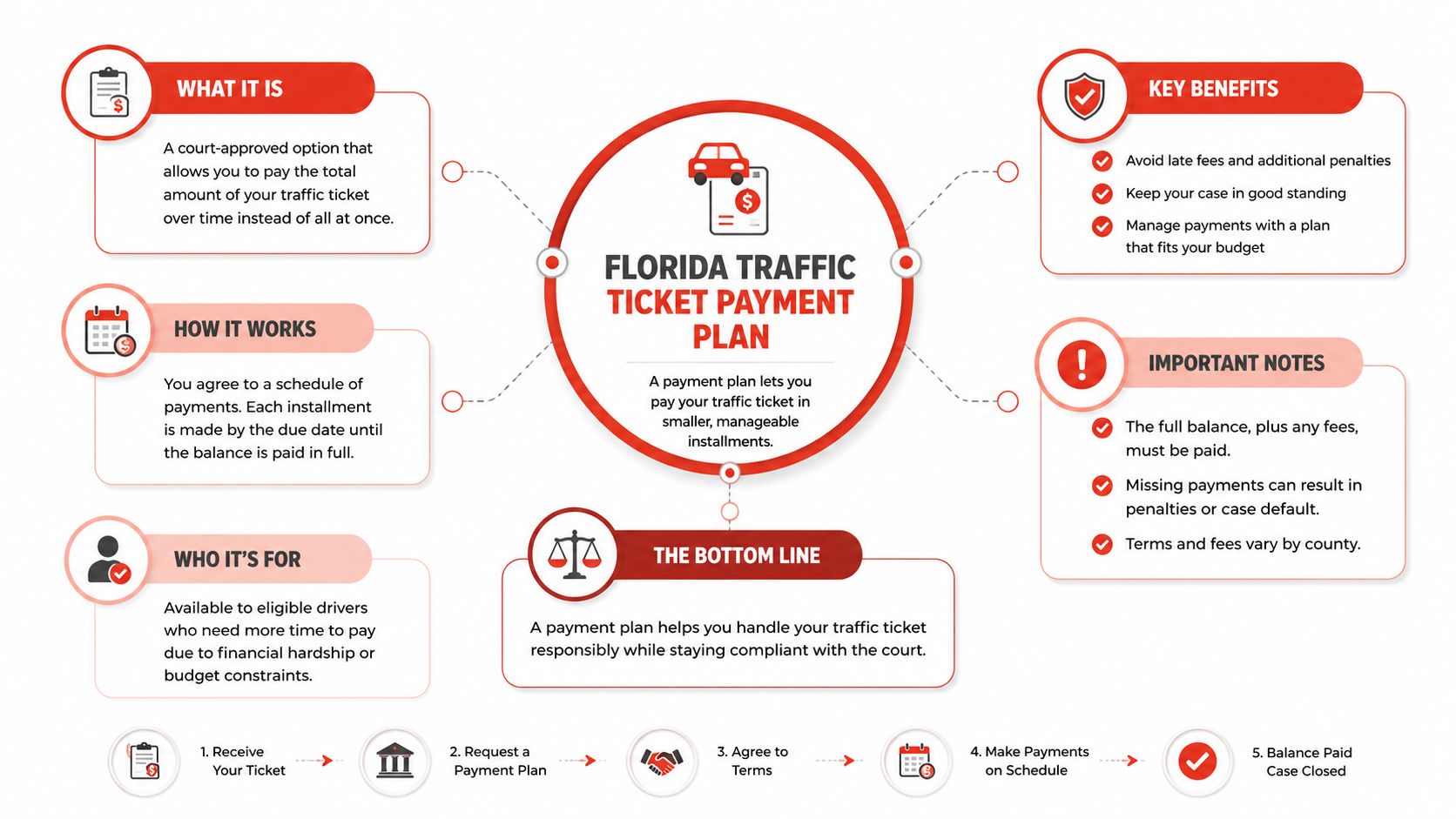
Un plan de pago de multas de tránsito de Florida es un acuerdo formal de pago a plazos con el secretario del tribunal o el tribunal del condado. Convierte una multa de tránsito de pago único en pagos programados, generalmente después de que el caso se haya resuelto mediante una declaración, un incumplimiento de pago u otro proceso judicial. Es papeleo, no misericordia.
Bajo el Estatuto de Florida 316.192, la conducción temeraria y las infracciones de tránsito similares entran dentro del marco de control de tránsito del estado, y eso importa porque el proceso de cobro del condado se basa en la administración judicial, no en promesas informales. Un plan administrado por el secretario tiene como objetivo cobrar el dinero con un cronograma que el tribunal pueda rastrear. No es un atajo para evitar la multa.
Un plan de pago cambia cuándo paga. No cambia lo que admitió.
Los conductores también confunden los planes de pago con otras formas de asistencia. Una fecha límite diferida pospone el pago. Una solicitud por dificultades económicas pide al tribunal que reduzca o reconsidere la multa. Un plan distribuye el saldo a lo largo del tiempo. Esas cosas no son lo mismo, y la diferencia importa cuando su objetivo es proteger su historial.
La dura verdad es que un plan de pago no elimina los puntos, no borra la condena ni evita que el seguro trate la citación como un incidente real. Si espera que un acuerdo mensual haga desaparecer el caso, se está preparando para una decepción. El secretario puede ayudarlo a pagar, pero no puede defenderlo.
Es por eso que debe tratar el plan como una herramienta de pago de último recurso, no como una primera respuesta. Si la multa aún se puede impugnar, dispútela antes de dejar que el caso se convierta en una condena. Si necesita una comparación sencilla de los planes de diferimiento de multas frente a la disputa de la citación, revise las opciones de diferimiento de multas de tránsito en Florida.
Elegibilidad, documentos requeridos y umbrales típicos

Los condados de Florida no otorgan planes de pago solo porque usted lo solicite. El secretario generalmente requiere una citación que califique para el tratamiento de pago a plazos, los documentos que el condado exige y suficientes detalles financieros para justificar el acuerdo. El proceso se establece mediante las normas del tribunal, y esas normas controlan el resultado.
Qué reunir antes de presentarse
Traiga la citación, una identificación emitida por el gobierno y prueba de su situación financiera actual. Eso generalmente significa registros de ingresos, una lista de gastos mensuales y, en algunos condados, una declaración jurada de dificultades económicas. Si no tiene a mano el número de citación, retrasará todo el proceso; por lo tanto, comience con una guía adecuada para la búsqueda del número de citación de Florida antes de dirigirse a la oficina del secretario.
A los tribunales también les importa el factor tiempo. En algunos condados de Florida, la multa debe procesarse a través del sistema judicial antes de que se acepte una solicitud de plan de pago. Si ignora la citación, puede convertir rápidamente un problema manejable en un problema de incumplimiento grave.
En pocas palabras: Preséntese con la multa, su identificación, su comprobante de ingresos y un presupuesto que se ajuste a la realidad.
Los costos judiciales son otra trampa. Los conductores se concentran en la multa y luego descubren cargos adicionales sumados al saldo. Es por eso que un plan de pago a menudo cuesta más de lo que parece a primera vista. Si desea una idea más clara de lo que el tribunal puede agregar a una multa de tránsito, lea cómo funcionan los costos de corte en las multas de tránsito.
Cómo solicitar un plan de pago paso a paso
Haga el trámite en la oficina del secretario al pie de la letra. Traiga la citación, su identificación y una solicitud clara para un plan de pago de la multa de tránsito. Si desea que el secretario le dé una respuesta directa, pregunte exactamente qué necesita el condado antes de que siquiera revisen su solicitud.
En persona en la oficina del secretario
Vaya a la ventanilla de tránsito o de cobros, si la oficina tiene una. Evite el vestíbulo general cuando pueda. Entregue la citación y la identificación, luego pregunte si el caso califica para un acuerdo de pago a plazos y si es necesario resolver algo primero. Si el secretario le solicita registros de ingresos, detalles de gastos o una declaración jurada de dificultades económicas, proporciónelos en el acto.
Use un diálogo directo:
“Quiero resolver esta citación de tránsito y preguntar si califico para un plan de pago. ¿Qué documentación necesitan de mí hoy?”
Eso mantiene la conversación enfocada y obliga a la oficina a decirle los requisitos reales en lugar de darle instrucciones vagas. Si le entregan una solicitud, lea cada línea antes de firmar. Una firma equivocada puede convertir un acuerdo de pago temporal en una condena que usted no necesitaba.
A través del portal en línea del condado
Muchos condados de Florida permiten a los conductores ocuparse de los asuntos de tránsito a través del sistema de pago en línea del secretario. Abra la sección de multas de tránsito o pagos, luego busque una solicitud de plan, una extensión de la fecha de vencimiento u otra opción de pago a plazos similar. Suba cada documento requerido exactamente como se solicita. Olvidar un solo archivo puede paralizar la solicitud.
No considere la pantalla de envío como una aprobación. Debe obtener una confirmación por escrito, un aviso por correo electrónico o un plan firmado antes de enviar el primer dólar. Si el portal solo muestra que envió una solicitud, continúe verificando hasta que tenga algo oficial en la mano.
Si necesita confirmar los detalles de la citación antes de comenzar, use los conceptos básicos de búsqueda de citaciones de tránsito. Si está comparando costos administrativos en asuntos no relacionados con el tribunal de tránsito, incluso algo como los precios de cerrajeros de autos en el Reino Unido muestra la rapidez con la que se pueden acumular cargos independientes cuando no se solicita el total completo por adelantado.
Costos, plazos y qué sucede si no realiza un pago
Un plan de pago parece manejable porque la cifra mensual es más pequeña. Ese es el anzuelo. El costo suele ser una pila de cargos independientes integrados en el monto de la cuota, y al secretario no le importa si el total le resulta pesado una vez que ya se ha comprometido.
Componente | Qué significa | Riesgo si se ignora |
|---|---|---|
Multa | La sanción base vinculada a la citación | El caso permanece sin resolver si no se paga |
Costos de corte | Cargos administrativos agregados por el tribunal | El total adeudado es mayor de lo esperado |
Tarifa de pago a plazos | Un cargo vinculado al acuerdo de pago | Los pagos mensuales pueden costar más con el tiempo |
Consecuencias por retraso | Lo que sucede si se pierde un pago | El incumplimiento puede desencadenar medidas de ejecución más severas |
El plazo de tiempo importa de igual manera. Algunos planes duran solo unos pocos meses, mientras que otros se prolongan mucho más dependiendo del saldo y de la política del secretario. Eso puede sonar útil en el papel, pero cada mes adicional mantiene el caso abierto y le da más tiempo para caer en un incumplimiento de pago.
Si no realiza un solo pago, el plan puede desmoronarse. Una vez que eso sucede, el tribunal puede considerar que el saldo está vencido, y el conductor puede enfrentar consecuencias de suspensión o medidas de cobro que se podían evitar desde el principio. Un plan de pago es un contrato y los tribunales lo hacen cumplir de esa manera.
Si desea comprender por qué el tribunal sigue agregando cargos al inicio, revise lo que suelen incluir los costos de corte. Para una comparación más amplia de cómo funcionan en la práctica otras tarifas automotrices del mundo real, incluso fuera de Florida, esta discusión sobre los precios de cerrajeros de autos en el Reino Unido es un recordatorio útil de que los cargos por servicio y los costos administrativos pueden cambiar rápidamente el precio de un problema.
Plan de pago frente a disputar la multa frente a pagarla por completo
Los conductores suelen plantear una citación como pagar ahora o pagar más tarde. Ese planteamiento es demasiado limitado y empuja a las personas a tomar la decisión equivocada. En realidad hay tres caminos, y solo uno de ellos le brinda una oportunidad real de proteger su historial.
Opción | Qué sucede | Principal desventaja |
|---|---|---|
Pagar en su totalidad | Cierra el caso rápidamente | Por lo general, acepta la condena y las consecuencias |
Plan de pago | Distribuye los pagos a lo largo del tiempo | Aún conserva la condena y el riesgo de puntos |
Disputar la multa | Un abogado lucha contra la citación | Requiere estrategia, pero puede proteger la licencia y el seguro |
Pagar en su totalidad es rápido, pero la velocidad no lo hace inteligente. Un plan de pago es más cómodo para su bolsillo este mes, sin embargo, deja la condena vigente. Disputar la multa es el único camino que le da una oportunidad de desestimación, un resultado sin puntos o un mejor resultado en su historial.
Es por eso que la opción del abogado suele ganar en términos de costo total. Si solo mira el monto de la multa, se pierde el impacto a largo plazo de las consecuencias. A las compañías de seguros les importa la condena, no si la pagó de una sola vez o la distribuyó en cuotas.
La objeción habitual es simple. “No puedo pagar un abogado”. Escucho eso todo el tiempo, y aun así les digo a los conductores que comparen los honorarios con el daño en su historial, la exposición a los puntos y las consecuencias del seguro que pueden surgir tras una mala declaración de culpabilidad. Un plan de pago puede parecer más barato hoy y costar más mañana.
Si desea comprender por qué el acceso directo a un abogado importa más que la automatización, lea por qué un abogado local supera a las aplicaciones. Luego tome la decisión que proteja su historial, no solo su calendario.
Por qué una defensa dirigida por un abogado supera a una aplicación de multas automatizada
Un caso de tránsito real en Florida es manejado por un fiscal real y revisado por un tribunal real. Debería querer a un abogado real de su lado, no a un bot de chat, un centro de llamadas o un intermediario que lee un guion. Eso importa porque su licencia y su seguro están en juego, no un carrito de compras en línea.
A las aplicaciones automatizadas y a los intermediarios de multas les encanta la palabra “fácil”. “Fácil” no es el estándar. Lo estratégico lo es. Una defensa dirigida por un abogado le permite hablar directamente con un profesional por teléfono o mensaje de texto, obtener una revisión del expediente por parte de alguien que conoce el tribunal y evitar explicar su caso a un extraño que no puede tomar decisiones de criterio. Ese acceso directo es el punto clave.
Mejor práctica: Si el objetivo es obtener Cero Puntos, no comience preguntando cómo pagar. Comience preguntando cómo anular la citación.
Una defensa reflexiva también le ofrece opciones que un plan de pago no puede igualar. Eso incluye luchar por la desestimación, presionar para obtener un resultado sin puntos o dirigir el caso hacia un mejor desenlace antes de que el tribunal lo fije en una condena. Esa es la razón principal por la que un conductor contrata asesoría en primer lugar.
Si quiere ver por qué el acceso directo a un abogado es más importante que la automatización, lea por qué un abogado local supera a las aplicaciones. Luego tome la decisión que proteja su historial, no solo su calendario.
Visite TicketShield.com ahora para una consulta gratuita, y deje que una defensa liderada por abogados de Florida luche por su licencia, su historial y su meta de Cero Puntos.