Multas por exceso de velocidad en el condado de Broward: tarifas, corte y defensas
Explicación de las multas de tránsito por exceso de velocidad en el condado de Broward: multas, puntos, pasos en el tribunal, audiencias, defensas y qué deben hacer después los conductores de otros estados. Proteja su

En 2017, el condado de Broward emitió 74,557 multas por exceso de velocidad, más que cualquier otro condado de Florida ese año. Una multa por exceso de velocidad en Broward es una infracción de tránsito según el Estatuto de Florida 316.187, y el plan de multas legales comienza en $25 y llega a $250 para el exceso de velocidad ordinario a 30 mph o más sobre el límite.
Usted está en la I-95 cerca de Sheridan Street o la US-1 en Fort Lauderdale. Las luces azules se desvanecen detrás de usted, y un oficial de la Oficina del Alguacil de Broward o un oficial municipal le entrega una pequeña multa amarilla y blanca. Escucha la fecha límite, generalmente de 30 días, y la multa parece un trozo de papel del que puede ocuparse más tarde.
No lo trate de esa manera. La ley de Florida clasifica las infracciones de los límites de velocidad establecidos bajo el Estatuto de Florida § 316.187 como infracciones de tránsito sancionables bajo el Capítulo 318. Una condena puede afectar su historial de manejo de Florida, el historial de su estado natal y su seguro. Antes de tomar cualquier medida, revise los puntos de la licencia de conducir de Florida y sus consecuencias, y mantenga la multa separada de cualquier material no relacionado, incluida la guía sobre los pasos a seguir después de una colisión.
Índice de contenidos
Explicación de las leyes de velocidad de Florida, niveles de multas y puntos
Por qué Broward lidera la aplicación de la ley de velocidad en Florida
Dentro del proceso del Complejo Judicial del Condado de Broward
Pagar, escuela o luchar: cómo eligen los conductores de Broward
Conductores de otros estados y la trampa de las multas de Broward
Lo que realmente significa una multa por exceso de velocidad en el condado de Broward para su licencia
El primer error que veo es tratar el pago como una tarea administrativa. En la práctica, pagar una multa por exceso de velocidad en Broward generalmente significa aceptar el cargo. Eso puede llevar a tres o cuatro puntos, dependiendo de la infracción, junto con una condena por infracción de tránsito que las aseguradoras y las autoridades de licencias pueden revisar.
Las leyes de tránsito de Florida otorgan al Departamento de Transporte de Florida la autoridad para establecer límites de velocidad razonables y seguros después de una investigación de ingeniería y tránsito. Una vez que se establece un límite de velocidad según el estatuto, una infracción no es simplemente una disputa privada entre usted y el oficial. Entra en el sistema oficial de tránsito.
La multa viaja más allá de Broward
La multa se presenta ante el secretario, se informa al Departamento de Seguridad Vial y Vehículos Motorizados de Florida y se puede transmitir a su estado natal a través del Pacto de Licencias de Conducir. Eso importa incluso si vive fuera de Florida o condujo por Broward por trabajo, vacaciones o un viaje al aeropuerto.
El volumen de control de Broward explica por qué este problema afecta a tantos conductores. En 2017, las fuerzas del orden emitieron 255,783 multas de tránsito, incluidas 161,598 infracciones de tránsito no penales y 74,557 multas por exceso de velocidad, según informes que resumieron los datos de multas del Departamento de Seguridad Vial y Vehículos Motorizados de Florida. El informe de multas de tránsito de Broward también colocó esas multas por exceso de velocidad por delante de cualquier otro condado de Florida ese año.
Regla práctica: No pague primero para investigar después. Una vez que elige una resolución, sus opciones pueden reducirse drásticamente.
La multa es solo el costo visible. El plan estatutario de Florida enumera $25 por 6 a 9 mph de exceso, $100 por 10 to 14 mph de exceso, $150 por 15 to 19 mph de exceso, $175 por 20 to 29 mph de exceso, y $250 por 30 mph o más de exceso, antes de cualquier costo judicial aplicable u otros cargos. Una multa por exceso de velocidad en una zona escolar o en un cruce escolar designado se duplica según el Estatuto de Florida § 318.18.
Las consecuencias en el seguro pueden eclipsar la multa. Su compañía de seguros puede reevaluar la condena al momento de la renovación, y el efecto puede continuar después de que el secretario cierre el caso. Es por eso que el objetivo correcto no es lograr que la multa se marque como pagada. Es proteger la licencia y buscar una resolución que evite los puntos.
Explicación de las leyes de velocidad de Florida, niveles de multas y puntos
Las reglas básicas de velocidad de Florida aparecen en el Capítulo 316. El Estatuto de Florida § 316.183 establece un límite general de 30 mph en distritos comerciales o residenciales y 55 mph en todos los demás lugares, al tiempo que permite a los condados y municipios reducir los límites residenciales a 20 o 25 mph después de que una investigación respalde el cambio.
La señal en la carretera controla su exposición práctica. Un conductor que ve un límite más bajo en un área residencial, cerca de una escuela o a lo largo de un corredor regulado localmente no puede confiar en el límite básico estatal. La multa se centrará en el límite publicado o establecido legalmente y en la medición de su velocidad por parte del oficial.
Lea atentamente el plan de multas
Los niveles estatutarios verificados son sencillos, pero el monto total a pagar puede incluir más que la multa base. No asuma que el número impreso al lado de la infracción es la consecuencia financiera final.
MPH sobre el límite | Rango de multa base | Puntos | Comparecencia ante el tribunal |
|---|---|---|---|
6 a 9 mph | $25 | Puede acumular puntos | Por lo general no se requiere |
10 a 14 mph | $100 | Puede acumular puntos | Por lo general no se requiere |
15 a 19 mph | $150 | Puede acumular puntos | Depende de la multa y la elección |
20 a 29 mph | $175 | Puede acumular puntos | Revise la multa cuidadosamente |
30 mph o más | $250 | Puede acumular puntos | La revisión legal inmediata es prudente |
La tabla refleja los montos de las multas base estatutarias en el Estatuto de Florida § 318.18. No promete una asignación de puntos particular ni un resultado en la sala de audiencias. Esos detalles dependen de la infracción imputada, la resolución y el historial aplicable.
Las zonas escolares requieren decisiones más rápidas
El Estatuto de Florida § 316.1895 impone reglas de zona escolar especialmente estrictas. Las zonas escolares no pueden publicarse por debajo de 15 mph, excepto por regulación local, no pueden exceder de 20 mph en un área urbana y, por lo general, solo se pueden hacer cumplir 30 minutos antes, durante y 30 minutos después de los períodos de llegada y salida relacionados con la escuela.
Ese tiempo crea una pregunta de defensa real. ¿Estaba activa la zona? ¿Era visible la señal? ¿Identificó el oficial el límite y la ubicación correctos? Debido a que la multa se duplica en una zona escolar o en un cruce escolar designado, no debe tratar una multa en una zona escolar como un problema ordinario de papeleo. Para una revisión en lenguaje sencillo del aspecto financiero, consulte las multas y sanciones por exceso de velocidad en Florida.
Por qué Broward lidera la aplicación de la ley de velocidad en Florida
Una parada por exceso de velocidad en Broward a menudo ocurre en una carretera construida para el movimiento constante. La I-95, la I-595, la Sawgrass Expressway, la US-1, las rutas del aeropuerto, los densos corredores urbanos y el viaje diario entre Fort Lauderdale y Miami mantienen alta la actividad de aplicación de la ley.
La escala es clara. Broward registró 74,557 multas por exceso de velocidad en 2017, más que cualquier otro condado de Florida ese año. Seis condados grandes representaron el 46% de todas las multas por exceso de velocidad en todo el estado en 2017, con Broward liderando ese grupo, según el análisis de multas estatal reportado.
El alto volumen cambia la experiencia en la sala de audiencias
En 2020, las fuerzas del orden de Broward emitieron 137,635 multas de tránsito, incluidas 91,270 infracciones de tránsito no penales y 39,687 multas por exceso de velocidad. Los informes sobre ese año identificaron el exceso de velocidad como la razón más común por la que los conductores recibieron multas en el área de Fort Lauderdale. Un análisis estatal posterior colocó a Broward cerca de la cima en volumen total de multas de tránsito, con alrededor de 210,000 multas en un año de informe, en comparación con aproximadamente 211,000 en el condado de Orange. Esas cifras aparecen en el informe de tránsito de Broward 2020.
El volumen cambia lo que está en juego en la práctica. Los secretarios procesan una gran cantidad de multas, los oficiales manejan calendarios de tránsito programados y los jueces esperan un problema legal o fáctico específico. "No iba a exceso de velocidad" no es una defensa por sí sola.
No confíe en una disputa genérica en línea. Revise la multa, la carretera, las señales, el método de medición y los materiales del oficial antes de elegir cómo resolver el caso. El volumen de control de Broward hace que la preparación organizada sea más importante, especialmente si la prioridad es proteger su licencia y su historial de seguro.
Dentro del proceso del Complejo Judicial del Condado de Broward
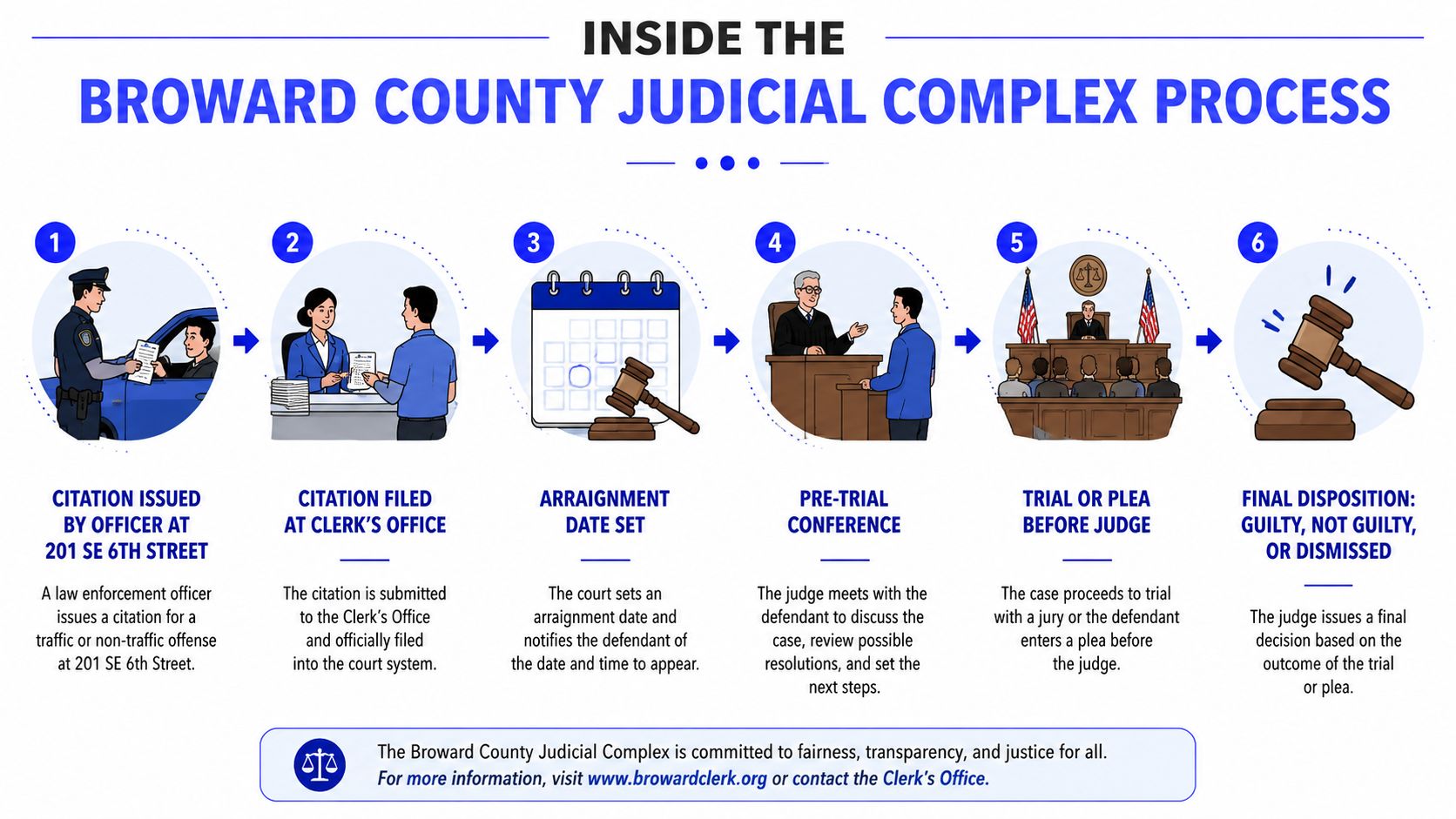
El Complejo Judicial del Condado de Broward en el 201 SE 6th Street en Fort Lauderdale no es misterioso, pero es implacable si no cumple con una fecha límite o llega sin saber lo que está pidiendo. El proceso comienza con la multa y termina con una resolución ante un juez o mediante un procedimiento autorizado de la secretaría.
Comience con el secretario
Dentro de la fecha límite impresa en su multa, generalmente debe seleccionar un camino. La oficina del secretario, incluida la ventanilla del secretario mencionada en la habitación 460, se encarga de los pagos y las elecciones de audiencia. Traiga la multa, identificación y cualquier documento que respalde su solicitud.
Un pago resuelve la multa, pero puede exponerlo a las consecuencias de una condena. Solicitar una audiencia preserva la oportunidad de impugnar el cargo. Si está considerando una declaración por escrito, confirme el procedimiento y el formulario correctos con el secretario antes de confiar en ello.
Conozca la secuencia de la audiencia
Una lectura de cargos formal es diferente de una declaración de inocencia por escrito. El proceso de declaración depende de la regla aplicable y del manejo del secretario, mientras que una lectura de cargos lo coloca ante el tribunal para abordar el cargo y la programación futura. La multa en sí controla las fechas importantes, así que lea cada línea antes de elegir.
El plazo desde la primera comparecencia hasta el juicio puede ser de 4 a 12 semanas, dependiendo del calendario y la situación del caso. Las salas de espera pueden estar llenas y se pueden llamar varios asuntos juntos. Una resolución informal puede llevar minutos, mientras que una audiencia impugnada puede consumir una mañana entera.
Si un oficial de la Oficina del Alguacil de Broward no comparece, el caso aún requiere una decisión judicial adecuada. No asuma que la multa desaparece automáticamente. El juez puede posponer el asunto, abordar las pruebas disponibles o tomar otra medida autorizada. Su abogado debe hacer la solicitud correspondiente para que conste en el expediente.
Para obtener orientación adicional sobre el proceso de Broward, revise esta guía de multas de tránsito del condado de Broward.
Pagar, escuela o luchar: cómo eligen los conductores de Broward
Después de una multa por exceso de velocidad en Broward, tiene cuatro caminos prácticos. Su historial, la velocidad alegada, la disponibilidad del tribunal y la prioridad de evitar puntos deben controlar la decisión, no la conveniencia de cerrar el expediente.
Opción | Costo estimado | Puntos en la licencia | Comparecencia ante el tribunal | Impacto en el seguro |
|---|---|---|---|---|
Pagar y declararse culpable | Multa estatutaria más costos aplicables | La condena puede sumar puntos | Por lo general, no se requiere comparecencia personal | La condena puede afectar la renovación |
Elegir escuela de mejoramiento de conducción | Costo del curso más montos aplicables | Puede evitar puntos si es elegible | La elección puede evitar la comparecencia | Puede reducir la exposición relacionada con puntos |
Declaración por escrito | Pueden aplicarse multas y costos relacionados con la presentación | Depende del resultado | El procedimiento de audiencia aún puede aplicarse | Depende de la resolución |
Contratar a un abogado de tránsito | Honorarios de abogado más montos de la corte | El abogado busca la desestimación o un resultado sin puntos | El abogado puede comparecer cuando esté autorizado | El resultado sin puntos ofrece una protección más sólida |
Pagar es rápido, pero gasta su posición
El pago es la opción administrativa más rápida, pero trata la multa como resuelta mediante la aceptación de la responsabilidad. Si proteger un historial de manejo limpio es importante, no pague simplemente porque la multa parece manejable. Una condena puede afectar su historial de licencia y la futura revisión de su seguro.
El Curso Básico de Mejoramiento del Conductor puede estar disponible según el Estatuto de Florida § 318.14(5). Confirme la elegibilidad antes de elegir la escuela porque la opción tiene límites. Las notas de práctica de Florida identifican un límite de por vida de cinco veces y una prórroga de 30 días. La escuela de conducción es una herramienta limitada, no un reinicio ilimitado.
Un abogado cambia la decisión
Una declaración por escrito puede parecer conveniente, pero muchos conductores no saben cómo identificar pruebas admisibles, mantener objeciones o impugnar el método del oficial. Un abogado puede revisar la multa y el expediente del caso, comunicarse con el fiscal o el secretario y buscar un resultado enfocado en proteger la licencia en lugar de únicamente reducir el costo inmediato.
La elección también depende de su capacidad para asistir al Complejo Judicial del Condado de Broward. Si el caso requiere una audiencia, tenga en cuenta la programación, el tiempo de espera y el riesgo de hacer una admisión sin estar preparado. El abogado puede comparecer cuando esté autorizado, pero la representación no garantiza la desestimación. Le brinda una revisión profesional del expediente y una solicitud enfocada en el resultado que justifican sus circunstancias.
Ticket Shield, PLLC utiliza un modelo dirigido por abogados en el que los clientes pueden comunicarse directamente con su abogado por teléfono o mensaje de texto. Las aplicaciones automatizadas y las fábricas de multas pueden desviar las preguntas a través de intermediarios, servicios de atención telefónica corporativos o chatbots. Pregunte quién es legalmente responsable de analizar su multa de Broward antes de elegir un servicio.
Defensas que se sostienen en los tribunales de Broward
Una defensa debe atacar las pruebas, no solo expresar desacuerdo. Los jueces de Broward escuchan negativas generales todos los días. Responden a preguntas concretas sobre cómo midió el oficial la velocidad, si el dispositivo era confiable y si la carretera estaba debidamente señalizada.
En la I-95, la US-1 o la Sawgrass Expressway, el oficial puede confiar en RADAR, LIDAR, seguimiento o método de marca visual. Cada método crea un expediente probatorio diferente. Un abogado debe identificar ese método a partir de la multa y solicitar los materiales necesarios para probarlo.
Enfóquese en debilidades mensurables
Los puntos de revisión útiles incluyen:
Método de medición: Examine la distancia de seguimiento del oficial, el tiempo, la observación visual o el funcionamiento del dispositivo.
Registros de calibración: Solicite información de calibración del velocímetro y registros de las unidades RADAR o LIDAR cuando corresponda.
Visibilidad de la señal: Verifique si la señal de límite de velocidad estaba presente, sin obstrucciones y colocada donde un conductor pudiera verla razonablemente.
Horario de la zona escolar: Determine si la restricción de la zona escolar estaba activa cuando ocurrió la presunta infracción.
Capacitación y certificación: Revise si el oficial tenía la capacitación necesaria y si la documentación del equipo está completa.
Prueba de video: Busque imágenes de la cámara del tablero, material de la cámara corporal y otras grabaciones que puedan contradecir o aclarar la multa.
Los problemas con el equipo requieren más que decir que el radar estaba equivocado. La defensa debe conectar el problema con la velocidad alegada y el testimonio del oficial. Los registros faltantes, los registros de calibración inconsistentes o las lagunas en la cadena de custodia de las pruebas pueden importar cuando se presentan correctamente. Lo mismo ocurre con una señal que estaba obstruida, dañada o que no era visible desde el acceso del conductor.
Un servicio de plantilla puede enviar una disputa genérica. Un abogado puede citar registros, interrogar al oficial y hacer una solicitud específica de desestimación o de una resolución sin puntos. Esa es la diferencia estructural descrita en esta guía de defensa de multas por exceso de velocidad de RADAR.
Una desestimación evita que la multa se convierta en una condena por infracción de tránsito. Ese es el resultado que su defensa debe buscar antes de aceptar una multa.
Conductores de otros estados y la trampa de las multas de Broward
Una placa de otro estado no lo protege de una multa en Broward. Si Florida informa una condena a través del Pacto de Licencias de Conducir, la autoridad de licencias de su estado natal puede evaluarla según sus propias reglas de registro y suspensión.
Eso crea dos problemas separados. Florida controla el caso de Broward, pero su estado natal controla las consecuencias en su licencia. Su aseguradora también puede revisar la infracción a través del historial de manejo del estado natal al momento de la renovación.
No envíe la multa por correo sin un plan
Un conductor no residente debe actuar antes de la fecha límite de la multa. Confirme la elección disponible en Broward, identifique si se requiere una comparecencia personal y determine cómo se informará la resolución. Una declaración por escrito o una solicitud de dificultad económica pueden estar disponibles en algunas circunstancias, pero deben manejarse a través del proceso correcto de la secretaría y del tribunal.
Los titulares de licencias de conducir comerciales (CDL) enfrentan una exposición adicional bajo las reglas federales de conductores comerciales. Una condena por exceso de velocidad puede afectar los privilegios de conducción comercial de manera diferente a una licencia personal ordinaria, por lo que un conductor comercial debe obtener asesoramiento antes de seleccionar una resolución.
Estado de origen | Puntos registrados | Activador de suspensión | Recargo promedio del seguro |
|---|---|---|---|
Georgia | Depende de las reglas del estado natal | Depende de las reglas del estado natal | Depende de la aseguradora y del historial |
Nueva York | Depende de las reglas del estado natal | Depende de las reglas del estado natal | Depende de la aseguradora y del historial |
Nueva Jersey | Depende de las reglas del estado natal | Depende de las reglas del estado natal | Depende de la aseguradora y del historial |
La tabla no puede predecir su resultado porque Florida informa la condena mientras que el estado natal aplica sus propias reglas. No asuma que la multa de Florida es el costo total y no asuma que una opción de escuela de tránsito de Florida controlará automáticamente el registro de su estado natal.
Un abogado de tránsito de Florida puede comparecer por usted cuando esté autorizado, evitándole un largo viaje de regreso a Broward. Antes de contratar a alguien, pregunte quién se comunicará con usted, qué resolución se solicitará y cómo abordará la firma el informe de la infracción. Esta guía para conductores con licencia de fuera del estado explica por qué las consecuencias en el estado natal merecen atención antes del pago.
Su próximo paso y cómo lograr cero puntos en su licencia
Las primeras 72 horas deben usarse para preservar las pruebas y tomar una decisión deliberada. Fotografíe la multa, la señal de límite de velocidad, las marcas de carril, las condiciones de la carretera y cualquier imagen disponible de la cámara del tablero. Escriba dónde lo detuvo el oficial, qué dijo el oficial sobre la medición y si el tráfico o la visibilidad afectaron el encuentro.
Luego confirme la fecha límite. No espere un recordatorio de la secretaría. Solicite la divulgación de información disponible de la agencia emisora, incluidas las notas del oficial, la información del dispositivo, las grabaciones y los materiales de certificación pertinentes.
Use un árbol de decisiones que priorice la licencia
Comience con el historial. Si la multa tiene un defecto técnico, un problema con las señales, una debilidad en la medición o una laguna probatoria, busque la desestimación. Si la desestimación no está disponible, evalúe si los hechos respaldan una reducción negociada a una infracción que no sea de movimiento, como equipo inadecuado, que conlleve cero puntos.
La escuela de tránsito puede tener sentido cuando es elegible y la elección produce la protección que necesita. No debe seleccionarse automáticamente. Verifique su uso anterior, confirme la fecha límite y comprenda si el resultado protegerá su historial de Florida y su posición frente al seguro.
Una declaración por escrito puede ayudar cuando viajar es imposible, pero aun así requiere una preparación cuidadosa. Si desea que un abogado se encargue de la comparecencia, contrate a un abogado de Florida que ejerza en el tribunal de tránsito de Broward y pueda explicarle exactamente qué sucederá. El objetivo es Cero Puntos, no simplemente un caso cerrado.
Ticket Shield, PLLC ofrece defensa para multas por exceso de velocidad en Broward dirigida por abogados con comunicación directa con el abogado por teléfono o mensaje de texto. La firma puede revisar la multa, explicarle la resolución disponible y buscar una solución diseñada para proteger su licencia antes de que venza el plazo.
Visite Ticket Shield, PLLC para obtener una consulta gratuita sobre su multa por exceso de velocidad en el condado de Broward. Hable directamente con un abogado sobre cómo perseguir el objetivo final, "Cero Puntos" en su licencia, antes de pagar o perder el plazo de 30 días.