Multa por obstruir el tráfico en Florida: costos y defensas
¿Multa por impedir el tráfico en Florida? Conozca el estatuto, los puntos, las defensas y cuándo contratar a un abogado. Actúe dentro de los 30 días posteriores a su citación.

An ordinary impeding traffic charge under Fla. Stat. §316.2045 is a noncriminal pedestrian-type violation under Chapter 318, while slow driving under §316.183(5) is a moving violation. Conduct that effects or attempts to effect a stop of another vehicle under the obstruction statute is a third-degree felony.
You're home with the citation on the counter, trying to figure out whether paying it will make the problem disappear. The officer's description may say only impeding traffic, and the payment amount may look manageable. Neither tells you enough.
Read the statute and subsection before you pay. That classification determines whether you're dealing with a civil payment, potential license points, or a criminal allegation that needs immediate legal attention.
Table of Contents
Impeding Traffic Charges at a Glance in Florida
Two citations can both say “impeding traffic” and carry different legal consequences. Start with the statute printed on your ticket, not the fine amount. The classification determines which options you should consider.
Florida Impeding Traffic Charges by Statute
Statute or Charge | What It Covers | Classification | Criminal Exposure |
|---|---|---|---|
Fla. Stat. §316.2045 (ordinary obstruction) | Willfully impeding, hindering or standing in a public roadway | Noncriminal pedestrian violation under Chapter 318; current text specifies nonmoving treatment | None for the ordinary offense |
Fla. Stat. §316.2045 (stop of another vehicle) | Conduct that effects or attempts to effect a stop of another vehicle | Third-degree felony | Yes, felony exposure |
Fla. Stat. §316.183(5) (slow driving) | Driving so slowly that you block normal and reasonable traffic movement | Noncriminal moving violation | None; points may apply |
The Florida obstruction statute distinguishes an ordinary noncriminal, nonmoving infraction from conduct that effects or attempts to effect a stop of another vehicle, classified as a third-degree felony. Historical pedestrian-violation language can make descriptions confusing. Match the statute and subsection on your citation to the applicable classification.
Florida's citation system also distinguishes impeding traffic from speed-based offenses. The violation code appears on the ticket, but it does not replace the statute or prove the alleged conduct. Use the Florida obstruction statute to check the law cited on your ticket.
First check: Read the statute number, subsection, violation description and court instructions together. A label alone does not explain the legal consequences.
For example, you slow on a two-lane Florida road because you are unsure where to turn. An officer stops you and writes “impeding traffic.” Check whether the cited law concerns unlawful slow driving, ordinary obstruction or conduct alleged to have stopped another vehicle. The fine amount alone cannot answer that.
Photograph both sides of the citation, then identify the statute and code before choosing whether to pay or contest it. Pay attention to the classification: paying, contesting, taking a course or seeking withheld adjudication can affect points, your record and insurance differently. Act within the 30 days after receiving the citation, and follow the court instructions printed on it.
What the State Must Prove and How to Defeat It
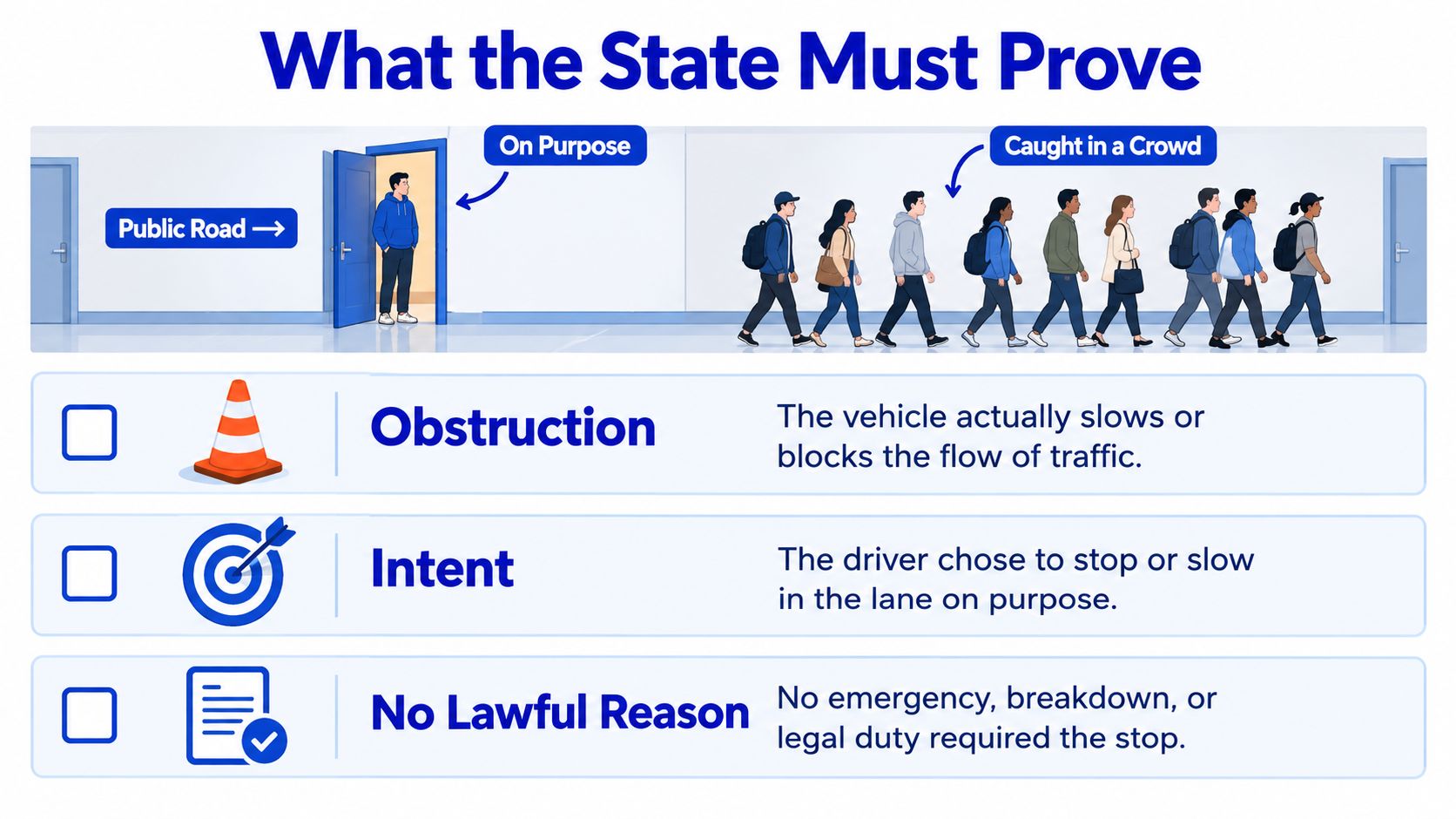
Think of a public road as a shared hallway. The obstruction law targets someone who deliberately plants themselves in the doorway, not someone who merely gets caught in a crowd.
That analogy has limits, but it exposes the central question: What did you choose to do, and what happened to traffic?
Separate Intent From Circumstance
The Florida Senate's obstruction statute requires willful obstruction of the “free, convenient, and normal use” of a public street, highway or road. Its listed conduct includes impeding, hindering, stifling, retarding or restraining traffic or passage, standing or remaining in the roadway, and endangering safe vehicle or pedestrian movement.
For an ordinary obstruction allegation, examine these components:
Willfulness: Did you act deliberately, or did a hazard, mechanical failure or surrounding traffic force your position?
Public-roadway use: Identify the precise location and how your conduct interfered with ordinary passage.
Covered conduct: Require a specific explanation of the obstruction or danger, not just a statement that your vehicle was stopped.
Choosing to stop isn't automatically proof that you unlawfully obstructed traffic. A driver can deliberately brake because continuing would cause a collision. The reason for the action matters.
The visual below organizes the factual questions, but the statute controls the legal test.
Check the Exceptions and the Correct Driving Rule
Authorized conduct can defeat an obstruction allegation. Examine police direction, traffic-control devices, legally authorized activity and permitted special events. Commercial solid-waste or recycling vehicles also have a collection exception when stopped solely for that work with amber flashing hazard lights.
Slow driving requires a different analysis. Florida's slow-driving statute, §316.183(5), establishes no fixed minimum speed for ordinary roads, prohibits blocking normal and reasonable traffic movement, and excuses reduced speed necessary for safe operation or required by law.
Driving below the speed limit isn't automatically impeding traffic. Fog, standing water, congestion, roadway design and a sudden hazard can explain a safe reduction. Being unfamiliar with an area, however, doesn't automatically justify stopping in a travel lane.
Use this factual checklist before preparing your defense:
Intent: Why did you slow or stop?
Location: Were you in a travel lane, shoulder, intersection or another position?
Duration: How long did the condition last?
Lane interference: Could other drivers pass safely?
Traffic impact: Did anyone queue, brake abruptly or face danger?
Exception: Were you following an instruction or performing authorized activity?
Match Each Defense to Proof
A defense needs evidence, not just disagreement with the officer.
Defense | Practical Test |
|---|---|
No willfulness | Circumstances forced the stop or roadway position |
No real obstruction | Traffic wasn't delayed, safe passage remained available, and no one was endangered |
An exception applied | Documents or recordings establish authorized conduct |
Mismatched citation | The charged rule doesn't match the conduct described |
Flawed stop or procedure | A specific procedural or constitutional defect supports an available legal remedy |
An empty road isn't a complete defense if your conduct endangered someone. Likewise, a procedural mistake doesn't automatically require dismissal.
Our case-review process examines procedure, the legal definition of the charged conduct and the constitutionality of the stop. That includes distinguishing racing from mere speeding when those allegations arise; for an obstruction citation, the relevant inquiry is whether the obstruction or slow-driving elements fit your conduct.
Our traffic ticket defense guide explains why that charge-specific review matters. Preserve the facts that support each defense before memories fade or recordings disappear.
Evidence That Makes or Breaks Your Case
Start preserving evidence immediately. A detailed recording can challenge a conclusory description, but it can also confirm the officer's account, so give your attorney the complete file.
Preserve time-stamped photographs and video. Keep original files showing the roadway, signs, visibility and traffic.
Save dashcam or phone footage before overwrite. Export the full sequence, including what happened before the stop.
Record lane position and room to pass. Sketch the lanes, shoulder, debris and surrounding vehicles.
Collect witness contact details. Get names and reliable contact information while people are reachable.
Document delay or queueing. Write down what you observed, separating facts from estimates.
Evidence That Proves or Breaks an Impeding Case
Evidence | What It Proves | Where to Get It | Usually Helps |
|---|---|---|---|
Time-stamped photos or video | Lane position, traffic flow and room to pass | Your phone or dashcam | Driver |
Traffic speed, volume and occupancy data | Whether traffic actually slowed or queued | Agency traffic records, requested from the agency | Either side |
Clearance time records | How long lanes were affected before reopening | Agency incident logs | Either side |
Witness contact details and statements | Whether anyone was delayed or endangered | Passengers, bystanders and other drivers | Driver |
Citation and officer narrative | Whether statute, location and duration are specific | Citation copy and officer report | Driver if details are vague or missing |
Exception documentation | Police direction, traffic-control device, permitted event or solid-waste collection | Event permits, officer notes and vehicle markings | Driver |
Roadway conditions records | Weather, construction or hazards justifying slow driving | Weather and roadwork records | Driver |
The Federal Highway Administration's traffic-operations guidance defines roadway clearance time as the interval from first recorded awareness until all lanes reopen, distinct from incident clearance time, which continues until the last responder leaves. That distinction helps prevent an extended responder presence from being mistaken for an equally long lane blockage.
Preserve Originals and Request Agency Records
Don't trim away footage that seems unimportant. Save an untouched original and a separate working copy, with the device's time settings noted.
For help understanding in-car recording equipment, Audio Jam Inc.’s vehicle security and insurance recording guide provides useful recording context. It isn't a substitute for preserving the original file.
Our Florida DOT traffic camera guide can help you identify possible roadway-camera resources. Don't assume a live camera means historical footage exists.
Request agency footage, incident logs and traffic records early. They won't arrive automatically, and a public camera may not retain the event you need.
Points, Fines and Insurance Costs You Could Face
If the statute on your citation classifies the offense as a moving violation, a conviction can add points to your record. Check that classification and your existing driving record before deciding whether to pay or contest. The fine alone does not tell you how serious the case is.
Money and License Consequences of a Conviction
Consequence | Governing Rule | What You Could Face | Notes |
|---|---|---|---|
Base civil penalty | Chapter 318 penalty schedule | Amount set by offense class | Check the statute and class on your citation |
Court costs and surcharges | Applicable clerk and court assessments | Charges added to the base fine | Confirm the county's itemized total |
License points, moving violation | Florida's license-point schedule under §322.27 | Commonly 3 points | Nonmoving pedestrian-type violations generally carry none |
Point-based license suspension | Florida's point-accumulation rule under §322.27 | Possible suspension when points reach a statutory threshold | The threshold depends on the accumulation period |
Insurance surcharge | Insurer rating after conviction | Premiums may rise for a period set by the insurer's rating rules | Treatment varies by insurer and driving record |
A moving offense's point value depends on its classification. Use your citation and driving record to assess the effect, and review what counts as a moving violation in Florida to understand the distinction.
Calculate the Cost Before Accepting It
The obstruction statute does not set one universal, all-in impeding traffic fine. Check the offense classification on your citation, then confirm the applicable penalty, assessments and court costs with the county clerk. A search result may not reflect the total you would owe.
Insurance is a separate part of the calculation. A citation with no points may still appear on a record insurers can review, and a premium change depends on the insurer's rating rules.
For a hypothetical calculation, a $40 monthly premium increase over three years equals $1,440. That is arithmetic, not a quote or prediction about your policy.
Cost check: Add the base fine, court costs and any projected premium difference. Consider license-point consequences separately.
Use your insurer's information to estimate any premium change. If your license is already suspended or close to suspension, check whether the proposed resolution addresses that status. Resolving a new citation does not automatically reinstate an existing suspension.
Typical Case Outcomes and What Each Does to Your Record
The statute and court disposition matter more than the fine alone. Paying generally means accepting guilt and the consequences tied to the charged classification. Contesting keeps open the option to seek dismissal or a reduction, but the outcome depends on the case.
Florida Resolution Routes Compared
Outcome | Points | Conviction on Record | Typical Fit |
|---|---|---|---|
Pay the citation | Points if the moving offense carries them | Yes, guilty plea | Clear violation after reviewing the charge and consequences |
Contest and win dismissal | None from the dismissed charge | No conviction | Evidence contradicts an element of the charge |
Reduced charge | Determined by the reduced classification | Yes, for the lesser offense if adjudicated guilty | The evidence supports seeking a lesser charge |
Driver improvement course | Points avoided when properly elected and completed | Adjudication withheld if approved | Eligible driver within election limits |
Nolo contendere with proof of compliance | Points avoided when qualifying requirements are satisfied | Court disposition controls | Applicable compliance proof filed with the court |
Adjudication withheld | Depends on the disposition; points may still apply without a qualifying route | No adjudication of guilt | Judge or magistrate grants withholding |
School and Withholding Aren't Automatic
The FLHSMV driving-record guide describes qualifying routes to avoid points. Under §318.14(9), effective July 1, 2024, a driver may elect traffic school no more than eight times in a lifetime and no more than once in any 12-month period. Make the election through the court in the county where the citation was issued. Commercial driver-license holders cannot use this election to avoid points.
A no-contest plea alone does not guarantee points avoidance. Before relying on a course or compliance filing, confirm that you qualify, submit the required proof, and understand the disposition the court will enter.
Adjudication withheld on a traffic ticket explains the difference between withholding an adjudication of guilt and erasing a case. Withholding is not expungement, and it does not automatically prevent points.
Read the Appearance Instructions
Check the citation for a court date, a required appearance, or instructions for a written response. File any hearing request or permitted response on time. An informal question to the clerk may not preserve your options.
Keep confirmation of each submission. Before choosing a route, identify what it means for this exact charge: the points, the record disposition, and the possible insurance effect.
Three Roadside Scenarios and How They Usually End
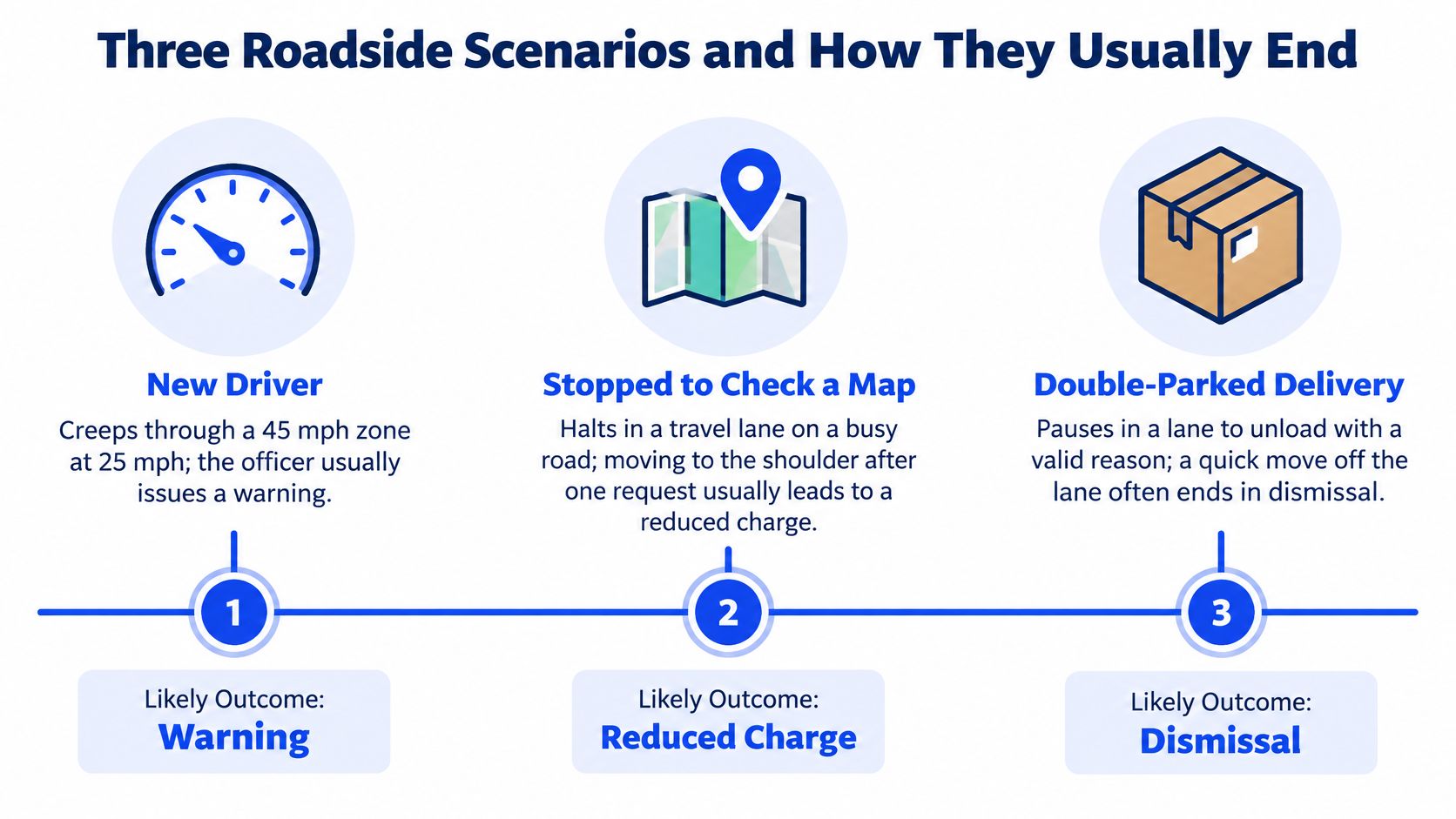
These are hypothetical situations, not promises of what a court will do. The charge, evidence and available defenses determine the appropriate path.
A New Driver Slows in Heavy Fog
Say a new driver travels at 25 mph through a posted 45 mph zone in heavy fog, with no queue behind her. She receives a slow-driving citation, but her dashcam shows severely limited visibility. Contesting with weather records and the original footage gives her a concrete safety-based argument for dismissal.
A Driver Stops for Debris
Suppose a driver stops in the left lane to avoid debris and twenty vehicles queue behind him. The officer documents the delay, so denying traffic impact won't be persuasive. Counsel should evaluate whether stopping was necessary, request traffic records and assess dismissal or reduction against the actual evidence.
A Driver Blocks Another Car During a Dispute
A driver positions a car to force another vehicle to stop during an argument. That requires immediate review for felony exposure, not routine fine-payment advice. Preserve recordings and obtain counsel before making additional statements about the confrontation.
Use the visual as an illustration of roadside situations, not as a prediction of warnings, reductions or dismissals.
Your action timeline
Day zero: Photograph the citation and calendar its instructions.
Days one through seven: Preserve evidence and make the first call to counsel.
Before day 30: Pay, make an eligible election or request a hearing through the proper process.
A criminal allegation or earlier required appearance needs immediate attention. Don't use the civil response window as permission to wait.
Confirm Your Next Step Before the 30-Day Deadline
The statute on your citation matters more than the amount due. It determines how the charge is classified and can affect points, your record, and insurance consequences. You have 30 days from your citation to act on an ordinary civil traffic ticket, so check the citation now for its classification, response options, and any court appearance or earlier instruction.
Keep the citation accessible as you decide what to do.

Which Move Fits Your Impeding Traffic Situation
Your Situation | Recommended Move | Why It Matters |
|---|---|---|
Stop-another-vehicle allegation under §316.2045 | Contact a Florida traffic lawyer immediately | Third-degree felony exposure |
Moving violation that would reach or exceed 12 points in 12 months | Evaluate contesting or negotiating before pleading | Risk of the 30-day suspension threshold |
Commercial driver-license holder | Evaluate contesting or negotiating; school election unavailable | School can't be used to avoid points |
Driver-school election already used this year or eight in a lifetime | Review eligibility and contest options with counsel | Election limits may block that route |
Nonmoving pedestrian-type violation with clear facts | Review the facts before paying | Confirm the classification and record consequences first |
A felony allegation or a moving violation that threatens your license calls for prompt legal advice. For a lower-stakes nonmoving allegation, check the classification and consequences before deciding whether to pay. Paying may close off other response options, so understand what the citation means first.
Use this guide to paying a Florida traffic ticket to consider how payment affects your decision.
Speak With the Attorney Handling Your File
Ticket Shield, PLLC provides lawyer-led traffic ticket defense, with direct attorney communication by phone or text. Its defense is designed so clients do not have to go to court. Traffic ticket defense attorneys start at $39.99.
Ask what response fits the statute on your citation and how it could affect points, your record, and your license. Confirm the fee and scope for your particular charge.
Ticket Shield offers lawyer-led review of impeding traffic citations. Visit Ticket Shield, PLLC to start your review before the 30-day deadline.