Multa por exceso de velocidad en Florida de 9 millas por encima del límite: lo que debe pagar
Una multa por exceso de velocidad en Florida a 9 millas por hora sobre el límite puede provocar multas, puntos y aumentos en el seguro. Conozca el estatuto, los costos y las opciones de defensa antes de pagar.

A Florida speeding ticket for 9 miles over falls in the 6–9 mph bracket, with a $25 base fine. Paying it generally creates a conviction and can assess 3 points against your license.
You may be sitting in your car right now with the citation on the passenger seat, trying to decide whether to pay it and move on. That reaction is understandable, but it can be expensive. The printed fine is only the starting point. The decision that matters concerns your driving record, insurance underwriting, and whether you can resolve the citation without points.
A small number on a citation can create a larger legal event. Treat it seriously before you send payment or miss the response deadline.
Table of Contents
The Citation in Your Hand Is Not the Final Bill
The officer stops you, explains the alleged speed, and hands you a uniform traffic citation. You look down and see a number that appears manageable. If the citation falls within Florida's 6–9 mph-over bracket, the listed base fine is $25 under Florida's statutory fine schedule.
That number doesn't answer the question you need to ask: What happens if I pay this citation? Florida's Department of Highway Safety and Motor Vehicles states that paying the civil penalty is treated as a conviction, and applicable points are assessed. A routine speeding conviction generally carries 3 points. Florida DHSMV's point-system guidance confirms the licensing consequence that many drivers overlook.
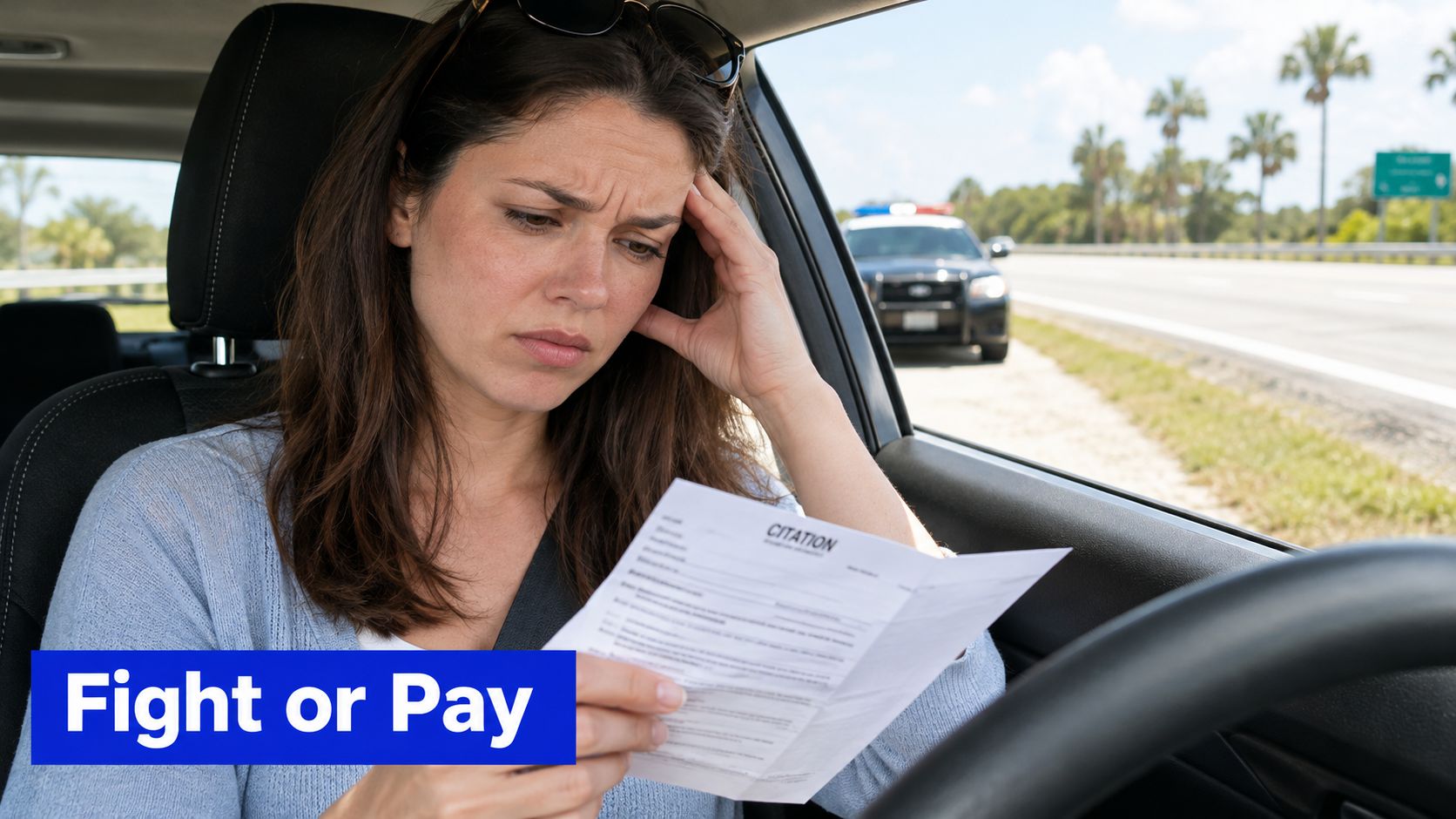
The low fine can hide the expensive choice
The final clerk balance can include court costs, county assessments, and administrative charges. A school-zone citation can receive different treatment because Florida law doubles the listed fine for speeding in a school zone or designated school crossing. The exact statute, roadway, zone designation, and disposition matter.
Practical rule: Don't decide based on the base fine alone. Decide based on the result that will appear on your record.
Your response also affects how an insurer evaluates the record. Insurance companies make their own underwriting decisions, and a moving-violation conviction can matter long after the clerk processes your payment. That's why learning how to read a Florida traffic citation should come before choosing a resolution.
The cost of doing nothing isn't limited to the dollars printed on the ticket. It can include a conviction, points, insurance consequences, and a missed opportunity to seek a no-points resolution.
How Florida Statute 316.187 Authorizes the Stop
Florida Statute 316.187 provides the legal authority for speed limits established on roads under the Florida Department of Transportation's jurisdiction. The department may set a reasonable and safe limit after an engineering and traffic investigation, and appropriate signs must give drivers notice of that limit. Section 316.187 also identifies maximum limits of 70 mph on limited-access highways, 65 mph on certain divided highways outside urban areas, and 60 mph on other roads under the department's authority.
The statute matters because a speeding citation isn't based only on an officer's personal view of what feels fast. It rests on a posted speed-control system created under Florida law. Section 316.187(3) classifies violations of those limits as moving violations punishable under Chapter 318.
The roadway determines the legal context
A state-road citation may identify Section 316.187. A municipal or county speed zone may instead involve Section 316.189, which governs municipal and county speed zones. Both provisions operate within Florida's broader statutory structure, but the citation's statute and location help define what must be reviewed.
For example, 39 mph in a 30-mph zone and 64 mph in a 55-mph zone are both 9 mph over. The raw difference is identical, but the roadway, signs, zone classification, and enforcement setting may not be. A lawyer reviews the actual location rather than treating every 9-mph citation as interchangeable.
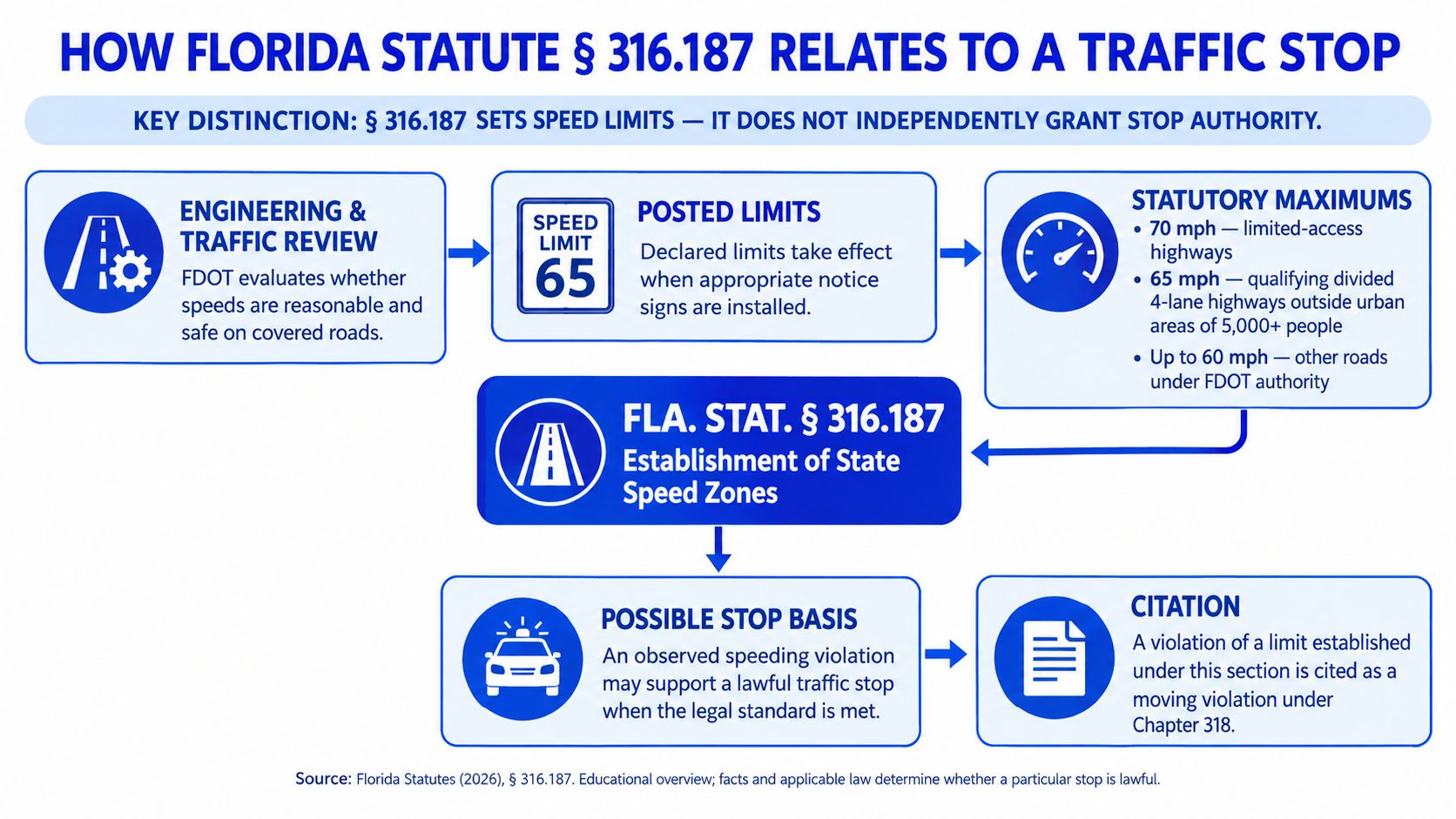
Florida's civil-penalty framework also separates ordinary speeding from extreme-speed categories. A routine 9-mph allegation is below the statutory threshold for the enhanced treatment associated with exceeding the posted limit by 30 mph or more, and it is far below the separate provision addressing speeds more than 50 mph over the limit. That distinction is important, but it doesn't erase the moving-violation issue.
The practical lesson is simple. Read the statute printed on the citation, identify whether the road is state, municipal, or county controlled, and verify that the posted limit and zone were legally established. A lawyer assessing probable cause in a Florida traffic stop will also examine the facts leading to the stop, not just the alleged speed.
How Florida Actually Charges 9 Miles Over the Limit
Florida Statute 318.18 places a citation for 9 mph over within the 6–9 mph bracket, which lists a $25 base fine. That is the statutory starting point, not necessarily the amount you'll pay to the clerk.
The citation's final balance may include court costs, county assessments, and administrative charges. The location can change the calculation. Speeding in a school zone or designated school crossing is subject to double the listed fine, so a driver should never assume that a 9-mph citation is automatically a simple $25 obligation.
Read the citation in this order
Identify the statute. Check whether the citation refers to a state-road, municipal, or county speed provision.
Confirm the zone. Determine whether the alleged speed occurred in an ordinary zone, school zone, or construction zone.
Review the total balance. The base fine doesn't necessarily include every clerk charge.
Check the response deadline. Paying late or failing to respond can create a separate compliance problem.
Compare the available resolutions. The lowest immediate payment isn't always the lowest overall cost.
A 9-mph allegation in a 30-mph zone may receive different local attention than the same difference in a 55-mph zone. That doesn't create a legal permission to exceed either limit. It means the citation's setting matters when a lawyer reviews the facts and negotiates a result.
Cost Component | Typical Range | Authority |
|---|---|---|
Base fine for 6–9 mph over | $25 | |
Court costs and county assessments | Varies by citation and county | Florida citation and clerk assessment framework |
School-zone or designated school-crossing treatment | Listed fine is doubled | |
Ordinary civil-infraction ceiling | Up to $500 | Florida Chapter 318 framework |
School-zone or construction-zone unlawful-speed ceiling | Up to $1,000 | Florida Chapter 318 framework |
The table shows why “9 miles over equals $25” is incomplete. The citation's classification and final clerk balance control the amount due, while the disposition controls whether the event becomes a conviction with points.
Points, Convictions, and What DHSMV Records
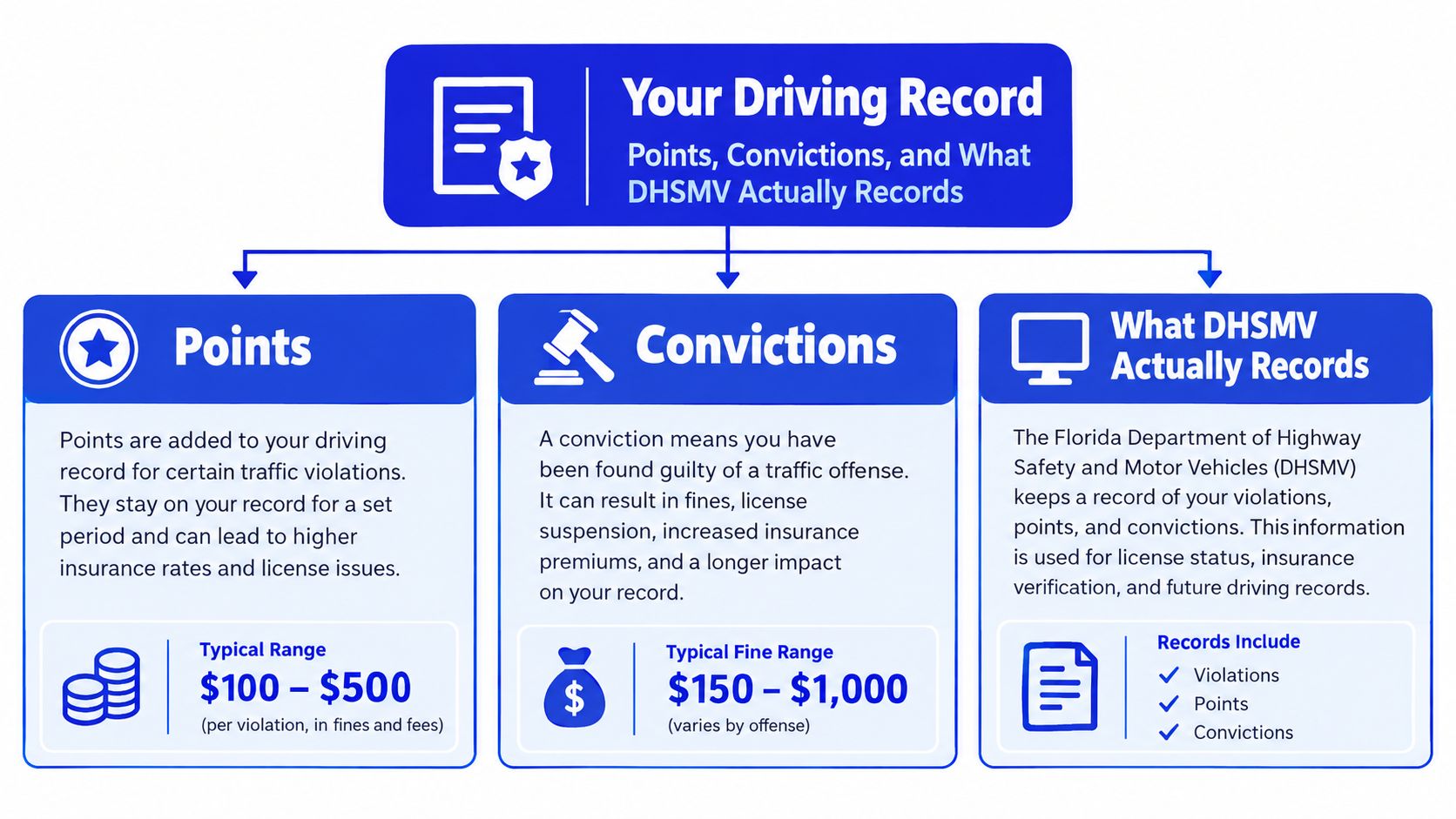
The licensing consequence begins with the conviction, not the amount printed beside the citation. Florida DHSMV treats payment of a civil penalty as a conviction, with points assessed when applicable. An ordinary speeding conviction carries 3 points. Review this Florida speeding ticket points guide before choosing payment or another resolution.
A 9-mph allegation ordinarily does not fall into the higher-speed category. DHSMV identifies violations under Sections 316.183(2), 316.187, or 316.189 at speeds exceeding 50 mph as 4-point violations. That is not the usual result for 9 mph over, but it confirms why the violation code, alleged speed, and road classification on the citation matter.
Payment creates a record event
Paying the clerk closes the immediate balance and selects a disposition that can produce a conviction. That conviction may then appear on the driving record reviewed by insurers and licensing authorities.
Your existing record changes the risk. A driver with no prior convictions faces a different practical concern from someone near a suspension threshold. Commercial drivers, out-of-state license holders, and people whose jobs depend on licensing should obtain an individualized review before selecting a resolution.
A low-dollar citation can still be a poor candidate for automatic payment when your record or insurance status matters.
Protect your record by reviewing the violation code before you pay. Confirm the alleged speed, road classification, and available disposition with the clerk or court. Ask whether a resolution that avoids points is available before payment creates a conviction. Doing nothing can leave you with fewer choices and a record event that costs more than the original fine.
The Insurance Hit That Outlives the Fine
Paying looks like the cheapest option because the base fine is small. That calculation ignores the separate decision made by your insurer. An insurance company may review a moving-violation conviction during underwriting and may treat the conviction as a reason to alter your premium or risk classification.
The insurer doesn't care that the statutory base fine was only $25. It sees the record event. The company may consider the conviction alongside your existing driving history, policy terms, and underwriting rules.
Why protecting the record matters
A surcharge or changed risk tier can continue beyond the day you pay the clerk. The financial impact may exceed the original fine, particularly when the driver renews a policy or seeks new coverage. A later moving violation can make the underwriting picture worse because insurers evaluate the record as a whole.
No lawyer can promise that a particular insurer will change its price, and Florida law doesn't set one universal insurance surcharge for every 9-mph conviction. The point is more direct: you control the legal disposition more readily before payment than after it.
Insurance reality: The fine is immediate. The record can keep influencing decisions after the payment clears.
That makes a no-points resolution the sensible objective for many drivers, even when legal representation costs more than the base fine. The right comparison isn't lawyer fee versus $25. It's the cost of representation versus the combined risk of a conviction, points, and adverse insurance treatment.
Plea Options From Pay to Contested Hearing
You have several possible ways to resolve a Florida speeding citation. The right path depends on whether you prioritize immediate simplicity, a protected record, or a factual challenge.
Paying the civil penalty
Payment is the fastest route, but it carries the clearest downside. Florida DHSMV treats payment as a conviction, and a routine speeding conviction generally brings 3 points. You also accept the final clerk balance, including applicable costs and assessments, without asking the court or prosecutor to pursue a different outcome.
This option may suit a driver who has reviewed the consequences and deliberately accepts them. It shouldn't be chosen only because the base fine appears small.
Driver improvement or negotiated disposition
An eligible driver may be able to elect a basic driver improvement course or seek a reduced or amended charge. Florida Statute 318.18 addresses election procedures and related traffic-citation treatment, but eligibility and consequences depend on the driver's history, license type, citation details, and local processing requirements.
A negotiated resolution can focus on avoiding points rather than merely reducing the dollars owed. Ask specifically what will be reported, whether adjudication is withheld or the charge is amended, and whether the outcome remains available given your prior elections.
Contested hearing
A contested hearing allows the defense to challenge the allegation and the evidence. The lawyer may examine the officer's observations, speed-measuring method, signs, roadway conditions, and required records. A hearing also carries uncertainty. The result depends on the evidence and the judge's ruling, so you should not elect it casually or miss the required deadline.
Use this framework:
Lowest immediate effort: Pay, but accept the conviction risk.
Record protection: Investigate traffic school or a negotiated no-points disposition.
Factual dispute: Consider a contested hearing after reviewing the evidence.
Commercial or out-of-state license: Obtain advice before choosing any resolution.
The response deadline is not a suggestion. Check the citation and the relevant clerk's instructions immediately. If you're unsure which option protects your license, get legal advice before making an election that may be difficult to undo.
Defense Strategies a Florida Traffic Lawyer Uses on a 9 mph Case
A 9-mph citation can affect more than the amount printed on the ticket. The defense should target the outcome that protects your record, not just the fastest way to close the file.
Start with the evidence
Begin by testing how the officer determined your speed. Depending on the facts, that review may include radar or lidar calibration and maintenance records, the officer's training documentation, and the method used to observe or pace your vehicle.
The citation also must identify the roadway, speed limit, statute, and alleged speed accurately. Missing, obscured, or nonconforming signs can support the defense because Florida's speed-limit system depends on legally established and properly posted limits.
Small inconsistencies can matter when they affect the reliability of the allegation.
Use mitigation to strengthen your case
Trial is not the only serious defense option. An attorney may present a clean driving history, relevant circumstances, supporting documents, or other mitigation while seeking an amended charge, reduced disposition, withhold of adjudication, or dismissal when the facts allow it. The goal is a lawful result that protects your license and keeps the focus on No Points.
A lawyer may communicate with the assigned state attorney, prosecutor, clerk, or court personnel as the applicable process permits. County procedures and citation types differ, so an automated response cannot address every trade-off.
Choose representation that reviews the case
An automated app can transmit a standard election or mail a not-guilty plea. Those tasks may help with paperwork. A lawyer evaluates the citation, investigates the evidence, and explains your options directly.
Defense objective: Measure success by the disposition's effect on your driving record, not only by whether the fine decreases.
Read more about fighting a Florida speeding ticket, including the difference between a paperwork response and an evidence-based defense. For a 9-mph allegation, the key question is whether counsel can pursue No Points, rather than merely sending payment on your behalf.
Protect Your Record With a Lawyer Who Answers the Phone
You don't need to panic over a 9-mph citation, but you shouldn't dismiss it. The base fine may be $25, yet payment can create a conviction and generally assess 3 points. The citation's location, statute, zone designation, and available disposition determine whether paying is sensible or shortsighted.
The decision should be based on your actual record. A driver with no prior issues may have different options from a commercial driver, an out-of-state license holder, or someone whose insurance is already difficult to maintain. A lawyer can review the citation, evaluate the evidence, and pursue dismissal, reduction, traffic-school treatment, or another no-points result when the facts and eligibility support it.
Ticket Shield, PLLC is a lawyer-led Florida traffic defense firm serving all 67 Florida counties, with 25-plus years of experience that includes former prosecutors. The firm states that clients can communicate directly with their attorney by phone or text, rather than dealing only with middlemen, corporate answering services, or automated chatbots. Its advertised pricing starts at $39.99, and it states that over 99 percent of clients never appear in court.
That direct attorney access matters when the issue is not just paying a clerk. You need someone to look at the statute, the speed measurement, the signs, the record, and the insurance consequences, then recommend a defensible path. Ticket mills and automated apps may offer convenience, but convenience is not the same as a strategy aimed at No Points.
The goal is not merely to close the ticket. The goal is to protect your license and pursue No Points.
Visit Ticket Shield, PLLC for a free consultation about your Florida speeding ticket for 9 miles over. A lawyer can review the citation, explain your resolution options, and pursue the ultimate objective, No Points on your license.