Licencia médica y DUI: Cómo los médicos de Florida pueden proteger la suya
Aprenda cómo se desarrolla un caso de licencia médica por DUI en Florida, desde las reglas de reporte hasta la disciplina de la junta, y cómo Ticket Shield protege su carrera y su expediente.

Lo acaban de detener, y ahora el problema es más grande que la parada en la carretera. Si usted tiene una licencia médica de Florida, un arresto por DUI no es solo un caso de tránsito. Puede convertirse en un caso penal, un caso de licencia de conducir y un caso de disciplina profesional al mismo tiempo.
Ese es el error que cometen los médicos. Se enfocan en la fecha de la corte e ignoran a la junta. Esperan a que el proceso penal se resuelva solo, para luego descubrir que el reloj de notificación ya comenzó a correr y que el papeleo ya importa más que la declaración que esperaban negociar.
Para los profesionales de la salud de Florida, la rapidez importa porque la conducta relacionada con el deterioro de facultades es una base recurrente para la disciplina, y la conducción bajo los efectos del alcohol sigue siendo un grave problema de seguridad pública en los Estados Unidos. En 2023, hubo 12,429 muertes de tránsito por conducción bajo los efectos del alcohol, lo que representó el 30% de todas las muertes de tránsito de vehículos motorizados en los EE. UU., con un promedio de una muerte cada 42 minutos (Datos del CDC sobre la conducción bajo los efectos del alcohol). Ese es el trasfondo que ven las juntas cuando revisan su expediente.
Si es médico, enfermero u otro clínico con licencia, la decisión correcta no es esperar a que el arresto desaparezca. Es proteger el expediente de su licencia antes de que la junta vea una historia incompleta. Por eso, una defensa dirigida por un abogado es importante ahora mismo, no después de que llegue la notificación.
Índice de Contenidos
El momento en que un DUI en Florida se convierte en un problema profesional
La regla de notificación de 30 días que la mayoría de los titulares de licencias pasan por alto
Suspensión de la licencia de conducir frente al riesgo de la licencia médica
Por qué una defensa dirigida por un abogado supera a una aplicación en este momento
El momento en que un DUI en Florida se convierte en un problema profesional
Un médico de Florida es detenido después de la cena, entrega su licencia y escucha las palabras que nadie quiere escuchar. El informe de arresto dice DUI, y el oficial comienza a hacer preguntas que suenan de rutina en el momento, pero que se leen de manera muy diferente después. En papel, es una noche. En realidad, es el comienzo de tres batallas distintas.
Tres vías se mueven a la vez
El caso penal es solo una vía. El caso de la licencia de conducir es otra. El problema de la licencia médica es el tercero, y a menudo se mueve en un cronograma diferente, con estándares diferentes y papeleo diferente. Un médico puede ganar el caso penal y, aun así, perder tiempo, credibilidad y reputación profesional si el informe, la declaración o el expediente de mitigación se manejan de manera incorrecta.
Regla práctica: trate el arresto como una emergencia de documentación, no solo como un problema de la corte.
La gente sale perjudicada. Piensan que la junta esperará hasta que la corte termine. Por lo general, no funciona así. El lado de las licencias se preocupa por lo que el arresto sugiere sobre la aptitud, la honestidad y el posible deterioro de facultades, no solo por si el caso penal sigue pendiente. Por eso, los primeros 30 días importan más que las siguientes 30 fechas en la corte.
Cuando un profesional médico de Florida se demora, el daño suele comenzar con declaraciones inconsistentes. Luego viene el documento judicial faltante, la postura de declaración confusa o el autoinforme tardío. Para cuando alguien intenta "arreglarlo", la junta ya tiene una razón para cuestionar su juicio.
Para obtener una explicación directa de por qué el DUI y el riesgo laboral chocan tan rápido, consulte la guía de Ticket Shield sobre DUI y trabajo. El punto es simple. Necesita una estrategia coordinada que proteja el caso penal, el registro de conducción y la licencia médica al mismo tiempo.
Lo que la ley de Florida define como un DUI
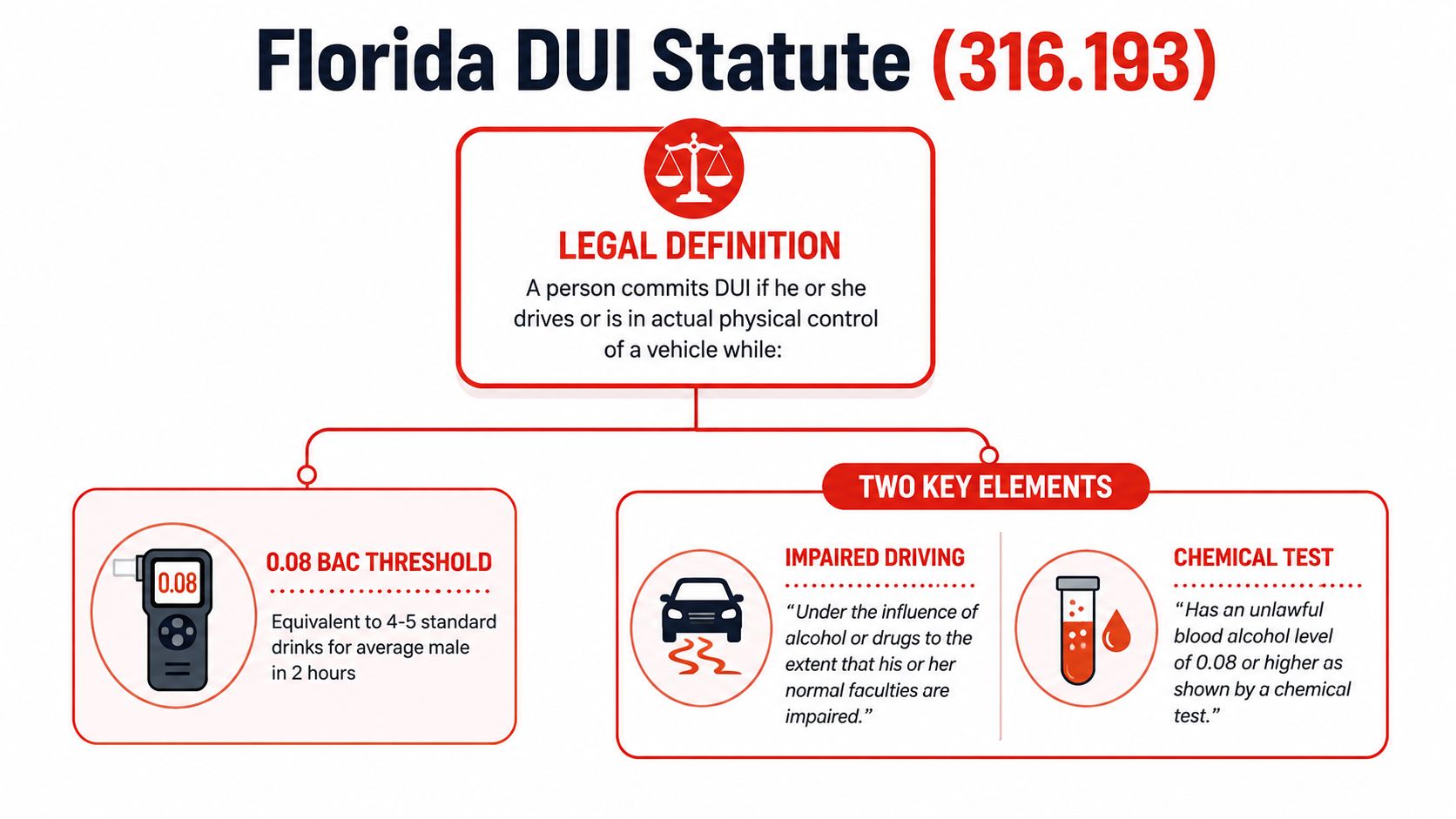
Florida no trata el DUI como una acusación imprecisa. La Sección 316.193 establece que es un delito conducir o tener el control físico real de un vehículo mientras se está afectado al extremo de que sus facultades normales estén deterioradas, o mientras se tenga un nivel de alcohol en sangre prohibido. El estado utiliza dos vías distintas para llegar al mismo resultado. Una vía es el deterioro de facultades, que puede derivar de las observaciones del oficial sobre la conducción, el habla, el equilibrio o el rendimiento. La otra vía es el resultado de una prueba química que alcanza el umbral legal.
El umbral legal que las juntas notarán
El estatuto de DUI de Florida define el límite de nivel de alcohol en sangre (BAC) como 0.08 gramos o más de alcohol por 100 mililitros de sangre, 0.08 gramos o más de alcohol por 210 litros de aliento, o 0.08 gramos o más de alcohol por 67 liters de orina (explicación del estatuto de DUI de Florida). Los revisores de licencias interpretan ese umbral como un marcador objetivo, incluso cuando el caso penal luego dependa de cuestiones de supresión de pruebas, problemas con las pruebas o negociaciones de declaración.
La lección práctica es contundente. Lea su informe de arresto para conocer la teoría del oficial. Si el informe enfatiza el desempeño en el campo y el comportamiento de conducción, el caso se basa en el deterioro de facultades. Si enfatiza el resultado del alcoholímetro, el estado se está apoyando en la prueba química. A veces utiliza ambos. Para ver un desglose en lenguaje sencillo de cómo Florida trata esas vías, revise la guía del estatuto de DUI de Florida de Ticket Shield.
Que no haya accidente no significa que no haya caso
Un primer DUI en Florida sigue siendo un delito penal. No es una multa civil, y no se vuelve insignificante porque nadie haya resultado herido. La junta no necesita un choque para ver un problema de aptitud profesional.
La junta lee el arresto a través de una perspectiva profesional, no de una perspectiva de multa de tránsito.
Un médico que es arrestado debe asumir que el informe se leerá para algo más que la culpabilidad o la inocencia. Los revisores de licencias observan la conducta, el rastro de papel y si el registro apunta a un deterioro de facultades. Por eso, el informe de arresto importa tanto en un caso de licencia médica.
La regla de notificación de 30 días que la mayoría de los titulares de licencias pasan por alto
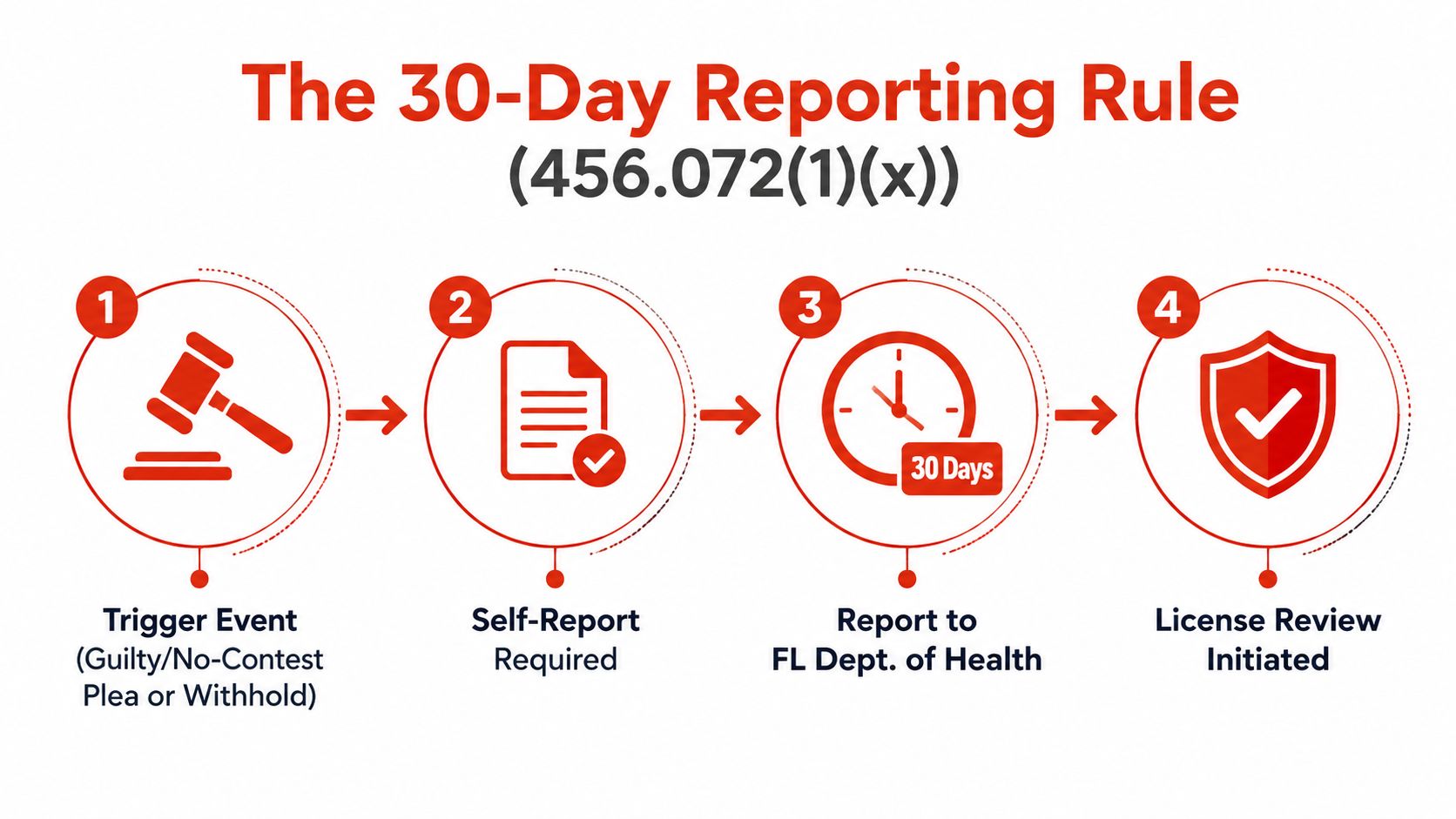
La regla de notificación de Florida es donde muchos profesionales con licencia quedan atrapados. La Sección 456.072(1)(x) exige que un profesional de la salud con licencia informe sobre una declaración de culpabilidad o de no disputa, incluso cuando se suspenda la adjudicación, a la junta de licencias o al Departamento de Salud de Florida dentro de los 30 días (resumen de la regla de notificación de Florida). Eso significa que la etiqueta penal no lo es todo. La declaración en sí misma puede activar la obligación de informar.
Por qué una suspensión de la adjudicación no es un pase libre
Una suspensión de la adjudicación puede ayudar en la corte penal, pero la junta de licencias aún puede tratar la declaración como un evento notificable. Ese desajuste es la razón por la que los médicos se ven sorprendidos. Piensan que "sin condena" equivale a "sin notificación". No es así. El área administrativa a menudo se preocupa por la conducta, no solo por la etiqueta penal final.
El error más grave es el silencio. No autoinformar puede convertirse en un detonante de disciplina independiente, y eso suele ser peor que el DUI en sí porque plantea un problema de honestidad aparte. A las juntas les importa la veracidad. Si piensan que intentó ocultar el caso, el arresto subyacente deja de ser el único problema.
Qué hacer antes de que expiren los 30 días
Necesita tener el papeleo listo, no improvisado.
Disposición judicial certificada: Obtenga el registro oficial, no un rumor o una captura de pantalla.
Documentación del arresto: Conserve la citación, el informe de arresto y cualquier documento de prueba de aliento o de rechazo.
Registros de finalización: Guarde todos los documentos de evaluación, monitoreo, tratamiento o clases.
Consistencia en la declaración: Asegúrese de que su versión en la corte, en la licencia y en las credenciales coincidan.
Regla práctica: nunca envíe un informe a ciegas. Preséntelo con los documentos exactos que la junta probablemente solicitará más adelante.
Es por eso que la decisión de informar debe ser coordinada por un abogado, no arrojada en un formulario en línea ni manejada por un empleado de recepción. La guía de Florida también advierte que debe consultar con un abogado de licencias de salud antes de informar un cargo o condena por conducir ebrio (guía de DUI para licencias de salud). Si necesita un análisis más profundo del proceso de audiencia que puede seguir a un informe, revise la guía de audiencia de suspensión administrativa de Ticket Shield.
Cómo decide la junta de Florida lo que sucede con usted
Una vez que la junta ve el arresto, no está juzgando de nuevo su DUI. Está decidiendo si la conducta afecta a su aptitud para ejercer, su juicio y el riesgo que puede representar para los pacientes o el público. Esa es una pregunta diferente, y le da a la junta margen para actuar de maneras en que la corte penal nunca lo hará.
Los resultados probables son más amplios de lo que la mayoría de los médicos esperan
Una junta puede responder con una carta de preocupación, período de prueba con monitoreo, una evaluación de consumo de sustancias, pruebas aleatorias de detección de alcohol o drogas, suspensión o medidas de emergencia. Los casos más graves se mueven rápido. Si la junta considera que se necesita protección inmediata, puede intervenir antes de que el proceso parezca haber terminado.
Esto no es teoría. Un estudio revisado por pares sobre 5,032 medidas disciplinarias de licencias médicas de 2004 a 2020 encontró que 3,841 acciones, o el 76.3%, estaban relacionadas con el consumo de sustancias, y esas acciones disminuyeron de 5.6 a 1.6 por cada 10,000 médicos durante el período del estudio (estudio sobre disciplina médica revisado por pares). El mismo estudio encontró que los casos de consumo de sustancias tenían más probabilidades de implicar sanciones indefinidas que los casos de deterioro físico, 69.2% frente a 58.1%, y más probabilidades de activar una medida de emergencia, 12.0% frente a 8.0%.
La junta lee buscando rehabilitación y honestidad
Por eso, la revisión de la junta suele plantearse como una investigación sobre la solvencia moral y la aptitud para ejercer. Observa si usted fue honesto, si se tomó el asunto en serio y si hay una rehabilitación documentada. Una declaración de DUI no termina automáticamente una carrera médica, pero una respuesta descuidada puede convertir un problema manejable en uno disciplinario.
Si necesita un recurso sobre las expectativas de tratamiento que a menudo coinciden con las preocupaciones de la junta, lea Tru Dallas Detox sobre el tratamiento ordenado por el tribunal. Las juntas recompensan la documentación, la estructura y la consistencia.
Para obtener un desglose más detallado de cómo la junta evalúa los asuntos relacionados con sustancias, revise la guía de evaluación de abuso de sustancias de Ticket Shield. El caso penal rara vez es la última palabra. La interpretación que la junta haga de él, por lo general, sí lo es.
Suspensión de la licencia de conducir frente al riesgo de la licencia médica
Los médicos a menudo confunden las dos vías. Eso es un error. El caso de la licencia de conducir de Florida y el de la licencia médica de Florida coinciden, pero no son el mismo procedimiento ni se resuelven de la misma manera.
Dos sistemas diferentes, dos estándares diferentes
El privilegio de conducir en Florida se rige por el Capítulo 316. La licencia profesional se rige a través del Capítulo 456 y el Departamento de Salud. Una vía puede mejorar mientras la otra empeora. Puede ganar una audiencia por dificultades económicas y aun así enfrentar disciplina de la junta. Puede resolver favorablemente el asunto de la junta y seguir lidiando con una suspensión de la licencia de conducir.
Asunto | Licencia de conducir de Florida | Licencia médica de Florida |
|---|---|---|
Vía legal | Revisión del privilegio de conducir bajo el Capítulo 316 | Revisión de disciplina profesional bajo el Capítulo 456 |
Detonante | Arresto por DUI, rechazo o medida relacionada con el BAC | Notificación obligatoria, investigación de la junta, preocupaciones de aptitud |
Enfoque principal | Conducción segura, suspensión, restitución | Honestidad, rehabilitación, seguridad pública |
Posible respuesta | Suspensión, problemas de dificultades, monitoreo vinculado al privilegio de conducir | Carta de preocupación, período de prueba, evaluación, suspensión, medida de emergencia |
La perspectiva de la aptitud funcional es similar
El informe de Prácticas de Revisión Médica de la NHTSA señala que los conductores con convulsiones o trastornos de pérdida de conocimiento deben estar libres de episodios durante seis meses, la visión debe ser de al menos 20/60 en un ojo, y el campo de visión horizontal binocular debe alcanzar al menos 35 grados tanto a la izquierda como a la derecha de la fijación. También señala que la incapacidad para distinguir los colores rojo, verde y ámbar puede hacer que la obtención de la licencia sea imposible en algunas jurisdicciones (Prácticas de revisión médica de la NHTSA).
Eso importa porque el lente de la aptitud médica es funcional, no abstracto. Los reguladores buscan estabilidad a lo largo del tiempo, hallazgos objetivos y la aprobación de especialistas. La misma mentalidad aparece cuando una junta evalúa un caso relacionado con DUI. Quieren saber si el problema fue aislado, si se está tratando y si el riesgo de recurrencia parece bajo.
En resumen: la batalla por la licencia de conducir y la de la licencia médica necesitan estrategias separadas, pero un solo abogado debería coordinar ambas.
Para los médicos de Florida, una defensa por DUI no puede construirse únicamente en torno al tribunal penal. Debe tener en cuenta a la junta, el historial de manejo y el momento exacto de cada declaración.
Mitigación que las juntas recompensan
A las juntas no les importan los discursos. Les importan las pruebas. El expediente de mitigación más sólido se construye antes de que la junta lo solicite, porque eso demuestra que usted se tomó el asunto en serio antes de que nadie lo obligara.
Comience con pruebas, no con promesas
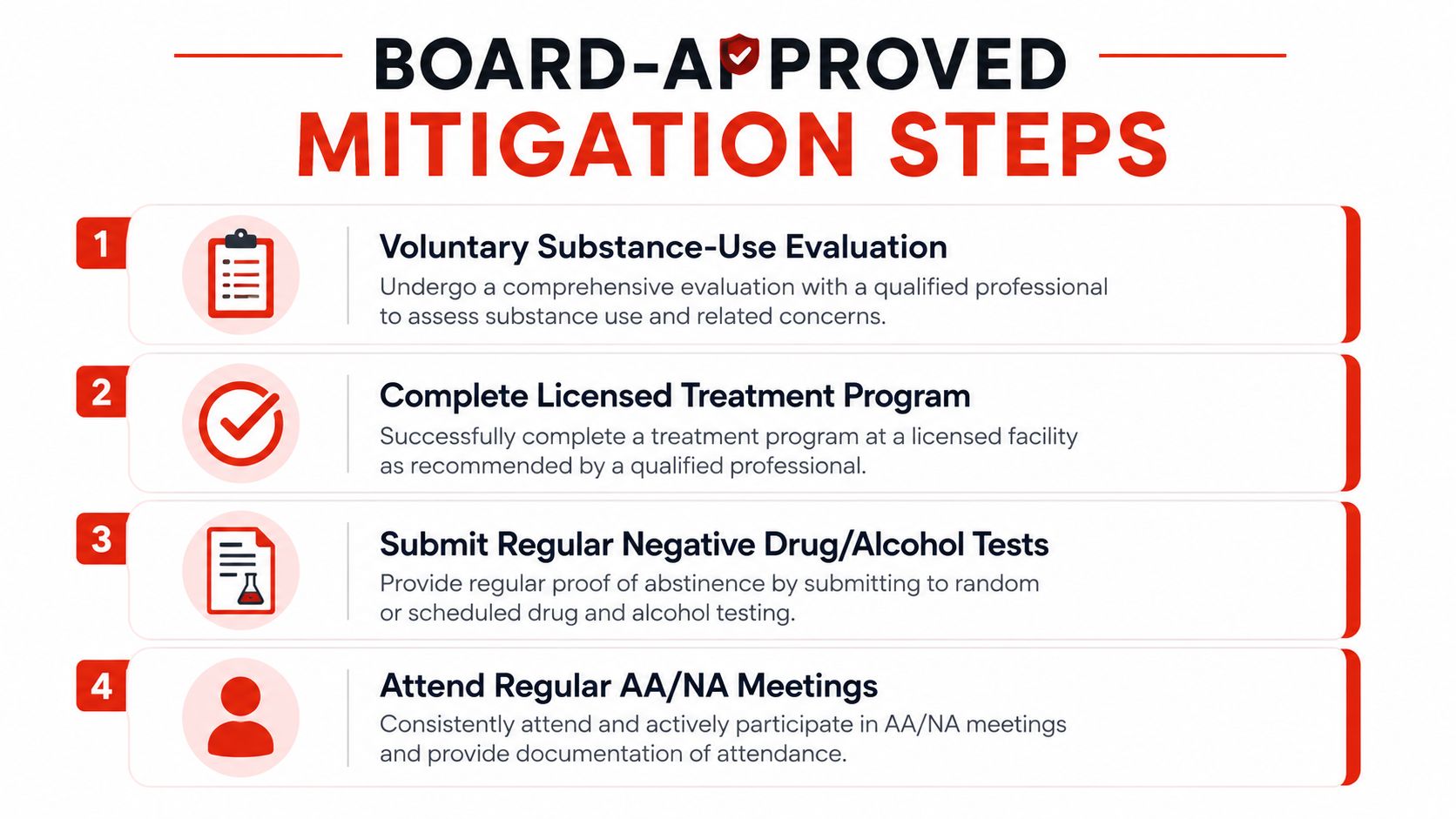
La mitigación más útil suele incluir una evaluación voluntaria de consumo de sustancias, la finalización de un programa de tratamiento con licencia si se recomienda, pruebas aleatorias negativas, registros de reuniones y cartas del empleador o de acreditación que hablen de su desempeño y confiabilidad. Las disposiciones judiciales certificadas también importan, porque la junta quiere registros oficiales, no un resumen de su memoria.
Una declaración con suspensión de la adjudicación no borra el problema de la notificación, y la desviación previa al juicio tampoco resuelve automáticamente la cuestión de la licencia. Todavía tiene que revelar lo que exige el estatuto y documentar lo que hizo después. La junta busca un patrón de responsabilidad, no solo una etiqueta judicial favorable.
Construya el expediente antes de que la junta lo solicite
Evaluación primero: Obtenga una evaluación calificada de consumo de sustancias desde el principio.
Evidencia de tratamiento: Conserve los registros de inscripción, asistencia y finalización.
Historial de pruebas: Guarde cada prueba negativa con fechas y resultados.
Cartas de apoyo: Reúna declaraciones de supervisores o colegas que puedan dar fe de su práctica profesional.
Papeleo oficial: Conserve las disposiciones certificadas y cualquier término de período de prueba o monitoreo.
La junta confía más en la documentación que en las explicaciones.
Para obtener una lista de verificación práctica enfocada en la junta, revise el recurso de Ticket Shield sobre la evaluación de abuso de sustancias en Florida. Si está tratando de entender cómo encajan los documentos de rehabilitación en una historia de cumplimiento más amplia, el punto es simple. El archivo debe verse organizado, consistente y honesto desde el primer día. Para un análisis más amplio de por qué la ayuda legal directa importa en esta etapa, consulte por qué un abogado local supera a una aplicación con un guion.
Por qué una defensa dirigida por un abogado supera a una aplicación en este momento
Un médico de Florida no necesita una aplicación, un chatbot o un centro de llamadas que lea un guion. Necesita a alguien que pueda coordinar la respuesta al arresto, la estrategia de la corte, la declaración ante la licencia y la narrativa de la junta en una sola voz. Si esas piezas entran en conflicto, hará que el caso sea más difícil de lo que ya es.
Lo que cambia el acceso directo a un abogado
Ticket Shield, PLLC es una firma de defensa de tránsito de Florida dirigida por abogados, y los clientes hablan directamente con su abogado por teléfono o mensaje de texto. Eso importa cuando el reloj está corriendo. No necesita un intermediario que le diga que alguien "revisará el mensaje". Necesita respuestas rápidas y las necesita del abogado que maneja la defensa.
La firma presta servicios en los 67 condados de Florida, incluidos Miami-Dade, Broward, Palm Beach, Hillsborough, Orange y Duval, y su trabajo de defensa contra DUI está estructurado para proteger el historial de manejo y limitar las consecuencias a largo plazo. Para los médicos, eso significa que un equipo se enfoca en el riesgo ante la junta mientras las otras partes del caso avanzan en las vías penal y de la licencia de conducir. Si desea una explicación más amplia de por qué la ayuda legal directa supera a la automatización, revise el artículo de Ticket Shield sobre cómo elegir a un abogado local en lugar de aplicaciones.
El consejo es simple
No permita que un sistema de admisión automatizado decida cómo se estructura su DUI. No permita que un servicio de atención corporativo hable por usted en un asunto de licencia médica. No presente una declaración apresurada antes de que su estrategia de defensa esté alineada.
Ticket Shield, PLLC ofrece una estructura de defensa rentable y orientada al valor desde $39.99, y ese precio solo importa si la representación es oportuna. En un caso de licencia médica por DUI, la capacidad de respuesta lo es todo. La junta, la corte y el proceso de la licencia de conducir necesitan una historia coherente, y esa historia debe provenir de un abogado que conozca Florida.
Visite TicketShield.com para una consulta gratuita y obtenga una defensa de DUI dirigida por un abogado, enfocada en proteger su historial, su licencia y su objetivo de Sin Puntos.
Ticket Shield, PLLC maneja defensas por DUI en Florida, problemas de licencia de conducir y las consecuencias de licencias que pueden seguir a un arresto por DUI. Si necesita ayuda directa ahora mismo, Ticket Shield, PLLC le ofrece contacto con un abogado por teléfono o mensaje de texto y una estrategia diseñada para proteger su historial profesional.