
Evite puntos: Escuela de Tránsito para Infracción de Luz Roja 2026
¿Recibiste una multa por pasarte un semáforo en rojo en Florida? Descubre si la escuela de tráfico para infracciones de semáforo en rojo es tu mejor opción. Nuestra guía de 2026 cubre elegibilidad, plazos y cómo mantener

You got the red light ticket, and now the clock is running. Don't treat it like a routine nuisance, because in Florida a moving violation can affect your record, your insurance, and your ability to keep driving without headaches later. If the citation came from an officer, or if you're staring at a camera notice and wondering whether to pay it, elect school, or fight it, you need to make the right move before the deadline closes the door.
Under Chapter 316, Florida treats traffic control violations seriously. Florida Statute § 316.192 on careless driving and § 316.027 on leaving the scene of a crash with death or injury sit inside the state's traffic code, and that matters because not every citation is just a fine on a piece of paper. The court process is mechanical, but your consequences are personal. Read how a red light ticket can affect your Florida record, then act fast.

Table of Contents
That Red Light Ticket A Critical Decision You Must Make
A red light ticket is not the moment to freeze and hope it disappears. Florida uses traffic school as a limited option, but it is not automatic, and it is not forgiveness. The state's safety response exists because red-light running is a real danger, with the Insurance Institute for Highway Safety reporting 1,149 deaths in 2022 in crashes involving red-light running, and earlier reporting cited about 260,000 red-light-related crashes per year and more than 700 crashes per day nationwide. Those figures are why traffic enforcement is taken seriously.
If you decide to pay without thinking, you may be choosing convenience over protection. If you elect traffic school, you may protect your record from points, but you still have to do everything correctly and on time. That's the trap most drivers miss. They think the court process is simple because it looks simple on paper.
Florida's traffic-school authority is rooted in Chapter 316, and that legal foundation is not decoration. It tells you the state considers traffic violations part of a broader public-safety system, not just an annoying bill. The smart move is to treat the citation like a deadline-driven legal problem, because that's what it is.
Practical rule: Do not assume the ticket is harmless just because you have a school option. The wrong response can cost you time, money, and points.
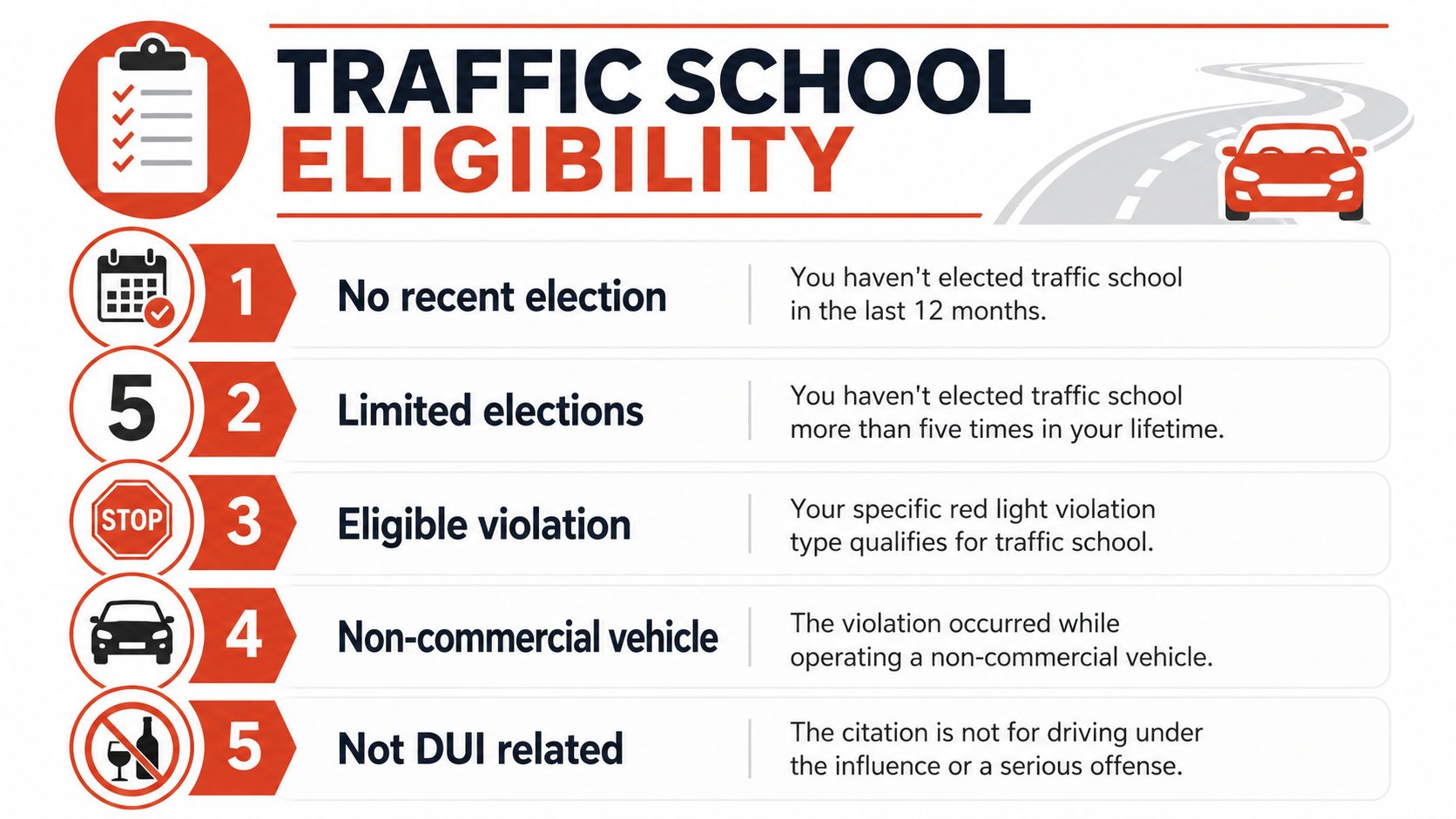
Checking Your Eligibility for Traffic School
Eligibility is the first gate, and it's the one drivers blow through carelessly. Florida traffic school is not for everyone, and if you guess wrong, you waste money and may still end up with points. The court process is unforgiving because it expects you to know whether your citation qualifies before you elect anything.
The court will look for hard disqualifiers
You generally need a valid Florida license, the violation must be eligible, and the offense must be a moving violation that fits the school rules. Courts also require that you haven't used traffic school too recently, and many drivers forget that timing matters just as much as the ticket itself. Florida traffic-school eligibility is time-limited, with the school option generally allowed once every 12 months, and in many court processes the election must be made within 30 days of the citation date. That timing rule is strict.
If you have a CDL issue, an alcohol or drug-related offense, or another disqualifier, traffic school may not protect you the way you want. The key mistake is assuming that every moving violation gets the same treatment. It doesn't. The court clerk doesn't care that you were busy, confused, or waiting for advice.
A missed deadline is usually worse than a bad plan, because a bad plan can sometimes be corrected. A missed deadline usually can't.
Treat the clerk's deadline like a hard stop
You need to handle the election with the Clerk of Court in the county where you got the ticket. That means you don't get to improvise, ignore the notice, or wait until the last minute because you're still deciding what feels easiest. If the court's instructions require an online portal action or mailed notice, do it exactly as directed and keep proof.
The practical issue is simple. Eligibility is not just about whether you can take a class, it's about whether you can still make the election in time to preserve the benefit. If you're unsure, don't guess. Get the ticket reviewed before you make a move.
The Process for Requesting and Completing Traffic School
Once you're eligible, the process still isn't casual. You don't just sign up for a class and call it done. You have to tell the Clerk of Court you're electing school, pay what the court requires, complete the approved course, and file proof by the deadline.
Step one is election, not enrollment
The election comes first. Florida courts require you to notify the clerk, then pay the full bail plus the non-refundable administrative fee and any other required court charges. Only after that do you move to the course itself. If you skip the filing step or use the wrong provider, the whole exercise can fail.
The state-approved course for a qualifying moving violation is typically a 4-hour Basic Driver Improvement course. It exists to refresh defensive-driving skills, traffic-law knowledge, and hazard awareness. That's the structure Florida uses. If you pick an unapproved class, you're gambling with your license for no reason.
Step two is proof, and proof is where drivers slip
The completion certificate has to reach the clerk by the assigned deadline. If it doesn't, the court treats that as a failure to comply. That can mean you lose the money you paid, the points get added, and your driving privilege can be put at risk.
Deadlines matter more than motivation. A driver who finishes late can still lose the benefit entirely.
That's why people who try to do this alone often create their own mess. They register too late, take the wrong course, or assume the certificate will “show up” without checking. It won't fix itself.
If you want a cleaner, attorney-guided process for handling the paperwork and the court side, Ticket Shield's traffic violator school guidance is the kind of resource that helps you avoid avoidable mistakes. The point is not to do more paperwork. The point is to keep the ticket from turning into points.
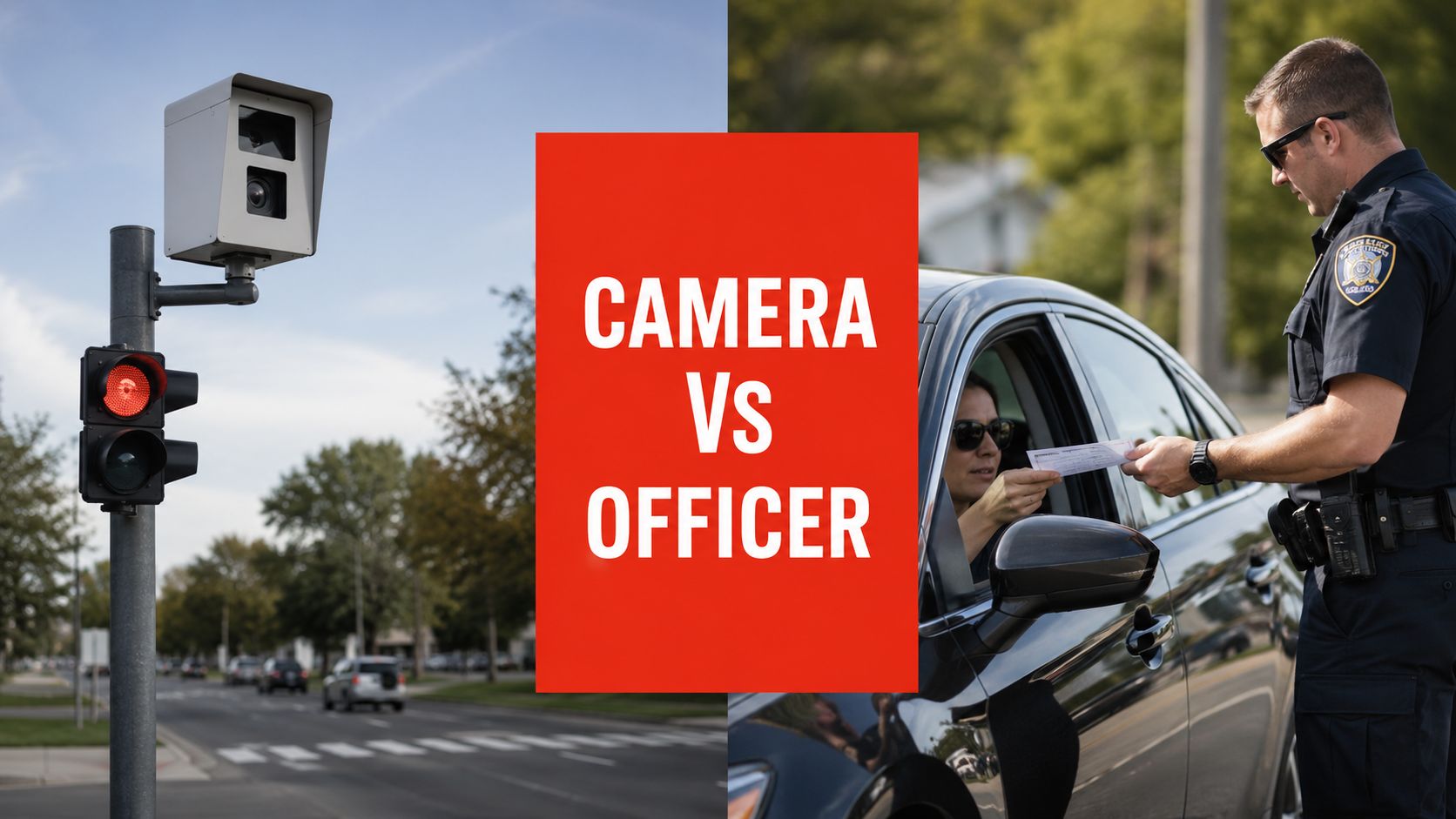
Red Light Camera Tickets vs Officer-Issued Citations
Do not treat a camera ticket the same way you treat an officer-issued stop. They're not the same problem, and they don't deserve the same strategy. A camera citation can be a procedural fight, while an officer-issued citation usually pushes you toward the traffic-school or defense decision tree much faster.
Camera enforcement can be a safety tool and a legal trap
Red-light cameras are used because they measurably change crash patterns. A peer-reviewed review found they were associated with a 20% decrease in total injury crashes, a 24% decrease in right-angle crashes, and a 29% decrease in right-angle injury crashes. That review explains why cities use them despite the legal complexity.
But from a driver's perspective, a camera ticket raises different questions. Who was driving, what does the image show, and did the setup meet the legal requirements? Those are evidence questions, not classroom questions. That's why traffic school is not always the smartest first move for a camera case.
Officer-issued citations demand faster decision-making
When an officer hands you the citation, the state's process is more direct. You need to decide whether school is available, whether it's worth using one of your limited elections, and whether the facts give you a defense that could do better than point avoidance. If you just pay it, you may be giving up an advantage you didn't know you had.
For a Florida red-light camera matter, this Florida-specific guide on camera tickets is worth checking before you make a choice. The wrong move here is treating every ticket like a school-only case. Sometimes the better answer is to challenge the citation itself.
Traffic School vs Hiring an Attorney Which Path Is Better
Traffic school is a fallback. It is not a victory. It can prevent points on an eligible minor moving violation, but Florida traffic school does not remove the violation from the record, which is why it's more accurate to call it a No Points result rather than a clean slate. That distinction matters.
Factor | Electing Traffic School Yourself | Hiring Ticket Shield |
|---|---|---|
Main goal | Avoid points if eligible | Pursue dismissal or the strongest available defense |
Court burden | You handle the clerk, class, and deadlines | The firm handles the process for you |
Communication | Court notices, portals, and forms | You speak directly to your attorney by phone or text |
Outcome | No Points if everything is done right | Strategic defense focused on the best possible resolution |
Risk | Miss a deadline and you lose the benefit | Less room for procedural mistakes |
The difference is control. If you do it yourself, you own every step and every deadline. If you hire a lawyer-led firm, the process is managed by someone who knows how the citation, the clerk, and the court work. Ticket Shield's traffic ticket lawyer guidance fits that model because it focuses on legal defense, not just paperwork.
Use the right tool for the right case
Traffic school makes sense when the case is eligible and the goal is to protect against points. It makes less sense when the facts may support dismissal or when the citation could affect your job, your driving record, or your future options. That's especially true if you drive for work, because the actual cost of a ticket isn't always the fine.
If you need a licensed Florida attorney to handle the citation directly, Ticket Shield, PLLC is a lawyer-led option where you can speak with your attorney by phone or text instead of getting shuffled through a call center. That kind of direct contact matters when the deadline is real and the margin for error is small.
The Ultimate Goal No Points on Your License
The goal isn't to sit through a class just to feel productive. The goal is to protect your license. Traffic school can do that in the narrow cases where you qualify, but it still leaves the violation on your record, and that's why you should treat it as a defensive tool, not a full solution.
If you want to understand how points affect the longer picture, start with the larger record issue and then work backward to the citation itself. This guide on removing points from a driving record is a useful companion if you're already thinking beyond the immediate ticket. And if you're also managing auto costs, resources like how to reduce California auto insurance costs show how seriously drivers have to think about insurance pressure after violations, even if your own case is in Florida.
The strategic move is simple. Fight the citation hard at the start, use traffic school only when it is appropriate, and don't waste one of your limited elections unless it serves your long-term record. If the case can be dismissed, that beats point avoidance every time.
Protect your license and your future. Visit TicketShield.com now for a free, no-obligation consultation and let our experienced attorneys fight for No Points on your license.
A CTA for Ticket Shield, PLLC.
