¿Es el registro vencido una infracción de tránsito en Florida?
Conductores de Florida: ¿es el registro vencido una infracción de tránsito? Comprenda la ley bajo la § 320.07, cómo funcionan los puntos y las multas, y qué debe hacer después de recibir una multa.

For a Florida registration expired six months or less, § 320.07 classifies the offense as a nonmoving infraction. Once the registration has been expired for more than six months, the consequences can escalate, especially for a second or subsequent offense.
You may be reading this after seeing flashing lights in your mirror, handing over your license, and hearing the officer say your tag is expired. You might already have renewed online, or you might have assumed the renewal date was later because Florida ties many individual registration cycles to the vehicle owner's birth month.
The important question isn't just “Is expired registration a moving violation?” In Florida, you need to identify how long the registration was expired, whether this is a first offense, what statute appears on the citation, and whether a separate problem affects the vehicle or your driving privileges.
Table of Contents
The Real Risk Behind an Expired Tag in Florida
You're driving to work when the patrol car pulls behind you. The officer checks the plate, asks for your registration, and tells you the tag expired months ago. You explain that you intended to renew it, or that you thought your birthday month gave you additional time. The officer still writes the citation.
Florida treats a registration violation differently from an offense based on driving behavior. Under Florida's registration statute, section 320.07, registration expired for six months or less is ordinarily a noncriminal traffic infraction punishable as a nonmoving violation. That classification matters because the charge concerns the vehicle's registration condition, not speeding, reckless driving, or another allegation about how you operated the vehicle.

The classification doesn't mean you should ignore the citation. A nonmoving designation generally separates the offense from the moving-violation point treatment that can affect a Florida license. You may still face fees, court requirements, registration problems, or additional consequences if the charge is mishandled. If the registration was expired beyond the statutory threshold, or if you have a prior offense, the analysis changes.
Practical rule: Renewing the tag is a necessary compliance step, but it isn't automatically a defense to a citation that was already issued.
The problem is widespread. CARFAX reported that nearly 17 million U.S. vehicles began 2025 with expired registration tags, with an average delay of about four months. The same report illustrates why a quick online renewal doesn't answer every legal question, because correcting the registration doesn't automatically defeat an already-issued citation. You can review additional practical guidance about driving with expired registration in Florida, but your own citation still controls.
Start with four facts:
Expiration date: Find the actual date the registration ended, not merely the date printed on an old sticker.
Citation date: Compare the stop date with the registration timeline and your birthday-based renewal cycle.
Offense history: Determine whether the citation identifies a first offense or follows an earlier expired-registration matter.
Charging language: Read the statute and description carefully. A citation involving a plate, insurance, or license issue may not be the same offense as expired registration.
A driver who pays without checking those details may resolve the immediate paperwork while overlooking a classification issue. A driver who assumes renewal erased the ticket may miss a response deadline. The safest approach is to cure the registration problem promptly, preserve proof, and evaluate the citation under the precise Florida statute charged.
How Florida Law Classifies Expired Registration
You are pulled over with an expired tag, and the vehicle was plainly moving when the officer stopped you. That fact alone does not make the registration charge a moving violation. Florida uses a statutory decision tree based primarily on how long the registration has been expired and whether the driver has a relevant prior offense.
The first branch is the six-month threshold. Under § 320.07(3)(a), operating a vehicle with registration expired for six months or less is a noncriminal traffic infraction punishable as a nonmoving violation under Chapter 318. Because the classification follows the registration condition, it falls under what counts as a non-moving traffic violation, even though the vehicle was in motion at the time of the stop.

The six-month decision point
For a first-level expiration of six months or less, the charge is generally treated as nonmoving. It is not handled like a moving offense carrying the ordinary point treatment associated with driving conduct. Fees, court requirements, registration compliance, or a separate charge can still apply, so nonmoving does not mean consequence-free.
Once the registration has been expired for more than six months, Florida applies a different penalty provision. A first offense at that stage carries greater statutory exposure than the ordinary six-month-or-less classification. A second or subsequent offense after more than six months can become a second-degree misdemeanor. Review the expiration period and offense history together before choosing how to respond.
Florida also includes a timing rule for a natural person whose registration follows a birthday-based cycle. The officer generally cannot issue the expired-registration citation until midnight on the last day of the vehicle owner's birth month in the year the registration expires. That rule does not authorize continued driving after expiration. It gives you a date to verify against the citation, the owner's renewal cycle, and the official registration record.
A visual explanation of the rule
The following video offers another explanation of the classification and enforcement questions:
Use this sequence after receiving the citation:
Confirm when the registration ended. Check the official renewal record, not only an old sticker or memory.
Measure the expiration period at the relevant time. The six-month threshold can change the statutory analysis.
Check the offense history. A prior qualifying matter may change the consequences after the threshold.
Preserve proof of renewal or attempted renewal. Save the confirmation page, receipt, transaction record, and any official email showing what happened and when.
Read the exact citation. An expired-registration charge is different from an absent-plate, insurance, or suspended-license allegation.
The officer's roadside explanation is not the final legal classification. The statute, citation language, dates, registration records, and offense history establish the position you must address.
Points, Fines, and Insurance Consequences Explained
A nonmoving classification is valuable because it generally keeps an expired-registration charge separate from the moving-violation point treatment on your Florida license. That protection is one reason you shouldn't treat the ticket as an ordinary bill. Paying blindly may close the case, but it can also mean accepting a disposition without checking whether a better resolution is available.
The charge can still require payment of applicable fees, court obligations, or registration-related costs. If the registration was expired beyond the statutory threshold, or if the citation identifies a second or subsequent offense, the potential exposure is different. A criminal classification also changes the seriousness of the matter and the need for a deliberate defense.
Compare the possible outcomes
Expiration Status | Offense History | Classification | License Points | Potential Escalation |
|---|---|---|---|---|
Six months or less | First-level expiration | Noncriminal traffic infraction, generally nonmoving | Generally not treated as a moving-violation point offense | Fees, court obligations, and compliance requirements may apply |
More than six months | First offense | Different penalty provision applies | Depends on the precise disposition and charge | Greater statutory consequences than the ordinary nonmoving classification |
More than six months | Second or subsequent offense | Can become a second-degree misdemeanor | Depends on the case disposition | Criminal exposure and court obligations |
The table describes the statutory path, not a guaranteed result in every courthouse. The citation may contain additional allegations, and the court's handling can depend on the exact facts and paperwork.
Protect the record before you decide
Gather the documents that can show what happened:
Renewal confirmation: Save the electronic receipt, confirmation page, and any transaction reference connected to the renewal.
Registration record: Preserve the current registration and any record showing the prior expiration date.
Citation copy: Keep every page, including the statute number, issue date, court information, and instructions.
Payment timeline: Note when you attempted renewal and whether the state processed it before or after the stop.
Related records: If a hold, insurance issue, plate problem, or license issue prevented renewal, document that separately.
Insurance companies don't all evaluate a citation identically. A nonmoving classification generally carries a different driver-record significance from a moving violation, but you shouldn't promise yourself that an insurer will ignore every traffic-related event. For broader context on how coverage choices work, you can compare Florida auto policies with attention to the terms of your own policy.
You also shouldn't assume the lowest immediate payment is the lowest overall cost. A missed deadline, failure to appear, unresolved registration hold, or incorrect plea can create problems that are harder to repair than the original administrative defect. Before deciding whether to pay, request correction, or contest the charge, review the potential cost of an expired-registration ticket and compare it with the long-term value of protecting your record.
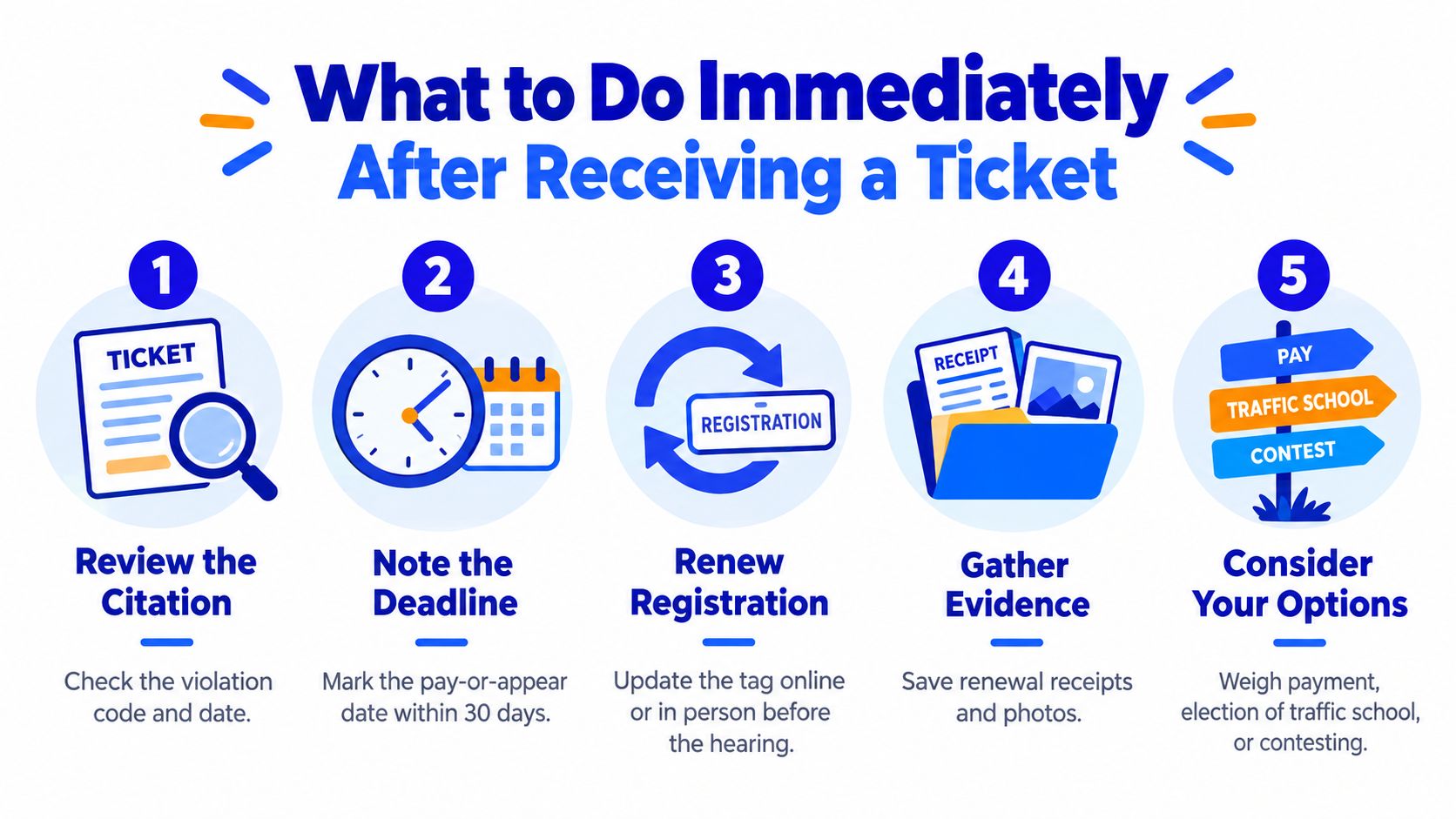
What to Do Immediately After Receiving a Ticket
The first response should be organized, not emotional. Within the first couple of days, confirm the dates and preserve the records that can establish whether the registration was expired, whether renewal had already processed, and whether the citation uses the correct statutory description.
Use this evidence sequence
Review the citation line by line. Confirm the statute, violation description, issue date, court location, and response instructions. Don't rely only on what the officer said at the roadside.
Verify the registration status. Check the Florida motor-vehicle records available to you and identify the exact expiration date. If the record shows a hold or failed renewal, save the notice explaining why.
Renew or correct the registration. Complete the renewal as soon as you can if the vehicle remains eligible. Keep proof of payment and confirmation, even if the transaction seems routine.
Build a timeline. Write down when you renewed, when the transaction processed, when the stop occurred, and when you received any confirmation. A timeline can reveal whether the registration was current before the stop or was corrected afterward.
Assess the response option. Determine whether your county permits a proof-of-correction process, requires payment, or requires a court appearance. Procedures differ, so don't assume an online upload automatically resolves the citation.
The citation date deserves special attention. Florida Statute 320.07 generally restricts issuance of the citation until midnight on the last day of the owner's birth month in the year the registration expires. That rule makes the expiration date, owner information, and citation date relevant to evaluating whether the charge was issued under the proper timeline.
Paying versus getting help
Paying may be efficient when the charge is accurate, the registration is corrected, and no meaningful defense or alternative disposition exists. But payment can be a poor choice when you haven't confirmed the classification, when the ticket contains additional allegations, or when the registration was renewed before the stop.
A lawyer can examine the citation and records together, identify a timing issue, and handle county-specific filing or appearance requirements. That may be particularly important when the registration problem overlaps with a hold, an insurance issue, a plate issue, or another charge. You can also review practical guidance about handling a ticket for expired tags, but don't submit incomplete proof or make admissions without understanding the procedure that applies to your case.
Common Myths About Renewing Online or Driving to Renew
Renewal fixes the registration status going forward. It doesn't rewrite the facts that existed when the officer stopped you.
That distinction defeats the first common assumption: “If I renew online tonight, the citation disappears.” Online renewal can be the right compliance step, but it doesn't automatically cancel an already-issued citation. The court or clerk may require proof of correction, payment, a formal request, or another response depending on the county and the charge.

The second assumption is more dangerous: “I can drive to the tax collector or renewal facility because I'm only going there to fix the problem.” Florida law prohibits operating a vehicle after the applicable registration period unless it has been renewed. A trip to correct the issue doesn't automatically create a general exception. If you need to move the vehicle, first confirm whether it can lawfully be operated and whether another transportation option avoids creating a new violation.
Separate the registration issue from related charges
The third assumption is: “Every expired-tag stop is a moving violation.” For registration expired six months or less, Florida's statute generally says otherwise. But the label on the tag may not capture every issue the officer identifies.
Check whether the citation or records involve:
An absent or invalid plate: A plate problem is factually and legally distinct from a late renewal.
Insurance compliance: A registration hold or separate insurance issue may prevent renewal and create its own consequences.
A suspended license: The driver's status is separate from the vehicle's registration status.
A commercial motor vehicle: Florida Statute § 316.605 addresses commercial motor vehicles operating with expired or missing registration. It allows law enforcement to detain the vehicle until the owner or operator produces proof of proper registration and pays applicable delinquent penalties. Review the commercial motor vehicle registration rule in section 316.605 if that category applies to you.
Don't combine separate problems into one explanation. Correct the registration, then identify every statute and factual allegation on the citation.
A receipt proving renewal is useful evidence, but its value depends on timing and the procedure available in the county handling the case. Preserve it, compare it with the stop date, and obtain confirmation that the court accepted whatever response you submitted.
Why Lawyer-Led Defense Protects Your License and Record
Expired-registration cases can look identical to a driver while producing different legal questions. One case may involve a registration expired six months or less and a straightforward correction. Another may involve an older expiration, a prior offense, a registration hold, a commercial vehicle, or a citation issued at a disputed point in the birthday-month timeline.
County procedure matters too. A filing process that works in Miami-Dade may not be the same as one used in Broward, Palm Beach, Hillsborough, Orange, or Duval County. The courthouse, clerk, prosecutor, and judge may each handle proof, appearances, and correction requests differently.
A lawyer-led review should focus on:
The statutory classification: Is the citation under the nonmoving provision, or does it charge something else?
The dates: When did the registration expire, when did renewal process, and when was the citation issued?
The offense history: Is there a prior matter that changes the penalty provision?
The proof: Do the receipt and official records establish correction, timing, or a registration hold?
The county procedure: What filing, appearance, or court response is required?
Ticket Shield, PLLC offers direct communication with an attorney by phone or text rather than routing you through a corporate answering service, middleman, or automated chatbot. That model gives you a direct place to explain the renewal timeline and ask what the citation means before you make a decision. You can read more about choosing a Florida traffic defense lawyer, but the essential goal is practical: resolve the registration issue while protecting your license and pursuing No Points whenever the law and facts support that result.
Visit Ticket Shield, PLLC for a free consultation about your Florida expired-registration citation. A lawyer-led team can review the charge, renewal records, and county procedure with you, with the ultimate goal of achieving No Points on your license.