¿Cómo afecta una multa por exceso de velocidad a mi seguro en Florida?
¿Cómo afecta una multa por exceso de velocidad a mi seguro en Florida? Conoce los puntos, el aumento de la prima y cómo disputarla puede ayudarte.

Three points. That's what a Florida speeding conviction usually adds to your license, and it jumps to four if you're clocked more than 50 mph over. Then the surcharge lands on your renewal, and it can keep landing for years if the ticket becomes a conviction. The fine printed on the ticket is the smallest part of the bill.
You need to separate three things right now: the citation in your hand, the record outcome in court, and the underwriting decision at renewal. They move on different tracks. Points can reach your record even in the narrow highway case where Florida law blocks the surcharge itself. Asking how does a speeding ticket affect my insurance means asking what happens at each of those steps, and what you can still stop.
Table of Contents
What Your Speeding Ticket Can Add to the Premium
One ticket at 11 to 15 mph over the limit carries an average premium increase of 22.7% nationally, according to a 2025 LendingTree analysis, while LegalClarity's breakdown of ticket costs puts Florida's average for that same band at about 12.4%. Those are averages across drivers and carriers. Your insurer, prior violations, age, vehicle, territory, coverage, and whether this citation becomes a conviction all move your number.
Read two lines on your ticket before anything else: the statute and the alleged speed. In Florida, ordinary speeding is a 3-point conviction, and driving more than 50 mph over under sections 316.183(2), 316.187, or 316.189 is a 4-point violation, per the Florida Department of Highway Safety and Motor Vehicles points schedule. The point count sets your license exposure. The surcharge is a separate decision your insurer makes at renewal, and a conviction does not guarantee one. Florida law can even bar a surcharge in narrow highway situations where the points still count.
Use the Table as Your Planning Range
Severity moves the benchmark. A national analysis cited by InsuranceQuotes with context from the Insurance Information Institute found average premium increases of approximately 21% for driving 1 to 15 mph over the limit, 28% for 16 to 30 mph over, and 30% for 31+ mph over. Treat those bands as a planning range. Your carrier prices its own risk.
Speed over the limit | Florida points if convicted | Premium benchmark | How the cost can last |
|---|---|---|---|
1 to 15 mph | 3 points | Roughly 21 to 22.7 percent nationally; about 12.4 percent in Florida for 11 to 15 mph | Often repriced for several renewals |
16 to 30 mph | 3 points | About 28 percent national average | Larger recurring surcharge risk |
31 mph or more, but not more than 50 over | 3 points | About 30 percent national average | Highest ordinary speeding band |
More than 50 mph over under 316.183(2), 316.187, or 316.189 | 4 points | No published average; insurers price severity and prior record case by case | Extra point and faster suspension exposure |
Find your row. At 12 mph over, don't let the word "minor" calm you down. That conviction can still reprice you. At 28 mph over, you sit in a heavier benchmark band even though the Florida point count stays at 3. Past 50 mph over, the fourth point raises both your license exposure and the risk an insurer reads off your record.
The math compounds. A modest percentage on a full-coverage policy becomes hundreds of dollars a year, and the charge can repeat at renewal after renewal. The insurance cost can pass the court fine fast. The fine is paid once. A surcharge keeps billing you.
Practical rule: Match your alleged speed, statute, and point band before you choose any option on the citation.
Don't pin every dollar of a future increase on this ticket. Market inflation, claims costs, and routine repricing can land on the same renewal bill. The ticket is still the one trigger you control: whether this citation becomes a reportable speeding conviction on the record your insurer reads.
Keep the ticket. Photograph it. Note the response deadline. Your next decision determines whether the table stays a warning or becomes your renewal.
How a Florida Citation Becomes an Insurance Record
Think of the ticket as a key, not the bill. The key opens a sequence. If you stop that sequence early, you can keep it from reaching your insurer as a speeding conviction.
The Florida Statutes Chapter 316 index identifies section 316.183 and section 316.187 as core provisions for unlawful speed and state speed zones. Section 316.183 prohibits driving faster than is reasonable and prudent under the circumstances. Section 316.187 governs the establishment of state speed zones. The statute on your citation is the legal hook for the stop and for what follows.
Here's the chain in plain terms. The officer issues the citation. The court case ends in some disposition. A conviction can post points to your driving record. Your insurer can then review that record when it decides eligibility and price at renewal.

The Four Moves That Matter
Your stop and citation. Record the road, posted limit, alleged speed, and statute number while your memory is fresh.
Your court election. The option you pick before the deadline shapes whether adjudication happens.
Your driving record. A conviction is what creates the point and reporting problem you want to avoid.
Your insurer's renewal review. The carrier applies its own rating rules to the record it sees.
Points don't set a statewide dollar surcharge. Each carrier weighs a conviction against your age, garaging territory, vehicle, coverage limits, and prior history. That's why two Florida drivers with the same citation can get very different renewals. It's also why nobody honest can quote your exact increase from the ticket alone.
If you're trying to protect both your license and your premium, read our guide to navigating Florida's points system for tickets, license, and insurance before your deadline passes. It connects the record you carry to the bill you pay. Don't wait until the renewal arrives to learn how the chain works.
Separate the events before you act. The citation is an allegation with a deadline. The record outcome is a legal result. The renewal is a pricing decision. Your position is strongest before the second step is locked in, so check that response date today.
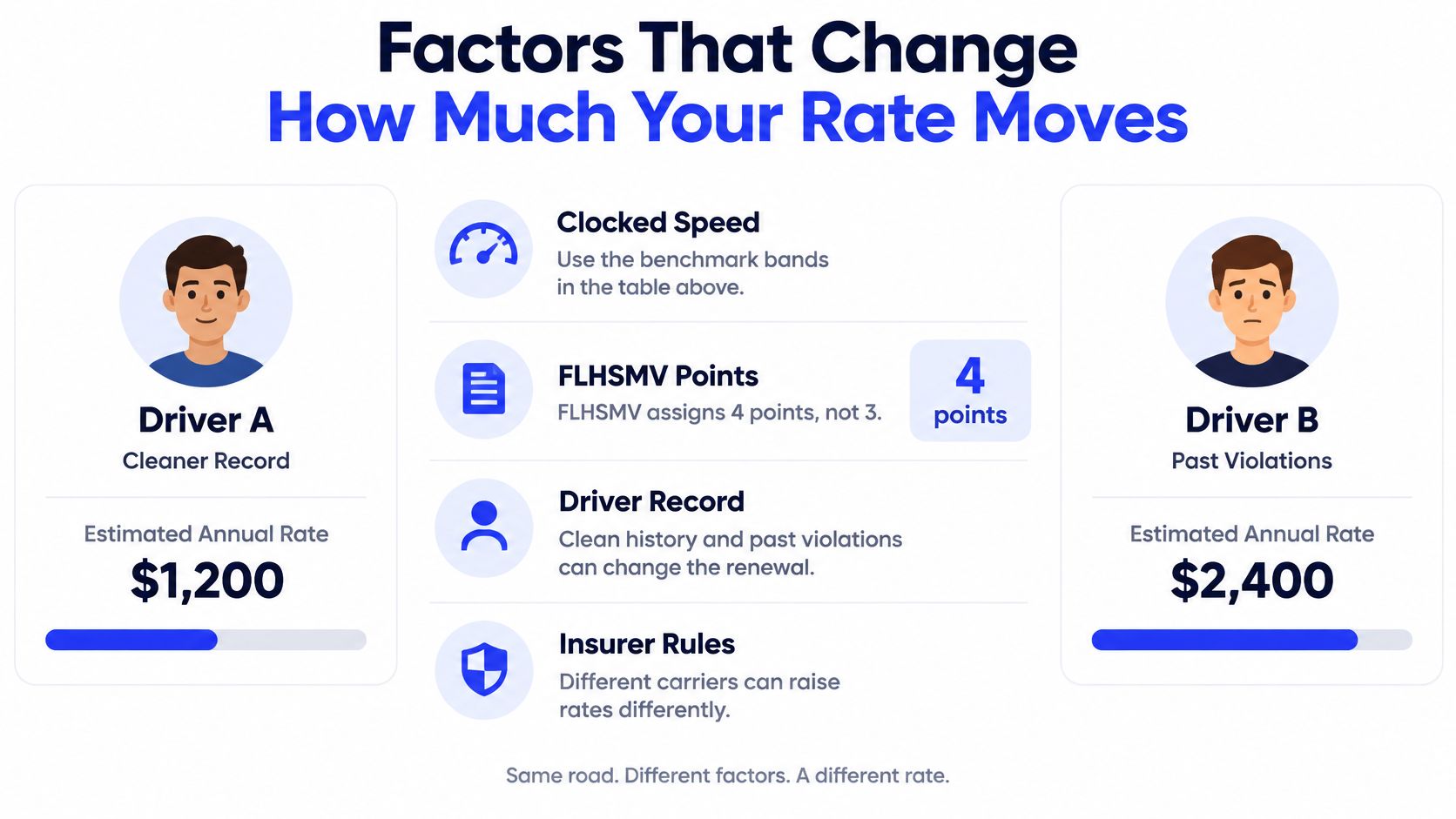
Factors That Change How Much Your Rate Moves
Speed matters. The multiplier sits in your file. The citation is the allegation, the point record is the legal result, and the renewal is the carrier's pricing call. Treat them as separate decisions, because a narrow highway rule may block a surcharge in limited facts while points and the conviction still count.
Start with alleged speed. Florida statute section 316.1926 covers exceeding the limit by more than 50 mph under sections 316.183(2), 316.187, or 316.189 and makes it a moving violation punishable under Chapter 318. A ticket in that range raises the stakes fast. It belongs in a different risk conversation than a routine speeding citation, and it changes what outcome is worth negotiating.
Rank Your Own Risk File
Review these inputs in order. They show why another driver's increase tells you almost nothing about yours.
Clocked speed and point band. Higher alleged speed puts you in a worse severity category, even before points change.
Prior moving violations. A first ticket on a clean record isn't priced like a second ticket close behind the first.
Age and experience. A younger driver already pays a higher base rate, so a percentage surcharge hits harder in dollars.
Garaging territory. Your Florida county and rating territory affect the base premium the surcharge is applied to.
Coverage level. Full coverage has a larger dollar base than minimum limits, so the same percentage costs you more cash.
Other facts shape the defense too. A school-zone or work-zone allegation, a very high clocked speed, or a companion charge can affect what result is realistic and what gets reported. Don't hide those details from your lawyer. They shape strategy.
Market pressure sits in the background as well. understanding California's insurance shortfall gives one out-of-state example of carriers repricing when risk pools tighten; Florida insurers can raise premiums apart from your citation too. That makes avoiding a preventable conviction even more valuable.
Ask one direct question before you pay. Does this outcome put a conviction, points, or both on my Florida record, and can my carrier surcharge it? If the answer is unclear, get the citation reviewed before the deadline. A lawyer you can call or text can read the speed, road type, and companion allegations together. An automated app sees a barcode.
When Florida Law Can Block a Speeding Surcharge
Don't believe the myth that no Florida speeding ticket affects insurance. Florida has a narrow shield, not a blanket exemption. If your facts don't fit it exactly, it won't protect you.
Florida Statutes section 626.9701 prohibits insurers from using a noncriminal violation solely for excessive speed to increase your rate or impose a premium surcharge when the speed was below 70 mph and the violation occurred on a qualifying highway outside business and residential districts, with at least four divided lanes and a median at least 20 feet wide, or on a highway forming part of the National System of Interstate and Defense Highways. Every element matters. Speed, road design, location, and a sole excessive-speed allegation all have to line up.
Test Your Ticket Against the Shield
Ask these questions against the actual road where you were stopped.
Was your alleged speed below 70 mph? At or above that threshold, the shield fails.
Was the road outside a business or residential district? An ordinary city street won't qualify.
Did it have at least four divided lanes and a median at least 20 feet wide, or was it an interstate highway? Guessing isn't enough.
Was excessive speed the only allegation? Additional conduct on the citation can take you outside the rule.
Say you were clocked at 65 mph on a divided highway with a wide median, outside business and residential districts, and speed is the only charge. That's the fact pattern to test. Say you were at 72 mph on a two-lane local road. That's not the shield, and you need a different strategy.
Even when the surcharge ban fits, don't assume you're fully clear. Points and licensing consequences can still matter, and your insurer may reprice you for other reasons. The statute blocks one use of one violation. It doesn't freeze your premium.
Save the ticket, the alleged speed, and the road name. Take photos of the roadway if you can do so safely. If you're weighing whether a course election fits your case, our breakdown of speeding tickets and defensive driving options explains what to confirm first. Have a lawyer match your facts to the statute before you call your carrier and accept a surcharge the law may forbid.
What Extra Premium Can Cost Over Three Years
Put the fine next to the renewal. That's the comparison that should drive your decision.

Start modest. A 2025 LendingTree analysis found one speeding ticket raised full-coverage premiums by an average of 22.7%, or approximately $340 annually on a $1,500 policy. Hold that increase for three renewals and you've paid about $1,020 extra. One stop, three bills.
Now scale it to Florida. The Florida benchmark for a ticket 11 to 15 mph over the limit is 12.4%, and on the same $1,500 policy that's about $186 more a year, roughly $558 across three renewals. It's smaller. It's still money you pay again and again for one mistake, and it's money you only avoid if the conviction never lands.
The severe end is worse. NerdWallet's May 2024 analysis found a speeding conviction increased full-coverage premiums by about 25%, with an average resulting annual premium of $2,486. On a $1,500 policy, a 25% surcharge is $375 a year, $1,125 across three renewals.
Watch this short video before you run your own numbers. The repeating nature of the charge is what catches drivers off guard.
One Surcharge Multiplied Across Renewals
Scenario | 1 renewal | 3 renewals |
|---|---|---|
Florida 11-to-15-over benchmark, 12.4 percent on a $1,500 policy | $186 | $558 |
National benchmark, 22.7 percent on a $1,500 policy | $340 | $1,020 |
Severe end, 25 percent on a $1,500 policy | $375 | $1,125 |
Your county and carrier won't match these averages exactly. Use them to see the shape of the loss. Three separate things decide whether this math ever reaches you: the citation itself, the points Florida puts on your license, and your insurer's renewal decision. A fine ends when the clerk is paid. A conviction can keep appearing in your renewals for as long as your insurer rates it, so ask how many cycles yours counts a ticket.
Check your billing just as carefully. Drivers cleaning up renewal charges can also learn to resolve double billing with Fintrack so an avoidable duplicate charge doesn't pile onto a surcharge fight. Every dollar you catch early is a dollar you don't finance for years.
If a dismissal, withhold, or non-moving reduction is within reach, the column above is the money you're fighting for. A lawyer you can call or text can tell you fast whether your facts leave that door open. Don't pay first and do the arithmetic later.
Paying the Fine Versus Contesting the Ticket
Paying feels finished. In Florida, it's often the start of the insurance problem.
The FLHSMV traffic citations page states payment of the civil penalty is considered a conviction and points will be assessed when applicable, and it warns accumulating points may increase the cost of insurance or lead to license suspension. Read that again. When you pay, you're not just closing a balance. You're creating the conviction your insurer can later price.

Choice | Record result | Insurance trigger | Your time |
|---|---|---|---|
Pay the civil penalty | Treated as a conviction | Points can be used at renewal for years | Short, then the surcharge can linger |
Contest the citation | Goal is dismissal, withhold, or a non-moving reduction | A clean or point-free result can avoid that trigger | Lawyer handles court; you usually do not appear |
Contesting is the route that can seek a dismissal, a withhold of adjudication, or a reduction to a non-moving violation, so points may never land. That's not a promise of any outcome. It's the only path that gives you a chance to change the record before your insurer reads it.
A strong file gets investigated, not just filed. At Ticket Shield, we investigate three things on every case, whether law enforcement followed proper procedure, whether your conduct meets the legal definition of racing or was just speeding, and whether the traffic stop itself was constitutional. Our traffic ticket defense is designed so you don't have to go to court.
That lawyer-led model matters. With Ticket Shield, PLLC, you speak directly with your attorney by phone or text. You don't get routed through a middleman, a corporate answering service, or an automated chatbot the way automated apps and ticket mills handle you. When your renewal money is on the line, you need a lawyer who knows your citation, not a queue.
Paying is fast. Fast is not the same as protective.
Take these steps now. Read the citation for the statute, speed, and response date. Don't pay before someone reviews the record consequence. Save roadway details if the highway surcharge rule might apply. Ask what result avoids points. Then let your attorney explain the court options and timeline.
If you're still weighing the decision, our analysis of whether it's worth contesting a speeding ticket walks through the tradeoffs in plain terms. Avoiding a conviction can remove one rating trigger, but it can't guarantee your next renewal stays flat if the market or your other history changes. Contest anyway. Removing a trigger you control is the cost-effective, value-driven move.
What to Check When Your Renewal Arrives
Don't accept a new premium without reading why it changed. Your renewal packet tells a story. Make your carrier prove it.
Run this check as soon as the bill arrives.
Compare the declarations page with your citation. Confirm the violation date, the statute, and whether a speeding conviction is listed.
Ask in writing what was rated. Have your insurer identify the exact driving record item it used and when that record was reviewed.
Ask how long it'll be rated. That answer is carrier-specific, so get it from your own insurer instead of guessing.
Send the court disposition if you won relief. If the case was dismissed, withheld, or reduced, submit that paperwork and request a re-rate.
Shop with identical limits. Compare quotes from other carriers using the same coverage so the comparison is honest.
Keep a simple log while you do this. Write down each premium, the date it changed, and the reason the carrier gave you. That log shows whether the ticket drove the increase or whether market pricing, claims history, or routine repricing did. It also gives your attorney hard facts if the Florida highway surcharge rule may apply to your stop.
Verify the record yourself instead of trusting the bill. Our guide on how to check your Florida driving record for points shows you what to pull and what to look for. If the record and the renewal don't match, challenge it in writing right away.
Get Your Citation Reviewed and Fight for No Points
You don't have to guess what this ticket will do to your insurance. Contact Ticket Shield, PLLC by phone or text to have your citation reviewed before your response deadline, and ask your attorney what can keep points off your record.
Keep three decisions separate. The citation is what the officer wrote. The Florida point record is what may follow a conviction. The renewal decision is what your insurer does with that record later. Protect the first two and the third has less to rate. If your stop may fall under Florida's narrow highway surcharge rule, raise it early, because that rule can block a surcharge even when points still matter.
Bring the citation, the cited statute, the alleged speed, and the road name. Those four facts let a lawyer see whether a dismissal, withhold, or reduction to a non-moving outcome is realistic. Ask the direct question: what keeps this conviction off the record your insurer reads?
At Ticket Shield, PLLC, you reach your attorney directly by phone or text, with no middleman, call center, or automated chatbot between you and your case. Traffic ticket defense covers fighting points, fines, and license risks, defense is designed so clients do not have to go to court, and traffic ticket defense attorneys start at $39.99. One client, Rafael B., said: “Ticket Shield made my speeding ticket totally stress-free. They were responsive, professional, and kept me updated the whole way.”
Read our guide on how a speeding ticket can end with no points, then move before your deadline closes. Contact Ticket Shield, PLLC by phone or text now.