
What to Expect in Traffic Court: A Florida Driver's Guide
Learn what to expect in traffic court, including hearings, penalties, and practical tips to prepare and present your case.
Getting a traffic ticket is stressful, but walking into court unprepared is even worse. Knowing what to expect on your court day can take a lot of the anxiety out of the process. It's a structured legal proceeding, and your first appearance is all about getting your bearings, handling the initial check-in, and making your plea.
Attorney Advertisement. Office in Broward.
Your First Day in Florida Traffic Court
Walking into a Florida traffic court for the first time can feel like you’ve stepped onto an unfamiliar stage. Don’t worry—this first day is mostly an orientation. The goal is to get you familiar with the environment, the key players, and the first few steps that will set the foundation for your case.
Your main tasks for the day are simple but absolutely critical: show up on time, find the right courtroom, and check in with the clerk. Make sure you have your driver's license, the traffic ticket itself, and proof of insurance or registration if it's relevant to your citation. Dressing in business casual shows respect for the court and the process.
Navigating the Courthouse and Checking In
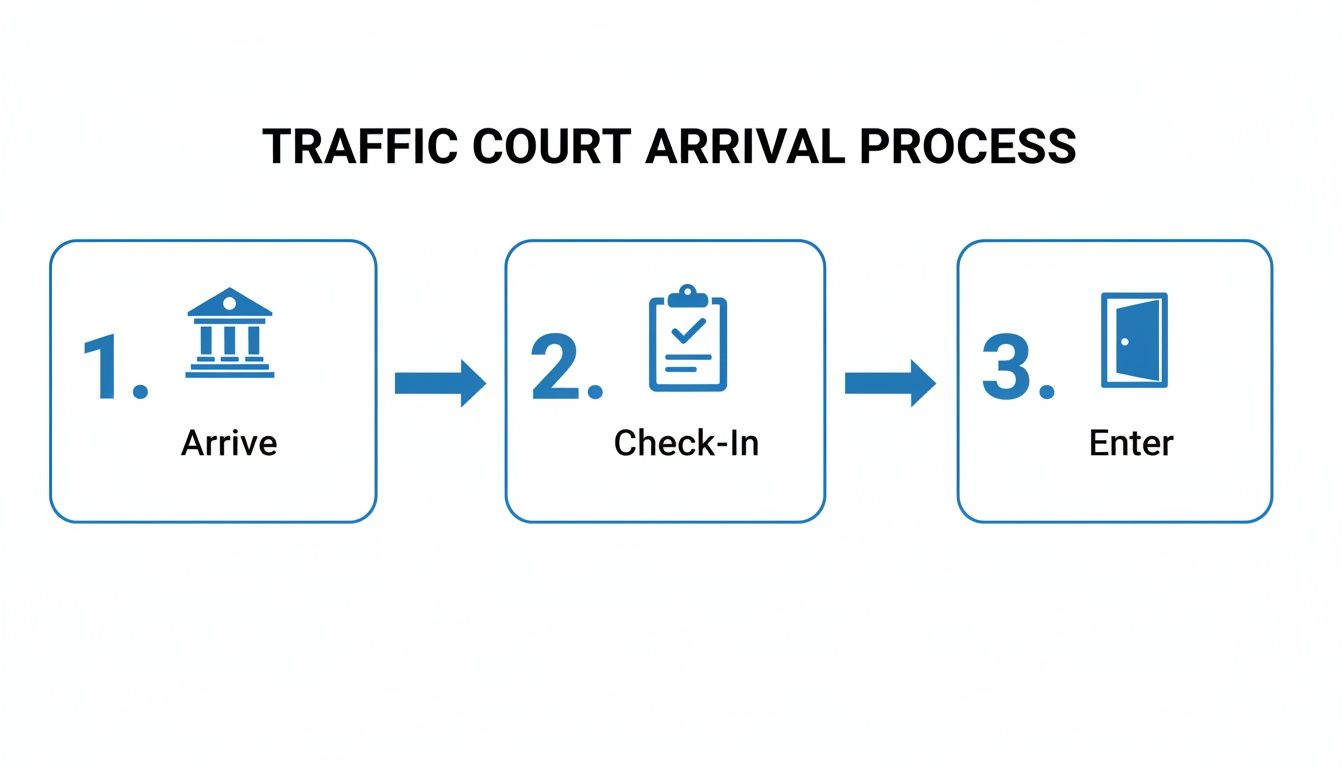
When you arrive, expect to go through a security screening, much like you would at an airport. Once inside, look for the court dockets—they’re usually on monitors in the lobby. Find your name and your assigned courtroom number.
After you find the right room, you’ll check in with the court clerk or bailiff. They’ll confirm you’re present and give you any further instructions. Punctuality is everything here. Being late can have serious consequences, and in some cases, you might need to reschedule.
This simple infographic breaks down the process of arriving at the courthouse.
Handling these first few steps professionally sets a good tone before you even say a word to the judge.
Understanding the Courtroom Environment
Traffic tickets are one of the most common reasons people end up in a courtroom. State courts handle an incredible 66 million cases every year, and a huge chunk of that is traffic violations. This massive caseload means you can expect crowded rooms and a fast-paced environment.
You’ll see a few key figures running the show:
The Judge: This is who presides over the courtroom, keeps things orderly, and makes the final decision. Always address the judge as "Your Honor."
The State's Attorney/Prosecutor: This person represents the state and will present the case against you.
The Court Clerk: The clerk handles all the administrative work, manages the paperwork, and swears in anyone who testifies.
Understanding how to respond to official court notices is a good skill to have in general. For example, the principles of clear and respectful communication also apply when preparing a jury duty excuse letter.
Understanding Your Plea Options in Florida
The first big decision you’ll make inside that courtroom is how to plead. This is a critical moment because your answer sets the entire tone for what happens next. In Florida, you’ve got three options, and knowing the strategy behind each one is the first step toward protecting your driving record.
Your plea isn’t just a simple “yes” or “no.” It’s a formal legal declaration. A hasty decision can lead to immediate consequences like fines and points, but the real pain often comes later with years of increased insurance rates.
Pleading Guilty or No Contest
Pleading guilty is a straight-up admission that you committed the violation as the officer wrote it. It’s the fastest way to get things over with, but it’s a direct path to a conviction on your record, bringing all the fines and points along with it. To see the full domino effect, you can learn more about what happens if you plead guilty in our detailed guide.
A plea of no contest, or nolo contendere, is a little different. You're not admitting you did it, but you are agreeing not to fight the charge and to accept the penalty. This can be a strategic move if the traffic stop could lead to a separate civil lawsuit (like a personal injury claim), because a no contest plea generally can’t be used against you as an admission of fault in that other case.
But let’s be clear: when it comes to your driving record, the Florida DHSMV typically treats a guilty and a no contest plea exactly the same. Both usually end in a conviction and points.
Pleading Not Guilty
Pleading not guilty is your constitutional right, and it’s where things get interesting. This plea tells the state, "Prove it." You're not necessarily saying you're innocent; you're just using your right to make the prosecutor prove their case against you at a formal hearing.
This is often a strategic move for a few key reasons:
It creates a chance for a dismissal. The officer who wrote the ticket might not show up to court. There could be errors on the citation or problems with the evidence. Any of these things can get the case thrown out completely.
It opens the door to negotiation. Once you plead not guilty, your attorney can talk to the prosecutor to work out a better deal, like reducing the charge, letting you do traffic school to avoid points, or agreeing to a "withhold of adjudication."
Choosing to plead not guilty forces the system to work and creates opportunities for a much better outcome. It's the only proactive way to defend your driving record. Past results do not guarantee future outcomes.
Before you make a final decision, it's helpful to see your options laid out side-by-side. This table breaks down what each plea really means for you.
Comparing Your Three Plea Options
Plea Option | What It Means Legally | Common Outcomes | When to Consider It |
|---|---|---|---|
Guilty | You are admitting you committed the violation as charged. | Conviction on your record, fines, court costs, and points assessed by the DHSMV. | Rarely a favorable option, as it offers no chance for a better outcome and guarantees a conviction. |
No Contest | You are not admitting guilt but are accepting the penalty and not fighting the charge. | Same as a guilty plea: conviction, fines, costs, and points. The only difference is it can't be used against you in a civil case. | If you must resolve the case quickly and there's a risk of a related civil lawsuit (e.g., from a car accident). |
Not Guilty | You are exercising your right to make the state prove its case against you beyond a reasonable doubt. | Potential for dismissal, negotiation for a reduced charge, a withhold of adjudication (no points), or a full hearing. | Almost always the most strategic choice, as it is the only plea that gives you a chance to avoid a conviction and points. |
Each path has a very different destination. Pleading guilty or no contest is a fast track to a conviction, while pleading not guilty is the only option that gives you a fighting chance to protect your record.
The Anatomy of a Traffic Court Hearing
If you plead not guilty, your case is headed for a hearing. Forget the dramatic courtroom battles you see on TV; a traffic hearing is a structured, predictable process where both sides get to present their version of events to the judge. Understanding how it unfolds removes the element of surprise and lets you build a focused defense.
The hearing is the state's chance to prove its case against you. The burden of proof is entirely on them—you don't have to prove you're innocent. Knowing the flow of the hearing is the key to preparing an effective response.

The State Presents Its Case
The hearing kicks off with the state's attorney, or prosecutor, laying out their evidence. In the vast majority of Florida traffic cases, this evidence comes down to one thing: the sworn testimony of the police officer who wrote the ticket.
The prosecutor will ask the officer a series of direct questions to establish the basic facts of the alleged violation.
For instance, the officer will likely testify about:
Where and when the traffic stop happened.
How they determined your speed (radar, laser, pacing, etc.).
What they observed about your driving.
Anything you said during the stop.
Your job during this part is to listen—carefully. You or your attorney will get the chance to question the officer in just a moment.
Cross-Examination of the Officer
This is where your defense has a chance to respond. After the officer finishes their testimony, your defense attorney gets to conduct a cross-examination. The goal isn’t to be confrontational but to ask strategic questions that can expose weaknesses or inconsistencies in the state’s case.
An attorney whose practice focuses on traffic defense knows what to look for. They’ll question the officer on details like the calibration records for their speed-measuring device, their line of sight, or any potential contradictions between their testimony and what’s written on the ticket. It’s a critical step, and you can learn more about effective strategies in our guide on how to beat a traffic ticket in Florida.
A successful cross-examination can create reasonable doubt. If the judge starts to question the accuracy or reliability of the officer's testimony, the state may fail to meet its burden of proof, which can lead to a dismissal.
Presenting Your Defense
Once the state rests its case, the floor is yours. You have the right to present your own evidence and even testify on your own behalf, but it's important to remember that you are not required to do so. Deciding whether you should testify at all is a key part of any defense strategy.
If you do choose to present a defense, your evidence could include things like:
Your own testimony giving your side of the story.
Witness testimony from passengers or anyone else who saw what happened.
Physical evidence like photos of the scene, dashcam video, or diagrams.
After all the evidence has been presented, both sides will make a brief closing argument. The judge will then weigh everything they’ve heard and deliver a final judgment.
Possible Outcomes and What They Mean for You
After all the arguments have been made and the evidence is laid out, the judge makes the final call. That decision is more than just the end of your day in court—it can have a ripple effect on your driving record, insurance premiums, and finances for years to come. It’s crucial to understand the full range of possible outcomes in a Florida traffic court.
What can happen runs the gamut, from a complete dismissal of your ticket to a conviction that carries some serious penalties. The final outcome almost always comes down to the strength of the state's case, how effectively you present your defense, and any deals that were made along the way.
Best-Case Scenarios: Dismissal and Deferral
The best possible result, of course, is a dismissal. This means the court throws the ticket out completely, as if it never existed. A dismissal can happen for a few reasons, like the officer who wrote the ticket not showing up to court or a critical error on the citation itself.
Another favorable outcome is a deferral, which in Florida is usually called a withheld adjudication. This is a common negotiated deal where you might agree to complete traffic school or pay court costs. In exchange, the judge doesn't formally convict you. You can get the full rundown on how this works by reading our detailed explanation of what is adjudication withheld. As long as you hold up your end of the bargain, no points are added to your license.
Convictions and Their Consequences
If the judge finds you guilty, the outcome is a conviction. This is the one you want to avoid, as it comes with a string of penalties that follow you long after you’ve left the courthouse.
A conviction usually brings a combination of hits:
Fines and Court Costs: You'll be ordered to pay a monetary penalty, which the court sets.
Points on Your License: The Florida DHSMV will add points to your driving record, which can eventually lead to a license suspension.
Increased Insurance Premiums: A conviction is a huge red flag for insurance companies. They see you as a higher-risk driver, which often means steep rate hikes that can last for years.
These consequences really highlight why a smart, strategic approach is so important. How justice system resources are used varies wildly by location. For example, the federal system handled 2,602.3 prosecutions per ten million people in March 2025, but enforcement priorities can be completely different at the state and local levels. Florida has its own patterns, which is why having local legal knowledge is a huge advantage when you're heading to traffic court.
A traffic ticket conviction is not just a one-time payment. It's a long-term financial liability that can cost you thousands in increased insurance premiums over the next three to five years. Protecting your record is an investment.
Beyond what the judge decides, it’s also smart to understand how traffic incidents can affect your car insurance, especially if the ticket was related to an accident. In those cases, you might also need to know how to file an auto insurance claim. Every outcome, good or bad, kicks off a chain of events. Knowing what's at stake helps you see why just paying the ticket is almost never the best move.
The Strategic Value of Hiring a Traffic Attorney
Sure, you have the right to represent yourself in traffic court. But walking into that courtroom alone can feel like stepping onto a field where you don't know the rules and the other team is made up of professionals. Hiring an attorney whose practice focuses on traffic defense isn't an admission of guilt—it's a strategic move to protect your driving record and your wallet.
For many people, the biggest immediate win is convenience. An experienced lawyer can almost always appear in court on your behalf. That means you don't have to burn a vacation day, find a babysitter, or deal with the headache of courthouse traffic and parking. That alone lifts a huge weight off your shoulders.

Leveraging Legal Knowledge and Experience
But the real value goes much deeper than just convenience. A traffic defense attorney brings critical legal knowledge to the table that you simply can't get from a quick online search. They are regulars in the local courts and know the tendencies of the prosecutors and judges. That insider's perspective is invaluable.
This experience allows an attorney to:
Negotiate from a position of strength. They know what kinds of plea bargains or resolutions prosecutors are actually willing to consider.
Spot procedural errors. A lawyer can identify mistakes the officer made during the stop or on the citation itself—errors that could get the whole case dismissed.
Challenge the state's evidence. They know how to cross-examine the officer effectively and question the reliability of speed detection gear.
This isn’t about finding some magic "loophole." It’s about holding the state to its burden of proof. The prosecutor has to prove you're guilty, and an attorney's job is to ensure your rights are protected every step of the way.
Our goal is to protect your license and driving record. We dig into the details of every case to achieve the best possible outcome, whether that's a dismissal, a reduced charge, or avoiding points altogether.
A Proactive Approach to Protecting Your Future
Think of hiring a lawyer as a proactive investment. The upfront cost is often a fraction of what you'd end up paying in the long run after a conviction, especially when you factor in years of increased insurance premiums. Not sure if it's the right call for your specific ticket? Get a clearer picture by exploring our guide on whether you need a lawyer for a traffic ticket.
Ultimately, you can face the court alone, but having an experienced professional in your corner can significantly level the playing field. Past results do not guarantee future outcomes, but skilled representation gives you a dedicated advocate fighting to protect both your driving privileges and your financial well-being.
Common Questions About Florida Traffic Court
We get it—the thought of going to traffic court can be stressful. You’ve got questions, and we have answers based on years of handling traffic and DUI defense matters across Florida. Here are some of the most common concerns we hear from drivers every day.
Disclaimer: This information is for educational purposes and is not legal advice. Submitting information via this website does not create an attorney-client relationship. Your situation is unique, so please consult with a licensed attorney to discuss your specific case.
Do I Really Have to Appear in Court for My Ticket?
For most civil traffic tickets in Florida, the answer is often no—but only if you hire an attorney to go for you. A traffic lawyer can handle every court appearance on your behalf, taking care of all the negotiations and legal arguments without you ever having to miss a day of work or step foot in the courthouse. It's a massive convenience.
However, if you're facing a more serious criminal traffic violation, like a DUI or reckless driving, a mandatory court appearance is usually required. Even then, having your attorney standing right there with you is absolutely critical to protect your rights.
What Happens if I Miss My Assigned Court Date?
Missing a court date is one of the worst mistakes you can make. It immediately turns a simple traffic issue into a serious legal mess.
When you fail to appear, the court can issue a bench warrant for your arrest. On top of that, the Florida DHSMV will likely suspend your driver's license for Failure to Appear. This means you're now facing extra fines, expensive reinstatement fees, and the risk of being arrested the next time you're pulled over. If you've missed a court date, you should call an attorney immediately to help get the warrant lifted and deal with the original ticket.
A missed court date transforms a simple traffic matter into a much more complex legal problem. Taking swift action with legal counsel is the best way to mitigate the damage and work toward getting your license reinstated.
Is It Better to Just Pay the Ticket and Move On?
While paying the ticket feels like the easiest way out, it's a trap. Legally, paying the fine is an admission of guilt. That means you get an automatic conviction on your driving record and points are slapped onto your license.
Those points have real, long-term financial consequences. Your insurance company sees them as a sign you're a risky driver and will likely increase your premiums for years. Collect too many points, and the state will suspend your license automatically. Before you even think about paying, you should always talk to a lawyer whose goal is to help you avoid these exact outcomes. Past results do not guarantee future outcomes.
How Should I Dress and Act in the Courtroom?
How you present yourself in court really does matter. It shows the judge you're taking the situation seriously.
Attire: Think business casual. You don't need a full suit, but you should avoid wearing shorts, sandals, hats, or t-shirts with prominent logos. A clean, professional appearance goes a long way.
Behavior: Be polite and respectful to everyone, at all times. Address the judge as "Your Honor" and always stand up when you're speaking to them. Never interrupt the judge, the prosecutor, or anyone else. A calm, respectful demeanor can only help your case.
Navigating the complexities of Florida traffic court can be challenging, but you don't have to do it alone. The team at Ticket Shield, PLLC handles traffic and DUI defense matters. Our practice focuses on helping protect your driving record and license. For a free consultation to discuss your case, visit us at https://www.ticketshield.com.
