
A Guide to Reinstating a Suspended License in Florida
Facing a suspended license in Florida? Learn the causes, penalties, and the clear steps required to restore your driving privileges with this complete guide.
Getting a notice about a suspended license in Florida means your driving privileges have been temporarily put on pause. This is a formal action from the Florida Highway Safety and Motor Vehicles (FLHSMV), and it makes driving illegal until you clear things up. Unlike a full-blown revocation, which cancels your license for good, a suspension is meant to be temporary.
What a Suspended License Means for You
A suspended license is a serious headache that sidelines your ability to drive legally. It’s not a permanent loss of your license, but a temporary hold until you meet the state's conditions. This could mean paying off old fines, finishing a required course, or just waiting out a specific time period.
The reasons for a suspension can be all over the map, from racking up too many points to a serious offense like a DUI. But sometimes, it's just administrative stuff, like an unpaid ticket in Sarasota County or a lapse in your car insurance. The bottom line is this: until you take specific steps to fix the problem, you're not allowed to drive.
Suspension vs. Revocation: What’s the Difference?
It’s really important to know the difference between a suspension and a revocation. A suspension is a temporary time-out. A revocation, however, is the complete cancellation of your license. To get back on the road after a revocation, you have to start from scratch and apply for a brand-new license once the revocation period is over.
Suspensions are much more common and are often tied to issues you can fix. In fact, a huge number of suspensions in Florida have nothing to do with dangerous driving at all.
A 2022 analysis showed that around 716,383 Floridians couldn't legally drive simply because of unpaid fines and fees. The same report found that about 75% of all license suspension notices in the state are for unpaid court debt, while only 3% are for things like a DUI. You can see the full breakdown from the Fines and Fees Justice Center.
The Path to Getting Your License Back
The first step to fixing a suspended license is to figure out exactly why it happened. The FLHSMV has an online portal where you can check your license status, which will spell out the specific issues you need to resolve.
Once you know what you’re dealing with, you can start the reinstatement process. This typically involves a few key steps:
Paying all outstanding fines and fees.
Completing mandatory driver improvement or substance abuse courses.
Providing proof of SR-22 insurance if it's required for your case.
Attending an administrative hearing.
Every situation is a little different, so the steps you need to take will depend on your specific circumstances. Our guide on how long a license suspension lasts can give you a better idea of what to expect.
Why Florida May Suspend Your Driver's License
A Florida license suspension doesn't just happen out of the blue. It’s the direct result of specific actions—or in many cases, inaction. Pinpointing the exact trigger behind your suspension is the first critical step toward fixing it, as every cause has its own unique path to getting back on the road.
The Florida Highway Safety and Motor Vehicles (FLHSMV) has a clear set of rules, and breaking them can put your driving privileges on ice. While some reasons, like a DUI, are well-known, others are purely administrative and can catch even the most careful drivers completely off guard.
By figuring out which category your suspension falls into, you can stop guessing and start building a real plan. Let's break down the most common reasons the state takes a driver's license away.
Accumulating Too Many Points on Your Record
Think of Florida's point system as a demerit system for your driving record. Every moving violation you're convicted of adds a certain number of points. If you rack up too many points too quickly, it signals to the state that you might be a high-risk driver, triggering an automatic suspension.
The thresholds are strict and the clock is always ticking. A driver in Pinellas County faces the exact same system as one in Miami-Dade.
Florida's Point System Thresholds for Suspension
12 points within a 12-month period results in a 30-day suspension.
18 points within an 18-month period leads to a 3-month suspension.
24 points within a 36-month period triggers a 1-year suspension.
Once you cross one of these lines, the FLHSMV will automatically suspend your license. For a deeper look at this system, you can learn more about how many points it takes to suspend a license in our detailed guide.
Driving Under the Influence (DUI)
A DUI arrest sets off immediate and severe consequences for your license, completely separate from what happens in your criminal court case. When an officer arrests you for DUI in Florida, they will usually confiscate your physical license right there and issue a citation that doubles as a temporary 10-day driving permit.
This action kicks off an administrative suspension process with the FLHSMV. How long that suspension lasts depends on the details, like whether you refused a breathalyzer or if this is your second offense.
First DUI Conviction: A conviction carries a mandatory suspension of 180 days to 1 year.
Refusal to Submit to Testing: A first-time refusal results in an automatic 1-year suspension.
These administrative penalties happen regardless of the final outcome of your criminal case, making it crucial to tackle both issues head-on and right away.
Failure to Comply with Court or Financial Obligations
This category is one of the most common reasons for a suspended license in Florida, and it's the one that most often catches people by surprise. It covers a range of issues that have nothing to do with your driving but can still get you pulled off the road.
Simple administrative oversights can quickly snowball into a full-blown suspension. Many drivers only find out there’s a problem when they're pulled over for a routine traffic stop.
Common triggers include:
Failure to Pay Traffic Fines: Ignoring a ticket or missing the payment deadline will lead to an indefinite suspension that lasts until the debt is paid.
Failure to Appear in Court: If you're required to show up in court for a ticket and you miss the date, the court notifies the FLHSMV to suspend your license.
Unpaid Child Support: Under Florida law, failing to comply with child support orders can and will lead to the suspension of your driver's license.
Other Significant Reasons for Suspension
While points, DUIs, and unpaid fines are the big three, several other situations can also land you with a suspended license. These are often tied to specific incidents or responsibilities that every Florida driver is expected to meet.
For example, getting into a crash without the proper insurance can trigger a suspension under Florida's Financial Responsibility Law. The state demands that all drivers have the ability to cover any damages they might cause.
Other reasons for suspension include:
Involvement in an Accident Without Insurance
Certain Medical Conditions Affecting Driving Ability
Violation of Commercial Driver's License (CDL) Rules
Being Designated a Habitual Traffic Offender (HTO)
Each of these scenarios comes with its own specific reinstatement process. Knowing exactly why your license was suspended is the key to getting back on the road legally and without wasting any more time.
The Consequences of Driving with a Suspended License
Understanding why your license was suspended is the first step, but realizing the serious risks of ignoring it is just as important. Getting behind the wheel with a suspended license in Florida isn't like a minor traffic ticket; it's a criminal offense with penalties that can spiral, impacting your freedom, your finances, and your future.
The state doesn't take Driving While License Suspended (DWLS) lightly. What feels like a simple decision to drive to work or the grocery store can quickly become a major legal headache, trapping you in a cycle that gets harder and harder to break. The consequences are designed to be a powerful deterrent, and they go far beyond just losing your driving privileges.
Criminal Charges for Driving While Suspended
In Florida, a DWLS charge boils down to two things: your prior record and whether you knew about the suspension. A simple traffic stop in a city like Sarasota can go in very different directions depending on what the state can prove.
DWLS Without Knowledge: If you were genuinely unaware of the suspension, it’s treated as a moving violation—a civil ticket. This keeps a criminal charge off your record, but it still comes with fines and adds more points to your license.
DWLS With Knowledge: If you knew your license was suspended, the situation becomes criminal. A first offense is typically a second-degree misdemeanor, carrying penalties of up to 60 days in jail and a $500 fine.
Repeat Offenses: The penalties get steeper with each conviction. A second offense is a first-degree misdemeanor, and a third can be charged as a felony, which could mean years in prison.
These charges create a permanent criminal record that can follow you for life. To see the full breakdown of these penalties, you can learn more about the specific consequences for driving with a suspended license in our detailed article.
The Ripple Effect on Your Finances and Daily Life
The fallout from a suspended license spreads far beyond the courtroom. The financial squeeze can be immediate and long-lasting, hitting everything from your insurance premiums to your job prospects. For many Floridians, it becomes a huge economic burden.
This isn't just an individual problem; it affects the whole state. One report estimated that over 700,000 Floridians have suspended licenses just because of unpaid fines or fees. The domino effect? The state loses out on roughly $491–$500 million annually in consumer spending. For a single driver, a suspension can make insurance rates jump by about 67% for at least three years, even if the suspension had nothing to do with driving. You can explore more of these economic impacts from the Fines and Fees Justice Center.
The financial fallout from a suspended license creates a vicious cycle. Higher insurance costs and reinstatement fees make it harder to get back on the right side of the law, while the inability to drive legally can put your job at risk, making it even tougher to pay off the original fines.
Long-Term Impact on Your Record and Insurance
One of the most significant long-term headaches is the requirement to file an SR-22 certificate with the state. An SR-22 isn't insurance itself; it's proof that you carry Florida's minimum liability coverage. It’s usually required for drivers convicted of serious violations, and DWLS is high on that list.
Mandatory SR-22 Filing: This immediately flags you as a high-risk driver to every insurance company out there.
Increased Insurance Premiums: Your auto insurance rates will shoot up, and you can expect them to stay painfully high for several years.
Employment Challenges: A criminal record for DWLS is a major red flag for employers, especially for any job that requires driving or even just a clean background check.
A DWLS conviction leaves a lasting stain on both your criminal and driving records, making it more expensive and difficult to move forward. The best way to avoid these compounding consequences is to tackle the root cause of the suspension head-on.
A Step-By-Step Guide to License Reinstatement
Getting your driver's license back isn't a maze of guesswork; it's a clear process. While the exact steps depend on why your license was suspended in the first place, the overall path to reinstatement follows a logical sequence. If you break it down into manageable steps, you can build a solid roadmap to get back on the road legally.
Don't believe it? Just look at what happened in Miami-Dade County. They were facing a crisis with an overwhelming number of suspended licenses. In 2022, a jaw-dropping 915,424 Miami-Dade residents couldn't legally drive.
In response, the county launched a Driver’s License Suspension Task Force to create clear, simple pathways for people to get reinstated. The results were nothing short of dramatic. Within three years, the number of suspended licenses in the county plummeted by 73% to 246,676, and about 85% of the people who actively participated got their licenses back.
This huge success in a major county proves a critical point: with the right information and a clear plan, getting your license reinstated is absolutely achievable.
Step 1: Identify the Cause of Your Suspension
Before you can fix the problem, you have to know exactly what it is. Your very first move is to find out the specific reason the Florida Highway Safety and Motor Vehicles (FLHSMV) suspended your license.
Thankfully, this is pretty easy. You can use the state's official online portal to check your driver's license status. This free tool gives you the crucial details you need, including:
The current status of your license (e.g., VALID, SUSPENDED).
The date the suspension actually started.
The specific citation or case numbers tied to the suspension.
This information is your starting point. It tells you precisely what you need to do next.
Step 2: Satisfy All Reinstatement Requirements
Once you have the details from the FLHSMV, it's time to knock out every single requirement tied to your suspension. Each cause has its own checklist, and you have to complete everything on it before the state will even consider lifting the hold.
The required actions can vary a lot, but they usually fall into a few key categories.
Common Reinstatement Tasks:
Pay Outstanding Fines: This is a big one. It covers unpaid traffic tickets, court costs, and any other financial loose ends.
Complete Required Courses: You might be required to enroll in and finish a program like the Advanced Driver Improvement (ADI) course for point-related suspensions or a state-approved DUI school for alcohol-related offenses.
Obtain SR-22 Insurance: For more serious violations, you'll almost certainly need to have your insurance provider file an SR-22 certificate with the state. This is just a form that proves you carry Florida's minimum liability insurance.
Fulfilling these obligations is non-negotiable. The FLHSMV's system is automated and will not let you move forward until every single requirement is officially checked off.
Step 3: Submit Fees and Documents to the FLHSMV
After you've paid all your fines and finished your courses, the final move is to pay the official reinstatement fee to the FLHSMV. The amount depends on the type of suspension, but it must be paid before your driving privileges are restored.
You can usually handle this last step online, by mail, or in person at a driver's license service center. Once your fee is processed and the system confirms all your other requirements are met, your license will be reinstated.
What About a Hardship License?
If you simply can't wait for the full suspension period to end, you might qualify for a hardship license. This is a restricted license that allows you to drive for essential purposes only, like getting to work, school, or medical appointments.
A hardship license, often called a Business Purposes Only (BPO) license, is not a full reinstatement. It is a temporary, limited privilege granted after a formal hearing to help you maintain your livelihood while you work toward getting your full license back.
The process involves submitting an application and attending an administrative hearing with the FLHSMV. During the hearing, an officer reviews your case to decide if you meet the criteria and can be trusted with limited driving privileges. To see if this is an option for you, check out our guide on the requirements for a hardship license in Florida.
Navigating the consequences of driving on a suspended license can feel overwhelming, as this visual guide shows.
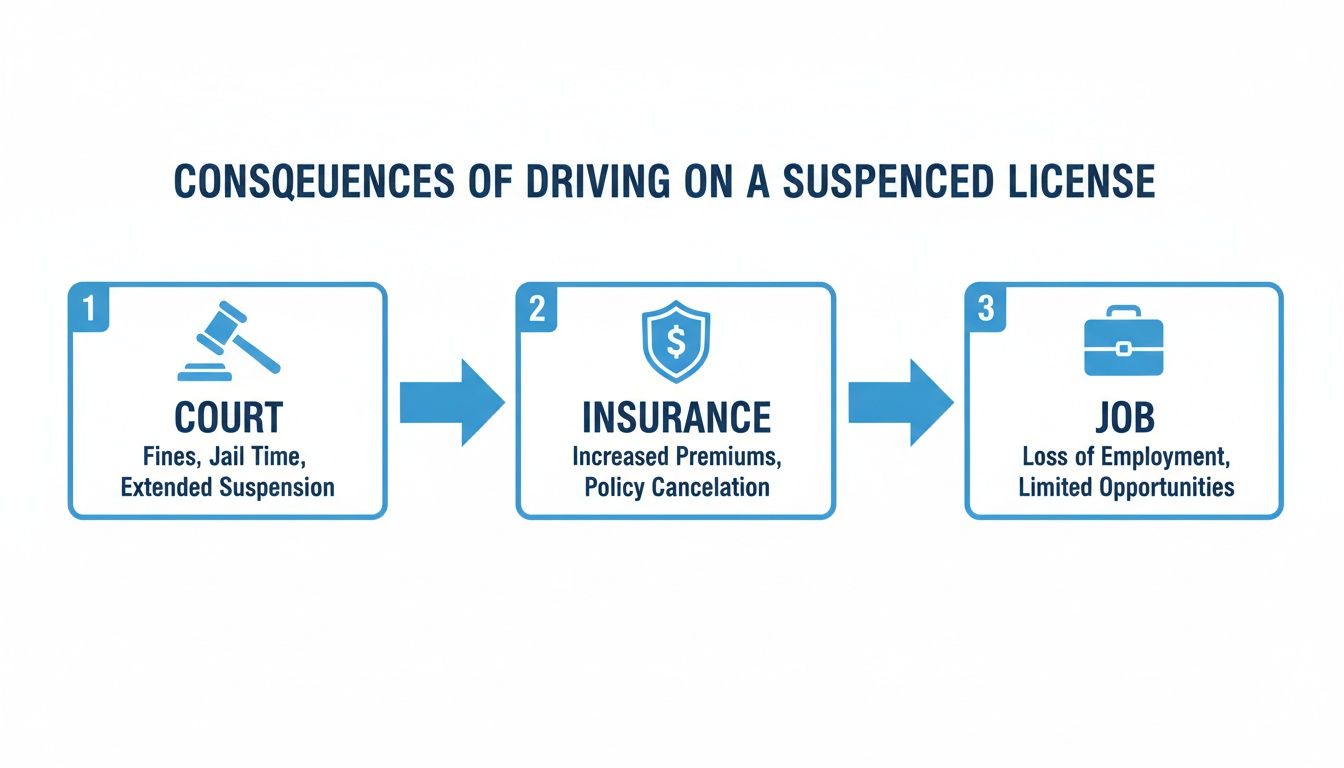
This flow highlights how a single decision can lead to a web of challenges in court, with your insurer, and even in your professional life.
How a Traffic Law Firm Can Help
Trying to reinstate a suspended license in Florida on your own can feel like you’re trapped in a bureaucratic maze. While you can technically handle it yourself, the confusing forms, strict deadlines, and tangled legal requirements often lead to frustration and delays. Partnering with a law firm that focuses on traffic defense can provide a clear path and a strategic edge.
An experienced attorney does a lot more than just fill out paperwork. They start by digging into the root cause of your suspension—was it an old, unpaid ticket in Sarasota County, a DUI charge, or just too many points piling up? By pinpointing the exact problem, they can map out the quickest and most effective way to get you back on the road.
Our entire goal is to protect your license and your record. We take on the headache of dealing with the FLHSMV and the courts, making sure every single requirement is met on time and correctly. It’s a proactive approach designed to help you sidestep the common mistakes that can drag out the reinstatement process for months.
Attorney Advertisement. Office in Broward.
Strategic Representation and Guidance
A key part of a traffic law firm's job is to stand up for your interests in any formal proceeding. If you're eligible for a hardship license, for example, your lawyer will build your case and argue on your behalf at the administrative hearing. Their experience with the system and what hearing officers look for can make a huge difference in the outcome.
They also get to work on fixing the underlying issues that got your license suspended in the first place. That might mean negotiating with a court to finally resolve an old citation or even challenging the legal basis for the suspension itself. For an overview of the services and operational aspects of various legal firms, you might want to learn more about legal firms and their specialized roles.
Past results do not guarantee future outcomes. Our practice focuses on protecting your driving privileges by addressing both the administrative suspension and any related traffic offenses.
A Clear Path Forward
At the end of the day, working with a lawyer is about getting a clear, actionable plan. Instead of guessing what to do next, you have a professional guiding you through every step, from completing the right courses to submitting the final reinstatement fees. That support saves you time, cuts down on stress, and helps you get back behind the wheel safely and legally.
If you're dealing with a suspended license, you don't have to figure it all out alone. Learn more about how a suspended license lawyer can help with your specific situation. Contact us today for a free, no-obligation consultation to discuss your case. Submitting information does not create an attorney-client relationship.
Frequently Asked Questions
When your license is on the line, you're going to have questions. Getting straight, clear answers is the first step toward getting back on the road. Here are some of the most common questions we hear from drivers across Florida.
How Can I Check if My Florida Driver License Is Suspended?
The fastest, most reliable way to know for sure is to use the official Florida Highway Safety and Motor Vehicles (FLHSMV) online portal. It's a free service, and all you need is your driver's license number.
The system will give you an instant, clear answer: valid, suspended, or revoked. More importantly, it will show you the specific case or citation numbers tied to the suspension. That's the exact information you need to start figuring out what went wrong and how to fix it.
Am I Eligible for a Hardship License for Work?
In many cases, yes. Florida offers what's officially called a "Business Purposes Only" (BPO) license, but most people just call it a hardship license. This restricted permit lets you drive for essential activities, like getting to and from work, driving as part of your job, or attending school.
Your eligibility really depends on why your license was suspended in the first place. Some serious offenses, like a DUI, require you to serve a "hard time" period where you can't drive at all before you can even apply. Getting one involves a formal application and an administrative hearing with an FLHSMV officer who will review your case and make the final call.
How Long Will a Suspension Affect My Florida Driving Record?
A suspension leaves a long-lasting mark. The suspension itself, along with the violation that caused it (like a DUI conviction or too many points), will stay visible on your official Florida driving record for years. Law enforcement and insurance companies will see it.
Even after you've jumped through all the hoops and gotten your full license back, this history can still follow you. Insurance providers often see a past suspension as a major red flag, which can lead to painfully high premiums that stick around for years. The goal isn't just to get your license back—it's to keep your record clean from here on out to dodge those long-term financial hits.
What Is the Difference Between a Suspension and a Revocation?
It's easy to use these terms interchangeably, but in the eyes of the FLHSMV, they are worlds apart. Understanding the difference is critical.
A suspension is like a temporary time-out for your driving privileges. Once you serve the required time and complete all the steps—paying fines, finishing courses, etc.—your license can be restored.
A revocation, on the other hand, is the complete termination of your license. It's cancelled. After a revocation period ends, you can't just reinstate your old license. You have to start over from scratch and reapply for a brand new one, which often means retaking the written, vision, and driving exams all over again.
Dealing with a suspended license in Florida is a complex and often stressful process. At Ticket Shield, PLLC, our practice is focused on traffic and DUI defense, and our goal is to protect your license and record. Don't navigate the system alone—contact us for a free, no-obligation consultation to understand your options.
Take the first step and get your free consultation from Ticket Shield, PLLC today.
