
How to Remove Points from Your Driving Record in Florida
Learn how to remove points from driving record with practical steps, including traffic school, contesting tickets, and protecting your license.
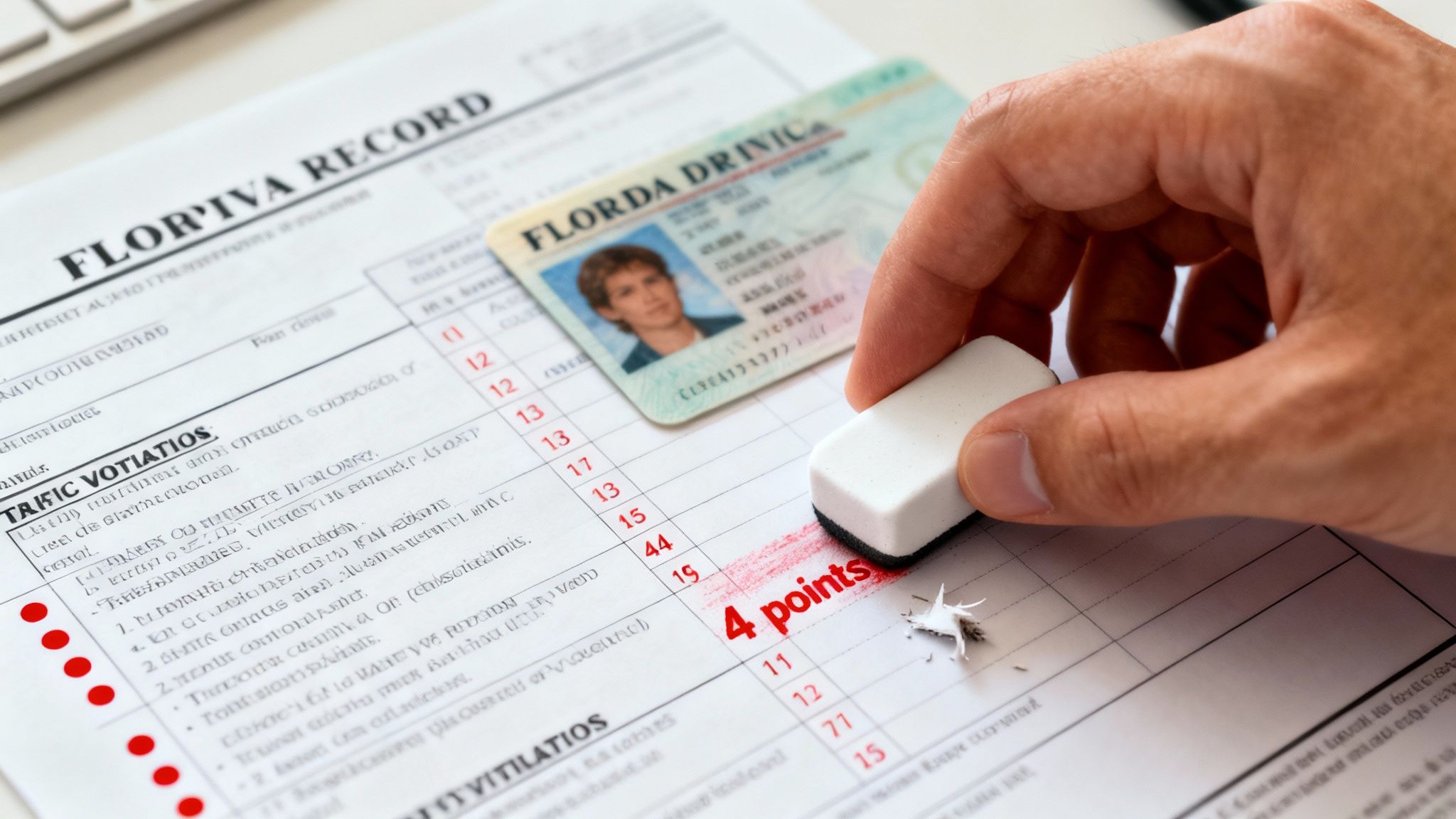
When you get a traffic ticket in Florida, your first thought is probably about points on your driving record. It's a valid concern. The two main ways to avoid points are either electing to attend a Basic Driver Improvement (BDI) course or contesting the ticket in court.
Knowing how the system works is your best defense against a tainted record and higher insurance rates. Our goal is to protect your license and record.
Understanding the Florida Driver Point System
The Florida Driver Point System isn't just an abstract concept; it's a real framework the Florida Department of Highway Safety and Motor Vehicles (FLHSMV) uses to track driving behavior. When you're found guilty of a moving violation, the state attaches a point value to that offense on your record. These aren't just numbers—they have serious, real-world consequences that can follow you for years.
Think of your driving record as your official driving report card. To get the full picture of how this is documented, it helps to understand what a Motor Vehicle Record (MVR) check is. Every conviction gets logged there, creating a detailed profile that insurance companies and even potential employers can pull.
Why Points Matter So Much
The more points you get, the more the state starts to pay attention. A minor infraction, like going 15 mph or less over the speed limit, might only add three points. But a more serious violation, like leaving the scene of an accident with property damage, can add six points on your record in one go.
For most drivers, the biggest worries are:
Insurance Premium Hikes: Your insurance company doesn't miss much. They regularly check driving records, and a conviction for a moving violation—especially one that adds points—labels you a higher risk. That often leads to a jump in your premiums.
License Suspension: The FLHSMV has very clear thresholds for suspension. Rack up too many points in a certain timeframe, and you'll lose your driving privileges. That can throw your entire life off-kilter, affecting your job, your daily commute, and your freedom.
Long-Term Record Impact: While the points used for suspension calculations expire, the conviction itself sticks around much longer, usually for at least five years.
How Long Do Points Stay on a Florida Record?
This is a really important distinction. The points themselves count toward a potential suspension for 36 months (three years) from the date you were convicted.
But the violation that caused the points? That stays visible on your public driving record for a minimum of five years, and for very serious offenses, even longer. Insurance companies can see that conviction long after the points have "expired" for suspension purposes.
You can learn more about how different violations add up in our detailed guide on the Florida traffic ticket point system.
Here in Florida, if you accumulate too many points within a specific window, you're facing an automatic license suspension.
Florida Point System Suspension Thresholds
Points Accumulated | Time Period | Length of Suspension |
|---|---|---|
12 points | 12 months | 30 days |
18 points | 18 months | 3 months |
24 points | 36 months | 1 year |
It's a straightforward but unforgiving system. Once you hit one of these thresholds, the clock starts on your suspension.
The idea of using points to promote safer driving isn't unique to Florida. These systems are common worldwide. For example, France has used a subtractive points system since 1992, where drivers start with 12 points and lose them for infractions. Their model also includes ways to earn points back, showing a balanced approach to road safety.
Attorney Advertisement: This blog post is for informational purposes only and does not constitute legal advice. Submitting information through our forms does not create an attorney-client relationship. Our goal is to protect your license and record. Past results do not guarantee future outcomes. Office in Broward.
Choosing Traffic School to Avoid Points
For most drivers in Florida, opting for a Basic Driver Improvement (BDI) course—what we all just call traffic school—is often the quickest and cleanest way to keep points off your license. It’s a proactive choice that lets you handle a ticket and sidestep the bigger headaches that come with a conviction.
When you elect traffic school, you’re basically striking a deal with the court. You agree to take a driver safety course, and in return, the court agrees to a "withholding of adjudication." It's a key legal term that means while you still have to pay the ticket fine, you're not officially found guilty.
The biggest benefit here? No points are added to your driving record. Florida law also prohibits your insurance company from raising your rates or canceling your policy because of that specific ticket.
Who Is Eligible for Traffic School
Not everyone gets this option, though. The state has some pretty clear rules about who qualifies for BDI, so you need to check if you fit the criteria before you do anything else.
Generally, you can choose traffic school if:
You haven't taken a BDI course for a ticket in the past 12 months.
You haven't used this option more than five times in your life.
Your ticket was for a non-criminal moving violation.
This route is off the table for serious offenses like DUIs or reckless driving. And a heads-up for commercial drivers: if you got a ticket in your commercial vehicle, you typically can't elect traffic school to keep points off your CDL.
This flowchart breaks down the two main choices you have right after you get a ticket.
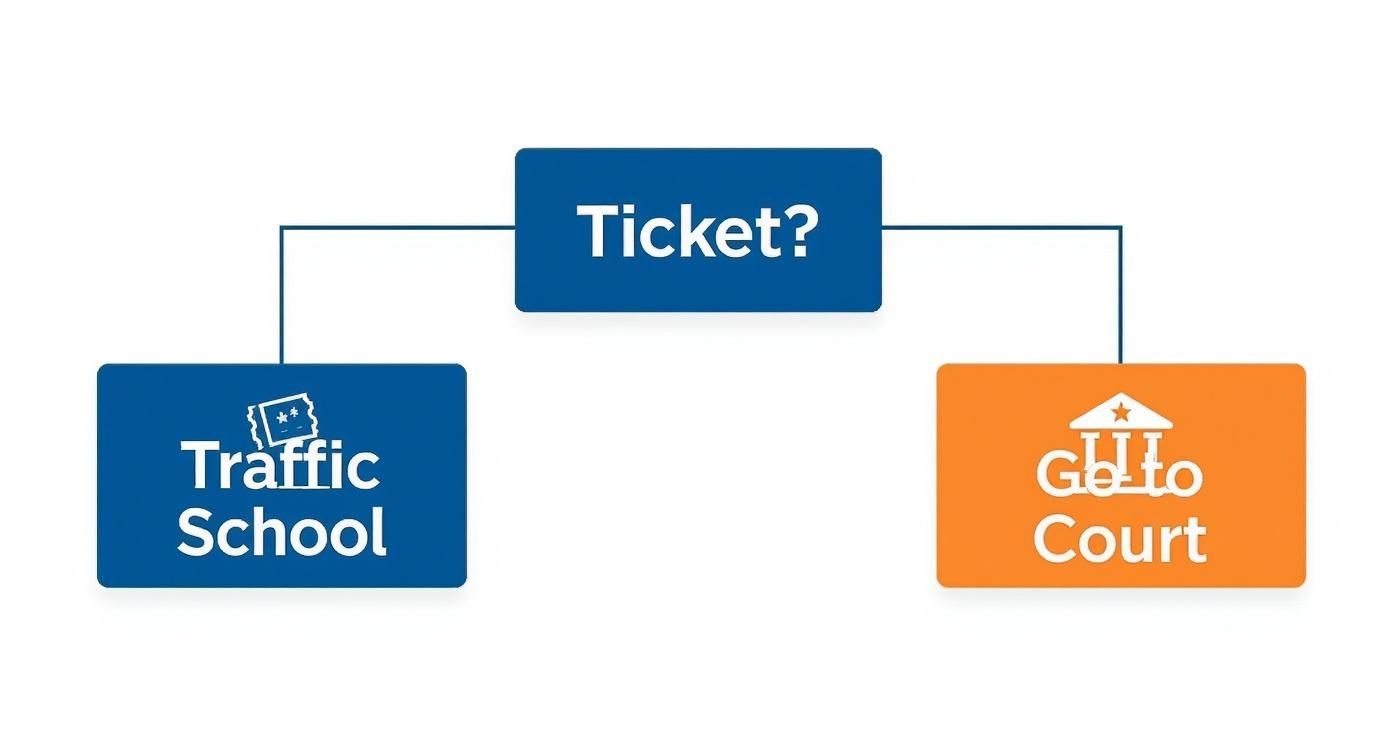
As you can see, you have to decide pretty quickly whether to go the traffic school route or prepare to fight it in court.
The Process for Electing and Completing BDI
If you’re eligible, the process itself is straightforward, but you have to be on top of the deadlines. One missed step and you could end up with a conviction and points on your record anyway.
First, you must inform the Clerk of Court in the county where you got the ticket that you want to elect traffic school. You have to do this within 30 days of the citation date. When you do, you’ll also pay the fine listed on your ticket. This isn't just a casual heads-up; it's a formal declaration.
Once you’ve paid up and made your election, the clock starts ticking. You’ll be given a set amount of time to complete a state-approved BDI course. These are usually four-hour courses, and you can find plenty of them online or in a classroom. Just make sure the provider is officially approved by the FLHSMV so your completion actually counts.
After you pass the course, you’ll get a certificate of completion. It’s your job to get that certificate to the Clerk of Court before your deadline. Many online schools will offer to file it for you (sometimes for a small fee), which is a great way to make sure it gets there on time.
Important Reminder: Just paying the fine is an admission of guilt. If you don't officially notify the Clerk that you're electing traffic school, you'll get a conviction, the points will go on your license, and you'll lose the chance to take the BDI course for that ticket.
Contesting Your Traffic Ticket in Court
Traffic school is a solid option for a lot of drivers, but it's not the only one. Sometimes, the right move is to contest the ticket in court. Pleading not guilty is a big decision, but if you want that ticket dismissed or reduced to a lesser charge, it's often the only path to keeping points off your record.
Going to court is a different ballgame than signing up for a class. Nothing is guaranteed. But with the right preparation, you can challenge the evidence and present a strong case. Our practice focuses on traffic and DUI defense, and our goal is to protect your license by scrutinizing every detail of your citation.

Developing a Defense Strategy
Walking into court and just hoping for the best isn't a strategy—it's a gamble. A real defense means digging into the state's case against you to find its weak spots.
So, where do you start looking?
Procedural Errors: Did the officer fill out the ticket correctly? A major mistake, like citing the wrong statute or getting the location completely wrong, can sometimes be enough to get a ticket thrown out.
Equipment Malfunctions: Those radar and laser guns aren't infallible. We always question if the device was properly calibrated and if the officer who used it was actually certified to do so.
The Officer's Point of View: A lot of tickets, like "improper lane change," are based on the officer's subjective opinion. We can challenge that view by bringing in facts about the traffic conditions, road layout, or other factors they may have overlooked.
Your case needs to be presented respectfully and factually. And for more complex cases or appeals where every word matters, using professional legal court transcription services can be critical for creating an accurate record of the proceedings.
What to Expect in Traffic Court
Traffic court is less formal than what you see in a criminal trial on TV, but don't be fooled. The rules of evidence and procedure are still in play. Either you or your attorney will get a chance to question the officer who wrote the ticket, present your own evidence, and make your arguments directly to the judge.
The outcome can go a few different ways. The judge might dismiss the case, find you not guilty, or find you guilty but agree to withhold adjudication (which means no points) or reduce the charge to a non-moving violation. Of course, there's also the risk of being found guilty and getting hit with the original fine, points, and court costs.
Attorney Advertisement: This blog post is for informational purposes only and does not constitute legal advice. Our goal is to protect your license and record. Past results do not guarantee future outcomes. Office in Broward.
The Role of a Traffic Ticket Attorney
Let's be honest—navigating the court system is intimidating if you don't do it every day. An experienced traffic attorney lives in this world. We know the local procedures, the judges, and the officers, and we can spot defense angles you'd likely miss. We handle criminal traffic matters across Florida and know what it takes to build a defense aimed at a favorable outcome.
An attorney can also appear in court for you, so you don't have to miss work. But the real value is in having a professional negotiate with the prosecutor or present your case in a way that's clear, compelling, and legally sound. The whole point is to stop those points from ever touching your record.
Choosing to fight is a strategic decision. To get a better feel for the kinds of defenses that work, check out our guide on whether you can fight a speeding ticket. A free consultation can help you figure out the best move for your specific situation.
Long-Term Consequences of Points on Your Record
A traffic ticket feels like a one-time hassle, but the reality is that the consequences can follow you for years. Those points on your Florida driving record aren't just numbers on a page—they have real weight, impacting everything from what you pay for insurance to whether you can legally drive at all.
Thinking of a ticket as just a fine is a mistake. It’s an investment in your future to take every single one seriously.
The Financial Hit from Higher Insurance Premiums
The most immediate and painful long-term consequence of points is the spike in your auto insurance rates. To insurers, a driver with points is a higher risk, and they don't hesitate to adjust your premiums to match that liability. Even a single speeding conviction can trigger a rate hike you'll be paying for years to come.
Let's put it in real terms. Say you get caught driving 16 mph over the speed limit. In Florida, that's a four-point violation. The fine might sting for a moment, but the real damage is what comes next. Your insurance company could easily raise your semi-annual premium by 20% or more. Over the next three to five years, that adds up to hundreds, sometimes thousands, of extra dollars out of your pocket.
Florida’s License Suspension and Revocation Rules
It’s not just about the money. Points put your actual driving privileges on the line. The Florida Department of Highway Safety and Motor Vehicles (FLHSMV) has a no-nonsense, cumulative point system. As we mentioned earlier, racking up just 12 points in 12 months gets you a 30-day suspension.
And it gets worse from there. If you hit 18 points in 18 months, that’s a three-month suspension. Get to 24 points in 36 months, and you're off the road for a full year. These aren't just warnings; they're mandatory actions that can completely derail your daily life.
Attorney Advertisement: This blog post is for informational purposes only and does not constitute legal advice. Our goal is to protect your license and record. Past results do not guarantee future outcomes. Office in Broward.
One of the most severe penalties is being labeled a Habitual Traffic Offender (HTO). This happens if you get three or more convictions for serious offenses—like DUI or driving on a suspended license—within five years. The result is a five-year driver's license revocation. For most people, that’s a life-altering event.
The Costly Path to License Reinstatement
If your license does get suspended, getting it back isn't as simple as just waiting it out. It's a process that costs both time and money.
To reinstate your license after a point-related suspension in Florida, you'll generally have to:
Complete an Advanced Driver Improvement (ADI) Course: This isn't your basic traffic school. It's a mandatory 12-hour course for suspended drivers.
Pay Reinstatement Fees: These are separate from your ticket fines and can be quite hefty.
Provide Proof of FR-44 Insurance: For serious violations like a DUI, you're required to carry much higher liability coverage, which comes with a much higher price tag.
Each one of these steps is another financial and logistical hurdle. The best strategy is always to protect your record from the start. Our practice focuses on traffic and DUI defense because we know how crucial it is to help drivers avoid these damaging long-term outcomes.
How Florida Tickets Affect CDL Holders and Out-of-State Drivers
For most people, a traffic ticket is just a pain. It's an unexpected expense and a frustrating bump in the road. But if you hold a Commercial Driver's License (CDL) or you're just visiting from out of state, that little piece of paper is a much bigger deal.
The stakes are suddenly a lot higher. The usual "just pay it" or "go to traffic school" options might not work for you, and a single mistake can put your career on the line or create a legal mess that follows you home.
The High Stakes for CDL Holders
If you drive for a living, your CDL isn't just a license—it's your livelihood. Florida law and federal regulations are very strict when it comes to commercial drivers, and even a minor moving violation can have a massive impact.
Here's the most important thing to know: CDL holders are not eligible to elect traffic school to avoid points. This isn't just for tickets you get in your rig; it applies to violations in your personal vehicle, too. That option is completely off the table. A conviction means points on both your regular Class E license and your CDL.
This immediately puts you in a tough spot:
Your Job is at Risk: Many trucking companies have strict policies about points on a driver's record. A single conviction could get you fired or make it nearly impossible to land another job.
Federal Rules Apply: The Federal Motor Carrier Safety Administration (FMCSA) has its own set of rules. Some "serious violations" can lead to an immediate CDL disqualification, even if it's your first offense.
Insurance Goes Through the Roof: Commercial insurance is already expensive. A conviction on your record will almost certainly drive up your employer's premiums, making you a more costly—and less desirable—employee.
Since taking a class to wipe away the points isn't an option, the only way to protect your CDL is to fight the ticket. We handle these cases all over Florida, and we understand the pressure you're under. Your career is on the line, and our entire focus is on protecting it.
How Out-of-State Drivers Are Impacted
Got a ticket while on vacation in Florida? The temptation is to just pay it online and get on with your life. This is a common mistake, and it can come back to haunt you.
Thanks to an agreement called the Driver's License Compact (DLC), what happens in Florida definitely does not stay in Florida.
This is an interstate pact where states agree to share driver information. With 45 states as members, there's a very high chance your home state's DMV will hear all about that Florida ticket.
Here's the Catch: When Florida reports the conviction, your home state will treat it as if it happened there. They'll then slap points on your license based on their rules, not Florida's.
You might not hear anything for months. Then, out of the blue, you get a letter from your DMV saying you've got points on your record. Worse, it could trigger a license suspension or a huge insurance hike that you never saw coming. Contesting the ticket from the start is the only reliable way to prevent that from happening.
Attorney Advertisement: This content is for informational purposes and is not legal advice. Submitting information via our forms does not create an attorney-client relationship. Our goal is to protect your license and record. Past results do not guarantee future outcomes. Office in Broward.
When to Hire a Traffic Ticket Attorney
Let's be real—most minor traffic tickets don't require an attorney. But some situations are different. Sometimes, what looks like a simple ticket can snowball into a major problem, threatening your license, your job, and your insurance rates for years.
Knowing when to call for help is key. It’s not just about one fine; it’s about protecting your entire driving record from long-term damage.
Red Flags That Mean You Need a Lawyer
Some tickets are clear warning signs. If you're looking at a criminal traffic charge—things like reckless driving, DUI, or leaving the scene of an accident—you should not handle it alone. The stakes are just too high.
Another major red flag? When a new ticket could push you over the edge into a license suspension. If you've already got points on your record, one more conviction might be all it takes to lose your driving privileges. That’s a risk you shouldn’t take.
When Your License is Your Livelihood
For commercial drivers (CDL holders), any ticket is a serious matter. In Florida, CDL holders can't just take traffic school to wipe away points. A conviction goes straight onto your record, and that can put your job on the line. You need an attorney who understands the nuances of both state traffic laws and federal CDL regulations to protect your career.
Are you an out-of-state driver who got a ticket in Florida? Don't assume you can just pay it and forget it. That ticket follows you home. Thanks to interstate agreements, the points can transfer to your home state's license, leading to surprises from your own DMV.
The Real Value of Professional Legal Counsel
A good traffic attorney does more than just show up in court. They're trained to spot the little things that get tickets thrown out—procedural mistakes on the citation, flawed evidence, or an officer’s testimony. They know how to negotiate with prosecutors for reduced charges or alternative resolutions you'd never get on your own.
Our practice focuses on traffic and DUI defense here in Florida. We live and breathe this stuff. Our job is to find a path to a dismissal or a reduced penalty that keeps your record clean. To get a better feel for this decision, check out our in-depth guide on whether you need a lawyer for a traffic ticket.
The whole point system is designed to change driver behavior, and studies show it works. One program in Italy was credited with preventing over 1,500 fatalities in just 18 months because drivers feared losing their licenses. But for the system to be fair, you need a way to fight back when you're wrongly cited—and that’s where professional legal help makes all the difference. You can see the global data on these systems for yourself.
Attorney Advertisement: This content is for informational purposes only and is not legal advice. Submitting information via our forms does not create an attorney-client relationship. Our goal is to protect your license and record. Past results do not guarantee future outcomes. Office in Broward.
Frequently Asked Questions About Florida Traffic Tickets
Getting a ticket brings up a lot of questions and, frankly, a lot of confusion. Let's clear the air and tackle some of the most common things Florida drivers ask about points, traffic school, and insurance hikes.
Can I Pay the Ticket Now and Pick Traffic School Later?
Absolutely not. This is probably the single biggest mistake you can make.
In Florida, when you pay that fine, you’re legally admitting guilt. The court considers the case closed, finds you guilty, and sends the conviction straight to the FLHSMV. The points hit your license almost immediately.
To avoid this, you have to formally elect the traffic school option with the Clerk of Court in the county where the officer wrote the ticket. You must make this election when you pay the fines and court costs—all within 30 days of getting the citation. It’s a one-shot deal.
How Long Will a Ticket Affect My Insurance?
Here's where things get tricky. The FLHSMV uses a point system to track violations over 12 to 36-month periods for license suspension purposes. But that’s just one piece of the puzzle.
Those points and the underlying conviction stay visible on your public driving record for at least five years. Insurance companies pull this record every time your policy is up for renewal, and they see everything. A single ticket can keep your premiums high for years, long after the points have technically "expired" for state suspension purposes.
Attorney Advertisement: This blog post is for informational purposes only and does not constitute legal advice. Submitting information through our forms does not create an attorney-client relationship. Our goal is to protect your license and record. Past results do not guarantee future outcomes. Office in Broward.
What Happens if I'm Not Eligible for Traffic School?
You’ve hit a wall. If you've already been to traffic school in the last 12 months or you've used the option five times in your life, you can't elect it again.
Your options narrow significantly at this point. You can either plead guilty, accept the conviction, and take the points on your license, or you can plead not guilty and fight the ticket in court.
This is exactly the moment when getting professional legal help is a smart move. An attorney can dig into the details of your case, find potential defense strategies you wouldn't know to look for, and work toward getting the case dismissed or the charge reduced. It's all about protecting your record.
If you're facing a traffic ticket in Florida and need to protect your driving record, Ticket Shield, PLLC can help. Our practice focuses on traffic and DUI defense across all 67 counties. Call us for a free consultation to discuss your options. Learn more at https://www.ticketshield.com.
