Can I Fight a Speeding Ticket in Florida?
Wondering can I fight a speeding ticket in Florida? This guide breaks down your options, defenses, and the court process to protect your record.
Yes, you can fight a speeding ticket in Florida. It's an option every driver has, and it's worth considering before you decide to simply pay the fine.
Many drivers choose to pay the fine just to resolve the issue quickly. However, paying the fine is an admission of guilt. This results in a conviction on your record, which automatically adds points to your license and can lead to an increase in your insurance rates.
What to Do in the First 30 Days
From the moment you receive a ticket, a 30-day period begins. The decision you make within this timeframe can affect your driving record and finances for years to come. It's important to understand your options before acting.
In Florida, you have three primary paths to choose from. Let's break down what each one entails.
Your Three Choices After a Ticket
You must select one of these options before the 30-day deadline. Missing this deadline can lead to the state suspending your license.
Pay the Fine: This is often seen as the easiest route, but it constitutes an admission of guilt. The conviction is added to your record, points are assessed, and your insurance rates will likely go up.
Elect Traffic School: This option can keep points off your license. However, you are still responsible for paying the full fine in addition to the cost of the school. The violation also remains on your permanent driving record. You can only elect this option once every 12 months and a maximum of five times in your life.
Request a Court Date: This involves pleading not guilty and challenging the ticket. It is the only option that offers the possibility of having the ticket dismissed, which would mean no fine, no points, and no impact on your insurance.
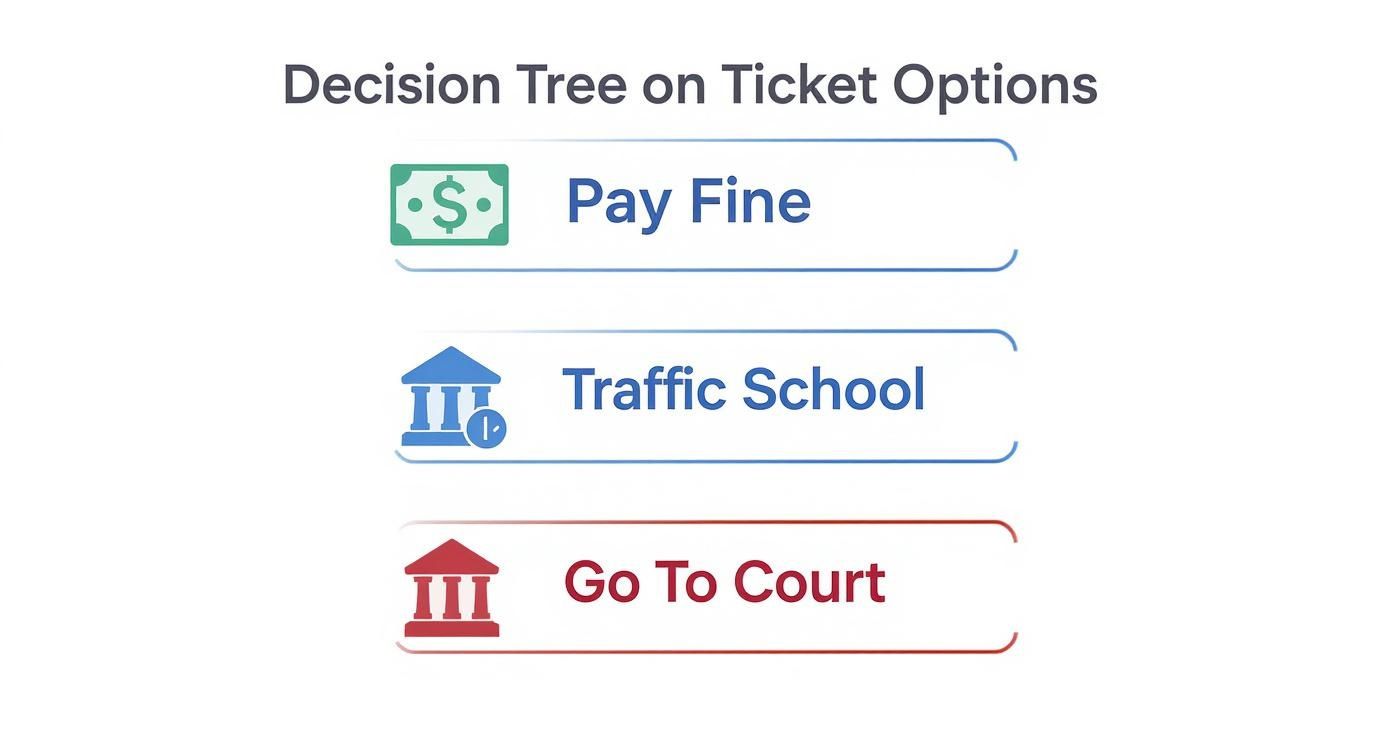
As you can see, going to court is the only way to potentially have all penalties waived.
Quick Guide to Your Florida Speeding Ticket Options
Within 30 days of receiving your ticket, you must choose one of the following paths. This table summarizes what each option means for your record and finances.
Option | Immediate Action | Impact on Your Record | Best For |
|---|---|---|---|
Pay the Fine | Admit guilt and pay the citation amount. | Guilty verdict. Points are added, and the violation appears on your record. | Drivers who want the quickest resolution and are not concerned about long-term insurance increases. |
Elect Traffic School | Pay the fine plus school fees and complete a course. | Adjudication withheld. No points are added, but the violation remains on your permanent record. | Eligible drivers (once per year, 5 times per lifetime) who want to avoid points. |
Go to Court | Plead not guilty and prepare to challenge the citation. | Potential for dismissal. A successful outcome means no points, no fine, and a clean record for this incident. | Drivers seeking the chance to avoid all penalties, who believe there are grounds for a challenge, or who wish to have a professional fight on their behalf. |
Choosing to fight is a strategic decision aimed at protecting your driving record and avoiding increased costs for the next several years.
The Real Cost of a Guilty Plea
The fine listed on your ticket is only the beginning. The more significant financial impact often comes from the points assessed against your license. A single speeding conviction can cause your insurance premiums to increase by hundreds, or even thousands, of dollars over the next three to five years.
For individuals with a Commercial Driver's License (CDL), the stakes are even higher, as a conviction can impact their employment.
Before making a decision, it is helpful to understand the full process of what happens when you get a speeding ticket. An informed choice within the first 30 days can prevent significant future complications.
How to Properly Contest Your Ticket and Meet Court Deadlines
If you've decided to fight your ticket, it's essential to follow the correct legal procedures. The process begins with formally notifying the court system that you are challenging the charge.
Your first step is to enter a "not guilty" plea with the Clerk of Court in the county where you received the citation. This is a formal request, typically submitted by mail or through the county clerk’s website. This action officially signals your intent to contest the ticket.
The Unforgiving 30-Day Deadline
It is critical to understand that you have 30 days from the date on the ticket to act. Within this period, you must either pay the fine, elect traffic school, or notify the Clerk of Court that you are pleading not guilty.
This is a strict deadline with no extensions. If you fail to act within 30 days, the state considers it an admission of guilt. The Florida Department of Highway Safety and Motor Vehicles (DHSMV) is notified, and they can automatically suspend your driver's license. Reinstating it involves paying the original ticket, late fees, and a reinstatement fee.
Key Takeaway: Missing the 30-day deadline is equivalent to pleading guilty. Your opportunity for a hearing is lost, and the penalties accumulate, beginning with a potential license suspension.
Submitting Your Not Guilty Plea
To initiate the process, you should follow the instructions on the ticket or visit the county Clerk of Court's website. The process generally involves these steps:
Find the Right Paperwork: Most counties provide a specific form or an online portal for entering your plea.
Provide Accurate Details: You will need the citation number, your name, and your address exactly as they appear on the ticket. Any discrepancies can cause delays.
Submit in Writing: Your plea must be a clear, written statement. If an official form is not available, a simple signed letter requesting a court hearing is usually sufficient.
Always keep a copy of your submission and proof of delivery, such as a mailing receipt or a confirmation email. This documentation is crucial for verifying that you met the deadline.
What Happens After You Plead Not Guilty
Once the Clerk's office processes your plea, a hearing will be scheduled. You will not receive a court date immediately. The court will mail a "Notice to Appear" to the address listed on your ticket, specifying the date, time, and location of your hearing.
This process can take several weeks or even a couple of months, depending on the court's schedule. It is your responsibility to ensure the address on your ticket is current and to monitor your mail. If you move, you must update your address with both the DHSMV and the Clerk of Court. Stating that you never received the notice is generally not considered a valid excuse by a judge and can lead to a license suspension and a ruling against you.
Building a Strong Defense Strategy for Your Case
Once you have decided to fight your ticket, the next step is to build a defense. A strong defense is based on facts, evidence, and identifying potential procedural errors. The goal is to challenge the state's evidence and protect your driving record.
A common misconception is that the only defense is proving you were not speeding. In reality, many successful defenses focus on the evidence presented by the officer and whether the proper procedures were followed. The objective is to create reasonable doubt.
Questioning the Speed Measurement Device
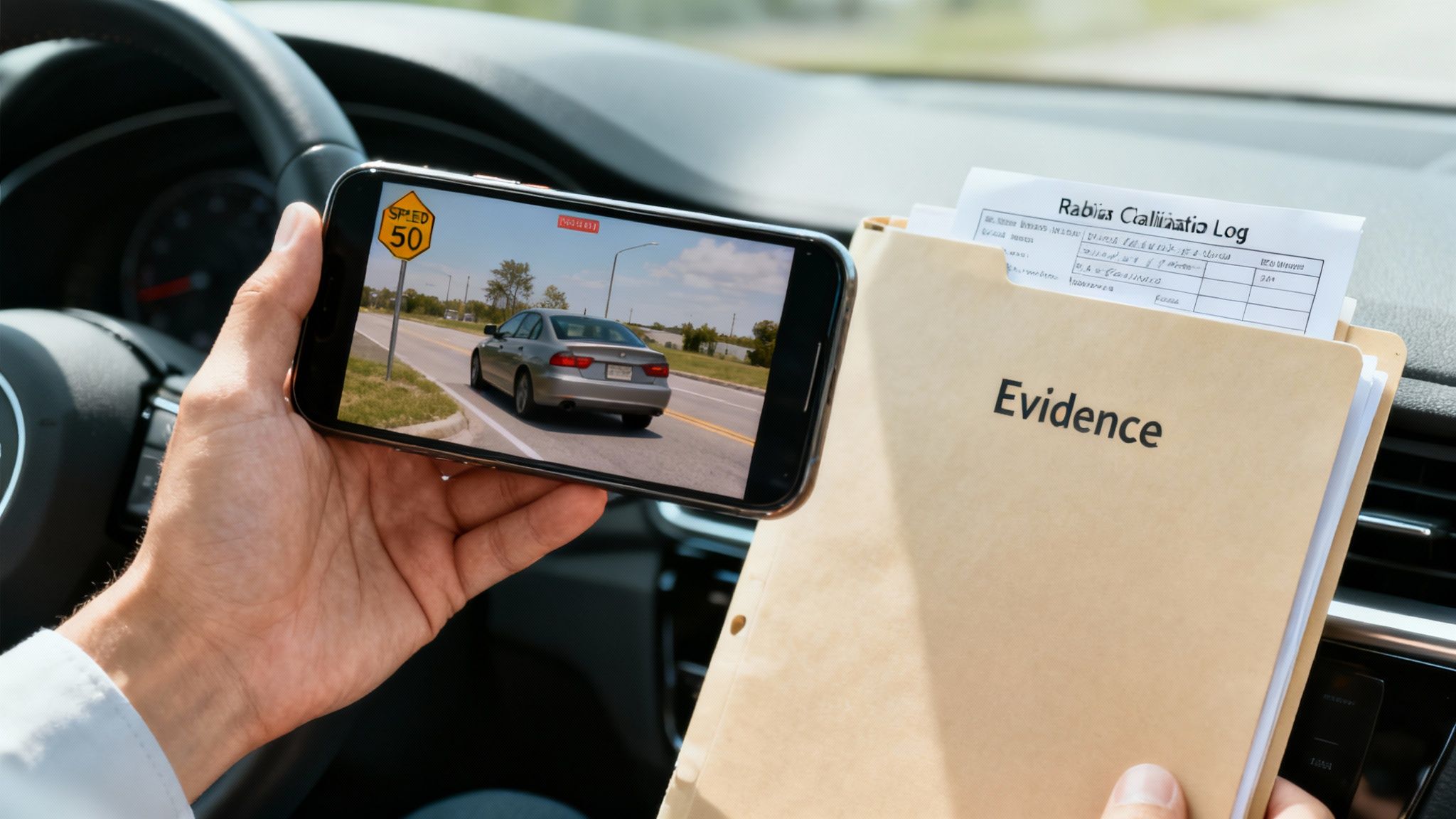
The prosecution's case typically relies on the reading from a radar or laser (LIDAR) device. These instruments require regular maintenance and calibration to ensure accuracy, and the officer must be trained in their proper use.
This provides an opportunity for a defense. An attorney focused on traffic matters will often request the maintenance and calibration logs for the specific device used in your case. If these records show missed service dates or other irregularities, the accuracy of the speed reading can be called into question.
Furthermore, the officer must be certified to operate the specific model of the device used. Any procedural inconsistencies can weaken the prosecution's primary piece of evidence.
Common Defenses and How to Use Them
Challenging the speed measurement device is a common strategy, but it is just one of many. A comprehensive defense examines every detail of the traffic stop. Here is a breakdown of some common strategies and the evidence needed to support them.
Defense Strategy | Key Argument | Evidence to Gather | Potential Hurdles |
|---|---|---|---|
Faulty Equipment | The radar/LIDAR gun was inaccurate due to improper maintenance or calibration. | Calibration logs, maintenance records, officer's training certificate. | Courts tend to give weight to official records, so clear evidence of a lapse is needed. |
Mistaken Identity | The officer clocked another vehicle in heavy traffic and wrongly attributed the speed to you. | Dashcam footage, photos of the scene showing multiple lanes or traffic congestion, your own notes. | This can become a matter of credibility without strong visual evidence. |
Obstructed View | The officer’s line of sight was blocked by a hill, curve, or large vehicle, leading to an inaccurate reading. | Photos/videos of the location from both your and the officer's perspective. | The state may argue the officer was trained to account for environmental factors. |
Mistake of Fact | The speed limit sign was missing, obscured by foliage, or unreadable. | Dated photos of the sign (or lack thereof), witness statements. | The prosecution may argue that the driver should have known the speed limit for that type of road. |
Emergency/Necessity | You were speeding to avoid a more serious and immediate danger (e.g., preventing an accident). | Dashcam video, witness testimony, police accident reports from the related incident. | This defense has a high standard of proof; you must show there were no other reasonable alternatives. |
Clerical Errors on Ticket | The citation contains significant errors (wrong date, location, statute) that may invalidate it. | A copy of the ticket itself. | Minor typographical errors are often overlooked; the error must be substantial enough to cause confusion. |
These approaches demonstrate that a defense can be built on technical and procedural grounds, not just on disputing the officer's account.
Gathering Your Own Evidence
While the state has the burden of proof, presenting your own evidence can be beneficial. The time immediately following the traffic stop is the best opportunity to begin collecting it.
As soon as it is safe to do so, write down everything you remember about the stop, including the location, traffic conditions, and any statements made. Detailed notes are valuable, as memories can fade.
Next, consider physical proof. If you have a dashcam, save the footage immediately. It provides an objective record of your speed, other vehicles, and the officer’s position. It can also be helpful to safely return to the scene later to take photos or videos with your phone.
What kind of photos can help your case?
Images of faded, obscured, or missing speed limit signs.
Pictures of a curve or hill that might have blocked the officer's line of sight.
Photos showing heavy traffic conditions that could make it difficult to single out one vehicle.
This type of evidence transforms your defense from a simple denial into a fact-based argument. It gives the judge tangible information to consider and can effectively counter the officer's testimony. Our goal at Ticket Shield is to protect your license and record. Please remember that past results do not guarantee future outcomes, and you should always consult a licensed attorney for legal advice on your specific case.
What to Expect in Florida Traffic Court
Appearing in court for the first time can be an intimidating experience. However, understanding the process can help alleviate anxiety. Knowing the procedures is the first step toward confidently addressing your speeding ticket.
While traffic court is less formal than a major criminal trial, professional decorum is still important. Dress respectfully (business casual is a safe choice), address the judge as "Your Honor," and remain quiet until your case is called. Simple courtesies, such as silencing your phone, can make a positive impression.

The Sequence of a Traffic Hearing
When your case is called, the proceedings will follow a standard order. The state, represented by the police officer, presents its case first. This is because the state has the burden of proof—it must provide sufficient evidence to convince the judge that you committed the violation.
The typical flow of a hearing is as follows:
The Officer's Testimony: The officer will be sworn in and will describe the incident, including the date, time, location, the posted speed limit, and the method used to determine your speed.
Your Cross-Examination: After the officer's testimony, you or your attorney will have the opportunity to ask questions. This is a critical part of your defense.
Presenting Your Case: Following the cross-examination, it is your turn to present your case. This is when you can testify, present evidence such as dashcam video or photos, and call any witnesses.
The Judge's Ruling: After hearing both sides, the judge will issue a ruling—guilty or not guilty—and determine any applicable fines or penalties.
Understanding this sequence helps you prepare and anticipate each step of the process.
Cross-Examining the Officer Effectively
Cross-examination is a strategic questioning process designed to challenge the state’s case and introduce reasonable doubt. It is not an argument with the officer.
Effective questions are typically "yes" or "no" questions that focus on facts rather than the officer's opinion. For example, instead of a general question like, "Wasn't the traffic heavy?" you might ask a series of more specific questions:
"Officer, were there other vehicles in the lane next to mine when you obtained the speed reading?"
"Can you confirm my vehicle was the only one of its make and color in that group of cars?"
"Did you maintain a clear, continuous line of sight to my vehicle from the moment you measured its speed until you initiated the traffic stop?"
Questions like these can highlight details that support your defense, such as the possibility of mistaken identity in traffic or an obstructed view that could have affected the speed reading.
Professional Tip: It is generally advisable not to ask a question unless you have a reasonable expectation of the answer. The purpose of cross-examination is to have the officer confirm facts that support your case, not to engage in speculation.
Presenting Your Own Evidence
When it is your turn to speak, present your case clearly, concisely, and factually. This is your opportunity to introduce any evidence you have gathered, such as dashcam footage, dated photos of an obscured speed limit sign, or a diagram of the location.
If you choose to testify, be direct. Explain the events calmly and respectfully, avoiding emotional statements or complaints about the officer. The judge is interested in the legal facts that could support a dismissal or reduction of your ticket.
For example, if your defense is that the speed limit sign was not visible, you would present your photos and state, "Your Honor, these photos, taken on the day of the incident, show that the speed limit sign was completely obscured by an overgrown tree branch."
A well-organized and respectful presentation enhances your credibility.
What Happens After Your Day in Court?
After both sides have presented their case, the judge will make a final decision. The verdict will have long-term consequences for your driving record, finances, and insurance rates.
According to the National Highway Traffic Safety Administration, in 2023, speeding was a contributing factor in 29% of all traffic fatalities in the United States. This statistic helps explain why traffic violations are taken seriously by law enforcement and the courts. A successful defense requires more than just hoping for a lenient outcome.
The Best Outcome: A Full Dismissal
A dismissal is a complete victory. It means the ticket is effectively nullified.
You pay no fines and no court costs.
No points are added to your Florida license.
Your insurance company is not notified, so there is no rate increase.
A dismissal typically occurs when there is a significant flaw in the state's case, such as improperly calibrated speed measurement equipment or a critical error on the citation. You can learn more about the factors that can lead to this outcome in our guide on the chances of getting a speeding ticket dismissed.
Other Favorable Outcomes That Protect Your Record
Even if a complete dismissal is not possible, an experienced attorney may be able to secure another positive result that keeps your record clean.
Withholding of Adjudication: In this scenario, the judge agrees not to formally convict you of the traffic violation. You will likely still be responsible for court costs, but the most significant benefit is that no points are added to your license. No points means no insurance increase.
Reduction to a Non-Moving Violation: This is another effective legal strategy. It is often possible to negotiate to have the speeding charge amended to a different infraction, such as "faulty equipment." These non-moving violations do not carry points and typically do not affect your insurance rates.
The Consequences of a Guilty Verdict
If the judge finds you guilty, you will face both immediate and long-term penalties.
A conviction means you are responsible for the full fine plus court fees. More importantly, the Florida DHSMV will add points to your license, and the conviction will become a permanent part of your driving history.
The Real Financial Hit: The fine itself is often just the beginning. The most significant financial penalty is usually the increase in your car insurance premiums. A single speeding ticket can cause your rates to rise by hundreds, or even thousands, of dollars over the next three to five years. This is why investing in a strong defense can be a financially sound decision.
Why You Should Consider a Traffic Ticket Attorney
You have the right to represent yourself in traffic court. However, doing so can be challenging without a thorough understanding of legal procedures.
Hiring an attorney whose practice focuses on traffic defense can significantly alter the dynamic of your case. It becomes a legal and procedural matter where you have a professional representing your interests.
An experienced attorney is knowledgeable about Florida's traffic laws, rules of evidence, local court procedures, and common weaknesses in the prosecution's case. They understand how to structure arguments effectively and how to properly cross-examine an officer.
The Professional Advantage in Court
One of the most immediate benefits is convenience. For most civil traffic infractions, your attorney can appear in court on your behalf. This means you do not have to miss work, travel to the courthouse, and wait for your case to be called.
Legal representation becomes even more important when the stakes are higher.
High-Speed Violations: A ticket for driving 30 mph or more over the speed limit often requires a mandatory court appearance and can result in a license suspension.
Accident-Related Citations: If your ticket was issued following a crash, the situation becomes more complex, potentially involving civil liability in addition to the traffic offense.
CDL Holders: For professional drivers, a speeding ticket can jeopardize their employment, as a clean driving record is often a job requirement.
Hiring an attorney is a strategic move to protect your driving record and avoid the cascading effects of a conviction, particularly the insurance increases that can cost you thousands over time. To learn more about your specific situation, read our guide on when you might need a lawyer for a traffic ticket.
Attorney Advertisement: Our goal is to protect your license and record. Past results do not guarantee future outcomes. For a Free Consultation regarding your specific case, please contact our office. Office in Broward. Submitting information via our forms does not create an attorney-client relationship.
A Strategic Investment in Your Driving Future
Ultimately, hiring an attorney involves weighing the upfront cost of legal services against the potential long-term financial consequences of a conviction. A guilty plea can result in fines, court costs, and years of increased insurance premiums.
An experienced lawyer's role is to prevent these outcomes. They manage the paperwork, navigate the court system, and build a defense aimed at achieving the best possible result, whether it is a dismissal, a reduced charge, or avoiding points on your license.
Answering Your Top Questions About Fighting a Florida Speeding Ticket
If you are facing a speeding ticket, you likely have many questions. Here are answers to some of the most common inquiries we receive. Please note that this is general information; for advice tailored to your specific situation, it is always best to consult with an attorney.
If I Hire a Lawyer, Do I Still Have to Show Up for Court?
For most standard civil traffic tickets, which include the majority of speeding violations, the answer is typically no, you do not. Your attorney can handle all court appearances on your behalf. This is a significant benefit, as it saves you the time and inconvenience of attending court.
The primary exception is for more serious criminal traffic offenses. In such cases, a judge may require your presence. Your attorney will inform you during your initial consultation if this is a possibility for your case.
I Missed the 30-Day Deadline to Respond. Now What?
This is a difficult situation. If you fail to respond to your ticket within 30 days, the state considers you guilty by default. The Clerk of Court then directs the DHSMV to suspend your driver's license.
To reinstate your license, you will need to pay the full original fine, additional late fees, and a separate license reinstatement fee to the state. This is a costly outcome, which underscores the importance of acting within the initial 30-day window.
Don't Ignore the Clock: The 30-day deadline is absolute. Missing it eliminates your options to fight the ticket and results in more severe consequences, beginning with a license suspension.
Is It Possible to Get My Ticket Reduced to Something Else?
Yes, this is a common objective. A skilled attorney can often negotiate with the court to have a speeding ticket amended to a less serious, non-moving violation, such as "faulty equipment."
This is a favorable outcome because non-moving violations do not carry points against your license and are generally not reported to your insurance company. While this result can never be guaranteed, it is an effective strategy that depends on the specifics of your case and your driving history.
How Many Points Is a Speeding Ticket in Florida, Anyway?
Florida's point system is based on the severity of the speeding violation.
15 mph or less over the limit: 3 points
16 mph or more over the limit: 4 points
Speeding that leads to an accident: 6 points
Accumulating 12 points in 12 months will result in a license suspension. This is why fighting to keep points off your record is crucial for maintaining your driving privileges.
Attorney Advertisement. Ready to protect your license and keep your insurance rates down? The team at Ticket Shield, PLLC focuses on traffic and DUI defense across all 67 Florida counties. Our goal is to protect your license and record. Past results do not guarantee future outcomes. Office in Broward. Get your free consultation today and let us handle the process for you. Submitting information via this website does not create an attorney-client relationship.