


Navigating Florida State Traffic Laws: A Miami-Dade Driver's Guide
Understand Florida state traffic laws, common violations, and the point system. Learn how to protect your driving record with this comprehensive guide.
That piece of paper an officer hands you can make your stomach drop. Getting a traffic ticket in Florida is more than just an inconvenience—it's a confusing and stressful experience that kicks off a legal process most people aren't prepared for, especially on the busy roads of Miami-Dade County.
The state’s traffic laws are there to keep everyone safe, but when you're the one holding a citation, just trying to figure out what it all means is the first, and most critical, step. This guide is here to cut through the legal jargon and give you a clear, straightforward overview of Florida state traffic laws and what a ticket really means for you as a Miami-Dade driver.
Your Guide to Navigating Florida Traffic Laws in Miami-Dade
Whether you’re navigating the packed expressways in Miami-Dade or driving down a quiet neighborhood street in Coral Gables, every driver in Florida is under the same set of rules. A traffic ticket isn't just a bill you have to pay; it's a legal notice that can have a lasting impact on your driving record and send your insurance rates soaring.
Think of this guide as your starting point for making sense of it all. We'll break down everything you need to know right after you get a ticket, demystifying the process and giving you the foundation to make a smart decision.
Understanding the Basics of a Florida Traffic Citation
The moment an officer issues a citation, it means you're being formally accused of violating Florida's traffic code. It's crucial to remember that a ticket is just an allegation—it is not a conviction. You have rights and options, but the clock is ticking.
Here’s what that ticket really means:
A Formal Accusation: The citation spells out the specific law the officer claims you broke.
A Hard Deadline: You generally have just 30 days to decide how you're going to respond.
Potential Penalties: The consequences can range from fines and points on your license to mandatory traffic school or even a court date.
Ignoring that deadline is the worst thing you can do. Failing to act can lead to much bigger problems, like having your driver's license suspended.
A Long History of Regulation
Florida has been managing traffic for a long time—long before the I-95 corridor through Miami-Dade even existed. The state was actually a pioneer in traffic regulation. Back in 1905, the legislature passed its first law for automobiles, requiring drivers to register their cars with the county tax collector.
It was one of the earliest laws of its kind in the entire country. This simple rule showed that as more cars hit the roads, the need for a system to track drivers and ensure safety was already becoming obvious. You can see just how far the rules have come by learning about some of the oldest traffic laws in Florida.
Attorney Advertisement. Office in Broward. Past results do not guarantee future outcomes. Our goal is to protect your license and record.
In this guide, we'll dive into the different types of violations, the state's point system, and the immediate steps you should consider after being pulled over. Getting a handle on these key pieces is the first step toward protecting your driving privileges.
Understanding Common Florida Traffic Violations
Getting behind the wheel in Florida means knowing the rules of the road. While most of them feel like common sense, the legal definitions—and the consequences that come with them—are often far more serious than drivers think. Knowing what you're up against is the first step to protecting your driving record.
The most common ticket handed out under Florida state traffic laws is for speeding. But not all speeding tickets are created equal. The penalty you face depends heavily on where you were and how fast you were going. A ticket for going 10 mph over on the highway is one thing, but doing that in a school zone in Miami where fines are doubled is a whole different ballgame.
It gets even more serious from there. If you're caught exceeding the speed limit by 30 mph or more, you’re looking at a mandatory court appearance. This isn't a ticket you can just pay online. It's a major infraction that can lead to significant fines and even a license suspension, which is why keeping an eye on your speedometer is so critical.
Speeding Tickets and Their Nuances
Florida law isn't one-size-fits-all when it comes to speeding. It's a tiered system, and law enforcement is always on the lookout, especially in high-risk areas. Understanding how these tickets are categorized helps you appreciate just how quickly things can escalate.
Standard Zones: This is your typical highway or city street with a posted speed limit. Points are assigned based on how far over the limit you were clocked.
School and Construction Zones: Fines are automatically doubled here to protect children and road crews. Even a minor slip-up can result in a painfully expensive ticket and points on your license.
Excessive Speed (30+ MPH Over): This is the big one. It triggers a mandatory court hearing where a judge—not you—decides the penalty, which often includes a possible license suspension.
Distinguishing Between Careless and Reckless Driving
They might sound alike, but in the eyes of the law, "careless driving" and "reckless driving" are miles apart. The real difference comes down to your mindset and the level of danger you created for others on the road.
Careless driving is a civil traffic infraction. Think of it as a momentary lapse in judgment—failing to drive in a "careful and prudent manner." It's the kind of ticket an officer in Miami-Dade often writes after a minor fender-bender. It’s an error, not a deliberate act of disregard for safety. To get a better sense of what falls into this category, you can learn more about what is a moving violation in our detailed guide.
Reckless driving, on the other hand, is a full-blown criminal offense. The law defines it as driving with a "willful or wanton disregard for the safety of persons or property." This isn't just a mistake; it's knowingly dangerous behavior, like weaving through traffic on the Dolphin Expressway at 100 mph or street racing. A conviction means you could face jail time, probation, and a criminal record—a world away from a simple traffic ticket.
Modern Violations You Need to Know
As our cars and habits have evolved, so have the laws. A few modern violations have become top priorities for law enforcement across Florida, including in Miami-Dade County.
A citation is more than just a fine; it is an official record of a driving infraction. Each violation, no matter how minor it seems, contributes to your overall driving history, which insurers and the state use to assess your level of risk.
Texting While Driving Florida law makes it illegal to manually type on any wireless device while your car is moving. Since 2019, this has been a primary offense. That means an officer can pull you over just for seeing you texting, with no other reason needed.
Red-Light Cameras You’ve seen them at busy intersections throughout Miami. These cameras automatically ticket any vehicle that runs a red light. While the initial "Notice of Violation" doesn't carry points, ignoring it is a big mistake. If you fail to pay the fine, the county will issue a Uniform Traffic Citation, which absolutely comes with points and bigger problems.
Stopping for School Buses Florida's school bus laws are ironclad. When a bus extends its stop sign and flashes its red lights, you stop. Period. The only exception is if you're on a divided highway with a raised median or an unpaved space of at least five feet between you and the bus. Illegally passing a school bus is a fast track to a significant fine and four points on your license.
How the Florida Point System Impacts Your License
The Florida Department of Highway Safety and Motor Vehicles (FLHSMV) uses a point system to keep track of driving violations, and it’s a lot more than just a bureaucratic detail. Think of it as a running tab against your driving privileges. Every moving violation adds points to your record, and if you get too many, you’re looking at serious trouble.
Most drivers don't give this system a second thought until they're staring down a license suspension. The concept is simple: the more serious the mistake, the more points you get. The first step to protecting your license is understanding exactly how this all works.
This chart breaks down how Florida categorizes traffic violations, from minor non-moving issues all the way up to criminal charges.
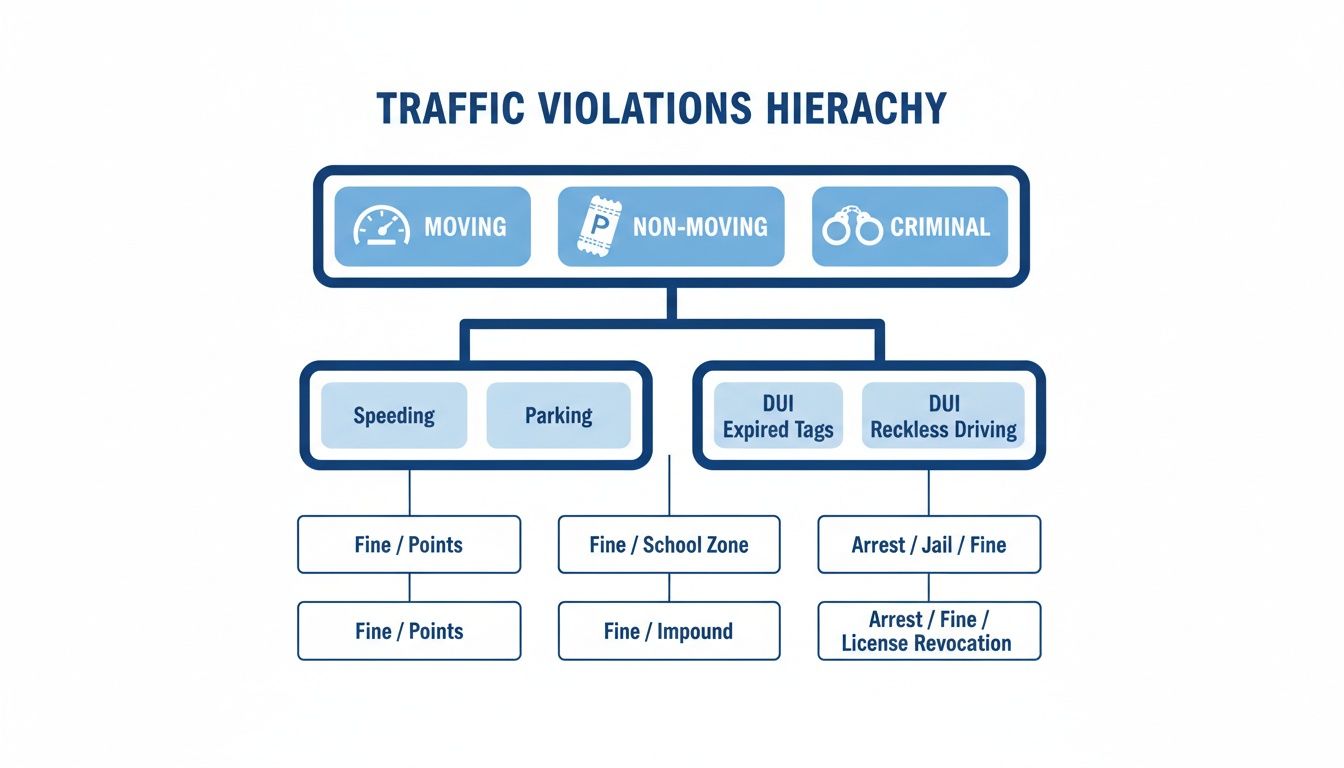
As you can see, it’s the moving violations you really have to watch out for. Those are the ones that rack up points and put your license at risk.
How Points Actually Get On Your Record
Here's a crucial detail: points don't hit your record the second an officer hands you a ticket. They only get added if you’re actually convicted of the violation. That conviction happens one of two ways—either you pay the fine (which legally is an admission of guilt) or you go to court and are found guilty.
Let’s say a driver in Broward County gets a ticket for speeding 16 mph over the limit. If they just go online and pay the fine, four points are automatically tacked onto their license. With that one ticket, they're already a third of the way to a suspension.
It’s surprisingly easy for these points to stack up from what feel like minor slip-ups. A ticket for running a red light? That’s four points. Failing to yield? Another three. A driver can find their license in jeopardy after just a couple of traffic stops in a single year.
The Suspension Thresholds You Need to Know
Florida has very clear lines in the sand that trigger an automatic license suspension. The FLHSMV watches your record over specific periods, so it’s critical to know where you stand.
The suspension periods are based on how many points you get within a set timeframe:
12 points within a 12-month period gets you a 30-day suspension.
18 points within an 18-month period results in a 3-month suspension.
24 points within a 36-month period leads to a 1-year suspension.
These aren't suggestions; they're mandatory. Once you cross that threshold, your driving privileges are gone for the specified time. And getting caught driving with a suspended license is a criminal offense that will only make things much, much worse.
To put this all in perspective, here's a clear breakdown of how the points add up for common offenses and how they lead to suspensions.
Florida Driver's License Point System Explained
Common Violation | Points Assigned | Points for Suspension | Suspension Duration |
|---|---|---|---|
Speeding (15 mph or less over) | 3 points | 12 points in 12 months | 30 days |
Speeding (16 mph or more over) | 4 points | 18 points in 18 months | 3 months |
Speeding resulting in a crash | 6 points | 24 points in 36 months | 1 year |
Running a red light | 4 points | - | - |
Violation of child restraint laws | 3 points | - | - |
Leaving the scene of a crash with property damage | 6 points | - | - |
This table highlights just how quickly a few tickets can put you on the path to losing your license. The system is designed to penalize repeat offenses within a relatively short window of time.
Beyond Suspensions: The Hidden Costs of Points
Losing your license is the most obvious consequence, but the fallout from accumulating points goes far beyond that. The financial impact can be a gut punch that follows you for years.
First and foremost, your auto insurance premiums will almost certainly shoot up. Insurance companies see points as a direct measure of risk. To them, a driver with points is more likely to cause an accident, so they jack up your rates to cover that risk. This isn't a small bump; it can cost you hundreds, or even thousands, of extra dollars over the life of your policy.
On top of that, some violations might force you to complete a mandatory traffic school, also known as a Basic Driver Improvement course. While this can sometimes keep points off your license for a specific ticket, you still have to pay for the course and sink hours of your time into it. For a closer look at how points are assigned for different violations, check out our complete guide to the Florida traffic ticket point system.
Ultimately, dealing with a traffic ticket is about so much more than the fine printed on the paper. It’s about protecting your license, your finances, and your freedom to get where you need to go. Every single point matters, and understanding how the system works is your best defense.
Understanding Florida’s Most Overlooked Traffic Laws
While every state has its share of standard traffic rules, Florida has a few unique statutes that are aggressively enforced and can catch even seasoned drivers off guard. These aren't obscure, dusty old laws; they're critical rules designed to protect everyone on Florida's notoriously busy roads, from first responders to stranded motorists. Getting a handle on these laws is key to avoiding a costly ticket and, more importantly, a dangerous situation.
The Move Over Law: It’s Not Just a Suggestion
One of the most important—and most frequently violated—of these is Florida's Move Over Law. Think of it less as a courtesy and more as a direct command. The law demands that you change how you drive when you see stopped emergency, law enforcement, sanitation, utility, or tow trucks on the shoulder. Its purpose is simple: to create a life-saving buffer for people working just inches away from speeding traffic.
The rules are straightforward. On a multi-lane road, you have to move over one full lane, putting an empty lane between your car and the stopped vehicle. If traffic is too heavy to move over safely, or if you’re on a two-lane road, you are required to slow down to 20 mph less than the posted speed limit. If the speed limit is already 20 mph or less, you need to drop your speed to 5 mph.
The law has been on the books since 1971, but it recently got a major update. It now also protects disabled vehicles displaying hazard lights, flares, or other warning signs, acknowledging that any stopped car is a potential hazard. The consequences for ignoring this are real. In one recent year, failing to move over caused 170 crashes in Florida, leading to one death and 10 serious injuries. You can read a full breakdown of the traffic law on FOX13News.com.
Attorney Advertisement. Office in Broward. Past results do not guarantee future outcomes. Our goal is to protect your license and record.
For CDL Holders, the Stakes are Sky-High
If you hold a Commercial Driver's License (CDL), a simple traffic ticket is never simple. What might be a minor headache for a regular driver can be a career-threatening event for a professional. That’s because Florida state traffic laws hold CDL holders to a much higher standard, whether they're in their big rig or their personal car.
Violations like an illegal lane change, following too closely, or failing to obey the Move Over Law are flagged as serious offenses for CDL drivers. Get convicted of two serious violations within three years, and you’re looking at a license disqualification for at least 60 days. A third one in that same window? That’ll get you a 120-day disqualification. When your livelihood is on the line, there’s no room for error.
Out-of-State Drivers: That Florida Ticket Will Follow You Home
Think you can just toss that Florida traffic ticket once you cross the state line? Think again. Florida is part of the Driver License Compact (DLC), an agreement between most states to share information about traffic violations. It’s basically a system to make sure drivers are held accountable, no matter where they get a ticket.
If you get a citation in Florida and just blow it off, Florida will report your failure to pay or appear in court to your home state’s DMV. Your home state will then most likely suspend your driver's license until you handle the Florida ticket. That ticket doesn't just disappear—it follows you home and becomes a much bigger legal mess than it was at the start. The best move is always to deal with a Florida ticket right away, no matter where you live.
What to Do After a Traffic Stop or DUI Arrest
The sight of flashing blue and red lights in your rearview mirror can make anyone's heart pound. Whether it's a routine traffic stop or a far more serious DUI arrest, the decisions you make in those first few moments are absolutely critical. Knowing your rights isn't just a good idea—it's your best defense against making a stressful situation much worse.
Your first priority is always safety. Find a well-lit spot to pull over as soon as you can do so safely. Then, turn off the engine, stay in your car, and place your hands on the steering wheel where the officer can see them.
This initial interaction sets the tone for everything that follows. While being polite and cooperative is always the smart move, it's just as important to understand where that cooperation ends. You are only required to provide your license, registration, and proof of insurance.
Responding to a Traffic Ticket
Once that citation is in your hand, a clock starts ticking. Under Florida state traffic laws, you have just 30 days to decide how you’re going to handle it. Ignoring the ticket is not an option; failing to respond will lead to a suspended license.
For a non-criminal traffic ticket, you have three basic choices:
Pay the Fine: This is the quickest way to put the ticket behind you, but it’s also a direct admission of guilt. Paying the fine means a conviction goes on your record, and points will be added to your license.
Elect Traffic School: If you’re eligible, you can complete a Basic Driver Improvement course to keep the points off your license. But you can only play this card a limited number of times.
Challenge the Ticket: You can plead not guilty and fight the citation in court. This gives you the chance to present your side of the story and challenge the officer's evidence.
Attorney Advertisement. Office in Broward. Past results do not guarantee future outcomes. Our goal is to protect your license and record.
The right move depends entirely on your specific situation—the violation, your driving history, and what you’re trying to protect. For most people, the goal is simple: avoid the points that lead to higher insurance rates and a potential license suspension.
The Critical 10-Day Rule for a DUI Arrest
A DUI arrest is in a completely different league from a regular traffic ticket. It kicks off two separate legal battles at the same time: the criminal case against you and an administrative process to suspend your license. That administrative action starts immediately, and your window to fight back is incredibly short.
This is what’s known as the “10-day rule.” From the moment of your arrest, you have only ten days to request a formal hearing with the Florida Department of Highway Safety and Motor Vehicles (FLHSMV). This hearing is your only chance to challenge the automatic suspension of your driver’s license.
If you miss this ten-day deadline, you lose your right to fight the suspension, and it will go into effect without question. The state is strict and unforgiving about this rule, making it one of the most urgent first steps in any DUI defense. To get a better handle on this, check out our guide on what happens after a DUI arrest.
Whether it’s a simple speeding ticket or a serious DUI charge, your actions in the hours and days that follow have consequences that can last for years. Knowing the rules of the road—and the courthouse—is the first step toward protecting your freedom to drive.
How an Experienced Traffic Attorney Can Assist You
Facing a traffic ticket can feel like an uphill battle, especially when you start thinking about what it could do to your license and insurance rates. Many drivers just pay the fine to get it over with, not realizing they’re officially admitting guilt and locking in points on their record.
An experienced attorney who lives and breathes Florida state traffic laws offers a much smarter path forward.
Our firm is set up to handle the entire legal headache for you. In fact, for over 99% of our clients, this means you never have to step foot in a courtroom. We go to court on your behalf, saving you the stress, lost time, and hassle of trying to navigate the system alone. This is a huge relief, especially for out-of-state drivers or anyone with a demanding schedule.
Developing a Defense Strategy
A traffic attorney focused on traffic and DUI defense does a lot more than just show up. The main goal is always to protect your driving record. This starts with a deep dive into your citation, reviewing every single detail—from the officer's procedures to the equipment they used—to find any procedural errors or weaknesses that could get the case thrown out.
Even when the evidence seems solid, a lawyer can often negotiate with the prosecutor for a better deal. We're always working towards outcomes like:
Reducing the charge to a non-moving violation, which means no points.
Negotiating a complete dismissal of the ticket.
Minimizing the fines and any other court-ordered penalties.
While past results do not guarantee future outcomes, our objective is to secure the best possible result for your specific situation. You can get more details on this in our guide that answers the big question: "Do I need a lawyer for a traffic ticket?".
Navigating Complex Legal Scenarios
Florida’s traffic enforcement landscape is massive and always active. To give you an idea, in a single recent year, law enforcement wrote nearly 62,000 tickets just for Move Over Law violations and similar right-of-way infractions. That number alone shows you the sheer volume of citations being handed out and why professional representation is so important.
In some complex situations that might arise after a traffic stop or a DUI arrest, you may need to consider legal tools to handle certain personal affairs. It can be helpful to understand what a Power of Attorney entails for these scenarios, and a lawyer can provide clear guidance on this and other legal instruments.
If you’ve received a ticket anywhere in Florida, don’t just pay it. We offer a free, no-obligation consultation to talk through the specifics of your case. Let us help you figure out your options.
Attorney Advertisement. Office in Broward. Our practice focuses on traffic and DUI defense. Protecting your license and record is our primary goal.
Frequently Asked Questions About Florida Traffic Laws
When you're staring down a traffic ticket in Florida, it's easy to feel overwhelmed. The laws can be confusing, and it's completely normal to have a ton of questions. We get calls every day from drivers just like you, so we've put together some straightforward answers to the most common questions we hear.
Just remember, this is for general information and isn't a substitute for legal advice. Every situation is different, and the best way to get guidance for your specific case is to talk to a licensed attorney.
Should I Just Pay My Florida Speeding Ticket?
Paying that ticket might feel like the quickest and easiest way to make the problem go away. But here's the catch: paying the fine is the same as pleading guilty. The moment you do, a conviction hits your driving record, and the state slaps points on your license.
Those points are what really sting. They can trigger a huge spike in your insurance premiums and push you one step closer to a driver's license suspension. Before you even think about paying a fine, you owe it to yourself to understand all your options. Our goal is always to protect your license and record, and exploring a defense is almost always the smarter move.
Attorney Advertisement. Office in Broward. Prospective clients may not obtain the same or similar results. Our goal is to protect your license and record.
Can a Red-Light Camera Ticket Be Dismissed in Florida?
Yes, it is possible to challenge a red-light camera ticket. These automated systems aren't perfect, and an attorney who handles traffic matters knows exactly where to look for weaknesses in the citation.
There are several defense strategies we can use, including:
Improper Signage: Was the sign warning you about the camera even visible or legally posted?
Calibration Issues: We can challenge the timing and maintenance records of the camera system itself.
Mistaken Identity: Can they really prove it was you behind the wheel?
Our practice focuses on traffic and DUI defense. We can dig into the evidence, find the flaws, and build a defense designed to get the ticket thrown out. For more answers, you can check out our comprehensive traffic law FAQs to get more information.
What Happens If I Miss a Court Date in Miami-Dade County?
Missing a court date, especially in a massive and busy jurisdiction like Miami-Dade County, kicks off a world of trouble. The court won't just forget about it—they'll almost certainly issue a bench warrant for your arrest and immediately notify the state to suspend your driver's license.
You have to act on this, and you have to act fast. An attorney can jump in right away, file a motion to withdraw the warrant, and start working to get your hearing back on the calendar. This helps resolve the original ticket and is the first step toward getting your driving privileges back.
If you've been handed a ticket anywhere in Florida, don't just hope for the best. Contact Ticket Shield, PLLC today for a free, no-obligation consultation and let us get to work protecting your driving record. Get started for as little as $39.99.
