
Can You Travel on Probation in Florida? A Guide
Can you travel on probation? Explore Florida's rules for domestic and international trips, how to get permission, and the risks of unauthorized travel.
Yes, you can often travel while on probation, but let's be crystal clear about one thing: it is never a right and always requires permission. Think of it as needing a hall pass from the legal system—you simply can't leave your designated area without getting it approved first. Every single trip, whether it's just across state lines or all the way to another country, must go through a strict approval process.
Understanding The Basics Of Probation Travel
When a Florida court places you on probation, your freedom of movement is legally restricted. This isn’t just to be difficult; it’s a core part of community supervision. The system needs to ensure you’re keeping up with all your obligations, like making it to required appointments, finishing community service, or paying off fines. Hopping on a plane whenever you want could easily get in the way of those duties.
Your Probation Officer (PO) and the court are the gatekeepers for any travel plans you have. The answer to "can you travel on probation?" depends entirely on getting their green light.
Why Permission Is Non-Negotiable
Trying to bypass the proper channels for a travel request is a serious mistake. It’s considered a technical violation of your probation, and the consequences can be swift and severe. Even a quick, unauthorized trip out of state for a legitimate family emergency could trigger a warrant for your arrest.
The risks of unapproved travel are serious and can include:
A Violation of Probation (VOP) Hearing: This is a formal court date where a judge decides if you broke the rules.
Revocation of Probation: The judge could revoke your probation entirely and impose the original jail or prison sentence you avoided.
Stricter Conditions: Even if your probation isn't revoked, it could be extended, or new, tougher terms like GPS monitoring could be added.
At Ticket Shield, PLLC, our practice focuses on traffic and DUI defense. We understand that life doesn’t just stop because you're on probation. Our goal is to protect your license and record as you navigate these complex legal requirements.
The Approval Process Starts With Your PO
For any potential trip, your first stop is almost always your Probation Officer. They handle your day-to-day supervision and are the first line of approval. You need to come to them with a clear, honest, and well-documented request. Simply assuming it’s okay or asking at the last minute is a recipe for denial—and it could seriously damage the trust you’ve built with your officer.
Before you even think about booking a flight, you need to understand what they're looking for. Let’s look at the key factors that can make or break your travel request.
Key Factors In Getting Your Travel Request Approved
When you ask for permission to travel, your PO and the court don't just flip a coin. They carefully weigh several factors to decide if approving your trip is a reasonable risk. Understanding what they're looking at can help you build a much stronger request.
The table below breaks down what matters most in their decision-making process.
Factor | Why It Matters | What Helps Your Case |
|---|---|---|
Your Compliance History | They want to see a consistent track record of following the rules. | Having a strong record of attending meetings, passing drug tests, and completing all requirements. |
Reason for Travel | Is it a luxury vacation or a critical family event? The "why" is hugely important. | A verifiable and compelling reason, like a close family member's wedding, funeral, or serious illness. |
Destination and Duration | A weekend trip to a neighboring state is viewed differently than a month-long international tour. | A clear, detailed itinerary with specific dates, addresses, and contact information for a reasonable length of time. |
Victim-Related Conditions | If your case involved a victim, travel might be restricted by no-contact orders or restitution payments. | Proving you are current on all restitution payments and that your travel will not violate any court orders. |
Risk of Flight/Reoffense | They need to be confident you'll return and won't get into trouble while you're away. | Having strong community ties (job, family, home) and a clean record while on probation. |
Ultimately, a strong request is one that shows you're taking your probation seriously and that your proposed travel is for a legitimate, well-documented reason that won't interfere with your obligations.
Understanding Florida's Probation Travel Restrictions
When a Florida court sentences you to probation, it’s not just a slap on the wrist; it’s a legally binding contract with some very strict rules. At the very core of that agreement are limits on your movement. The best way to think about it is that probation creates a defined boundary—you get the privilege of staying in the community instead of sitting in a cell, but that freedom comes with clear geographical limits.
The legal backbone for these rules is Florida Statute §948.03, which lays out the standard conditions of probation. One of the most common and universal conditions is that you simply cannot leave your county of residence or the state without getting permission first from your Probation Officer (PO) or the court. This isn't just arbitrary; it's designed to make sure you stay accountable and are always available for supervision.
The Core Principle Behind Travel Rules
So, why is the legal system so strict about this? It all comes down to the two main goals of probation: rehabilitation and public safety. To make sure those goals are met, the court needs to know you're consistently handling your business, which can include things like:
Showing up for regular check-ins with your PO
Submitting to mandatory drug or alcohol tests
Finishing court-ordered programs, like DUI school
Paying off fines, court costs, and any restitution you owe
Holding down a steady job or staying in school
Traveling without permission throws a wrench in all of that. If you’re not where you're supposed to be, you can't check off these boxes. It also raises a huge red flag about you being a potential flight risk, which is something the court takes very seriously.
Supervised vs. Unsupervised Probation: What's the Difference?
Not all probation is created equal, and the type you’re on makes a huge difference when it comes to travel.
Supervised probation is what most people get, especially for offenses like DUIs or other criminal traffic violations. This means you have a PO actively monitoring you. Under supervised probation, all travel outside your approved area requires explicit, advance permission. There are no gray areas here. No exceptions.
Unsupervised probation, sometimes called administrative probation, is a bit more relaxed and is usually for very minor offenses. While you might not have a PO you have to report to, the travel restriction often still applies. You’ll likely need to file a motion directly with the court to get permission. Never just assume unsupervised probation means you have a free pass to go wherever you want—always double-check your court order.
A common mistake people make is thinking a lenient sentence, like getting an "adjudication withheld," means the probation rules are looser. The truth is, even with an adjudication withheld, you are still bound by every single condition of your probation, including travel restrictions. Violating those terms can land you in serious trouble.
State Probation vs. Federal Probation
It’s also crucial to know whether your probation is being handled by the state of Florida or the federal government, because the rules are worlds apart.
State Probation (Florida Department of Corrections): The vast majority of traffic and DUI-related probation cases are handled at the state level. The process to request travel usually starts with your PO, who might have the authority to approve short, in-state trips on their own. For anything out-of-state, you’ll often need to file a formal request or even get a court order.
Federal Probation (U.S. Probation and Pretrial Services): Federal probation is a whole different ballgame—it’s typically much stricter. The rules are more rigid, and any travel outside your assigned judicial district almost always requires a formal motion and a sign-off from a federal judge.
Make no mistake, travel restrictions are a standard and serious part of probation everywhere. Under Florida Statute §948.03, leaving the state without permission can lead to an immediate arrest warrant and the revocation of your probation. This isn't just a Florida thing, either; a national analysis found that 57% of jurisdictions explicitly forbid out-of-state travel without permission, and plenty of them even require you to get approval just to leave your county. Ignoring these rules is a gamble with your freedom you just can't afford to take. A simple trip can turn into a massive legal headache if you don’t follow the proper steps.
How to Request Permission for Domestic Travel
Getting the green light for domestic travel while on probation isn't about just asking nicely. It’s a formal process, and you need to approach it methodically. Think of it less like asking for a day off and more like applying for a small loan—you have to present a solid, well-documented case to get approved.
The entire process kicks off with your Probation Officer (PO). They are your first and most important point of contact.
The single biggest key to success? Planning well in advance. A frantic phone call the day before you want to leave is a surefire way to get a "no." You need to give your PO at least two to four weeks' notice. This simple step shows you respect their time and are taking your probation seriously.
Starting the Conversation with Your Probation Officer
That first conversation you have with your PO sets the tone for everything that follows. Be ready to lay out specific, verifiable details about your trip. If you’re vague or don't have your facts straight, you’ll only raise red flags and make them hesitant to support your request. Honesty is your best friend here.
Before you even pick up the phone, get all your information together. Having everything organized from the get-go shows this is a legitimate, well-thought-out trip, not some last-minute whim that could jeopardize your probation.
This visual guide breaks down the very first question you need to consider.
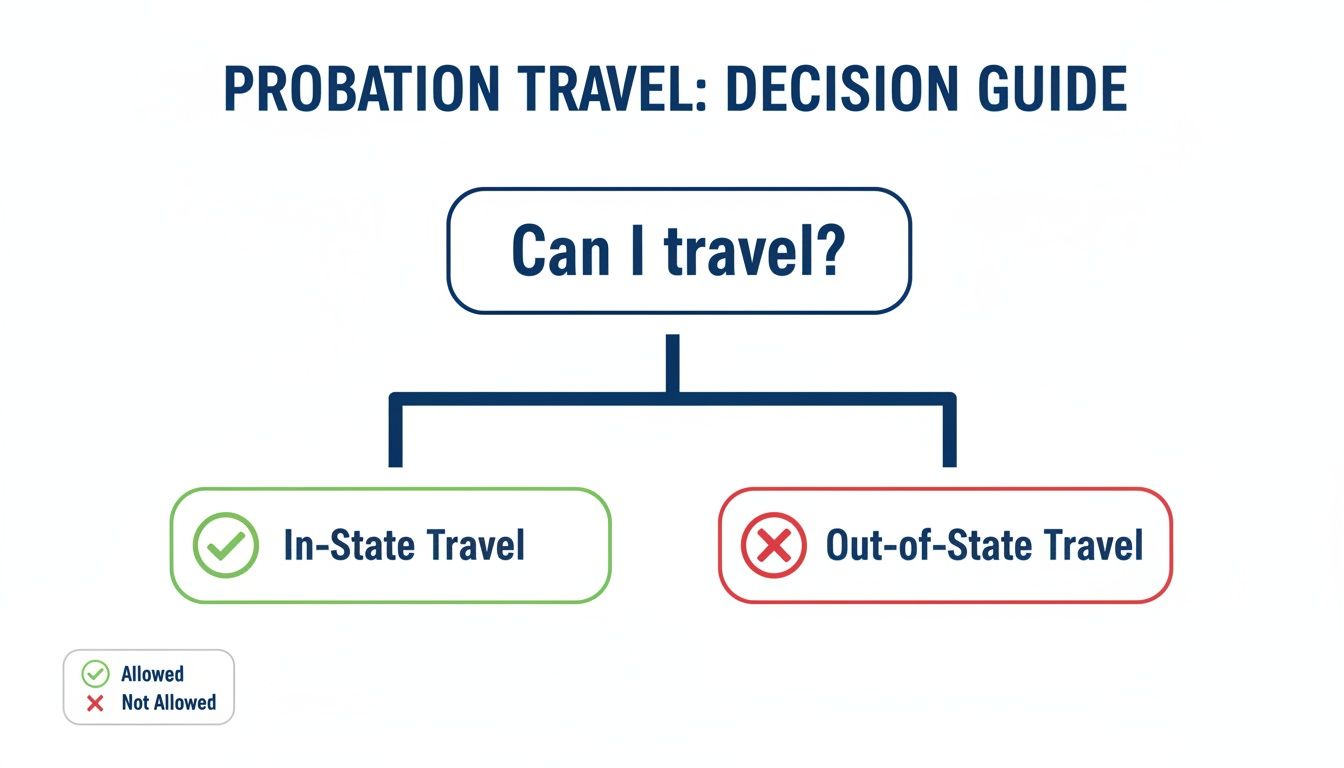
As the chart makes clear, the big divide is whether you're crossing state lines. Any out-of-state travel immediately triggers a more formal approval process.
What Your PO Needs to Know
To even consider your request, your PO needs the full picture. It’s best to provide these details in writing so there’s no confusion. Be prepared with:
Exact Travel Dates: Don't say "sometime next month." Give them your specific departure and return dates.
Destination Address: A city and state isn't enough. They need the full street address where you'll be staying.
Contact Information: This includes a phone number for where you'll be and the names of the people you're staying or traveling with.
Reason for Travel: Explain why you need to go. Legitimate reasons—a family wedding, a funeral, a mandatory work conference—are much more likely to get approved than a casual vacation.
Supporting Documentation: Back up your story with proof. This could be a wedding invitation, a formal letter from your boss on company letterhead, or a note from a doctor about a sick family member.
Handing this over in a neat, organized package makes your PO’s job easier, which only helps your cause. It proves you’ve done your homework.
When Your PO Cannot Grant Permission Directly
In many Florida jurisdictions, a PO simply doesn't have the final say. They might be able to approve a quick trip to an adjacent county, but travel that crosses state lines almost always requires a judge's signature. If your PO tells you they can't approve it themselves, don't panic. This is standard procedure.
Your next move is to file a formal Motion to Travel with the court that originally sentenced you. This is a legal document that officially asks the judge for permission. While you can technically file this motion on your own, this is where getting some legal help becomes a really good idea.
A well-drafted motion can make a significant difference. It presents your request professionally, anticipates the judge's questions, and frames the trip in the best possible light.
An attorney knows how to structure the motion, include the right evidence, and make a persuasive argument. The goal is to make it as easy as possible for the judge to say "yes" by showing that you’re reliable and the trip is important. For instance, if you need tips on how to address the court properly, a guide on how to write a letter to a judge for traffic ticket can offer great insight into the correct tone and format.
Navigating International Travel While on Probation
If getting permission for domestic travel on probation is like applying for a loan, asking to travel internationally is like applying for top-secret security clearance. The process is far more intense, the level of scrutiny is off the charts, and the chances of a denial are significantly higher. Leaving the country is almost never a simple request—it’s a major legal undertaking that nearly always requires a judge's direct approval.
This isn't a one-step process. You're facing a dual-permission system, and you have to get a green light from both. First, you need permission from the Florida court system. Then, you have to be granted entry by your destination country. A "no" from either one brings your travel plans to a dead stop.
The First Hurdle: Getting Court Approval
Before you even dream of booking a flight, you have to get permission from the judge who sentenced you. Your Probation Officer (PO) simply doesn't have the authority to sign off on international travel. This means your attorney needs to file a formal Motion for Permission to Travel Internationally.
This isn't a standard form; it has to be a rock-solid, well-documented request. The judge is going to weigh several critical factors, with one question looming over all others:
Flight Risk: This is the court's number one concern. The judge needs total assurance that you will come back to Florida to finish your probation. Your motion must prove you have strong ties to your community—things like a stable job, family, and owning property.
Nature of the Offense: The seriousness of your crime is a huge factor. Someone on probation for a felony or a serious DUI will have a much tougher time convincing a judge than a person with a minor misdemeanor.
Reason for Travel: A casual vacation to the Bahamas? Highly unlikely to get approved. Your reason needs to be compelling and verifiable. Think things like the funeral of an immediate family member or a critical, once-in-a-lifetime business trip that absolutely can't be handled remotely.
The Second Hurdle: Meeting the Destination's Entry Requirements
Even if you walk out of the courthouse with a signed order from a judge, your journey is far from guaranteed. Every country has the absolute right to control its own borders and decide who gets to cross them. Many nations have incredibly strict policies that can make it difficult—or impossible—for anyone with a criminal record to enter.
It's not just about getting permission from your PO. It's vital to understand that other countries have their own rules, including specific health and character requirements for international travel that can be directly affected by a criminal record or your current probation status. A DUI, for instance, is considered a serious crime in many countries and can be grounds for being turned away at the border on the spot.
It's a common and costly mistake to assume a court order from Florida guarantees entry into another country. Foreign immigration officials are not bound by a U.S. judge's decision and will enforce their own laws at the border.
How Different Countries View Criminal Records
Immigration rules are all over the map. What might be a non-issue in one country could be an absolute deal-breaker in another.
Canada: Our neighbor to the north is famously strict, especially about DUIs. Canada considers a DUI a serious crime, and you can be labeled "criminally inadmissible" and denied entry, even if the offense happened years ago.
United Kingdom & Europe: While the rules vary, many European countries share criminal data through systems like the Schengen Information System (SIS). Being on active probation can easily get you flagged. The UK, in particular, can deny entry for convictions that resulted in jail time or are otherwise seen as serious.
Other Destinations: Around the globe, the rules can get even tougher. Australia, for example, has very strict character checks, and New Zealand demands you disclose all convictions. Many Asian countries have a zero-tolerance policy for drug-related offenses.
At the end of the day, trying to travel internationally while on probation is a high-stakes gamble with a high probability of denial. It demands meticulous planning, a powerful reason for the trip, and skilled legal help to navigate both the U.S. court system and the complex web of foreign immigration laws.
The Serious Consequences of Unauthorized Travel
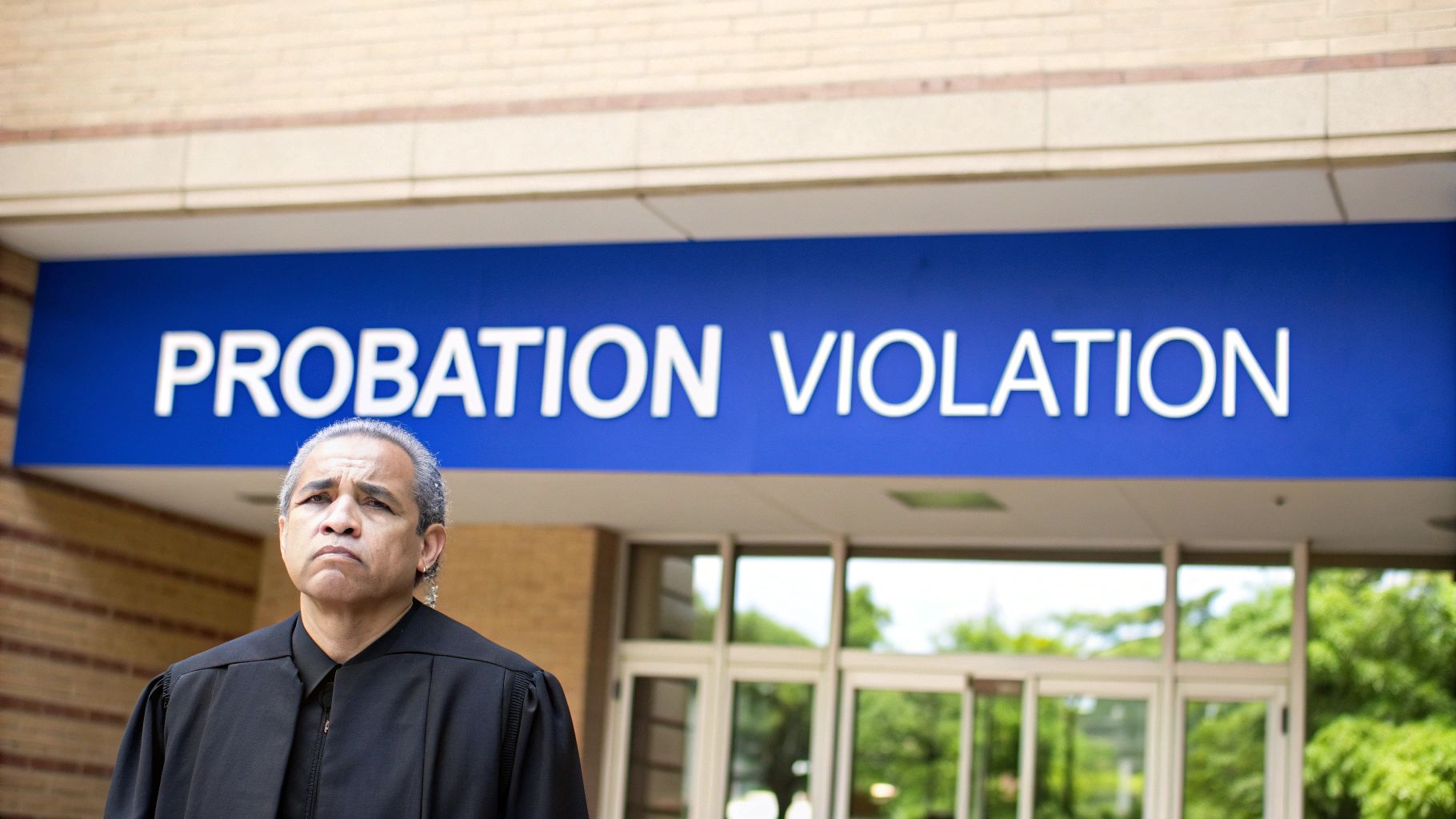
It’s easy to think a quick, unapproved trip out of state won’t hurt anyone, especially if you have a good reason. This is a dangerous mistake. Traveling without getting the green light first is a direct violation of your probation terms, and the fallout can unravel all the progress you've made and put your freedom at risk.
Even if you don’t get into any new trouble, just leaving your approved area is considered a technical violation. When your Probation Officer (PO) finds out—and they often do, whether it’s from a missed check-in, a random traffic stop, or even a friend's social media post—they’re usually required to report it to the court.
That report kicks off a formal legal process that can escalate fast. The first thing that usually happens? A judge issues a warrant for your arrest.
The Violation of Probation (VOP) Hearing
Once you're picked up on that warrant, you’ll be scheduled for a Violation of Probation (VOP) hearing. It's crucial to understand this isn't like a normal criminal trial. The stakes are just as high, but the rules are completely different—and they're stacked against you.
The biggest difference is the burden of proof. In a regular trial, a prosecutor has to prove you're guilty "beyond a reasonable doubt." In a VOP hearing, the standard is much, much lower. They only need to show a "preponderance of the evidence."
This legal phrase just means the judge only needs to be convinced that it's more likely than not (think a 51% chance) that you broke the rules by traveling. That’s a much easier bar for the state to clear.
Because that bar is so low, defending yourself is a serious challenge. The prosecutor doesn't need a jury or a mountain of evidence. Often, all it takes is your PO testifying that you weren't where you were supposed to be. You can get more details on what to expect by reading our guide on the consequences of a DUI probation violation.
Potential Outcomes of a VOP Finding
If the judge agrees you violated your probation by traveling, they have a lot of power in deciding what happens next. Any leniency you got during your original sentencing is usually off the table.
The penalties can include:
Revocation of Probation and Jail Time: This is the worst-case scenario. The judge can cancel your probation entirely and order you to serve the original jail or prison sentence that was hanging over your head.
Extension of Your Probation: The court could decide to restart your probation term from scratch or add more time, keeping you under supervision for much longer.
Stricter Probation Conditions: Your probation could be modified with much tougher rules. Think more frequent check-ins, mandatory counseling, or even a GPS ankle monitor to track your every move.
The bottom line is simple: taking an unauthorized trip is a gamble you can't afford to lose. A short getaway can easily turn into jail time, years of extended supervision, and a permanent black mark on your record that wipes out all your hard work.
When You Should Consult a Defense Attorney
Navigating the rules of probation can feel like walking a tightrope. Knowing when to call for backup is a huge part of staying on that rope and not falling off. While your Probation Officer (PO) is your day-to-day contact, there are plenty of situations where their hands are tied or where having a legal professional in your corner is simply the smartest move you can make.
Think of legal help not as a last resort, but as a strategic tool to protect your freedom. For simple, routine questions, your PO is the right person to ask. But the moment your travel request gets complicated—like crossing state lines or dealing with an emergency—the value of an attorney becomes crystal clear. They know how to package your request in a way the court understands and respects.
Scenarios That Call for Legal Counsel
Some situations almost always demand a call to a defense attorney. Trying to navigate these minefields on your own can easily lead to a denial, a misunderstanding, or worse, an unintentional violation that lands you in hot water.
If you find yourself in any of these spots, getting legal advice is a proactive, protective step:
Your PO is Unresponsive or Unsupportive: You’ve made a reasonable request with plenty of notice, but you’re getting the runaround or a flat-out "no" without a good reason. An attorney can step in, get the process moving, and make sure your request is actually heard by the court.
The Travel is for an Urgent Matter: Life happens. For sudden, critical events like a family medical crisis or a funeral, you don't have time to wait. An attorney can file an emergency motion to get you in front of a judge for a quick decision.
Your Probation is for a Serious Offense: If you're on probation for a felony, a DUI, or another serious crime, every request you make is going to be under a microscope. Bringing in an attorney shows the court you're taking the process as seriously as they are.
Travel is Essential for Your Job: When your paycheck depends on your ability to travel, you can't afford a denial. A lawyer can help you gather the right proof from your employer and structure the request to show it’s a necessity, not a vacation. They might even be able to get a standing order for recurring work trips.
How an Attorney Strengthens Your Request
Hiring an attorney for a travel motion isn't just about having someone fill out paperwork. It’s about leveraging their legal expertise to build a persuasive case that directly addresses the court's biggest concerns—flight risk and public safety.
Here’s what a lawyer really brings to the table:
Drafting a Compelling Legal Motion: They know how to write a formal motion in the language of the court. They’ll clearly lay out the "who, what, when, where, and why" of your trip, framing it in the most positive and responsible light possible.
Gathering and Presenting Evidence: They will guide you in collecting the right supporting documents. A letter from your boss, a wedding invitation, or a doctor’s note becomes much more powerful when it's submitted as a formal exhibit with your motion.
Representing Your Interests in Court: If the judge wants a hearing, your attorney will be there to argue your case. They will answer the judge’s questions, counter any objections from the prosecutor, and advocate for your request to be granted.
Past results do not guarantee future outcomes, but our goal is to protect your freedom and record. Having a professional present your case properly may improve the chances of a favorable result.
Ultimately, deciding to hire a lawyer is an investment in your own peace of mind and freedom. It might seem like another hurdle, but understanding your options is the first step. For a general idea of when legal help makes sense, you can check out our guide on whether you need a lawyer for a traffic ticket.
Attorney Advertisement. Office in Broward. Prospective clients may not obtain the same or similar results.
Frequently Asked Questions About Probation and Travel
Figuring out the rules of probation can feel like walking through a minefield, especially when you need to travel. Here are some straight answers to the most common questions we hear from people on probation in Florida.
Can I Go on a Cruise While on Probation in Florida?
Taking a cruise is almost always treated as international travel, even if the ship leaves from and returns to a Florida port. The second that ship hits international waters or docks at a foreign port—even for a few hours—you've officially left the country.
Because of this, your Probation Officer (PO) can't just sign off on it. You need explicit permission from a judge to go on a cruise. This means filing a formal motion with the court, which is a tough request to get approved. You also have to make sure every single country on the cruise itinerary will even let you in, as a criminal record could get you turned away at the port.
What if I Need to Travel Out of State for My Job?
Work-related travel is probably the most common and legitimate reason people ask to leave the state. If you know your job requires travel from the get-go, it’s best to address this with the court right when you are first sentenced to probation.
If the travel need is new, you have to follow the standard process and submit a formal request well ahead of time. You'll need solid proof from your employer, like a letter on company letterhead explaining the trip's purpose, dates, and destination. Courts are usually reasonable about legitimate work trips, but you need approval for each one. An attorney can help you ask for a pre-approved travel plan if your job requires frequent, recurring trips.
Does My Offense Affect My Chances of Traveling?
Yes, absolutely. The nature of your original offense plays a huge role in whether a travel request gets a green light. A judge or PO is going to look at a request from someone on probation for a minor traffic violation very differently than a request from someone convicted of a felony, a DUI, or a violent crime.
For more serious offenses, the court's main worries are public safety and the risk you might not return. It’s going to be much harder to convince them that letting you travel is a good idea. An experienced attorney can help build a stronger case by presenting evidence of your compliance with probation and your strong ties to the community to help ease those concerns.
Don't let a simple mistake on probation put your freedom at risk. If you have questions about traveling while on probation or need to file a motion with the court, the team at Ticket Shield, PLLC is here to help. Our practice is focused on traffic and DUI defense across all 67 Florida counties.
Contact us 24/7 for a free, confidential consultation to discuss your case. Let us help you protect your record.
