
Florida DUI for Xanax and Driving? Your Defense Plan
Charged with a DUI for Xanax and driving in Florida? A prescription is not a defense. Understand the risks and how an experienced attorney can protect you.
Driving after taking prescribed Xanax is not a defense in Florida. If the medication impairs your normal faculties, you can be charged with a DUI under Florida Statute § 316.193. The penalties are the same as an alcohol DUI, threatening your license and freedom.
If you were arrested for a Xanax DUI, you are facing a serious criminal charge. Your valid prescription is not a defense. The only thing that matters is whether the state can prove the drug impaired your ability to drive safely. You need an immediate, protective legal strategy.
What is the Law on Xanax and Driving in Florida?
Do not make a critical mistake: your prescription is not a get-out-of-jail-free card. In Florida, that piece of paper from your doctor is irrelevant the moment an officer decides you're impaired. The state does not have to prove you took an illegal substance. It only needs to prove that your "normal faculties" were compromised.
What Does "Impaired Normal Faculties" Mean?
Florida law is direct. Your “normal faculties” are the basic abilities you need to drive a car. This includes your ability to see, hear, walk, talk, judge distances, and make quick decisions.
Xanax is a powerful benzodiazepine, often used for anxiety treatment. It works by slowing down your central nervous system. Its very purpose is to have a sedative effect, which directly impacts the skills you need to operate a vehicle safely.
To the court, there is no difference between a DUI for alcohol and a DUI for a legally prescribed drug.
Is an Alcohol DUI the Same as a Xanax DUI?
Yes. The law makes no distinction between impairment from a six-pack and impairment from a single prescription pill. Here is how they compare in the eyes of the court.
Legal Element | Standard Alcohol DUI | Prescription Xanax DUI |
|---|---|---|
Legal Status of Substance | Alcohol is legal for adults 21+. | Xanax is legal with a valid prescription. |
Basis for DUI Charge | Driving with a BAC over the legal limit OR with faculties impaired by alcohol. | Driving with normal faculties impaired by the chemical substance (Xanax). |
Relevance of Prescription | N/A | Irrelevant. The prescription is not a defense against impairment. |
Legal Standard in Court | Impairment must be proven beyond a reasonable doubt. | Impairment must be proven beyond a reasonable doubt. |
The law that governs all DUIs in Florida is explicit.
Florida Statute § 316.193 states a person is guilty of DUI if they are in physical control of a vehicle while under the influence of any chemical substance to the extent that their normal faculties are impaired. This statute makes no distinction between illegal narcotics and prescribed medication.
A DUI for prescribed Xanax is not just a traffic ticket. It is a serious criminal charge. A routine traffic stop near the Richard E. Gerstein Justice Building in Miami can escalate into a life-changing legal battle.
This is a critical moment. Unlike automated "ticket mill" apps that use chatbots or pass you to a paralegal, Ticket Shield, PLLC provides immediate, direct protection. When you call or text, you speak directly with your attorney. We start building your defense from that first conversation. This is a crucial head start when your license and future are at risk. You can learn more in our guide on the BAC limit in Florida and how impairment is measured.
Your prescription is not a defense. You need a strategic, lawyer-led defense to fight a Xanax DUI charge.
How Can Xanax Impair My Driving?

You took your prescribed Xanax. You feel calm, not high. This is the deceptive trap of a prescription DUI. Your personal feeling of "normal" is not what a police officer is trained to see at the roadside.
Xanax, or alprazolam, belongs to a class of drugs called benzodiazepines. Its entire job is to depress your central nervous system. It slows the vital communication between your brain and your body. That is the same communication you need to drive safely.
What Signs of Impairment Do Police Look For?
When a Florida officer suspects a DUI, they are not just looking for drunkenness. They are trained to spot the subtle clues of drug impairment that are hallmarks of Xanax use. These are not subjective opinions. They are observable signs that will form the foundation of a DUI charge against you.
Delayed Reaction Time: You are a fraction of a second slower to brake. You hesitate at a green light. This is a dangerous effect of Xanax.
Poor Coordination: You fumble for your license and registration. Your movements seem clumsy. On the road, this means trouble staying in your lane or jerky steering.
Drowsiness and Fatigue: Your eyelids look heavy. You seem lethargic or have trouble focusing on the officer’s questions. This is a direct sedative effect.
Blurred or Double Vision: Xanax can affect eye muscles, making it hard to judge distances or see road signs, other cars, and pedestrians.
Slurred Speech: The drug relaxes muscles in your jaw and tongue. This can cause you to speak slowly or slur your words—a classic indicator of impairment.
These facts will go into the police report. A prosecutor will use them against you in court. Arguing you "felt fine" will not work against documented evidence. The data shows a clear link between Xanax and dangerous auto accidents.
Florida Statute § 316.193 makes it a crime to drive while your "normal faculties" are impaired. The signs listed above are direct evidence of impaired normal faculties. The law makes no distinction between impairment from alcohol and impairment from a legally prescribed medication.
Your prescription is not a shield. At Ticket Shield, PLLC, we understand this reality and how to fight these charges. We do not use chatbots or paralegals as middlemen. You speak directly with your attorney by phone or text. We build a defense strategy focused on challenging the officer's observations and protecting you from the severe consequences of a Xanax DUI conviction.
How Does Florida Law Treat Prescription Drug DUIs?
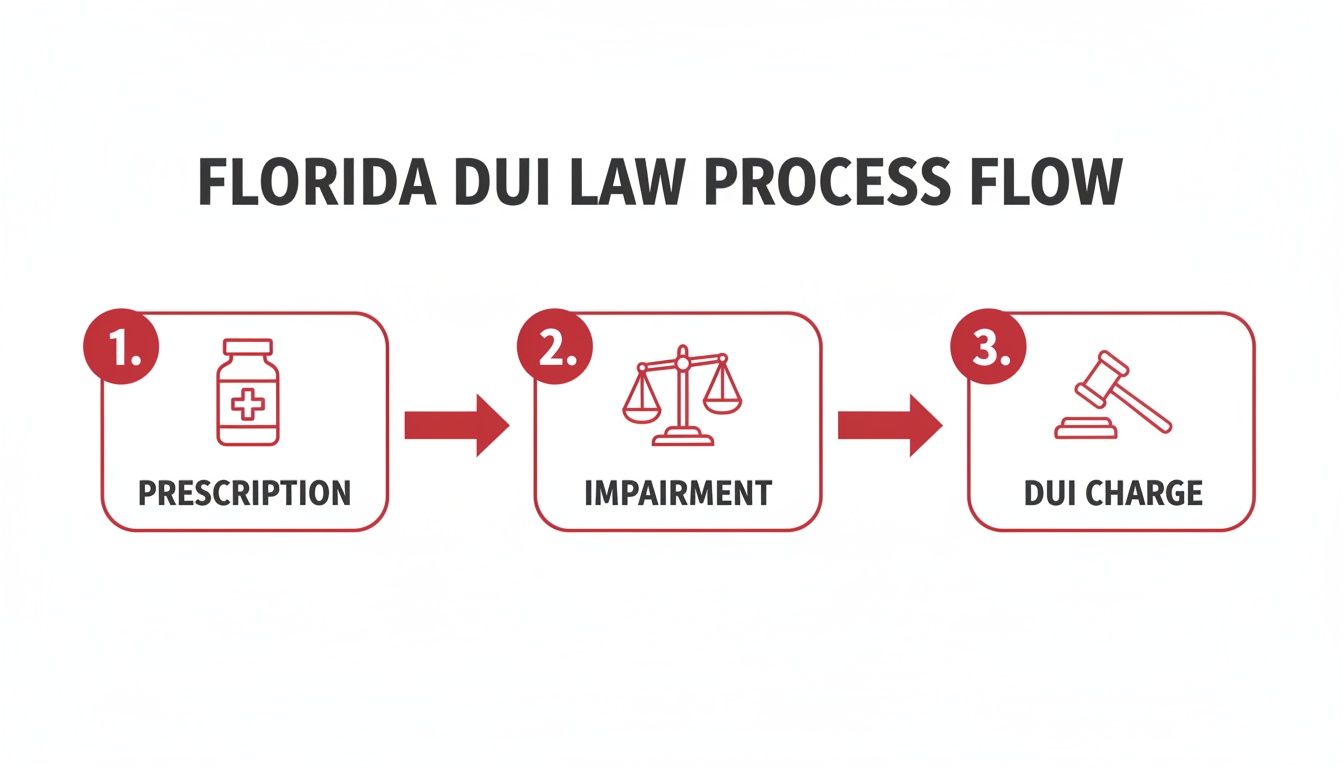
If you were charged with a DUI after taking Xanax, the most dangerous mistake is assuming your prescription protects you. It does not.
In Florida, the law is brutally simple. It does not care if the substance that impaired you was alcohol, an illegal drug, or a medication from your doctor. The only thing that matters is whether your “normal faculties” were compromised behind the wheel.
Why Doesn't My Prescription Matter?
The case against you is built on Florida Statute § 316.193. This is the state’s DUI law. You must understand what it says. A person is guilty of DUI if they are in physical control of a vehicle and are "under the influence of any chemical substance... to the extent that the person’s normal faculties are impaired."
Look at that key phrase: "any chemical substance."
The statute does not list exceptions for Xanax, Valium, or Ambien. This is intentional. A valid prescription is a defense against a drug possession charge. It is not a defense for driving while impaired by that drug.
What are "Normal Faculties" in a DUI Case?
"Normal faculties" refers to the basic human abilities you need to operate a vehicle safely. This includes your ability to:
See clearly and judge distances.
Hear traffic, sirens, and other warnings.
Walk without stumbling or losing balance.
Talk without slurring your words.
Make quick, rational decisions.
Xanax is designed to depress the central nervous system. It directly impacts your coordination, reaction time, and judgment. The drug's intended effects are the exact signs of impairment police are trained to spot. Your prescription proves you were allowed to possess the drug. But it also helps the state prove what substance was in your system causing impairment.
The state's case against you is simple: you took a substance known to cause impairment, and an officer observed signs of that impairment. Your prescription is not a defense; it is evidence.
This is the reality you will face inside a Florida courthouse like the Edgecomb Courthouse in Tampa. The legal battle is not about whether the drug was legal. It is about whether you were safe to drive. Learn more about the severe consequences in our guide on the Florida penalty for DUI.
This is not a fight for automated apps or ticket mills that use chatbots and paralegals. This fight demands direct access to a dedicated attorney. At Ticket Shield, PLLC, you call or text your lawyer directly. We do not use middlemen. Your defense starts the moment we speak.
What Should I Expect During a Xanax DUI Traffic Stop?
The blue and red lights flash in your mirror. Your heart pounds. You took your prescribed Xanax as your doctor instructed. Now a police officer is at your window. This moment is critical. Every word you speak will be used to build a case against you.
You must understand the situation from the officer's viewpoint. They are trained to look for specific signs of impairment. Their goal is not to discuss your medical history.
What are the First Things an Officer Looks For?
The process begins the moment an officer sees your car. They are trained to spot signs of impaired driving before they even turn on their lights. You should know your rights regarding all types of stops, including those discussed in our article on DUI checkpoint legality.
Erratic Driving: Weaving, drifting, or driving too slowly are classic red flags.
Delayed Reactions: A slow response to a green light or braking too late raises suspicion.
Physical Appearance: The officer assesses everything at your window. Your eyes (glassy or heavy-lidded?), your speech (slow or slurred?), and your coordination (fumbling for your license?).
These first impressions are subjective but powerful pieces of evidence. They form the "reasonable suspicion" needed to escalate a traffic stop into a DUI investigation.
What is a Drug Recognition Expert (DRE)?
If the officer suspects impairment from something other than alcohol, they will likely call in a Drug Recognition Expert (DRE). This is an officer with specialized training to identify impairment from different drugs. The DRE will guide you through a 12-step evaluation that is far more intense than standard roadside exercises.
A DRE’s evaluation is highly subjective and designed to be difficult. Their final report becomes powerful evidence for the prosecution. A strategic attorney knows how to challenge its validity, the officer's training, and their conclusions.
The entire process is designed to gather evidence to use against you. Knowing what to do is your only real protection.
What Are the Immediate Steps to Take?
Be Polite and Compliant: Hand over your license, registration, and insurance. Do not argue.
Exercise Your Right to Remain Silent: You do not have to answer questions like "What medications have you taken?" Simply state, "Officer, I choose to remain silent and I want to speak with my attorney."
Politely Refuse Field Sobriety Exercises: These roadside tests are voluntary in Florida. They are subjective and difficult to pass even when sober. Politely say, "I am not going to participate in any field sobriety tests."
Contact Your Attorney Immediately: The moment you can, call a lawyer. Do not wait.
Unlike automated apps or firms that use middlemen, Ticket Shield, PLLC gives you direct access to your attorney. When you call or text us, you are speaking directly with the lawyer who will defend you. We provide the urgent, protective guidance you need.
What Are the Penalties For a Xanax DUI Conviction?
A Xanax DUI conviction is not a minor traffic ticket. You face mandatory fines, a permanent criminal record, potential jail time, and losing your driver's license. Your car insurance rates will explode. Your professional life could be seriously damaged.
In courthouses like the Broward County Judicial Complex in Fort Lauderdale, the state will apply the same unforgiving standards to your case as any other DUI. The stakes are immense. This is why you need a strategic, lawyer-led defense, not an impersonal app that cannot offer the protective shield your future requires.
What Are the Criminal and Administrative Sanctions?
Florida attacks a DUI conviction from two directions. You face criminal penalties from the court and administrative penalties from the DHSMV.
Criminal Penalties: A judge orders these upon conviction. For a first-time conviction, you can expect:
Fines: A minimum fine of $500 and up to $1,000.
Jail Time: Up to six months in county jail.
Probation: A mandatory probation period, usually up to one year.
Community Service: A required 50 hours of community service.
DUI School: You must enroll in and complete a substance abuse course.
Vehicle Impoundment: Your car will be impounded for 10 days.
These penalties get much worse for a second offense. If this is your first time, read our guide on first-time DUI penalties to see the full scope of what is on the line.
Administrative Penalties: The DHSMV operates separately from the criminal court. A conviction automatically triggers:
Driver's License Revocation: A mandatory license revocation for at least 180 days and up to one full year.
What Are the Hidden Costs Of a Xanax DUI?
The damage from a Xanax DUI goes far beyond the courtroom. These "hidden" penalties can be just as destructive.
The true cost of a DUI conviction is measured in lost opportunities. It can slam doors to jobs, housing, and financial stability. An aggressive defense is a necessity.
Think about the ripple effect on your life:
Skyrocketing Insurance Rates: Your car insurance premiums will jump by thousands of dollars a year. You will be forced to carry expensive FR-44 insurance.
Job Loss and Career Damage: Many companies have zero-tolerance policies for employees with a DUI. If you drive for work, a conviction is a career-ender.
Professional Licensing Issues: A DUI can put professional licenses for nurses, pilots, and real estate agents in serious jeopardy.
Security Clearance Problems: A DUI conviction can mean losing your security clearance if you are in the military or a government contractor.
You cannot afford to face these penalties with a generic, automated defense. You need a real, experienced attorney you can actually talk to—by phone or text. At Ticket Shield, PLLC, you work directly with your lawyer. No chatbots. No middlemen.
How Can An Attorney Defend Me Against a Xanax DUI Charge?
A Xanax DUI charge is serious, but a charge is not a conviction. Your defense starts the moment you decide to fight back with an attorney who knows the system. An experienced lawyer will not argue that you "felt fine." Instead, we work to dismantle the prosecution's case, piece by piece.
The state has the full burden of proving you were impaired beyond a reasonable doubt. Our job is to create that doubt.
At Ticket Shield, PLLC, you speak directly with your attorney by phone or text. You will not deal with middlemen, chatbots, or automated apps. We start building your protective defense from our very first conversation. This is a critical advantage when your license and freedom are on the line.
How Can You Challenge the Initial Traffic Stop?
Your defense begins before the officer ever reaches your car window. The officer must have a valid reason—"reasonable suspicion"—to pull you over. They must witness a genuine traffic violation or erratic driving that suggests impairment. If their justification was weak or unlawful, any evidence they gathered afterward can be thrown out of court. This includes:
The officer's observations about your appearance or speech.
Your performance on any roadside sobriety exercises.
The results of any blood or urine tests.
A successful challenge to the initial stop can end the case before it starts. We meticulously review police reports and dashcam footage to find flaws in the officer's reasoning.
Can You Attack the Field Sobriety and DRE Evaluations?
Yes. Field sobriety exercises (FSEs) are notoriously subjective and difficult for anyone to perform perfectly. For someone who has taken prescribed Xanax, these tests are even more problematic. The medication’s known side effects can mimic the "clues" of impairment, even if your driving ability was not affected.
A Drug Recognition Expert (DRE) evaluation is not foolproof science. It is a series of observations and opinions. A strategic attorney knows how to attack its validity. We can argue that the DRE's conclusions are subjective beliefs, not objective facts.
The presence of Xanax in your system does not automatically equal impairment. The state must prove the drug actually affected your normal faculties at the time you were driving. We hold them to this high standard.
This is where a hands-on, lawyer-led defense provides a massive advantage over impersonal "ticket mill" services. An attorney can expose the weaknesses in these subjective tests during cross-examination. For more ways to fight a DUI, see our guide on how to beat a DUI charge.
How Do You Scrutinize Chemical Test Evidence?
If you provided a blood or urine sample, that evidence is not absolute. Your attorney will investigate every step of the process to find errors that can get the results thrown out. We challenge:
The Chain of Custody: Was the sample properly collected, sealed, labeled, and transported? Any break in this chain can compromise the evidence.
Testing Procedures: Were lab instruments properly calibrated? Did the technician follow every required protocol?
The Results Themselves: We can hire our own toxicologists to argue that the level of Xanax detected does not prove you were impaired at the time you were driving.
Facing a Xanax DUI charge near a major legal landmark like the Orange County Courthouse in Orlando can feel overwhelming. The prosecution has a system. So do we. We use our experience to find the cracks in their case and protect your rights.
Frequently Asked Questions About Xanax DUIs In Florida
When you face a prescription DUI charge, the questions come fast. The anxiety is real. Here are direct answers to the questions we hear most often from drivers in your exact situation. This is a serious problem, but you have rights.
Do I Have to Tell the Officer I Took Xanax?
No. You have the right to remain silent. You should use it. You are required to provide your license, registration, and proof of insurance. You are not obligated to answer questions about your medical history or medications. A polite statement like, "Officer, I'm choosing to remain silent and I would like to speak with an attorney," is your best defense.
Can I Refuse the Chemical Test for a Drug DUI?
Yes, but that decision has immediate, automatic consequences. Under Florida’s implied consent law, refusing a lawful request for a chemical test automatically triggers a license suspension. A first refusal means a one-year license suspension. This is a difficult decision. A dedicated DUI attorney can help you navigate the consequences of whichever path you chose.
Will a Xanax DUI Show Up On a Background Check?
Yes. A DUI is a criminal offense. If you are convicted, it creates a permanent criminal record. It will show up on background checks for jobs, housing applications, and professional licensing boards.
A Xanax DUI conviction can shut doors you have not even thought of knocking on yet. Fighting the charge is about protecting your entire future.
Unlike automated apps or "ticket mills" that pass your case to a middleman, Ticket Shield, PLLC provides a dedicated, lawyer-led defense. You speak directly with your attorney by phone or text. We do not use chatbots. We build a real strategy focused on dismantling the state's case and protecting your record. Having a prescription is not a defense, but having a powerful legal strategy is.
For a free consultation focused on the "No Points" goal, visit TicketShield.com today.
