Traffic Attorneys Jacksonville FL: Protect Your License
Facing a ticket? Our traffic attorneys jacksonville fl protect your license & insurance. Fight points and fines in Duval County with a free consult today.
A traffic ticket in Jacksonville demands urgent action. An experienced attorney can get charges reduced or dismissed, avoiding points, license suspension, and insurance hikes. Protect your record now.
You saw the lights. Your stomach dropped. Maybe it happened on I-95, JTB, or coming off the Buckman Bridge. Now you are holding a citation and wondering if you should pay it and move on.
Do not do that until you understand what you are giving up.
A Jacksonville traffic ticket is not just a bill. It is the start of a legal case that can affect your license, your insurance, your work, and your record. If you are a gig driver, military member, or working professional, the damage can spread fast.
You Just Got a Ticket in Jacksonville What Now
Your first job is simple. Slow down and make a smart decision.
Most drivers make the same mistake. They treat the ticket like a nuisance. They go online, pay it, and learn that they accepted points, triggered insurance problems, or made a bad situation harder to fix.

If you are in this position right now, start with a practical guide on what to do when you get a ticket. Then act fast.
Why paying the ticket is often the wrong move
In Florida, traffic cases are governed by Chapter 316. For speeding, Florida Statute 316.187 is one of the key laws you need to know. Once you pay many citations, you are closing the door on defenses you could have raised first.
That matters in Jacksonville.
Duval County sees a large volume of traffic enforcement. Drivers there are not dealing with a rare event or a casual warning culture. They are dealing with a system that processes a large number of cases, and that means your response needs to be deliberate.
What you should focus on right now
You do not need to solve the case tonight. You need to protect your options.
Keep the citation safe: Take a clear photo of the front and back.
Check the deadline: Missing your response window creates bigger problems.
Write down what happened: Location, traffic conditions, what the officer said, and what you said.
Do not admit guilt: Not to the officer, not online, not in a call.
Get legal advice before paying: A short conversation early can prevent a long mess later.
If your first instinct is to pay and forget it, stop. Convenience is expensive when it costs you points and a permanent record issue.
Jacksonville drivers need clear answers, not confusion. That starts with understanding what this ticket can do to you.
What Are the Consequences of a Jacksonville Traffic Ticket
You can pay a Jacksonville ticket in a few minutes. You can spend the next few years paying for that decision.
In Duval County, traffic enforcement is constant, and the court is built to move cases fast. A citation is not just a fine. It can put points on your record, raise your insurance, and limit what a lawyer can fix later. Analysts cited in Duval County traffic ticket data summarized here found that represented drivers often get better outcomes, including dismissals and adjudication withheld in a meaningful share of non-criminal moving violations.
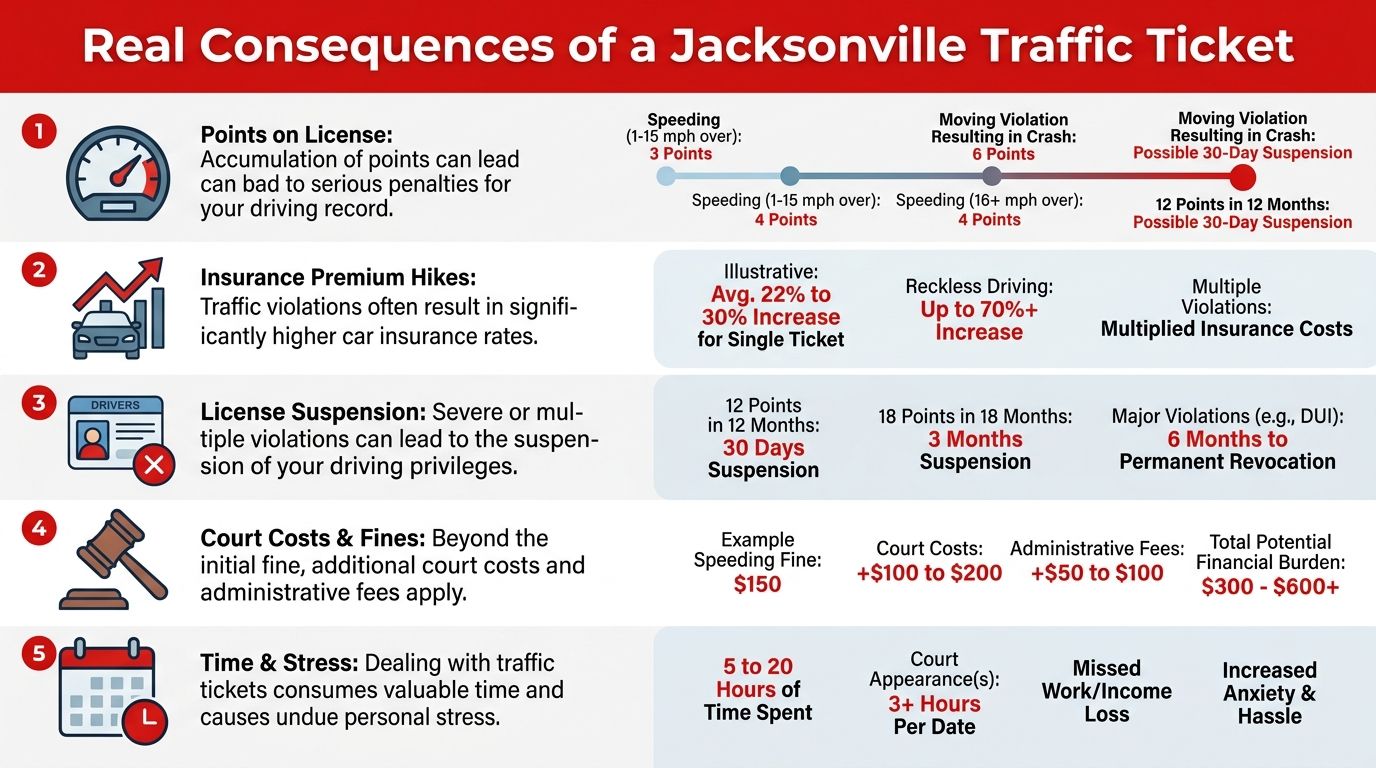
The fine is rarely the part that hurts most
Many drivers mistakenly treat the ticket like a simple bill. That is the mistake.
The court cost is visible. The long-term cost is not. A conviction can put points on your license, trigger insurance increases, and leave you with less room for error the next time you are stopped. If you need to see how Florida assigns and stacks points, read this guide to the Florida traffic ticket point system.
Those points matter because insurers, employers, and state regulators all look at your record for different reasons. A paid ticket can follow you long after the due date passes.
License trouble starts with patterns
One ticket usually does not scare people. A record does.
Florida does not look at your driving history as a series of unrelated bad days. It looks for repeat violations and accumulated points. That is how drivers end up facing suspension risk, driver improvement requirements, and avoidable stress over a problem that started with a citation they thought was minor.
Call a lawyer before the record gets worse. That is how you protect your options.
Duval County rewards preparation
Duval County is not the place to trust a ticket app that files paperwork and leaves you guessing. The courthouse has its own pace, its own personnel, and its own practical realities. If your defense depends on direct attorney judgment, local court experience matters.
That is why the lawyer-led model matters. Ticket Shield is built around attorney communication, not a ticket mill process where you upload a citation and hope someone handles it correctly. If your goal is to protect your record in Duval County, you want a lawyer who can assess the charge, spot weaknesses, and tell you what the courthouse is likely to do with your case.
Work drivers get hit harder
If you drive for Uber, Lyft, delivery, sales, or field service, a ticket can threaten your income fast.
A commuter usually worries about insurance. A driver who works on the road may face platform penalties, employer scrutiny, or both. Even a relatively ordinary moving violation can create a business problem if your job depends on a clean record and uninterrupted driving privileges.
The same ticket does not hurt every driver the same way
Driver type | What is really at risk |
|---|---|
Daily commuter | Insurance increases and a weaker driving record |
Gig or delivery driver | Account problems, lost shifts, and lost income |
Military or security-cleared worker | Extra professional scrutiny over a preventable record issue |
Parent managing school and work | Court obligations, scheduling pressure, and transportation disruption |
If you are searching for traffic attorneys jacksonville fl, focus on one question. Are you getting a real lawyer who will speak with you and handle the Duval County process directly, or are you being pushed into an impersonal volume system? That difference often decides whether this stays manageable or gets expensive fast.
What Common Offenses Do Jacksonville Drivers Face
Jacksonville drivers see the same core charges again and again. The label on the citation matters. So does the statute behind it.
The city’s road safety problems are serious. Jacksonville recorded a crash rate of 2.34 collisions per 100,000 people, which exceeded Florida’s statewide 1.7, and speeding accounted for over 40% of the 150,000+ tickets issued in Duval County annually, according to Jacksonville crash and citation statistics.
That local environment shapes enforcement. Officers are looking hard at speed, aggressive driving, signal violations, and impairment-related stops.
Is speeding the most common problem
Usually, yes.
Under Florida Statute 316.187, a driver can be cited for unlawful speed. Many people assume a speeding case is automatic. It is not. The officer still has to support the stop and the method used to measure speed.
Common Jacksonville situations include:
I-95 enforcement
JTB speed traps
Highway transitions where speed limits change
Bridge approaches and heavy commuter corridors
If you are dealing with that charge, this guide on a speeding ticket in Duval County FL can help you understand the local issue.
What about red light violations
Red light cases look simple on paper and messy in practice.
Some come from direct officer observation. Others involve camera-based enforcement. The legal issue is not just whether your vehicle entered an intersection. It is whether the evidence, notice, and process hold up.
Red light violations can create record concerns, and drivers often mishandle them because they think a mailed notice is less serious than a roadside stop. That is a mistake.
When does careless or reckless driving become dangerous
When careless or reckless driving becomes dangerous, a traffic case starts to feel more serious.
Careless driving centers on how the officer describes your behavior. Reckless driving can move into criminal territory depending on the allegation. If the citation says your driving showed willful or dangerous disregard, do not treat it like an ordinary ticket.
Look closely at the accusation. Was it:
weaving through traffic
excessive speed tied to road conditions
abrupt lane changes
an incident connected to a crash
The wording matters because prosecutors and judges react to the facts described, not just the name of the offense.
A charge that sounds routine can become much harder to resolve when the report claims your driving put other people at risk.
How serious is a DUI-related traffic stop
Very serious.
A DUI is not a moving violation. It can trigger criminal exposure, license consequences, and major record problems. In Florida, impairment cases often turn on the stop, the officer’s observations, field exercises, and testing issues.
A lot of Jacksonville drivers make the same bad assumption. They think the case is unbeatable because the officer wrote a detailed report. That is not how defense works. A report is not a conviction.
Which charges deserve immediate legal review
Some cases demand immediate attention because the downside is larger and the defenses can be technical.
Use this short triage list:
Speeding with a bad prior record: You need to protect against cumulative damage.
Red light or camera-based notice with confusing paperwork: Deadlines matter.
Reckless driving allegation: Criminal exposure changes everything.
DUI or DUI-related charge: The stop and evidence need to be examined immediately.
Jacksonville enforcement is active because the roads are busy and the crash picture is ugly. That does not mean every citation is valid, fair, or unbeatable. It means you need to respond like the case matters.
What Should You Do Immediately After Getting a Ticket
You need a checklist, not guesswork.
What should you do at the roadside
Stay calm. Be respectful. Do not argue facts on the shoulder of the road.
The stop is not your hearing. It is not your trial. Nothing good comes from trying to litigate the case while the officer is standing at your window.
What should you preserve after the stop
Your memory fades. Preserve details while they are fresh.
Save the ticket: Front, back, envelope, and any companion documents.
Record the scene: Signs, lane markings, traffic flow, weather, and lighting.
Note your route: Where you entered, where you exited, where the stop occurred.
Write down the conversation: Short notes are enough. Keep them accurate.
What should you avoid doing
Drivers sabotage their own cases every day.
Do not:
Pay online: That can amount to admitting the violation.
Post about it: Social media creates problems you do not need.
Call the court to explain facts: You can misstate something important.
Assume traffic school is always the answer: Sometimes it is not the best result.
Good defense starts before court. It starts with protecting your options in the first few days after the citation.
What is the most important deadline
The response deadline on the ticket matters. Treat it seriously.
If you wait too long, your options diminish. Your choices get narrower. Problems that could have been managed early become harder and more expensive to fix.
What should your next move be
Take the ticket out of the “I’ll deal with it later” pile.
Then do three things:
Confirm the charge and statute number
Gather your documents
Get legal advice before making any election
That is the cleanest path. It keeps you from locking yourself into a bad outcome for no reason.
How Can a Traffic Attorney Protect Your Record in Duval County
A good traffic defense is not magic. It is inspection, pressure, and precision.
An experienced attorney looks for mistakes that ordinary drivers do not spot. That includes citation defects, missing detail, weak stops, unsupported officer conclusions, and problems with the devices used to build the case.

What does a lawyer look for
Start with the paperwork.
Florida traffic cases depend on the officer’s citation and affidavit. If the details are incomplete, vague, or legally insufficient, that weakness matters. Experienced traffic attorneys challenge procedural technicalities, including insufficient detail on an officer’s affidavit, and they also examine calibration logs for speed measurement devices or breath-testing instruments to seek suppression of evidence, as explained in this Florida traffic crimes discussion.
That is why broad promises from automated services fall short. A defense requires a person who can read the file, spot the issue, and push it in the right forum.
For a broader look at that role, review how traffic ticket lawyers approach these cases.
Why procedural errors matter so much
Because the government still has to follow the rules.
If an officer fails to document the basis for the stop properly, that can matter. If the charging document is sloppy, that can matter. If the speed device or breath device maintenance records do not support reliability, that can matter.
Each one of those issues can alter your position in the case.
A lawyer is not there just to “show up.” A lawyer is there to test the case.
Why direct attorney access matters
Many drivers encounter problems here.
A lot of ticket services market convenience. Then the client ends up dealing with intake staff, a portal, or canned updates. That is not legal strategy. That is case processing.
You need a lawyer-led defense model. You should be able to speak directly with your attorney by phone or text. Your case should not be filtered through middlemen, chatbot prompts, or a ticket mill that treats you like a file number.
That difference matters in Duval County because traffic outcomes often turn on details: what the officer wrote, what was omitted, what hearing is appropriate, whether negotiation makes sense, or whether the case should be attacked instead of managed.
What can a lawyer try to achieve
The goal is not identical from case to case.
Sometimes the right target is dismissal. Sometimes it is adjudication withheld. Sometimes it is reducing the charge to protect the record. Sometimes it is keeping a criminal traffic case from spiraling.
Here's a practical way to assess it:
Situation | Legal goal |
|---|---|
Standard moving violation | Avoid points and protect the record |
Weakly documented stop | Attack legal sufficiency |
Speed device issue | Challenge reliability of measurement |
DUI-related traffic offense | Suppress evidence or weaken the state’s proof |
A short explainer can help if you want to see how these issues play out in real practice.
Why local court familiarity changes outcomes
Duval County is not a theory exercise. It is a working courthouse with its own routines, calendars, personalities, and pressure points.
A lawyer who handles these cases knows how traffic matters move, what documents need close review, and when a hearing strategy makes sense. That is very different from handing your case to an impersonal app that promises speed but offers no direct legal judgment when the file gets complicated.
If you cannot reach your actual lawyer, you do not have a defense relationship. You have a processing relationship.
That is not enough when your license is on the line.
How Does the Duval County Court Process Work
You get cited on Atlantic Boulevard, toss the ticket on the passenger seat, and tell yourself you will deal with it later. That is how drivers turn a manageable Duval County traffic case into a license problem.
In Jacksonville, traffic cases are processed through the Duval County Courthouse. Your result depends on what gets filed, what deadlines apply, whether a hearing is set, and who handles your defense. This is exactly why lawyer-led representation matters. Duval County is not a place for a ticket mill app to shuffle your file through a portal and hope for the best.
What happens first after the ticket
The clock starts when the citation is issued.
You have to respond by the deadline. Pay it, contest it, or have a lawyer step in and take control before a small mistake becomes a bigger one. Paying fast may close off defenses. Ignoring it can trigger added penalties, a suspended license, or both.
If you need the basic deadlines and filing rules, review these Jacksonville traffic court requirements.
Who handles the case inside the courthouse
Several people can affect the outcome, and each one plays a different role:
Clerk’s office: receives filings, records elections, and processes payments
Judge or hearing officer: decides procedure, hears arguments, and enters rulings
Law enforcement officer: serves as the state’s fact witness if the case goes to hearing
Defense attorney: reviews the citation, spots legal weaknesses, files the right response, and speaks for you in court when permitted
That last role is where drivers get separated into two groups. Drivers with direct access to a real lawyer get legal judgment. Drivers using a high-volume app often get status updates, scripted messages, and very little advice that fits the Duval docket.
What the case can look like after the response is filed
Some citations stay simple. Others do not.
A routine infraction may be resolved without a full evidentiary hearing. A contested ticket can move into a setting where the officer’s testimony, the wording of the citation, and the court’s procedural rules start to matter. Criminal traffic charges raise the stakes fast because they can involve mandatory appearances, sharper exposure, and less room for casual mistakes.
Court process is not just paperwork. It is timing, posture, and judgment.
A lawyer-led defense model like Ticket Shield puts an attorney between you and those mistakes. That matters in Duval County, where a file can look ordinary on day one and become much more serious after a missed deadline, a bad election, or an avoidable hearing.
Why drivers want to stay out of the courtroom when possible
Court appearances cost time, money, and control. If you miss work, arrange childcare, or depend on driving for income, the burden hits immediately.
There is also a legal reason to keep the process tight. Drivers who appear without counsel often talk too much, concede facts they did not need to concede, or miss a procedural issue that could have helped them. A controlled response from counsel protects the record and keeps the case from drifting off course.
Can a lawyer handle the process without dragging you into court
In many traffic cases, yes.
That is one of the clearest advantages of hiring a real traffic attorney instead of using an impersonal ticket mill. A lawyer can review the citation, choose the right response, communicate with the court, and appear for you in many situations where the rules allow it. You stay focused on your life while your defense is handled by someone who knows how Duval County works.
Direct attorney communication is not a luxury here. It is protection.
What Are Your Representation Options and Which Is Right for You
You have three clear choices after a Jacksonville traffic ticket.
One is risky. One is impersonal. One gives you a defense.
Option one is handling it yourself
This is the DIY path.
It appeals to drivers who think the case is minor or who assume nobody can fight a traffic ticket anyway. That assumption is wrong. The problem with self-representation is not just lack of legal knowledge. It is lack of perspective.
You may not know:
whether the charge is weaker than it looks
whether the officer’s paperwork is defective
whether a better resolution is available
whether paying now creates lasting record damage
DIY also costs time. You do the research. You track the deadline. You communicate with the court. You appear if required. And if you misjudge the case, you own the result.
Option two is using an automated app or ticket mill
This path sells ease.
The pitch is simple. Upload your ticket. Get updates. Let the system handle it. That sounds efficient until the case becomes fact-sensitive or legally technical.
Then the weakness shows.
These services often rely on layers between you and the person responsible for the legal work. Intake staff, support teams, forms, portals, scripted messages. You may not get a meaningful conversation with the lawyer assigned to the file.
That matters because a defense is not automation. It is judgment.
Option three is hiring a lawyer-led Florida traffic defense firm
This is the option I recommend.
You want direct attorney communication by phone or text. You want a person who can read your citation, identify the statute involved, evaluate the facts, and tell you plainly what the case calls for. You want a strategy customized to your record, your work, and your goals.
That is especially important if:
you hold a CDL or depend on driving for income
you have prior tickets
the citation suggests reckless driving or DUI exposure
you cannot afford points on your record
you need the matter handled with minimal disruption
Which option makes sense for most drivers
Here is the blunt answer.
| Option | Good for | Main risk |
|---|---|
| DIY | Very simple cases only, if you accept the risk | You miss defenses and damage your record |
| Automated app or ticket mill | People chasing convenience above all else | You lose direct legal judgment and personal attention |
| Lawyer-led firm | Drivers who want a strategic defense | You still need to act before deadlines pass |
If you are searching for traffic attorneys jacksonville fl, you are probably not looking for a lecture. You want the safest path.
That path is not gambling on yourself in a courthouse you do not know. It is not trusting a chatbot or middleman to “process” a case that can affect your license and income. It is hiring a Florida traffic defense lawyer who knows Chapter 316, understands Duval County practice, and can fight for the outcome that matters.
The right result is not just paying less today. It is preserving your record for tomorrow.
If you want a lawyer-led defense instead of an automated app or ticket mill, visit Ticket Shield, PLLC for a free consultation. Speak directly with your attorney by phone or text, get a strategic Florida defense, and fight for the goal that matters. No Points.