
Your Guide to Safe Driver on Florida License Status
Learn what a safe driver on Florida license status means for your insurance costs and driving record. Discover how to protect your status and save money.
Here in Florida, being a safe driver isn't about getting a fancy certificate from the state. It's more of a reputation—a status you earn with insurance companies simply by keeping your driving record clean.
Earning and keeping that status is one of the smartest things you can do behind the wheel. It leads directly to lower insurance premiums and keeps you far away from the headache of a license suspension.
What a Safe Driver Status Means for You in Florida
Think of your safe driver status like a credit score for the road. It's the story your official driving record tells anyone who looks at it, from insurance carriers to potential employers and, of course, the Florida Highway Safety and Motor Vehicles (FLHSMV).
A spotless record tells them you're a low-risk driver. That's a good story to have.
On the flip side, every traffic ticket—for speeding, running a red light, or any other moving violation—is a black mark on that reputation. Each citation can add points to your license, pushing you closer to suspension and telling insurers that you're a bigger risk to cover.
The Foundation of Your Status: Your Driving Record
The state of Florida keeps a close eye on every driver's history. This isn't just bureaucratic paperwork; it’s the backbone of how the state manages traffic safety. And with Florida's licensed driver population swelling from just under 15 million in 2004 to over 17 million by 2019, that's a lot of records to track.
During one five-year period, the state handed out an average of over 1.1 million traffic violation convictions every single year. This massive data set, detailed in this state report on driver licensing, helps officials spot trends and enforce safety rules, making your driving record an incredibly important document.
So, what are the real-world perks of keeping that record clean?
Lower Insurance Premiums: This is the big one. Insurers often reward safe drivers with significant discounts for having a clean record.
Avoiding License Suspension: Racking up too many points in a short period triggers an automatic suspension. A clean slate keeps your driving privileges secure.
Better Job Prospects: Many jobs that involve driving, from sales reps to delivery drivers, may require a clean record.
To put it all into perspective, here's a quick breakdown of what your safe driver status really means.
Florida Safe Driver Status At a Glance
Aspect | How It Works | What It Means for You |
|---|---|---|
Insurance Rates | Insurers use your driving record to assess risk. Fewer violations equal lower risk. | A clean record can earn you "Good Driver" discounts, potentially saving you money. |
License Points | Moving violations add points to your license. Too many points lead to suspension. | No tickets mean no points, keeping you safe from losing your driving privileges. |
Employment | Employers for driving-related jobs check your record as part of their hiring process. | A good record opens doors to more job opportunities. A bad one can close them. |
Ultimately, your safe driver status is in your hands. Every decision you make behind the wheel either strengthens or weakens it.
Attorney Advertisement: Our goal is to protect your license and record. Past results do not guarantee future outcomes. Our office is located in Broward.
Understanding what's at stake is the first step. Protecting your license, your finances, and your freedom to drive legally across the Sunshine State is what matters most.
How Florida's Point System Shapes Your Driving Record
Think of your driving record as the official story of your life behind the wheel. In Florida, that story is written in points. To keep your safe driver on Florida license status, you have to understand how a single ticket can add a new, unwanted chapter.
It starts with a clean slate. But every moving violation—even for something that seems minor, like going a few miles over the speed limit—adds points. More serious offenses, like reckless driving, pile them on even faster. This isn't just about paying a fine and moving on; it’s a system that directly threatens your driving privileges and your wallet.
The Point Thresholds You Can't Afford to Ignore
The Florida Highway Safety and Motor Vehicles (FLHSMV) has strict limits on how many points you can accumulate over time. If you cross these lines, your license gets suspended. Automatically.
It’s a simple but unforgiving math problem:
Get 12 points in a 12-month period, and you'll face a 30-day suspension.
Get 18 points in an 18-month period, and you're looking at a 3-month suspension.
Get 24 points in a 36-month period, and your license is gone for a full year.
A suspension can turn your life upside down, making it a challenge to get to work, run errands, or handle family responsibilities. The best defense is to keep those points off your record in the first place.
This is where being a safe driver really pays off. It's not just an abstract concept—it has tangible benefits that protect you from these exact consequences.
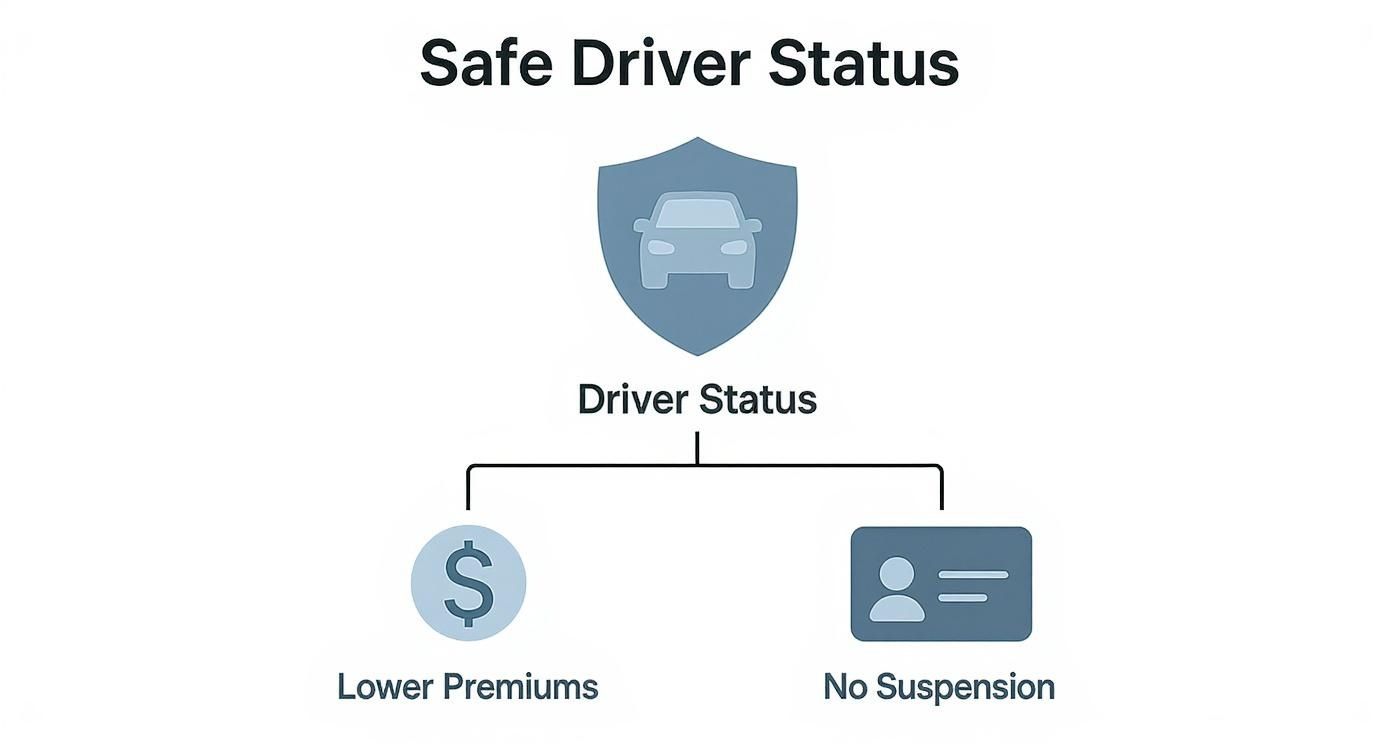
As you can see, a clean record leads directly to potential financial savings on insurance and, most importantly, keeps you legally on the road.
Checking Your Driving Record Status
You don't have to be in the dark about where you stand. The FLHSMV lets you pull an official copy of your driving record, which lays out your entire history of tickets, points, and any past suspensions.
Making a habit of checking your record once a year is a smart move. It helps you spot any errors and shows you exactly what your insurance company sees when they decide your rates. Knowing what’s on your record gives you the power to protect it. To see how different violations stack up, check out our complete guide to the Florida traffic ticket point system.
Attorney Advertisement: Our goal is to protect your license and record. Past results do not guarantee future outcomes. Our office is located in Broward.
At the end of the day, every point is a potential problem. Understanding that a simple ticket has long-term consequences is the first step toward keeping your driving future secure in Florida.
The Real Financial Impact of a Clean Driving Record
Sure, keeping your license out of the suspension zone is a big deal, but let's talk about something you'll feel every single month: money. Having that safe driver on Florida license status is one of the best ways to keep more cash in your pocket. It's simple, really. Insurance companies are all about managing risk, and your driving record is their number one tool for predicting how likely you are to cost them money.
When your record is spotless, you're sending a clear signal: "I'm a responsible driver." Insurers often reward that with "Good Driver" or "Safe Driver" discounts. These can lead to serious savings. But get one ticket, and poof! Those discounts can disappear, and your rates can shoot up faster than you'd expect.
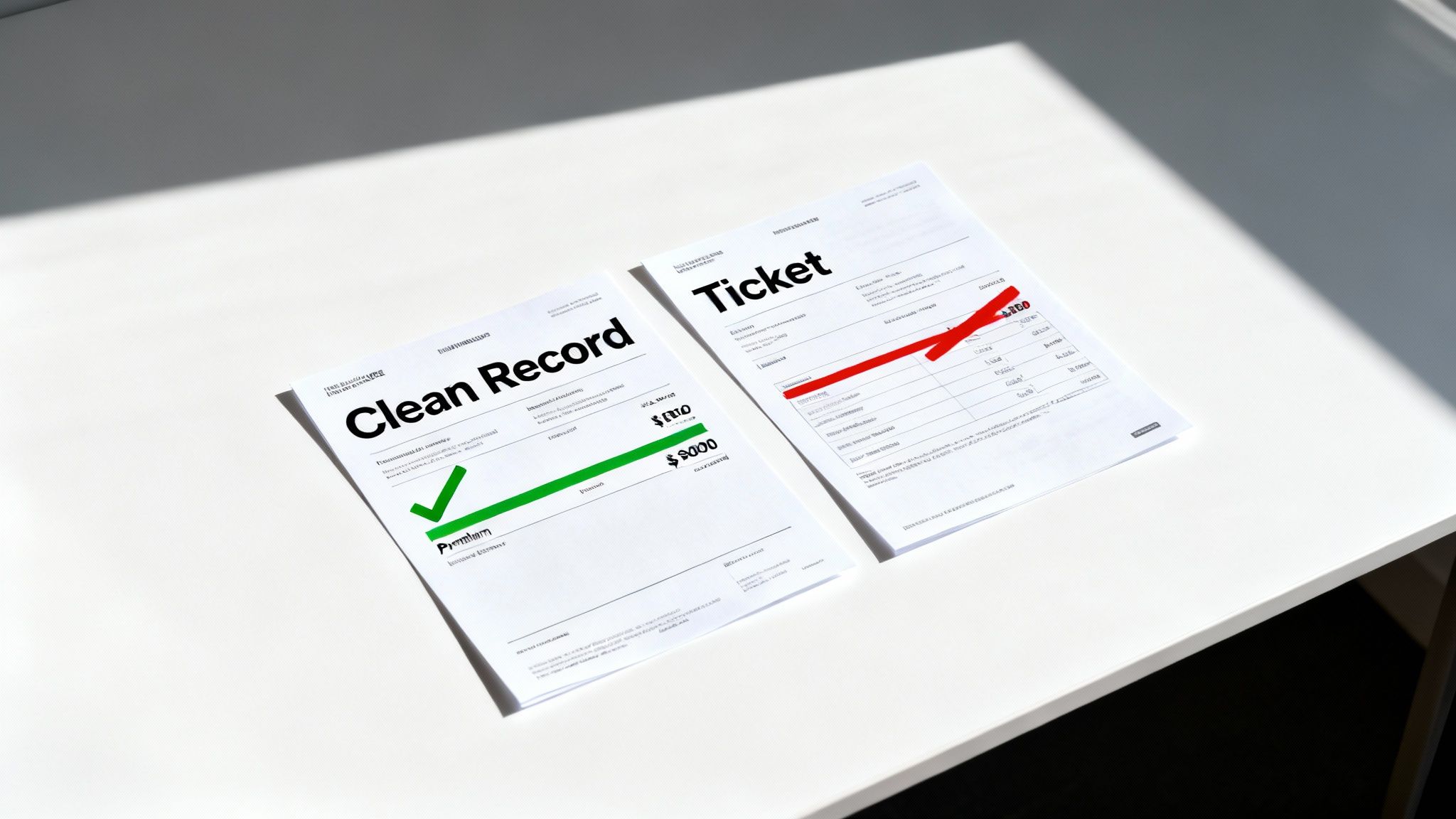
Comparing Insurance Costs: A Hypothetical Scenario
Let's paint a picture to see how this plays out. Take two Florida drivers—same age, same car, same neighborhood.
Driver A has a perfect driving record for the past three years. No tickets, no problems. Their insurance company gives them a 20% safe driver discount, and their annual premium is a manageable $1,800.
Driver B got a single speeding ticket six months ago. The insurance company removes the discount and tacks on a surcharge. Suddenly, their annual premium jumps to $2,300.
Just like that, one little ticket costs Driver B an extra $500 a year. And it doesn't stop there. Over three years, that single mistake adds up to $1,500 out of their pocket—way more than the initial fine. The financial sting of a violation sticks around long after you've paid the clerk, which is why it's so critical to understand how long traffic tickets stay on your record and keep hitting you where it hurts.
Attorney Advertisement: Past results do not guarantee future outcomes. Our goal is to protect your license and record.
Beyond Insurance: Your Record and Your Career
The financial fallout doesn't end with your insurance bill. In Florida, where driving is a part of so many jobs, a clean driving record is a legitimate career asset.
Think about it. Fields like sales, delivery, construction, and even home healthcare often require you to get behind the wheel of a company car. The first thing a potential employer does is run a check on your driving history.
If they see recent violations or a pile of points, it can be a huge red flag. It can knock you out of the running for a job, even if you’re the most qualified person otherwise. Protecting your record isn’t just about dodging fines; it’s about protecting your paycheck and keeping your career options wide open.
Strategic Choices After Getting a Florida Traffic Ticket
The flashing lights in your rearview mirror are just the beginning. That sinking feeling you get when an officer hands you a traffic ticket is real, but what you do in the next few days is what truly matters.
A snap decision can wreck the safe driver on Florida license status you've worked hard to protect. Before you do anything, take a breath and understand your options. You have three distinct paths forward, and each one carries very different consequences for your driving record, your insurance premiums, and your wallet.
Making the right choice here is your best defense against points on your license and the financial pain that follows. Let's walk through your options so you can pick the one that makes the most sense for you.
Option 1: Pay the Fine and Accept the Points
This is the path of least resistance, but it often comes with the heaviest long-term cost. When you just pay the fine for a moving violation, you're legally admitting guilt. Simple as that.
Once that payment goes through, the conviction is locked onto your driving record, and the state adds the corresponding points to your license. It might feel like the fastest way to make the problem go away, but it's a direct hit to your safe driver status and can trigger a nasty surprise on your next insurance bill.
Option 2: Elect Traffic School to Avoid Points
Florida law offers a valuable escape hatch: you can elect to attend a Basic Driver Improvement (BDI) course to keep points off your license for an eligible ticket. This can be a smart move for protecting your record.
But this isn't a get-out-of-jail-free card. There are strict rules:
You can only choose the traffic school option once every 12 months.
You are limited to a total of five times in your entire lifetime.
This option is generally off-limits for Commercial Driver's License (CDL) holders trying to avoid points.
And while the course successfully prevents points from being added, the ticket itself doesn't just vanish. It often remains visible on your complete driving history. It's a strategic play, not a magic eraser.
Attorney Advertisement: Our practice focuses on traffic and DUI defense. We handle criminal traffic matters across Florida. Our office is located in Broward.
Option 3: Contest the Ticket in Court
Your third path is to plead not guilty and fight the ticket. This is your chance to push for a complete dismissal of the charges or get the offense reduced, either of which can prevent points and shield your record from harm.
Of course, contesting a ticket means you'll have to make your case in front of a judge, which can feel incredibly intimidating if you go it alone.
This is where having an experienced traffic attorney in your corner can be beneficial. Attorneys who focus on traffic defense navigate the court system every day. They know how to spot weaknesses in the case against you and argue for a better outcome on your behalf. Our goal is to protect your license and keep your record clean.
Remember, past results don't guarantee future outcomes, but putting up a strong defense gives you a real fighting chance. The decision you make right now can save you a world of stress and money down the road.
Proactive Steps to Safeguard Your Driving Record
Keeping that safe driver on Florida license status isn't just about what you do after you see flashing lights in the rearview mirror. It's about the small, smart decisions you make every single day.
The real key to long-term success is shifting from a reactive mindset to a proactive one. This approach doesn't just protect your driving record; it protects your wallet, too. It’s about building good habits that go way beyond just following the speed limit. Think of it as cultivating a defensive driving mindset, keeping your car in top shape, and knowing the rules of the road inside and out.
Adopt Defensive Driving Habits
Defensive driving is simple in theory: you anticipate danger to avoid accidents before they even have a chance to happen. It's all about staying alert, managing the space around your car, and assuming other drivers might do the unexpected.
Maintain a Safe Following Distance: The three-second rule is your best friend. It gives you the cushion you need to react if the driver in front of you slams on their brakes.
Minimize Distractions: We all know texting is bad, but distracted driving is so much more. It's anything that takes your eyes off the road, your hands off the wheel, or your mind off the task of driving.
Check Your Blind Spots: Mirrors don't show you everything. A quick glance over your shoulder before changing lanes or merging is a non-negotiable habit.
These simple routines dramatically cut your risk of getting a ticket or, even worse, causing a collision that puts points on your license.
Confidentiality Notice: Submitting information through our website's contact forms does not establish an attorney-client relationship. Your privacy is important to us.
Prioritize Routine Vehicle Maintenance
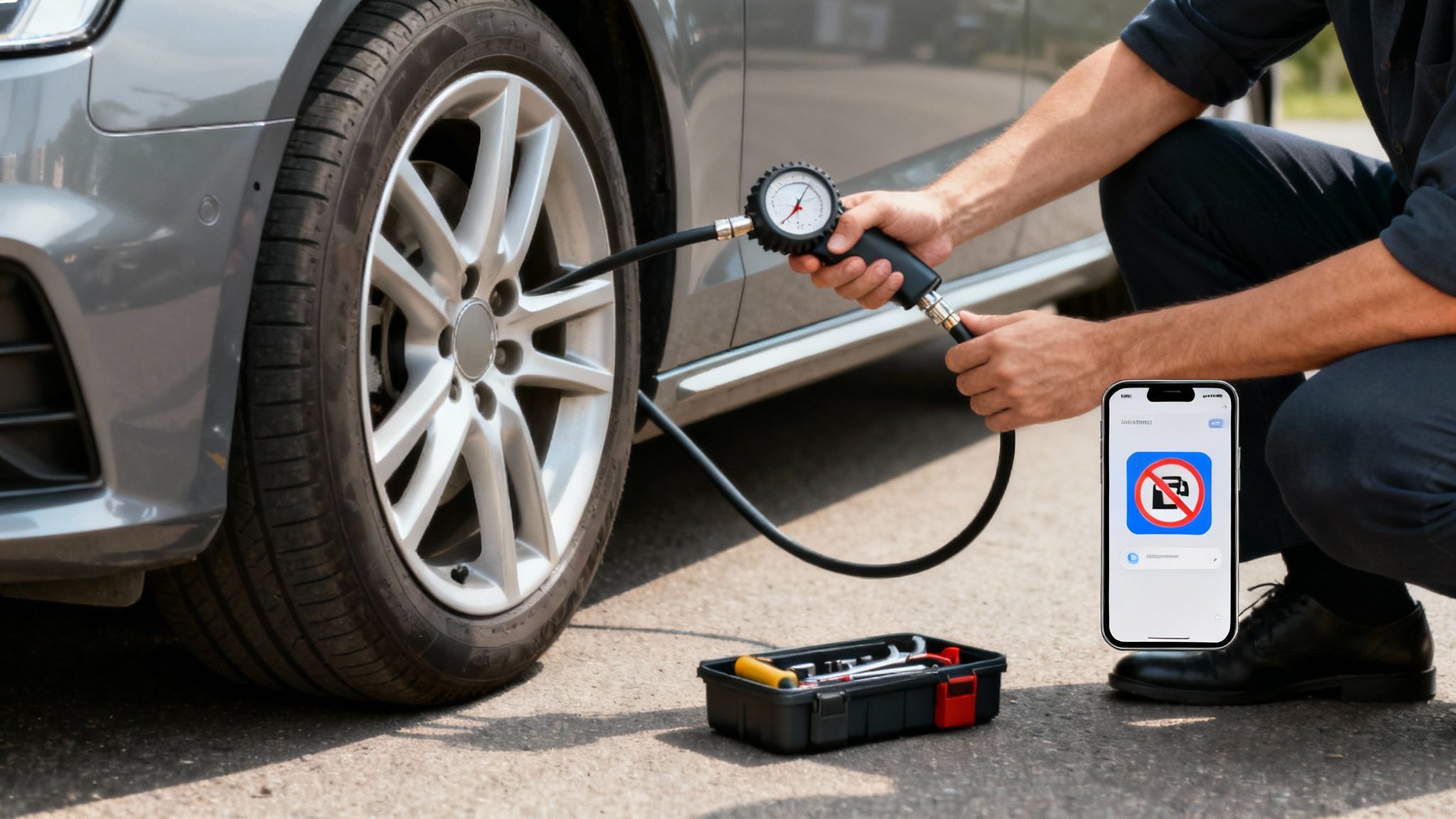
Your car's health is just as critical as your driving habits. Why? A well-maintained vehicle is a safer vehicle, and police can—and do—issue tickets for equipment violations. We're talking about things like a burned-out headlight or tires with no tread left.
Think of routine maintenance as a cheap insurance policy for your driving record. Regularly check your tire pressure, walk around the car to make sure all your lights work, and get your brakes inspected. Ignoring basic upkeep can lead to a preventable traffic stop and a costly ticket that ruins an otherwise perfect record.
Finally, get into the habit of pulling your official Florida driving record at least once a year. This lets you spot any errors or inaccuracies that could be quietly costing you money on your insurance. Being proactive is your best defense for protecting the clean record you've worked hard to build.
Common Questions About Florida Driving Records
Trying to figure out the rules around your driving record can feel like a maze. If you're like most drivers, you've probably wondered what a ticket really means for your license, insurance rates, and your goal of keeping that safe driver on Florida license status.
Let’s tackle some of the most common questions we hear from drivers across Florida. While this info is here to give you some general clarity, it’s not a substitute for legal advice. For help with your specific situation, you should always talk to a licensed attorney.
How Long Do Points Stay On My Florida Driving Record?
This is a big one, and the answer has two sides. First, let's talk about the state. For the purpose of a potential license suspension, the Florida Highway Safety and Motor Vehicles (FLHSMV) keeps points from a violation active for 36 months. Think of it as a rolling three-year window the state is constantly looking at to see if you’ve accumulated too many points.
But then there are the insurance companies, and they play by a different set of rules. They often look back even further—usually somewhere between three to five years—when setting your premiums. So, a ticket from four years ago might not put your license in danger anymore, but it could still be quietly costing you money every month on your insurance bill.
Can I Still Get a Safe Driver Discount with One Ticket?
This is a classic "it depends" situation. Whether one ticket torpedoes your safe driver discount comes down entirely to your insurance provider's specific policies. At the end of the day, insurance is a game of risk, and every company has its own math for what they consider "safe."
Some insurers might give you a pass with a "first-ticket forgiveness" program, especially if your record is otherwise squeaky clean. Others are far less forgiving and will yank that discount the moment a single moving violation hits your record. The only way to know for sure? Pick up the phone, call your agent, and ask them directly.
People often think a ticket just vanishes once they pay it. The truth is, how you handle it dictates its long-term impact. Knowing your options is the critical first step to protecting your record.
Does Traffic School Erase a Ticket from My Record?
This is a common myth. Lots of drivers believe that going to traffic school (or a driver improvement course) wipes the slate clean, as if the ticket never even happened. That’s not quite how it works.
When you successfully complete traffic school for an eligible ticket, it does one incredibly important thing: it prevents points from being added to your license for that violation. That's a huge win for avoiding a potential license suspension. But the citation itself doesn't disappear. It typically stays on your complete driving history, where it can still be seen by law enforcement and, you guessed it, your insurance company.
Think of it as a strategic move to prevent immediate damage, not a magic eraser. It’s always a good idea to know what’s on your record, and our guide on how to check your driving record in Florida can walk you through it.
What Is the First Thing I Should Do After Getting a Ticket?
Stop. Before you do anything else, just take a breath and read the citation from top to bottom. Pay close attention to the details of the alleged violation and, critically, the deadlines for taking action. Missing a deadline can snowball into much bigger problems, like a suspended license.
Your very next step should be to understand your options before you make a decision. Just paying the fine is an admission of guilt, and it guarantees you’ll get points on your record. We always recommend getting a free consultation with a law firm that focuses on traffic defense. An experienced attorney can look at your case, explain the potential outcomes, and help you make the smartest choice to protect your license and your wallet.
Attorney Advertisement. This article is for informational purposes only and does not constitute legal advice. Past results do not guarantee future outcomes. Our practice focuses on traffic and DUI defense. Office in Broward.
At Ticket Shield, PLLC, our entire focus is on protecting your license and your record. If you’ve been given a ticket anywhere in Florida, let us take the stress off your shoulders and fight for the best possible result. Get your free consultation today by visiting https://www.ticketshield.com.
