
Florida Running a Stop Sign Fine: Your Next Steps
Facing a Florida running a stop sign fine? Learn about the points, insurance hikes, and defenses. See how a lawyer can protect your record. Free consult.
You’re probably staring at the citation right now, irritated, busy, and tempted to just pay it so it goes away. That instinct is exactly what gets Florida drivers into expensive trouble.
A running a stop sign fine looks small on paper. It isn’t small in real life. In Florida, this is a Chapter 316 moving violation. Once you pay it, you’re not “resolving” it. You’re admitting it.
That admission can affect your license, your insurance, and for some drivers, your job. If you drive for work, hold a professional license, commute daily, or don’t want your rates to jump for years, you need to treat this ticket like a legal problem, not an inconvenience.
Table of Contents
You Just Got a Stop Sign Ticket What Now?
A Florida stop sign ticket isn't just a fine. It’s 3 points on your license and a multi-year insurance hike. Paying the ticket is a guilty plea. To protect your record, you must fight it with an experienced attorney.
You got pulled over. The officer says you rolled the sign. Now you have a citation under Florida Statute §316.123, and your first thought is simple: pay it and move on.
That’s the wrong move.
A stop sign ticket feels minor because there was no arrest, no handcuffs, and no courtroom that day. But Florida treats it as a moving violation with real consequences. The state doesn’t care that you were late for work, inching forward for visibility, or trying to make a safe turn. If you pay, the system records a conviction and moves on without giving you any reason to expect mercy later.
Immediate reality: paying first and asking questions later is how drivers end up with points they could have avoided.
If you haven’t dealt with this before, start by reviewing practical guidance on what to do when you get a ticket. Then make a decision quickly and carefully.
Immediate steps to take
Check the deadline: Your citation has a response date. Missing it creates a bigger problem than the original ticket.
Preserve your memory: Write down where the stop sign was, traffic conditions, weather, sight lines, and what the officer said.
Look at the location: If the line was faded, the sign was obscured, or the intersection layout was confusing, that matters.
Do not admit the violation broadly: Casual statements to anyone can box you in later.
Get legal advice before paying: Once you pay, you’ve made the state’s case easy.
If your goal is protecting your record, you need a response built around that goal from the start.
What is the Real Cost of a Florida Stop Sign Ticket?
The fine isn’t the primary problem. The conviction is.
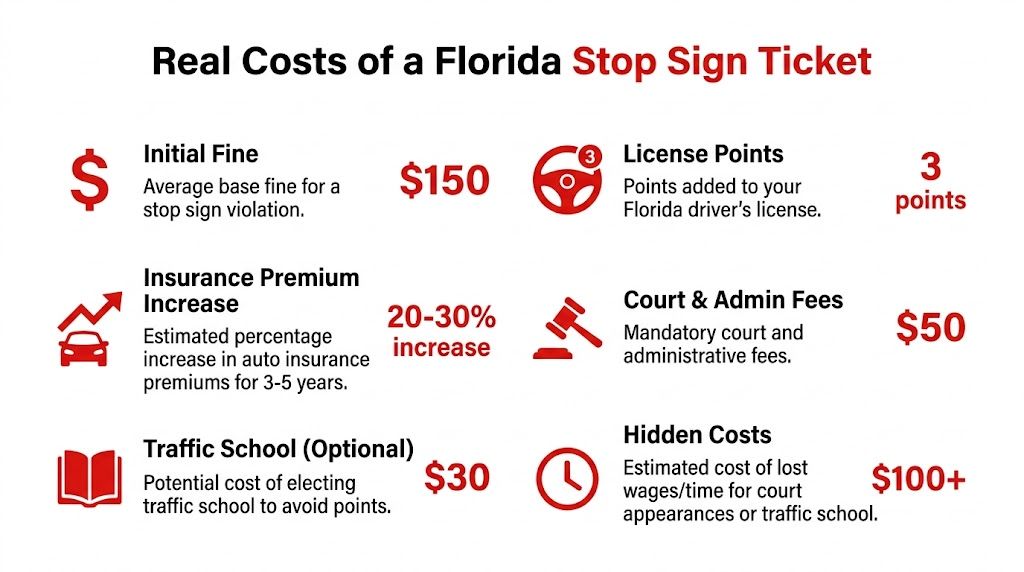
Under Florida Statute §316.123, running a stop sign is a noncriminal moving violation that adds 3 demerit points to your record. If you reach 12 points within 12 months, Florida can suspend your license for 30 days. Fines plus court fees can total $150-$275, and insurance premiums can increase 20-50% for 3-5 years post-conviction, according to this Florida stop sign violation breakdown.
If you want a fuller breakdown of the hidden financial damage, review this guide on the cost of ticket for running a stop sign.
What do the points do to your license
Three points may not sound dangerous. That’s because most drivers look at the ticket in isolation. The DMV doesn’t.
If you already have prior tickets, those 3 points can move you much closer to a suspension. That risk is worse for:
Gig drivers: A moving violation can trigger account reviews or deactivation.
Commercial drivers: Even routine traffic issues can create licensing and employment pressure.
Frequent commuters: More time on the road means more exposure to future citations.
Military personnel and cleared professionals: A clean record is critically important.
Here’s the practical issue. You don’t get to decide later that the points were a bad idea. Once you pay, they attach.
Why insurance is the real financial hit
Most drivers focus on the court payment because it’s visible. Insurance is where the damage lasts.
A conviction for a stop sign violation can push premiums up 20-50% for 3-5 years post-conviction, based on the same Florida citation analysis linked above. That means the running a stop sign fine isn’t just a one-time expense. It can become a recurring penalty every time your policy renews.
The court takes your payment once. Your insurer can keep collecting the price of that conviction for years.
Look at the cost categories side by side:
Cost category | What happens |
|---|---|
Court cost | You pay the ticket amount and fees |
License impact | Florida adds 3 points |
Suspension risk | Prior points can make this ticket much more serious |
Insurance impact | Premiums may rise for 3-5 years |
Work impact | Driving-based jobs may become harder to keep |
A lot of drivers say, “I’ll just eat the fine.” That’s not what you’re eating. You’re accepting the fine, the points, and the insurance consequence all at once.
Why this changes the right decision
If your only goal is closing the file fast, paying makes sense. If your goal is protecting your record, it usually doesn’t.
You should judge this ticket by its long-term cost, not by the number printed on the citation. That’s the difference between reacting emotionally and responding strategically.
What Does Florida Law Actually Consider a Stop?
Florida law is specific. The officer doesn’t get to define “stop” however he wants.
Under Florida Statute §316.123, a driver must stop at the proper place before entering the intersection. In plain terms, your vehicle must come to a complete stop. Rolling, creeping, or stopping beyond the required point can still lead to a citation.
Where you must stop under the statute
The location matters as much as the act of stopping.
Florida’s rule follows a sequence:
At the marked stop line, if one exists.
Before the crosswalk, if there is no stop line.
Before entering the intersection, if neither is marked.
That order matters because many stop sign tickets come from disputes about where the vehicle stopped, not just whether it stopped at all.
Why that legal definition matters to your defense
Many drivers get caught in this situation. They say, “But I did stop.” The officer says, “Not where you were required to stop.”
That’s a legal issue, not just an argument.
Questions that often matter include:
Was the stop line visible
Was the sign clearly placed at the intersection
Was there a crosswalk
Did the driver stop short, at the line, or after it
Could the officer see the wheels stop
A valid defense often starts with the exact geometry of the intersection, not with a broad denial.
This is also why DIY defenses usually fail. Drivers argue fairness. Courts look at statutory elements.
At courthouses like the Orange County Courthouse in Orlando, the difference between a conviction and a better outcome often comes down to details in the citation, the roadway markings, and the officer’s ability to testify precisely about what he observed. If the state can’t clearly prove the required stop under §316.123, that weakness matters.
Why Is Just Paying the Fine a Bad Strategy?
Because paying is surrender.
You may think you’re buying convenience. In reality, you’re giving up the opportunity to dispute the ticket. If you pay a stop sign ticket, you remove the chance to challenge the officer’s observations, the citation language, and the evidence.
If you’re weighing that decision right now, compare the consequences in this breakdown of pay ticket vs hire a lawyer.
Paying is a guilty plea
Florida doesn’t treat payment like a neutral administrative act. It treats it as an admission.
Once you pay:
The case is effectively over
You lose the chance to contest the allegation
The license consequences follow
The insurance consequences can follow
The state has no reason to reduce or revisit anything
That’s why “I’ll just pay it” is not a strategy. It’s a waiver.
Why Florida treats these tickets seriously
Stop sign violations are prosecuted aggressively because they are tied to serious intersection crashes. Nearly 700,000 police-reported crashes occur at stop signs annually in the United States, and a detailed analysis found that stop sign violations accounted for about 70% of all crashes at two-way stop-controlled intersections, according to this PubMed-indexed study on stop sign crashes.
That context matters. Judges and prosecutors don’t see this as paperwork. They see a safety offense.
When the state views a violation as a crash risk, hoping for automatic leniency after a guilty plea is unrealistic.
Here’s the practical takeaway. The system is designed to punish easy admissions because the state wants compliance at intersections. If you hand the state a conviction by mail or online payment, you should expect the legal consequences to attach cleanly.
A quick explainer may also help if you want a visual summary before deciding how to proceed.
How Does a Lawyer Defend a Stop Sign Ticket?
You hire a lawyer for one reason. To force the state to prove the charge instead of letting a clerk, an app, or a payment portal turn a manageable ticket into a conviction.
That process starts fast. At the Richard E. Gerstein Justice Building in Miami and in traffic courts across Florida, a defense attorney builds the case around what the prosecutor must prove under §316.123. The work is specific to your intersection, your citation, and the officer’s claimed observations. A real defense is not a mass-processing workflow.
What your attorney reviews
A serious review is detailed because small facts decide these cases.
A lawyer may examine:
The citation itself: Wrong statute, vague location, incomplete allegations, and clerical errors can weaken the case.
The officer’s vantage point: Could the officer clearly see your wheels, the stop line, and the point where your vehicle paused?
Roadway markings: Was there a visible limit line, crosswalk, or other clear stopping point?
The sign condition: Was the sign visible, unobstructed, and placed where a driver could reasonably react to it?
Video evidence: Bodycam, dashcam, and nearby footage may contradict a quick visual judgment.
Video matters more than many drivers realize. Dashcam and bodycam review can expose angle problems, distance distortion, and mistaken assumptions about whether a car stopped, as discussed in this analysis of stop sign defense and video distortion.
That is where a lawyer earns the fee. The issue is rarely whether a police officer wrote a ticket. The issue is whether the officer can prove, with reliable detail, that you violated the statute at that exact location.
Why direct attorney access matters
You should be able to speak to the lawyer handling your case.
That sounds obvious, but many drivers end up in ticket-mill systems built around intake forms, scripted updates, and non-lawyer staff. Those systems can process volume. They do not prepare a defense specific to your facts. A Florida stop sign case can turn on a blocked line of sight, a bad stop line, a weak narrative, or a video frame that changes the whole hearing.
A dedicated attorney can review the evidence, tell you where the case is strong or weak, and make a recommendation that fits your record and risk level. If you want to see how fact-specific dismissal arguments can be, review this guide on how to get a stop sign ticket dismissed.
Ticket Shield, PLLC is one Florida firm that uses that lawyer-led model rather than routing clients through an app or non-lawyer intermediary.
What happens after you hire counsel
For you, the process should be simple. For your lawyer, it is not.
Review the ticket for legal defects and deadline issues
File the appropriate plea or court paperwork
Request and analyze available evidence
Identify factual and statutory weaknesses
Choose between negotiation, mitigation, or a contested hearing
Appear in court so the client usually does not have to
Strong traffic defense is built before the hearing date. It comes from close file review, evidence analysis, and a lawyer who knows what to press and what to challenge.
That is why treating a stop sign ticket like a minor annoyance is a mistake. The right response is a professional defense.
What Are Common Defenses and Mitigation Options?
A stop sign ticket is defendable, but only if someone looks at the actual facts instead of pushing your case through an app.
That is the difference between a lawyer-led defense and a ticket mill. A dedicated attorney checks the officer’s account against the intersection, the signage, the stop line, any video, and your driving history. Then the attorney picks the strongest path. Fight the proof, push mitigation, or both.
If you want to see how these arguments work in real cases, read this guide on how to get a stop sign ticket dismissed.
Can the officer actually prove you failed to stop
This is usually the first pressure point.
Officers often write these citations as if the violation was obvious. It often was not. A brief full stop can be hard to see from the side. A patrol car can have a blocked angle. Traffic, glare, bushes, parked vehicles, and intersection geometry all matter. One bad vantage point can weaken the entire case.
A careful defense may focus on:
Obstructed sign visibility: Trees, glare, construction, or poor placement can affect whether the sign was reasonably visible.
Unclear stopping point: Faded lines, missing markings, or an awkward intersection layout can create doubt about where a lawful stop had to occur.
Weak citation detail: Thin descriptions make it harder to prove the violation with confidence.
Officer recollection problems: By hearing date, some officers remember the stop poorly or rely too heavily on a generic report.
Statements and report language: The report may leave gaps that matter, especially if the wording does not clearly establish a failure to stop.
One weakness may not carry the day. Several weaknesses together often change the value of the case.
What mitigation can still do for you
Some cases are better handled through mitigation than an all-or-nothing hearing. That is still a legal strategy, not surrender.
The goal is to limit record damage, keep points off where possible, and reduce the insurance fallout that usually costs far more than the fine itself. According to The Ticket Clinic, a stop sign conviction can raise insurance costs for years and add more than $2,000 over time in its discussion of hidden stop sign ticket costs.
A lawyer who knows the local court can decide whether to press for dismissal, negotiate for a reduced outcome, or present mitigation built around your record and risk level.
Situation | Practical legal focus |
|---|---|
Strong factual dispute | Attack the officer’s proof and seek dismissal |
Mixed facts | Push for a reduced result that limits damage to your record |
Weak facts but clean history | Present mitigation in a way that gives the court a reason to soften the outcome |
High-risk driver profile | Focus on avoiding points and protecting insurability |
Why handling this yourself is risky
Drivers lose good cases by talking too much, missing the right election, admitting facts they did not need to admit, or showing up with explanations instead of evidence.
Judges do not dismiss tickets because a driver feels the stop was unfair. They want a legal defect, a factual problem, or a sensible negotiated resolution. Local court habits matter too. At places like the Broward County Judicial Complex in Fort Lauderdale, knowing what arguments get traction can make the difference between a routine conviction and a controlled result.
Your job is not to tell your side of the story as emotionally as possible. Your job is to protect your record, your insurance, and your license exposure. A lawyer does that by building a case, not by processing a ticket number.
What Happens If You Ignore the Ticket?
Ignoring the ticket is the worst option on the table.
A traffic citation has a deadline. If you don’t respond, the problem stops being a routine moving violation and starts becoming a compliance problem with the court and the state.
Why delay makes everything worse
Fines for stop sign violations can range from $25 to over $300, but the bigger issue is escalation. Court fees and hidden costs can compound the damage, and ignoring the ticket can lead to license suspension and more severe legal penalties, as explained in this discussion of the overall costs of running a stop sign ticket.bakersfieldtraffictickets.com/blog/2024/july/the-real-costs-of-running-a-stop-sign-ticket-bey/).
That means your “I’ll deal with it later” plan can become:
A suspended license
Additional fees and administrative problems
Greater employment risk if you drive for work
A much harder cleanup process
If you’re already behind on a citation, review what can happen with unpaid tickets in this article on can you get a warrant for unpaid tickets.
Florida drivers should also take out-of-state issues seriously. Reciprocal reporting can still affect your Florida record and insurance situation. The safe assumption is simple: if the citation touches your driving history, treat it as something that can follow you home.
At the Edgecomb Courthouse in Tampa and courts statewide, the best results usually come from early action. Delay gives you fewer options.
Take Action to Protect Your Record Today
A Florida stop sign ticket under §316.123 is not a harmless errand. It’s a legal risk with a paper trail.
The running a stop sign fine is only the first layer. Underneath it are 3 points, possible suspension exposure if your record already has problems, and insurance consequences that can outlast the court case by years. Paying the ticket closes the file fast, but it does it on the state’s terms, not yours.
If your priority is No Points, don’t handle this casually.
What you should do next
Pull out the citation today: Confirm the county, charge, and response deadline.
Do not pay before reviewing your options: Payment is the mistake many drivers can’t undo.
Gather the facts: Intersection photos, your recollection, and any available video can help.
Speak with a lawyer, not a chatbot: You need actual legal judgment.
Act before the deadline closes your options: Delay helps the state, not you.
You do not need to guess your way through this. You need a plan focused on your record, your license, and your insurance exposure.
If you want a lawyer-led response focused on the No Points goal, visit Ticket Shield, PLLC for a free consultation. You’ll get clear direction on the citation, the deadline, and the smartest next step to protect your Florida driving record.
