
Red Light Camera Rules Ontario: Your 2026 Driver's Guide
Understand red light camera rules ontario for 2026. Learn about fines, your rights, and how to dispute tickets with expert guidance. Drive confidently!

You opened your mail. You saw a red light camera notice. Your stomach dropped. For red light camera rules Ontario, stop and reset. The notice matters, but the smartest response is fast, organized, and deliberate.
Drivers often make bad decisions. They ignore it. They pay it without reading it. They trust an automated app that treats every case the same. That's a mistake. A camera ticket is paperwork-driven enforcement. Paperwork creates opportunities, but only if you act before deadlines close.
Table of Contents
What You Must Do After Getting a Red Light Ticket
TL;DR: Don't ignore a red light camera notice. Read it, track the deadline, preserve every document, and decide quickly whether to pay or contest it. Early action protects you. Delay hands control to the system.
You got a letter, not a roadside stop. That doesn't make it minor. It means the case started on paper, and paper deadlines can hurt you just as fast as a courtroom date.
If you're in Florida, I'd tell you the same thing I tell drivers walking into the Richard E. Gerstein Justice Building in Miami. Fast action wins an advantage. Passive waiting loses it.

Why your first reaction matters
A red light camera case often feels less serious because no officer stopped you. That's exactly why people mishandle it. They treat it like junk mail. It isn't.
Ontario's camera system has been operating since 1999, and the notice goes to the registered owner because the camera photographs the vehicle rather than identifying the driver, according to Durham Region's red light camera rules. That owner-based structure is simple, but it also means your first move needs to be careful and documented.
Practical rule: Never admit anything before you've reviewed the notice, the date, and the images.
Immediate steps to take
Open everything immediately: Read the full notice, not just the fine line or payment box.
Check the dates: In Ontario, the offence notice must be mailed within 23 days of the incident, with expected arrival within 7 days, for a maximum 30-day receipt window, as summarized in this Ontario red light camera timeline overview.
Save the envelope and all pages: Mailing dates, print errors, and document issues can matter.
Compare the plate and vehicle details: Don't assume the notice is flawless.
Avoid instant payment: Payment closes off your fight.
Read a calm next-step guide: what to do when you get a ticket
If your case is in Ontario, the owner-based system is the core of the problem. If your concern is Florida procedure, the legal framework is different, and that difference matters. You need to know which system controls your options before you do anything else.
How Do Florida's Red Light Cameras Legally Work
Florida drivers need to understand the statute before they react. The controlling law is Florida Statute 316.0083, inside Chapter 316. That statute governs red light camera enforcement and gives you the framework to challenge what the government sent.
This is not criminal at the opening stage. It starts as a civil enforcement process. That distinction matters because the procedure, deadlines, and consequences change depending on whether the case stays at the notice stage or escalates.
What Chapter 316 means for you
Florida's red light camera enforcement is built around a notice first. If the system captures a vehicle entering the intersection after the light turns red, the registered owner receives a notice. The owner can then decide whether to pay or contest it under the process recognized in 316.0083.
Under Florida law, the notification must be sent within 30 days of the violation, and the owner has the right to request an administrative hearing within 60 days following the date of notification before a Uniform Traffic Citation is issued, as described in this summary of Florida Statute 316.0083 hearing rights.
If you miss the procedural window, you give up options you had on day one.
Florida drivers who want a practical breakdown of the system should review this Florida red light camera overview.
Notice of Violation versus Uniform Traffic Citation
These are not the same thing.
A Notice of Violation is the opening notice. It tells you the camera system claims your vehicle entered after the signal turned red. At this stage, the matter remains in the earlier civil framework.
A Uniform Traffic Citation is the next level. Once the case escalates, you're no longer dealing with the same simple posture. The filing posture changes. The pressure increases. The consequences can expand.
Here's the clean comparison:
Document | What it means |
|---|---|
Notice of Violation | Initial camera-based allegation sent to the registered owner |
Uniform Traffic Citation | Escalated citation if the initial matter is not resolved in time |
If you're worried because you searched for red light camera rules Ontario, keep your systems separate in your head. Ontario uses its own owner-liability structure. Florida uses Chapter 316 and a notice-to-hearing path. Mixing them up leads to bad choices.
Who Is Responsible and What Are the Penalties
The first question drivers ask is the right one. Who's on the hook?
In Florida, the answer is blunt. The registered owner is legally responsible for the red light camera notice, not the driver, and the owner receives a Notice of Violation carrying a mandatory $158 penalty if the vehicle is captured entering after the light turns red, according to this Florida red light camera penalty summary.
Who the law targets first
This owner-based structure frustrates people, but you need to face it clearly. The government does not start by proving who had hands on the wheel. It starts with the registration record.
That's why your first review should focus on ownership, plate details, vehicle match, and whether the notice paperwork lines up with the event being alleged.
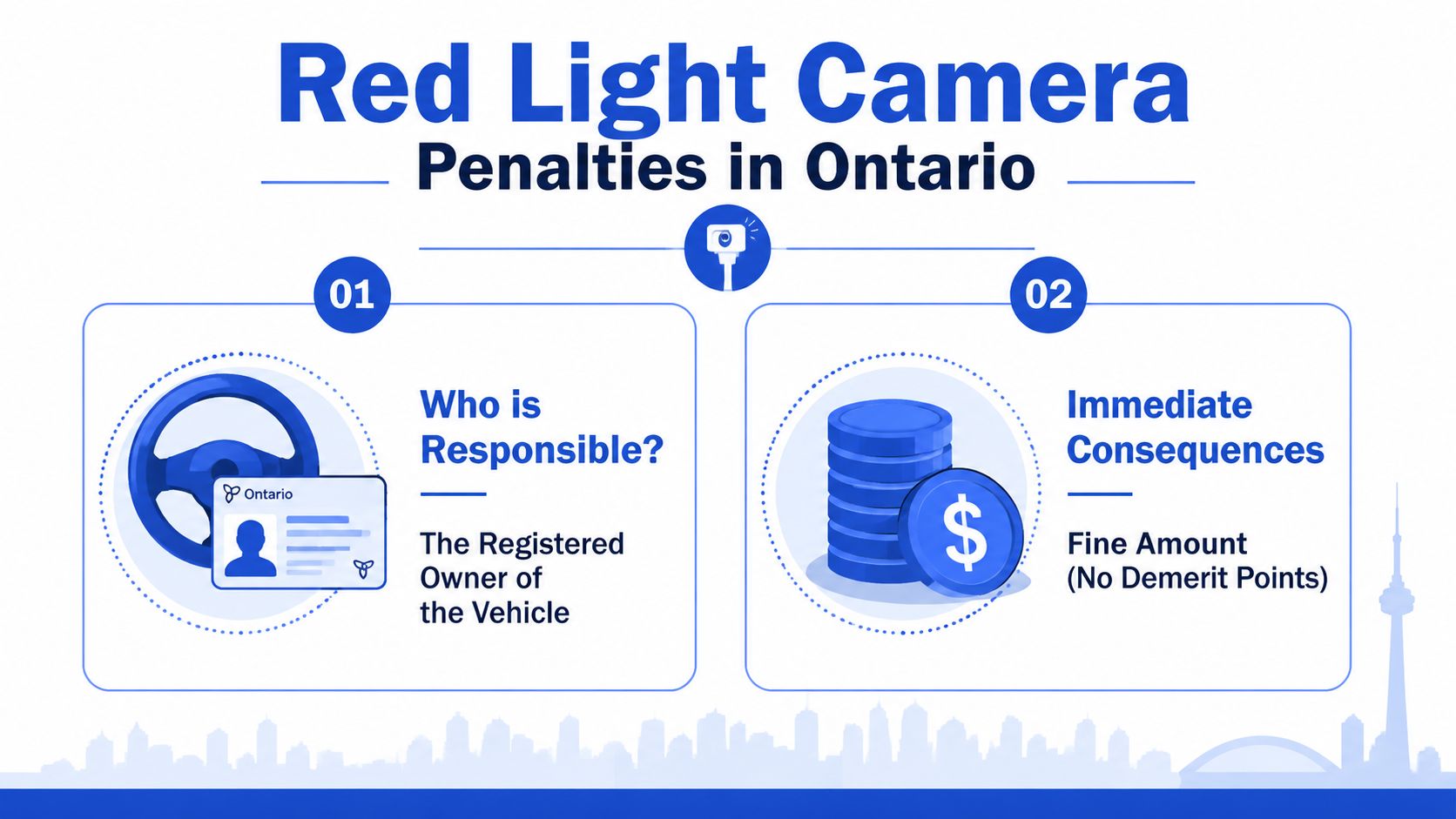
If your concern is Ontario specifically, the owner-based rule is similar in one important way. The notice goes to the registered owner because the system identifies the vehicle, not the driver. But don't blur the rest. Procedures and downstream consequences depend on the jurisdiction.
What the penalty does and does not do
Here's the point many drivers need to hear. A Florida Notice of Violation is painful, but at that stage, it isn't the same as a moving violation conviction that puts points on your license.
That should calm you, but not lull you.
Use this short checklist:
Who receives it: The registered owner
What it demands: Payment of $158
What it should trigger: A quick legal review, not procrastination
What you should read next: cost of a ticket for running a red light
A no-point notice can still become a very expensive mistake if you let it mature into a larger case.
For Ontario readers, the ticket there is also owner-based and does not place demerit points on the driver's record in the camera context. That often makes people underestimate it. Don't. A manageable notice is still a legal notice.
What Happens If You Ignore the Notice
Ignoring a red light camera notice is the lazy option. It's also the dangerous one.
Drivers tell themselves they'll handle it later. Then later becomes a worse document, a tighter deadline, and a problem that starts touching their driving privilege instead of just their wallet.
Why silence creates a bigger problem
Florida Statute 316.0083 creates a process. Processes keep moving when you do nothing.
If you don't pay or contest the initial notice, the matter can convert into a Uniform Traffic Citation. Once that happens, you've lost the easiest chance to contain the case. You're now dealing with a stronger enforcement posture and a more serious administrative problem.
I see this pattern constantly. The driver wasn't trying to refuse compliance. The driver got busy. That excuse doesn't stop escalation.
Here's the practical progression:
You receive the notice
You do nothing
The case advances
The pressure shifts from optional response to enforced consequence
What to do before the deadline passes
The fix is simple. Act while the matter is still small enough to control.
Use this triage list:
Mark your response deadline today: Put it in your phone and calendar.
Pull every related document into one folder: Notice, envelope, screenshots, registration.
Decide whether you're contesting or resolving: Delay is not a strategy.
Learn how unpaid ticket problems can spiral: can you get a warrant for unpaid tickets
A lot of people make the same emotional mistake. They hear “camera ticket” and think “low priority.” Then the paperwork hardens against them.
The system rewards prompt response. It punishes silence.
If you searched red light camera rules Ontario, this warning still applies in principle. Owner-based camera enforcement may look administrative and routine, but ignoring official notices is how small cases become messy ones. Keep control while you still have room to choose.
What Are Your Options to Fight the Ticket
You do have options. Use them early.
In Florida, 316.0083 gives you the right to request an administrative hearing within 60 days of the notification, before a Uniform Traffic Citation is issued, and the notification itself must be sent within 30 days of the violation under the source cited earlier. That deadline is your advantage. Miss it, and you shrink your defense before anyone even hears it.
At the Richard E. Gerstein Justice Building, procedure matters. Deadlines matter more than speeches. Drivers who preserve documents and request review on time start from a stronger position.

How to request a hearing in time
Don't overcomplicate this. Your mission is to preserve the right to fight.
Immediate Steps to Take
Confirm the notice date: Your hearing window runs from the notification date, so get that date right.
Organize the evidence package: Keep the notice, mailing materials, and any images or online screenshots together.
Request the hearing before the window closes: Waiting for a “better time” is how people lose their procedural rights.
Review a tactical guide: how to beat a red light ticket
Defense angles worth reviewing
Not every defense wins. Some are weak from the start. A serious review focuses on the evidence and the process.
Here are common areas worth examining:
Defense angle | Why it matters |
|---|---|
Vehicle identification issues | If the plate, vehicle, or ownership details don't line up, the notice deserves scrutiny |
Photographic clarity | A blurry or incomplete record can weaken the allegation |
Timing and procedure | If required notice procedures weren't followed, that can matter |
Driver versus owner confusion | In owner-based systems, the legal target matters |
For Ontario readers, many people ask whether they can argue they weren't driving. In owner-based camera systems, that argument often doesn't carry the force people hope it will. Focus on the notice, the evidence, and the technical details instead.
Why You Need a Lawyer Not an Automated App
A red light camera case looks simple until it isn't. That's why automated apps and ticket mills are a bad fit for drivers who want a strategic defense.
You need a human being reading your documents, spotting procedural defects, and telling you what matters in your specific case. You don't need a chatbot recycling canned answers.

Why direct attorney access changes the outcome
A lawyer-led defense gives you something automated platforms can't. Judgment.
That means someone can look at the notice date, compare it to the mailing window, examine the images, and decide what argument is worth pressing. It also means you can ask follow-up questions by phone or text instead of sending your case into a support queue run by middlemen.
For Florida drivers, local practice matters too. A lawyer handling cases around the Broward County Judicial Complex, Edgecomb Courthouse, or Orange County Courthouse understands that procedure isn't just what the statute says on paper. It's also how cases move in real buildings with real hearing officers and court staff.
One lawyer-led option is Ticket Shield, PLLC, a Florida firm that handles traffic defense with direct attorney communication by phone or text rather than routing clients through automated intake systems.
What automated services miss
Automated services flatten every case into the same script. That's the problem.
They often miss things like:
Document defects: Small errors can matter if someone carefully reads for them.
Jurisdiction differences: Florida Chapter 316 procedure is not the same as Ontario owner-liability processing.
Client-specific facts: Shared vehicles, registration issues, and notice timing need real analysis.
This short video gives useful context on why legal strategy beats generic automation in ticket defense:
Real defense starts with a file review, not an auto-generated script.
If your goal is No Points, don't hand your case to software pretending to be legal judgment.
Take Control of Your Ticket Today
You don't need panic. You need action.
If you received a notice and searched for red light camera rules Ontario, the key lesson is simple. These cases are owner-focused, deadline-driven, and easier to handle when you move early. If your case is in Florida, Chapter 316 gives you a path to fight before the matter gets worse.
Your goal is simple
Protect the record. Avoid escalation. Preserve the chance for a result that keeps points off your license.
Do these three things now:
Read every page carefully
Calendar the deadline
Get the case reviewed before you pay or ignore it
That approach protects you better than wishful thinking. It protects you better than delay. It definitely protects you better than automated apps that don't know your facts, your court, or your risk.
A red light camera notice is manageable when you confront it early. It becomes expensive when you let the system make the next move for you.
If you want a lawyer-led review focused on the No Points goal, visit Ticket Shield, PLLC for a free consultation.
