Reckless Driving Ticket Price: Your Florida Cost Guide
What is the real reckless driving ticket price in Florida? Learn about fines, criminal penalties, hidden costs, and how an attorney can protect your record.

A Florida reckless driving ticket isn't just a fine. It's a criminal charge under Florida Statute § 316.192, and its full price can include court penalties, insurance increases, record damage, and career risk.
You're probably reading this with a citation in your hand, a court date on the calendar, and one question in your head: what is this going to cost me?
The blunt answer is that the reckless driving ticket price in Florida is usually higher than drivers expect. Not because the fine always looks massive on paper, but because reckless driving sits in criminal court, not routine traffic court. That changes everything. It changes how prosecutors treat the case. It changes what shows up on your record. It changes what your insurer may do next.
In places like Tampa's Edgecomb Courthouse, drivers make the same mistake every week. They treat a reckless driving charge like a speeding ticket, pay it, and move on. That's the wrong move. A criminal traffic charge can keep costing you after court is over.
Table of Contents
Your Reckless Driving Ticket Is More Than a Fine
Most drivers focus on the amount written on the citation. That's understandable. It feels concrete. It feels manageable. It's also the wrong way to measure risk.
A Florida reckless driving case can carry a courtroom penalty, but the reckless driving ticket price is bigger than the number a judge may order you to pay. It can include higher insurance costs, a criminal record problem, time away from work, and damage to jobs that depend on a clean driving history.
That's why I tell people to stop asking only, “What's the fine?” Start asking, “What happens if this sticks?”
Practical rule: If the charge is reckless driving, treat it like a criminal defense problem from day one.
Florida drivers often learn this too late. They think they're dealing with a traffic ticket. Then they find out they're in a criminal courtroom, dealing with prosecutors, formal pleadings, and consequences that don't disappear when the clerk takes payment.
If you're worried about what happens after the case ends, insurance should already be on your radar. Ticket Shield's discussion of the cost of insurance increases after a Florida speeding ticket gives you the right frame of mind. A serious driving conviction can keep billing you long after court.
Why drivers underestimate this charge
Three things cause most of the damage:
The criminal label: A reckless driving charge isn't handled like a basic noncriminal infraction.
The long tail of the case: Insurers, employers, and licensing bodies may care more than the court fine suggests.
The wrong help: Automated apps, ticket mills, and chatbot-driven intake systems often move fast, but they don't replace direct legal judgment.
A reckless driving allegation needs strategy. Facts need to be examined closely. The officer's observations matter. The roadway conditions matter. The driving pattern matters. A lawyer needs to assess whether the conduct rises to reckless driving under Florida law, or whether the state overcharged the case.
That's where a lawyer-led defense matters. You need direct access to the attorney handling your case by phone or text. Not a middleman. Not a call center. Not a chatbot trying to triage a criminal traffic charge.
What Is a Reckless Driving Charge in Florida?
Florida reckless driving is governed by Florida Statute § 316.192. The key legal phrase is driving with a willful or wanton disregard for the safety of persons or property. That wording matters. It's what separates this charge from an ordinary mistake behind the wheel.
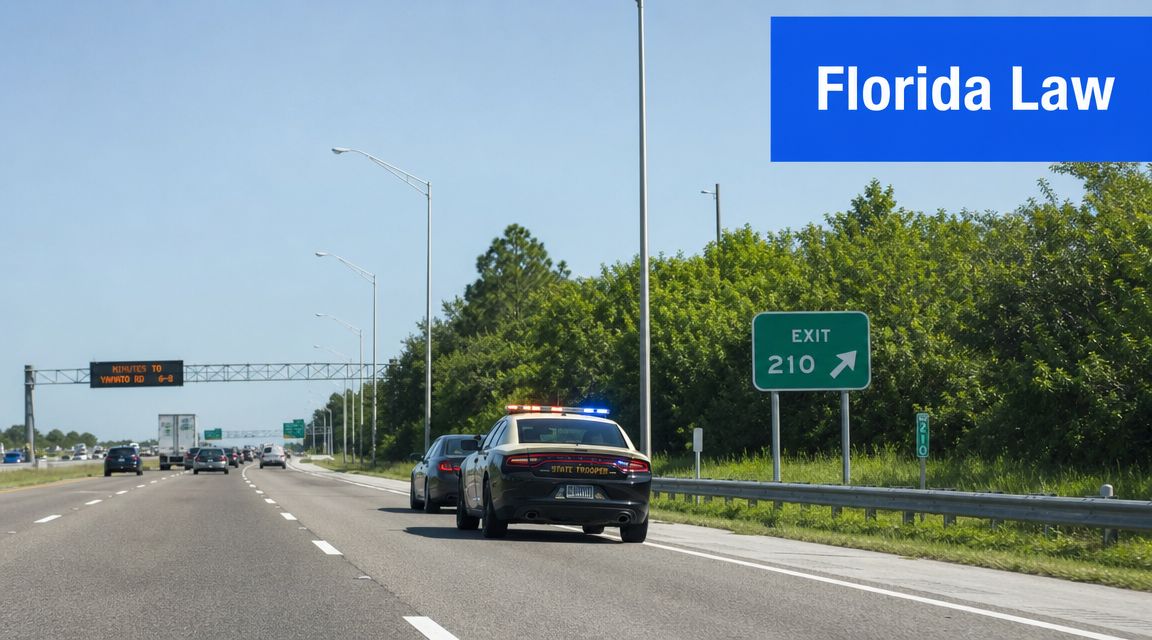
You can review the statute in more detail through Ticket Shield's page on the Florida reckless driving statute. The point is simple. The state isn't claiming you merely broke a traffic rule. The state is claiming you drove with a level of disregard that justifies criminal punishment.
What Florida law actually says
Florida law treats reckless driving as a second-degree misdemeanor on a first offense, with penalties of up to 90 days in jail and a fine of up to $500. A second offense can bring up to 6 months in jail and a $1,000 fine. If the case involves property damage or injury, it can rise to a first-degree misdemeanor with up to 1 year in jail and a $1,000 fine. If the case involves serious bodily injury, it can become a third-degree felony punishable by up to 5 years in prison and a $5,000 fine, as outlined in Ticket Shield's review of Florida reckless driving penalties.
Those numbers should change how you view the case immediately. You are not pricing out a routine ticket. You are managing criminal exposure.
If your case also involves an accident, injury allegations, or a dispute about civil responsibility, it may help to understand the broader liability environment. My Safety Manager's Florida tort analysis is a useful background read on how Florida's liability framework affects serious roadway disputes.
Why the criminal label matters
A criminal traffic charge changes your position and your risk.
Pay a noncriminal ticket without a fight, and you may absorb points and a fine. Plead to reckless driving without a defense plan, and you may hand the state a criminal conviction.
That distinction affects more than court. It can affect professional licensing, driving-based work, military careers, security clearance concerns, and any background check where criminal history matters.
Drivers often assume the state can prove reckless driving just because the officer wrote the citation that way. That's not how defense works. The officer's conclusion is not the final word. The legal standard still has to be met, and in many cases the facts deserve a harder look than they get at roadside.
How Much Are the Direct Fines and Court Costs?
The direct out-of-pocket bill usually starts with the statutory fine. It doesn't end there.
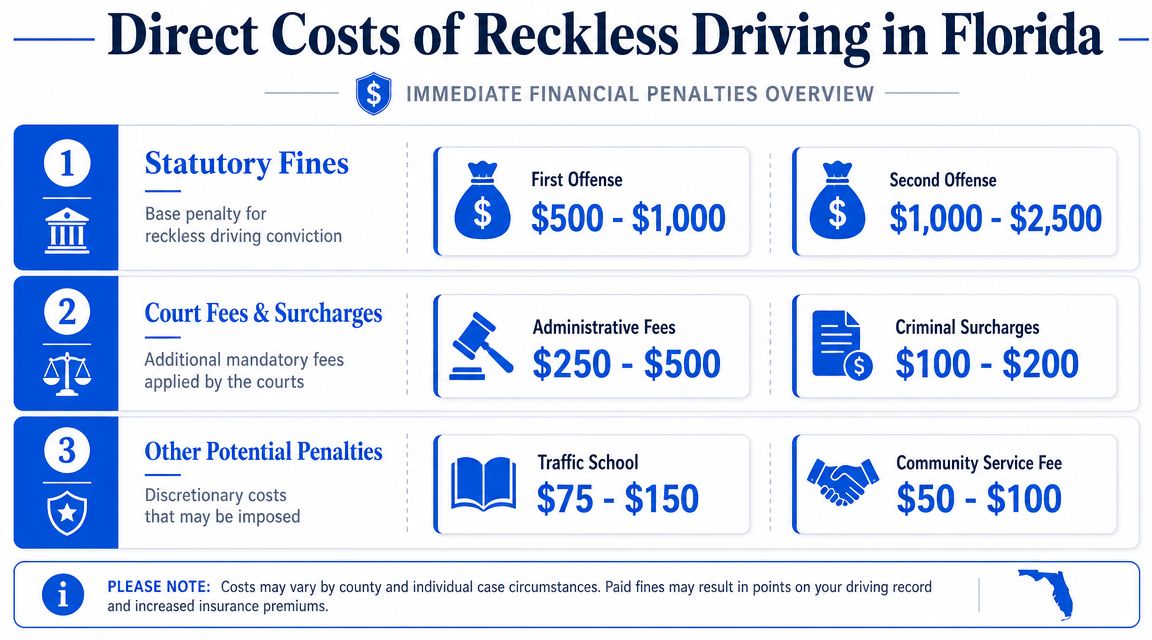
One of the most useful ways to think about the reckless driving ticket price is this: it's a criminal-penalty stack. That phrase fits because the total bill often combines the base fine, court assessments, and later financial fallout. A legal summary on reckless driving penalties explains that this kind of charge is not priced like a simple infraction and that the criminal classification itself triggers additional costs that increase the total bill under a criminal-penalty stack model.
What you see first
The first number drivers usually hear is the statutory maximum tied to the offense level. In Florida, that depends on whether the case is a first offense, repeat offense, injury case, or felony-level bodily injury case, as discussed earlier.
What many people miss is that the court process itself carries expenses beyond the headline fine. Clerks assess costs. Courts impose required charges. Administrative obligations follow the case. The exact total depends on the county, the judge, the charge level, and the final disposition.
If you want a general sense of how court-imposed amounts can grow beyond the face value of a citation, Ticket Shield's breakdown of traffic ticket court costs is worth reviewing.
Why the court number is only the starting point
Here's the practical problem. Drivers budget for the fine and ignore the structure around it.
A reckless driving case may involve:
Base fine exposure: The statutory amount tied to the offense level.
Court assessments: Required charges that attach through the criminal court process.
Case-management costs: Administrative obligations that increase what you pay out.
Defense-related costs: If you wait too long, your options narrow and your total expense can rise.
A short comparison helps:
Cost category | What it means |
|---|---|
Statutory fine | The punishment amount authorized by law |
Court costs | Charges added through the court system |
Administrative burden | Time, filings, appearances, and compliance requirements |
Downstream expense | Insurance and record-related fallout after court |
The statute gives you the ceiling for punishment. It does not give you the full invoice for the case.
That's why asking the clerk, “How much is my ticket?” is the wrong question. The better question is whether the charge can be reduced, dismissed, amended, or resolved in a way that limits what follows you after judgment.
What Are the Hidden Financial Penalties of a Conviction?
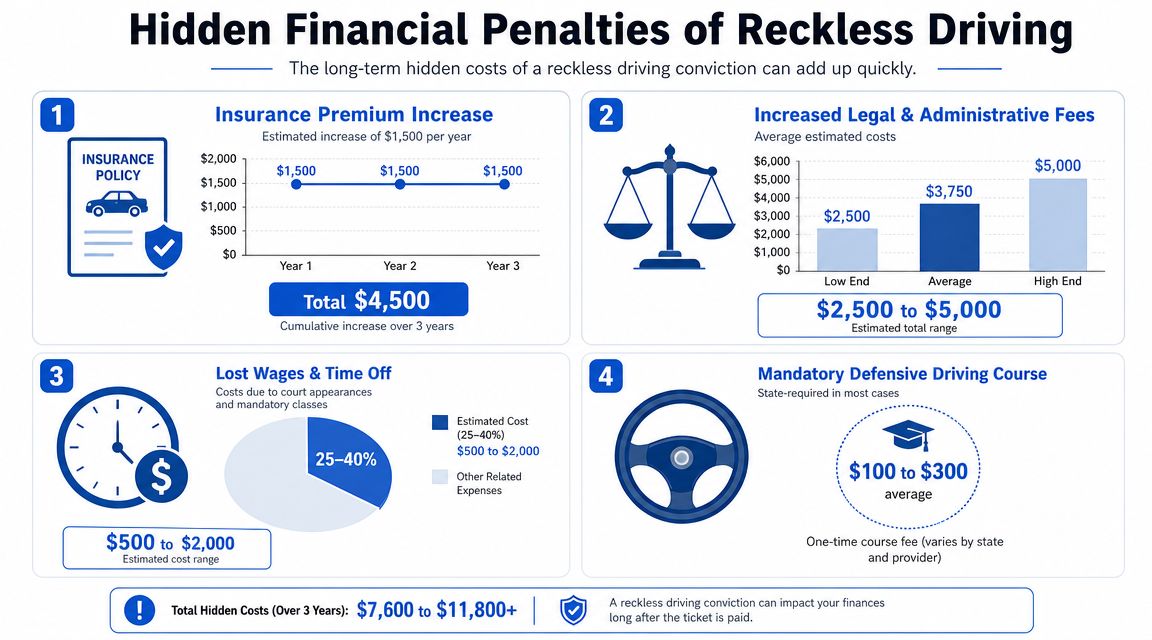
The hidden costs are usually the part that hurts most. They arrive after the court date, after the payment, and after most drivers think the case is over.
Insurance is often the real bill
A legal analysis notes that a reckless driving conviction can increase insurance premiums by up to about $2,000 per year for three years, which implies a potential $6,000 indirect cost before attorney fees or court costs are counted, according to this explanation of what a reckless driving speeding ticket can cost over time.
That is why paying a reckless driving charge just to “get it over with” is often a bad financial decision. The court may close the file. Your insurer may keep charging you for years.
If you drive for Uber, Lyft, DoorDash, or any job that depends on a clean record, the risk expands. Even if your employer never uses the words “reckless driving ticket price,” they care about the same thing. Your eligibility. Your insurability. Your reliability on paper.
Your record can cost you money in other ways
The hidden price also shows up in less obvious places:
Work disruption: Court dates, mandatory appearances, and case requirements can force you off the road and away from work.
Professional screening: Employers often react differently to a criminal driving conviction than they do to a basic moving infraction.
Commercial and fleet consequences: Companies that insure drivers may treat reckless driving as a serious underwriting issue.
Career friction: Military service members, clearance holders, and regulated professionals can face extra scrutiny.
Most drivers think the case ends when they pay. Financially, that may be when it starts.
A conviction record also changes how any future traffic stop is viewed. Prior history matters. Prosecutors care about it. Judges care about it. Insurers certainly care about it.
That is why damage control has to happen early. The best time to protect your money is before a conviction is entered, not after.
What Factors Can Change Your Ticket Price?
No honest lawyer should give you a one-size-fits-all number for a reckless driving case. The facts drive the risk.
Some cases stay within misdemeanor territory. Others become much more serious because the conduct, context, or outcome gives the prosecutor a stronger position. A reckless driving ticket price can change sharply based on what the officer claims happened and what the state thinks it can prove.
Some facts make the case much more dangerous
The first category is aggravating conduct. That includes allegations like extreme speed, dangerous lane changes, racing-type behavior, near-collisions, actual collisions, property damage, and injuries.
A legal discussion of reckless driving penalties in other jurisdictions makes a broader point that still applies here: pricing changes drastically based on case facts, and work-zone, emergency-zone, injury, or death allegations can drive penalties much higher because the details matter more than a generic fine range, as noted in this review of how reckless driving penalties change with the facts.
The Florida version of that same principle is straightforward. If the facts suggest property damage or injury, the case becomes more dangerous. If serious bodily injury is alleged, the stakes rise dramatically.
Your history matters too
The second category is your record. Prior driving history affects how your current case is evaluated. A repeat offense is treated more harshly than a first encounter. Prior citations can also affect negotiation posture even when they don't formally increase the charge level.
You should also understand the separate risk tied to your driving record. If you're unsure how Florida tracks and applies points, review Ticket Shield's explanation of the Florida license point system.
Here are the case facts I look at first:
Speed and driving pattern: Was this brief acceleration, or does the report describe sustained dangerous conduct?
Roadway setting: Heavy traffic, school-adjacent areas, poor weather, or congested streets can make the same driving look worse.
Crash allegations: Once property damage or injury enters the report, exposure changes fast.
Officer narrative: The wording in the affidavit often shapes how the prosecutor initially values the case.
Prior record: Clean history helps. Repeated issues make resolution harder.
A reckless driving charge rises or falls on details. That's why you should never assume the citation tells the whole story, or that the officer's label is the final classification that must stick.
How Can You Reduce or Avoid These Costs?
You reduce the reckless driving ticket price by attacking the charge before it hardens into a conviction. That is the job.
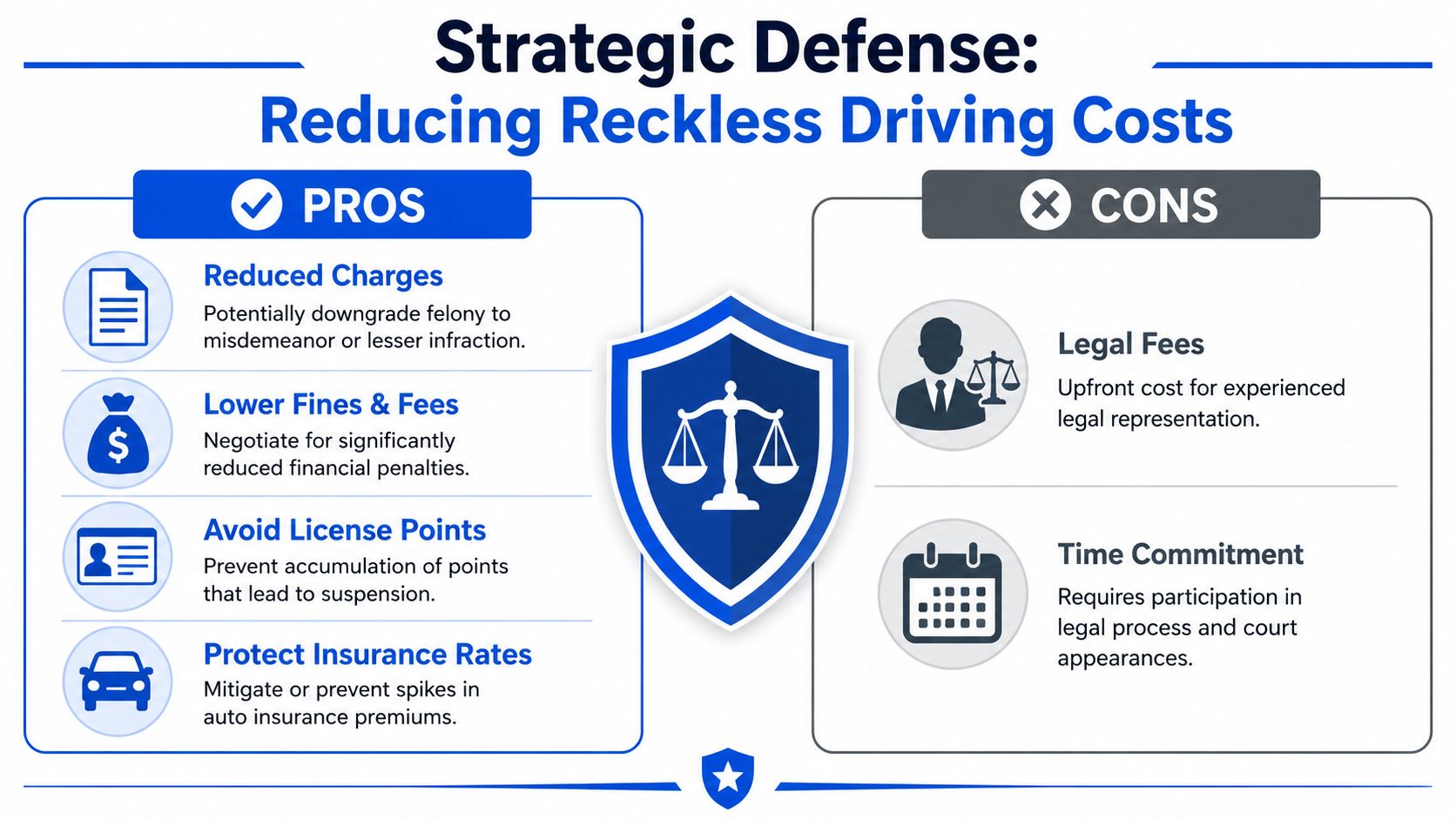
The defense goal is usually one of four outcomes: dismissal, reduction to a lesser offense, a resolution that avoids the worst record consequences, or a negotiated result that protects your license and insurance position better than a straight conviction would.
A practical legal principle from reckless driving litigation is that costs rise sharply once conduct crosses the line into a criminal charge, and a key defense strategy is to fight to stay below that threshold, as explained in this analysis of how criminal classification drives total reckless driving cost.
The wrong move is paying first and asking questions later
When you just pay, you lose your advantage. You stop contesting the officer's version. You stop challenging the legal classification. You turn an accusation into a result.
That's why legal defense is not a luxury in this situation. It's financial damage control.
A lawyer may be able to challenge whether the facts support reckless driving at all. In other cases, the focus is negotiation. That can mean pushing for a lesser noncriminal offense, arguing for terms that protect your record as much as possible, or seeking a disposition that avoids the worst insurance and employment fallout.
A lawyer-led model's value is evident. Ticket Shield, PLLC handles Florida traffic defense with direct attorney communication by phone or text, which is very different from automated apps or ticket-mill systems that route clients through nonlawyer middlemen. If your goal is to avoid points and limit the true cost of the case, that direct access matters.
If you're evaluating options, this guide on how to get a traffic ticket dismissed is a useful starting point for understanding what a defense strategy tries to accomplish.
Immediate steps to take
Take these steps now:
Do not plead blind: Don't assume the fastest resolution is the least expensive one.
Get the charging documents: The citation is only part of the story. The report and affidavit matter.
Write down the facts immediately: Traffic, weather, road conditions, passengers, and officer statements fade fast.
Protect your timeline: Court dates and deadlines matter. Missing one can limit your options.
Talk to a real lawyer, not a chatbot: Reckless driving is a criminal charge. You need legal judgment, not automated intake.
Aim for the right objective: In Florida traffic defense, the practical target is often no points, no criminal conviction if possible, and no unnecessary court appearance.
A good defense doesn't just try to shrink the fine. It tries to prevent the conviction from becoming an expensive problem that follows you for years.
The right strategy depends on the facts, the county, the charging document, and your record. But one recommendation is constant. Do not treat this like a payable ticket if you care about your license, your insurance, or your future.
If you're facing a Florida reckless driving charge and your goal is No Points, don't wait for the damage to spread. Visit TicketShield.com for a free consultation.