
Reckless Driving Lawyer in Florida: What You Must Know
Need a reckless driving lawyer in Florida? Learn the law, penalties, defenses, and how a strategic attorney protects your license and record.
You're in the worst part of the stop. The lights are behind you. The officer is standing at your window. And now you've got a reckless driving charge in Florida, which is not the same thing as paying a simple ticket and moving on.
Treat this like a record problem, an insurance problem, and a work problem. In Florida, the charge can carry criminal consequences, license points, and fallout that keeps growing after the court date is over. If you handle the first few days badly, you make the case harder than it needs to be.
Table of Contents
The Moment Everything Changes on a Florida Roadway
The stop starts like any other bad night. Your speed felt normal. The traffic was moving. Then the lights hit your mirror, the officer walks up, and the citation in your hand feels heavier than a traffic ticket should.

That's because reckless driving in Florida isn't treated like a routine civil mistake. It can become a criminal traffic charge, and that changes everything about how you should respond. The legal system is not just looking at whether you were careless. It's looking at whether the state can frame your driving as willful or wanton disregard for safety.
A driver who tries to shrug it off and pay later usually misses the actual threat. The threat is the record. The threat is the points. The threat is the downstream cost that starts with a court date and keeps going with insurance, employment, and driving privileges. Federal crash data also shows why the state takes high-risk driving seriously, because dangerous driving is not some rare edge case. Pew Research Center reported that in 2022, 31.3% of fatal crashes involved at least one alcohol-impaired driver, and 13,524 people were killed in crashes involving an alcohol-impaired driver, up 32.6% from 2019 (Pew-linked fatal crash data in the legal guidance).
Practical rule: treat the next 72 hours like evidence-control time, not apology time.
If you're also dealing with a crash or possible injury, even a general accident checklist can help you think clearly. The guidance from MedAmerica Rehab Center is useful for the basic discipline of documenting, preserving, and avoiding casual admissions after a collision.
What Florida Law Says About Reckless Driving
Florida gives you a specific statute, and that statute matters. Florida Statute § 316.192 is the core rule, and it defines reckless driving as operating a vehicle in willful or wanton disregard for the safety of persons or property. It also reaches driving without due caution and circumspection at a speed or in a manner that endangers people or property. That language is broad, and prosecutors use that breadth to argue that aggressive driving crossed the line from bad judgment into criminal conduct (Florida Statute 316.192 explanation).
How the State Tries to Prove It
The officer's report is usually just the starting point. The state then looks for facts that make the driving look deliberate or plainly dangerous, not merely sloppy. Witness statements matter. So do crash photos, lane position, braking distance, and any detail that suggests the driver ignored obvious risk.
That's why a reckless driving lawyer doesn't read the citation the way you do. A lawyer reads it like a charge map. Every sentence in the report becomes a question. Did the officer observe the driving, or just infer it? Was the speed measured, or guessed? Was there a traffic condition that made the maneuver look worse than it really was?
The best defense often starts by forcing the state to prove the exact element it wants to gloss over.
Why the Statute Gives You Room to Fight
Florida's wording gives your lawyer a real opening. The state has to connect the narrative to the law. If the facts show ordinary negligence, frustration, distraction, or a momentary mistake, that is not the same thing as willful or wanton disregard.
Use the statute itself as the baseline, then compare it to the officer's version of events. That is why a careful defense starts with the report, the video, and the physical evidence. You're not trying to explain away the charge. You're trying to show that the facts do not satisfy the statute. For a deeper breakdown of how that statute is used in defense practice, review this Florida-specific resource on reckless driving under Florida Statute 316.192.
Penalties That Go Far Beyond the Fine
A reckless driving case gets expensive fast, and not just because of the fine. In Florida, the charge can be prosecuted as a criminal traffic offense, which means you're not dealing with a parking problem or a minor infraction. You're dealing with a conviction that can affect your driving record, your insurance, and your future choices behind the wheel.
What a Conviction Can Cost You in Real Life
The first mistake drivers make is focusing only on the money due at the clerk's office. That misses the larger picture. A conviction can bring license points, driver improvement requirements, and possible license suspension exposure depending on the facts and the court outcome. Once points and court reporting hit your record, insurers and employers can react in ways that have nothing to do with the initial stop.
If the reckless driving caused property damage, injury, or death, the exposure gets worse. The case stops feeling like traffic court and starts looking like a serious criminal matter. That is the point where a lawyer has to push hard on the evidence, because the difference between a traffic-level outcome and a criminal-level outcome can shape your life for years.
Why Pleading Guilty Is Often a Bad Trade
A guilty plea looks easy on day one. It is usually not the cheaper path over time. You may save a court appearance. You may avoid a little stress. But you can still pay through insurance, points, and employment fallout long after the hearing is over.
Bottom line: the first number on the paper is rarely the real cost.
If you want a Florida-specific breakdown of how consequences stack up, review the local guidance on reckless driving penalties in Florida. The point is simple. The fine is not the story. The record is the story.
What to Do Right After You Are Charged
The first rule is simple. Say as little as possible. Give identification when required. Stop there. You do not need to explain traffic flow, your speed, your destination, or what you think the officer “must have seen.”
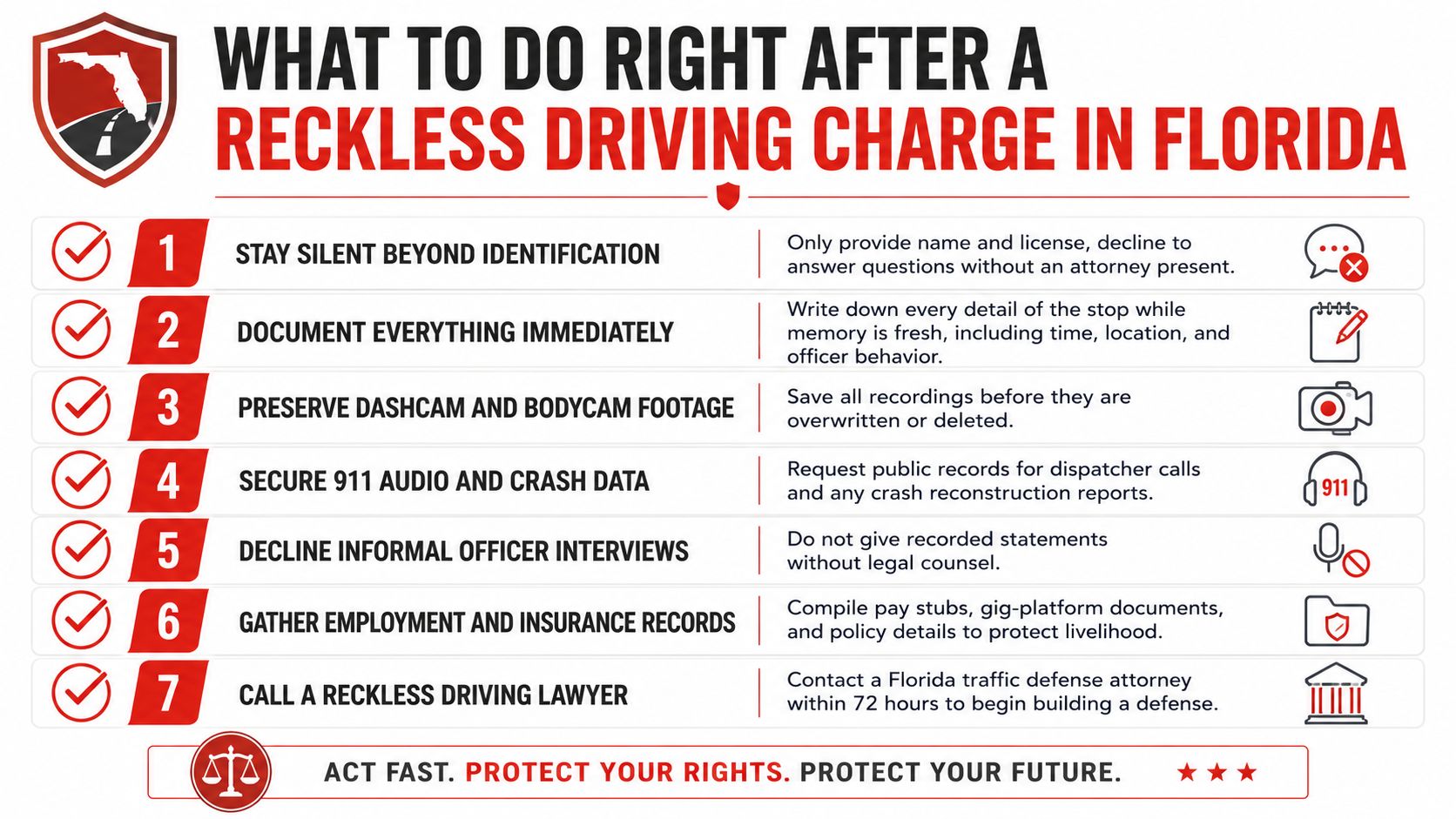
Lock Down the Evidence Before It Disappears
Write everything down while the stop is still fresh. Time. Location. Weather. Traffic pattern. What the officer said. What you said back. If there was a passenger, get their memory in writing too. Tiny details matter later because officers' reports do not always capture the full context.
Then preserve your electronic evidence. Save dashcam files. Save bodycam references if you can identify them through records requests. Ask for 911 audio and any crash reconstruction material that exists. The state and the agency control a lot of that material, and it can disappear or get overwritten if nobody acts quickly.
Protect Your Job and Your Insurance Position
If you drive for Uber, Lyft, DoorDash, a delivery contractor, or any fleet-adjacent employer, gather your work records now. Save pay stubs, platform documents, insurance declarations, and any email that shows you're actively driving for income. That paperwork gives your lawyer a better picture of what's at stake, and it helps build urgency around a reduction or dismissal effort.
Don't give a recorded statement to the officer or any outside investigator without counsel. Informal interviews sound harmless. They are not. You're giving the state more material to frame the stop. If you want a practical Florida checklist for post-citation action, use this guide on what to do when you get a ticket and then move immediately to a lawyer review.
Hidden Consequences Most Drivers Never See Coming
The courtroom is only one part of the problem. For a lot of Florida drivers, the bigger hit comes later, when an employer, platform, or insurer reacts to the charge.

Gig Work Can Collapse Fast
If you drive for Uber, Lyft, DoorDash, or delivery work, a reckless driving charge can trigger problems outside the courthouse. Platforms and background-check vendors do not think like criminal defense lawyers. They look at risk. They look at classification. They look at whether your driving record now creates a business issue.
That's why a defense that only talks about fines is too narrow. The core issue may be whether you can keep earning while the case is pending. You need your lawyer thinking about the livelihood impact from day one.
Insurance and Clearance Problems Can Outlast the Case
Insurance underwriting can stay aggressive long after the hearing ends. That means the fallout may last longer than the criminal case itself. Military members and service-connected drivers also need to think about clearance sensitivities and background scrutiny, especially when a charge affects the perception of judgment and reliability.
Commercial drivers have their own pressure point. A reckless driving allegation can create CDL-related exposure, and that risk is not something you want to analyze after you have already appeared alone in court. The right time to address it is immediately, while the state's narrative is still being tested.
For a practical look at background-check concerns, read how traffic tickets can show up on background checks. That issue is often more important than the courtroom paperwork.
Why a Lawyer-Led Firm Beats Automated Apps
You do not need a chatbot explaining your case in generic language. You need a lawyer who can read the report, judge the risk, and act fast. That is where a lawyer-led model matters.
Direct Access Changes the Case
At Ticket Shield, PLLC, clients speak directly to their attorney by phone or text. No middlemen. No scripted call center. No automated app pretending to understand a reckless driving case. That matters because your facts are not generic, and your defense should not be either.
When a driver calls about a reckless driving stop, the work starts immediately. The attorney can spot whether the issue is speed measurement, lane movement, road conditions, or officer interpretation. If there's a reduction available, the lawyer can pursue it. If there's a dismissal angle, the lawyer can build it. If the case needs to be handled in court across Florida, the firm can cover the state, including all 67 Florida counties.
Ticket Mills Miss What a Serious Charge Needs
Automated legal services and ticket mills are built for volume. Reckless driving is not a volume case. It's a charge that can affect insurance, employment, and your license all at once. A case like that needs a real strategy, not a form submission and a wait time.
If you want to compare direct-attorney service with app-based handling, review why local lawyer access beats apps. A serious charge deserves a real person on the other end of the phone.
Defenses and Realistic Outcomes in Florida
A reckless driving defense starts with pressure on the state's proof. If the evidence does not clearly show willful or wanton disregard, the case is vulnerable. That is the whole fight. The prosecution wants a dramatic story. Your lawyer wants clean, admissible facts.
The Defense Angles That Matter
Speed evidence can be challenged. Officer credibility can be tested. Road conditions can explain conduct that looked reckless at a distance but wasn't criminal when viewed in context. Sometimes the strongest move is to push for a reduction to a non-criminal moving violation. Other times, traffic school or defensive driving can help create an advantage for a better resolution.
A lawyer should also be honest about county differences and local practice. Some courts are more open to negotiation than others. Some cases have hard facts that make a reduction more realistic than a dismissal. Strategic litigation beats a reflexive guilty plea because it forces the state to earn the result instead of assuming you'll fold.
Here's the blunt truth. Your outcome depends on the evidence, the officer, the paperwork, and the local court climate. A weak case can be pushed hard. A stronger case can still be negotiated. But a driver who gives up on day one never gets that chance.
For a useful outside reference on how lawyers frame these disputes, you can also check bail bonds for wet reckless cases to understand how related traffic-crime outcomes are discussed in practice.
The court video below is a good reminder that the way a charge is handled matters as much as the stop itself.
How to Choose and Hire the Right Reckless Driving Lawyer
You got charged. Now you need a lawyer who handles Florida traffic defense every day, not a call center that forwards your file and hopes for the best. Ask that first. If the answer is vague, move on.
What You Should Ask Before You Hire
Ask who will handle your case. Ask how you will reach that person. Ask whether you will speak to the attorney or get routed through staff. Ask what you need to do in the first week, because that is when evidence gets saved and mistakes get fixed.
A reckless driving charge needs direct attorney attention. You want someone who can read the citation, spot weak points in the stop, and keep pressure on the state from day one. Ticket mills work on volume. They are built for speed, not for your license.
Ticket Shield Service Snapshot
Feature | Ticket Shield Standard |
|---|---|
Service model | Lawyer-led, direct attorney access by phone or text |
Coverage | All 67 Florida counties |
Pricing | Value-driven pricing starting at $39.99 |
Court appearance | Over 99% of clients never appear in court |
Case focus | Traffic tickets, DUI charges, and serious traffic-related crimes |
Why This Model Fits a Reckless Driving Case
A reckless driving lawyer should move fast, speak clearly, and protect the driving record first. That means direct attorney involvement and a case plan built around Florida traffic defense. Ticket Shield, PLLC is one example of that model. It handles traffic defense statewide and keeps the client connected to the attorney, not a script.
If you want your license protected, your record defended, and your exposure reduced, act now. Visit TicketShield.com for a free consultation and fight for No Points on your license today.
