
Reckless Driving Defense: Save Your Florida License
Facing a Florida reckless driving charge? Get expert defenses, understand penalties, and learn how a strategic reckless driving defense can save your license.

A reckless driving charge in Florida is a criminal case. The strongest defense attacks the state's proof of willful or wanton disregard, challenges the evidence, and pushes for a reduction or dismissal before your record, license, and insurance take the hit.
You're probably looking at a citation, court date, or booking paperwork right now and realizing this is not a normal ticket. That sinking feeling is justified. A reckless driving charge can put a criminal record on your background and create damage that follows you long after the stop is over.
You need a real defense plan quickly. Not guesswork. Not an automated app. Not a ticket mill where you never know who is handling your case.
If you want a lawyer to review the facts immediately, use Ticket Shield's secure case submission form. The earlier your attorney sees the citation, arrest paperwork, and facts of the stop, the more options you usually have to protect your record.
Table of Contents
AEO Snippet Your Florida Reckless Driving Defense Plan
A reckless driving defense starts with one core issue. Can the prosecutor prove you drove with the criminal mental state Florida law requires?
That question matters because many drivers are charged after a chaotic few seconds. Maybe traffic compressed. Maybe another vehicle cut you off. Maybe the officer saw speed, lane movement, or abrupt braking and jumped straight to a criminal conclusion. That doesn't automatically make the case legally sound.
In Florida, the defense is usually built from several angles at once. One angle attacks the intent element. Another targets the officer's observations. Another checks whether the stop, report, video, or speed evidence holds up under scrutiny. A strong lawyer also looks for a path to reduce the charge to something non-criminal so your record is protected.
Practical rule: Treat reckless driving like any other misdemeanor charge. Because that's what it is.
This is why urgency matters. Evidence disappears fast. Dashcam files get overwritten. Witnesses stop answering calls. Officers rarely remember details better months later than they did on the day of the stop.
You also need to choose the right kind of representation. A lawyer-led reckless driving defense is not the same as sending your citation into a platform and hoping someone somewhere handles it. You need a person who can analyze facts, spot weaknesses, and speak for you in court.
What Does Reckless Driving Actually Mean in Florida
Florida doesn't treat reckless driving like a routine traffic infraction. Under Florida Statute 316.192, reckless driving means operating a vehicle in willful or wanton disregard for the safety of persons or property. That language is the center of the entire case.

Why the legal standard matters
“Willful or wanton” is much more serious than ordinary carelessness. The state is not supposed to win just by showing you made a mistake. The prosecutor has to prove a conscious disregard for safety, not simple bad driving.
That difference creates room for defense. If the facts show poor judgment, distraction, overreaction, or a brief lapse, your attorney may be able to argue that the conduct falls short of criminal recklessness. That's often where cases are won or reduced.
Examples that prosecutors often point to include aggressive weaving through traffic, racing behavior, or driving in a way that appears openly dangerous. But labels don't decide cases. Facts do. Video matters. Road layout matters. Traffic density matters. The officer's vantage point matters.
If you want a fuller breakdown of the statute and how Florida courts frame these cases, review Ticket Shield's explanation of the Florida reckless driving statute.
How reckless driving differs from careless driving
This distinction is one of the most important in your case. Careless driving is generally treated as a non-criminal civil traffic offense. Reckless driving is a criminal charge under Chapter 316.
That means the same driving event can trigger a major legal fight over classification. Your lawyer's job is often to force that distinction into focus and challenge whether the facts support the criminal version.
Driving issue | Legal significance |
|---|---|
Momentary mistake | May support a non-criminal interpretation |
Poor judgment under pressure | May fall short of criminal intent |
Alleged aggressive or dangerous conduct | Prosecutor may argue reckless driving |
Weak factual record | Can create leverage for reduction or dismissal |
The right question isn't “Did I drive perfectly?” It's “Can the state prove a crime?”
That's the question your reckless driving defense should attack from day one.
What Are the Severe Penalties You Face
If you're charged with reckless driving, you need to understand the exposure clearly. Florida treats this as a misdemeanor offense. For a first conviction, the statute allows up to 90 days in jail and/or a $500 fine. A second conviction can become a more serious misdemeanor with up to one year in jail and a $1,000 fine, as outlined in Ticket Shield's guide to Florida reckless driving penalties.
The criminal penalties are real
The fine is not the main problem. The criminal record is.
A conviction can affect employment screenings, professional licensing, jobs that require driving, and positions where a clean record matters. If you hold a CDL or drive for work, the risk is even sharper. Insurance fallout can also hit hard after the case ends, even if the court process felt manageable in the moment.
Use this table as your snapshot.
Florida Reckless Driving Consequences at a Glance
Penalty Category | Potential Consequence |
|---|---|
Criminal classification | Misdemeanor conviction |
Jail exposure | Possible incarceration under the statute |
Financial penalty | Court-imposed fine |
Driving record impact | Points and licensing consequences may follow |
Employment fallout | Background checks and driving-related work can be affected |
Insurance impact | Premium increases may follow a conviction |
Immediate steps to stop the damage from spreading
You can still make this worse after you've been charged. Many people do.
Don't plead guilty just to get it over with. A quick plea can create a permanent problem.
Don't call the court to explain what happened. Explanations are not defenses.
Don't assume the officer's version is unbeatable. Many reckless driving cases have factual weaknesses.
Do preserve every document. Citation, bond papers, hearing notice, towing paperwork, and any video all matter.
Do get a defense review before your first court date. Early negotiation and early evidence requests can change the path of the case.
If your case is pending near Orlando, the Orange County Courthouse is one of the places where criminal traffic matters move fast and paperwork deadlines matter. Waiting until the last minute is a bad strategy.
A reckless driving conviction can outlast the stress you feel today. Fight the charge before it becomes the record everyone else sees.
What Are the Immediate Steps to Protect Yourself
The first hours and days after a reckless driving charge matter. This is when you either preserve your defense or accidentally damage it.
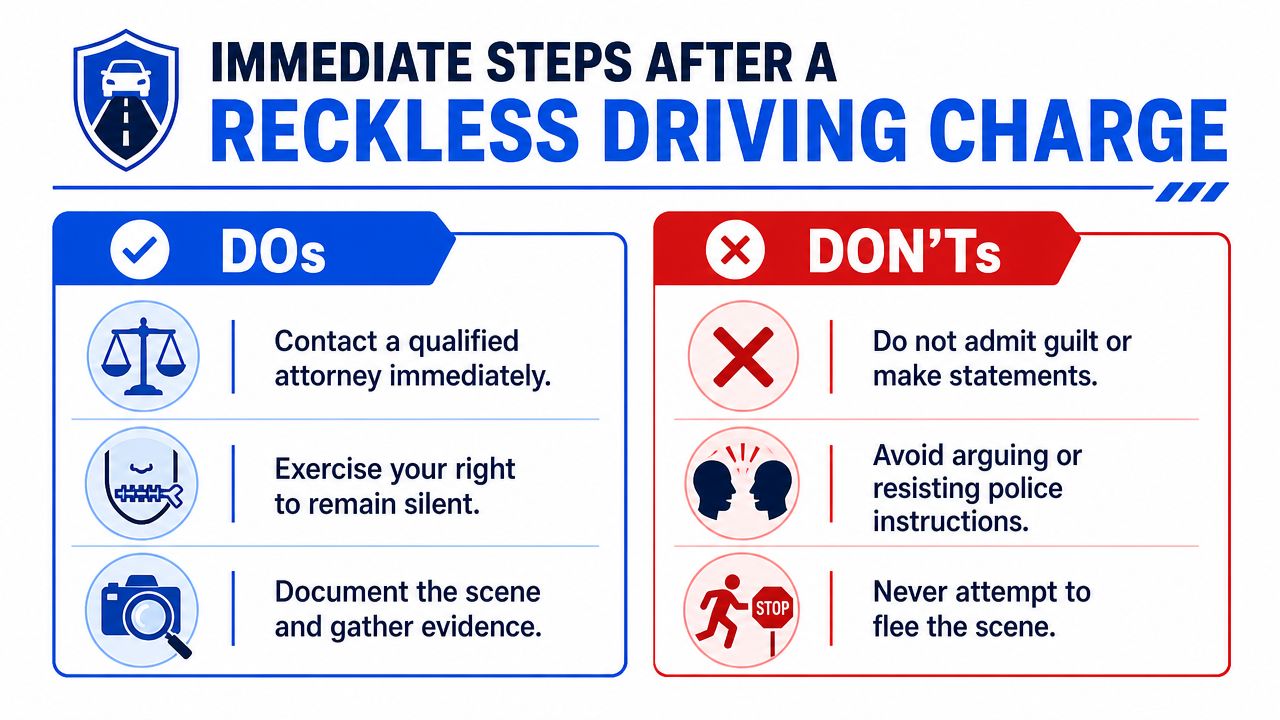
What to do today
Stay quiet about the facts. Give the officer your identification and required documents, but don't explain, justify, or admit anything.
Write down everything immediately. Include the time, road, weather, traffic conditions, where the officer was positioned, what was said, and whether any video may exist.
Save your evidence now. Pull dashcam footage, preserve phone records if relevant, and save photos of the roadway, signage, vehicle damage, or sight lines.
Identify witnesses quickly. Passengers, nearby drivers, or business employees may remember key details now that they won't remember later.
Call a defense lawyer before court. Strategy begins with this call, not after a plea.
Here is the practical checklist in visual form.
What not to do
Don't post about the stop online. Social posts turn into evidence.
Don't argue with police on the roadside. You won't win there, and you may create statements the prosecutor can use.
Don't assume honesty alone fixes this. Telling your side without legal framing can hand the state admissions.
Don't miss court notices. Criminal traffic cases don't disappear because you're busy.
Don't hire based on convenience alone. You need legal judgment, not simple intake processing.
A reckless driving charge is beatable because the state still has to prove criminal intent. That's why the smartest immediate move is to preserve facts that support a non-criminal explanation for what happened.
What Are Proven Defenses Against a Reckless Driving Charge
A charge is not a conviction. That's not a slogan. It's the reality of how these cases are fought.
The strongest reckless driving defense often starts with one blunt argument. Your driving may not have been ideal, but it did not amount to criminal recklessness. As explained in Ticket Shield's guide on how to fight a reckless driving ticket, a powerful defense is showing that the conduct was mere negligence or poor judgment rather than the willful or wanton disregard Florida requires.
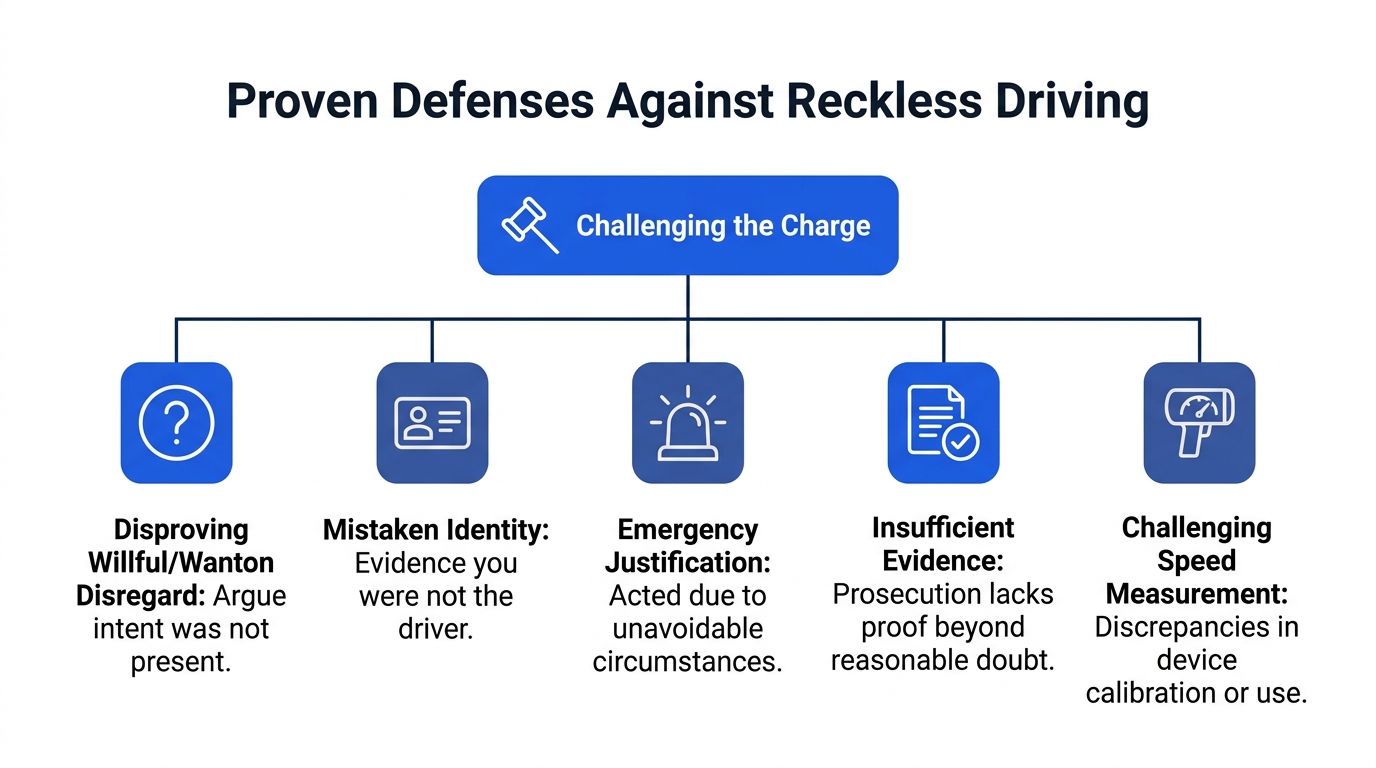
The strongest defense often attacks intent
Many cases often turn here.
If you changed lanes abruptly to avoid another car, reacted badly to a sudden traffic shift, or made a brief but stupid decision, your lawyer may argue that the facts show negligence, not criminal intent. That argument matters because it targets the exact element the prosecutor must prove.
This defense works best when it is tied to evidence, not excuses. Video, road conditions, traffic flow, witness statements, and the timing of the event can all support the argument that the conduct was a short-lived lapse rather than a conscious disregard for safety.
Bad driving and criminal driving are not the same thing.
Another strong factual defense is emergency justification. If you reacted to avoid a collision, responded to a medical issue, or faced an unexpected hazard, the event may look very different once the full context is presented.
Technical and factual defenses can change the case
Some reckless driving cases depend heavily on speed allegations. When that happens, the defense often shifts into a technical review of the proof. Independent defense guidance explains that lawyers should demand the officer's certifications and the calibration records for radar or LIDAR devices because expired certification or improper calibration can weaken or exclude the state's speed evidence, as discussed in this analysis of defenses to reckless driving charges.
Other defenses may include:
Mistaken identity: If the state can't firmly prove you were the driver, the case has a serious problem.
Insufficient evidence: An officer's conclusion may be too vague or too thin to support a criminal conviction.
Improper stop: If law enforcement lacked a lawful basis to stop you, the defense may challenge what followed.
Report inconsistencies: Bodycam, dashcam, and written reports don't always line up.
A good lawyer doesn't pick one theory too early. The defense is built by pressure-testing all of them, then using the strongest combination.
How Does the Florida Court Process Work
Most drivers are anxious because they don't know what happens next. Once the charge is filed, your case moves through a criminal court process that can feel confusing fast. If your case is in Miami-Dade, for example, you may be dealing with hearings at the Richard E. Gerstein Justice Building.
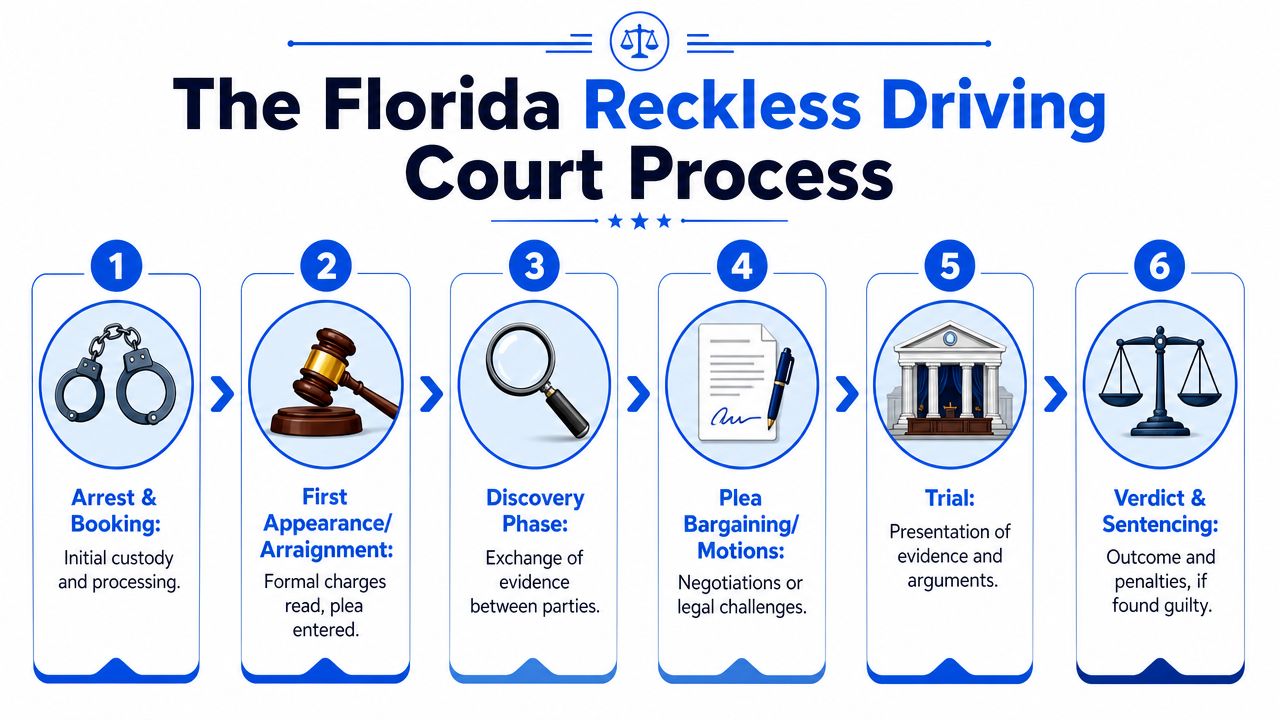
What happens after the charge
The process usually starts with a first appearance or arraignment. That's where the charge is formally addressed and a plea is entered. In many cases, the correct move is to plead not guilty and begin the defense process instead of rushing into a resolution.
After that comes discovery. During this stage, your attorney demands the evidence. That can include the officer's report, bodycam, dashcam, witness materials, and any speed-related records. In speed-based cases, one of the most important discovery requests is for the officer's training and certification records plus the calibration logs for the speed device used. If those records are weak, outdated, or missing, the prosecution may have trouble relying on its main evidence.
Then come pretrial conferences and motion practice, where a strategic lawyer may challenge the stop, attack the sufficiency of the evidence, or negotiate for a reduction to a non-criminal offense.
Why direct attorney handling matters in court
Court process is not paperwork alone. It is judgment.
A real attorney reads the video differently than an intake team does. A real attorney knows when to push, when to negotiate, and when to set the case for trial. A real attorney also knows that facts that sound bad in a police report can look very different once timing, road design, and witness perspective are examined.
Here's the basic sequence:
Arraignment: The case is formally addressed.
Discovery review: The defense gathers and analyzes the state's evidence.
Pretrial negotiation: Prosecutors and defense counsel discuss resolution.
Motions: The defense may challenge evidence or procedure.
Trial decision: If the case doesn't resolve properly, it can proceed to trial.
Court is where strategy gets tested. You do not want your first real case analysis to happen in front of the judge.
Why Is a Lawyer-Led Defense Your Strongest Shield
Now, you need to make the right decision.
A reckless driving defense is not data entry. It is not a form submission. It is not a chatbot collecting your citation and routing it into a queue. If you use an impersonal service, you may never get the careful analysis your case needs.
An app can intake information, but it can't defend you
Some legal services are built like volume operations. They collect information, push updates, and keep clients at a distance from the attorney handling the matter. That model may feel convenient, but convenience is not the same as protection.
Even support roles matter in legal workflow. If you're curious about how law firms structure first-contact communication, this overview of an intake specialist is useful. Intake can help organize information. It cannot replace legal judgment, courtroom advocacy, or a customized defense strategy.
That distinction matters because reckless driving cases often turn on nuance. A lawyer has to listen closely, compare your account to the report, identify factual gaps, and decide whether the strongest move is attack, negotiation, or trial preparation.
Direct attorney access changes the outcome strategy
When you speak directly with your lawyer by phone or text, your defense develops faster and with fewer mistakes. That's especially important when details shift, witnesses appear, or video becomes available after the initial charge.
Ticket Shield, PLLC offers a lawyer-led model for Florida traffic and criminal traffic cases, including direct communication with the attorney handling the matter and information about Florida traffic ticket lawyers. According to Ticket Shield, over 99% of clients never have to appear in court for their traffic-related cases, because the attorney handles court appearances on the client's behalf through the firm's process on TicketShield.com.
That doesn't mean every result is guaranteed. It means the structure is built around actual legal representation instead of middlemen. If your goal is No Points, no criminal record if possible, and the strongest shot at a reduction or dismissal, that structure makes sense.
You need someone who can do all of this:
Read the evidence critically
Spot legal weaknesses early
Talk to you directly when facts change
Negotiate from a position of preparation
Stand in court and argue your case clearly
A reckless driving charge can be managed. But it should be managed by a lawyer, not a system.
Protect your record and your future with Ticket Shield, PLLC. Get a free consultation now and take immediate steps toward the desired result, No Points on your Florida record.

