Defend Your Reckless Driving Charge In Florida
Expert legal guidance for your Florida reckless driving charge. Understand penalties, defense strategies, & protect your license & record in 2026.
A reckless driving charge in Florida is a criminal accusation, not a routine ticket. You need a defense plan now to protect your license, record, insurance, and income. Move fast. Say little. Get a lawyer involved before you make this worse.
You were stopped. The officer walked back with paperwork. Then you heard the words that changed the situation: reckless driving.
That moment hits hard. Your mind jumps straight to court, your job, your insurance, your license, and whether this is going to follow you for years. That reaction is justified. In Florida, a reckless driving charge is not something you handle casually. It falls under Florida Statute § 316.192, and it puts you into the criminal system, not just the traffic system.
If you're holding that citation right now, don't minimize it. Don't assume you'll just pay something online and move on. Don't trust an automated app, a call center, or a ticket mill to manage a criminal case with the care it deserves. A reckless driving charge needs legal judgment, local court experience, and direct attorney involvement.
Table of Contents
Introduction A Reckless Driving Charge Is a Criminal Offense
What Penalties Am I Facing for a Reckless Driving Conviction
What Are the First Steps to Take After a Reckless Driving Charge
Introduction A Reckless Driving Charge Is a Criminal Offense
The paper you received might look like a traffic citation, but the legal reality is much more serious. A reckless driving charge in Florida alleges criminal conduct. That changes everything about how you should respond.
Under Florida Statute § 316.192, the state is not saying you merely made a mistake. The state is saying your driving showed a level of disregard that justifies a criminal prosecution. That can affect your record, your finances, your ability to drive for work, and how future employers or insurers view you.
You should also assume the prosecutor will read the officer's version of events in the harshest possible light unless someone pushes back early and effectively. If your case is in Miami-Dade, that fight may play out at the Richard E. Gerstein Justice Building. The building is formal. The repercussions are tangible. The process moves whether you're ready or not.
Practical rule: Treat a reckless driving charge like a criminal case on day one, because that's exactly what it is.
A lot of drivers make the same mistake after the stop. They talk too much. They explain. They apologize. They post about it. They tell friends what happened in a way that can later be twisted into an admission. That is avoidable damage.
A better approach is simple:
Recognize the risk: This is not a routine payable ticket.
Stop talking about facts: Your explanation may feel harmless, but it can become evidence.
Act quickly: Early legal review can identify weaknesses in the stop, the report, and the charging decision.
You're not powerless. But you do need to move with discipline.
What Does a Reckless Driving Charge Mean in Florida
A reckless driving charge in Florida starts with the language of Florida Statute § 316.192. The key phrase is “willful or wanton disregard for the safety of persons or property.” That phrase matters because it separates criminal driving allegations from ordinary traffic mistakes.

What the statute actually says
The state has to do more than show you were speeding or that an officer didn't like how you were driving. The accusation is stronger than that. It claims your conduct crossed into criminal territory because it allegedly showed a conscious disregard for safety.
That distinction is why this charge deserves focused legal analysis. Florida drivers often benefit from understanding the statute itself and how local courts apply it. A useful starting point is this breakdown of the Florida reckless driving statute and what it means for your case.
If you're a newer or anxious driver trying to separate basic rule violations from conduct prosecutors may call reckless, it also helps to review broader guidance on essential traffic laws for nervous learners. Not because your case is simple. It isn't. But because clarity matters when the state is trying to label your conduct as criminal.
Why this charge is so subjective
One of the hardest parts of a reckless driving charge is that the definition is broad. A supporting legal analysis explains that the definition is deliberately broad, gives law enforcement and prosecutors significant discretion, and requires the state to prove “willful or wanton disregard,” meaning the driver knew or should have known the conduct created danger, making the charge highly subjective, as discussed in this review of how reckless driving is interpreted and defended.
That subjectivity matters in real life. The officer may describe acceleration, lane changes, following distance, or the surrounding traffic in a way that makes the scene sound worse than it was. Prosecutors often build from that report. Your defense starts by testing whether the facts support the legal standard.
The central question isn't whether your driving looked bad for a moment. It's whether the state can prove criminal disregard.
That is a fight over details. Road conditions. Traffic flow. Visibility. Distance. Timing. Whether the officer observed what the report claims. Whether your conduct was unsafe, or merely imperfect.
How Is Reckless Driving Different From Other Major Offenses
People often confuse reckless driving with other serious traffic-related allegations. That confusion hurts defense strategy. You need to know what you're charged with, what you're not charged with, and what the prosecutor still has to prove.
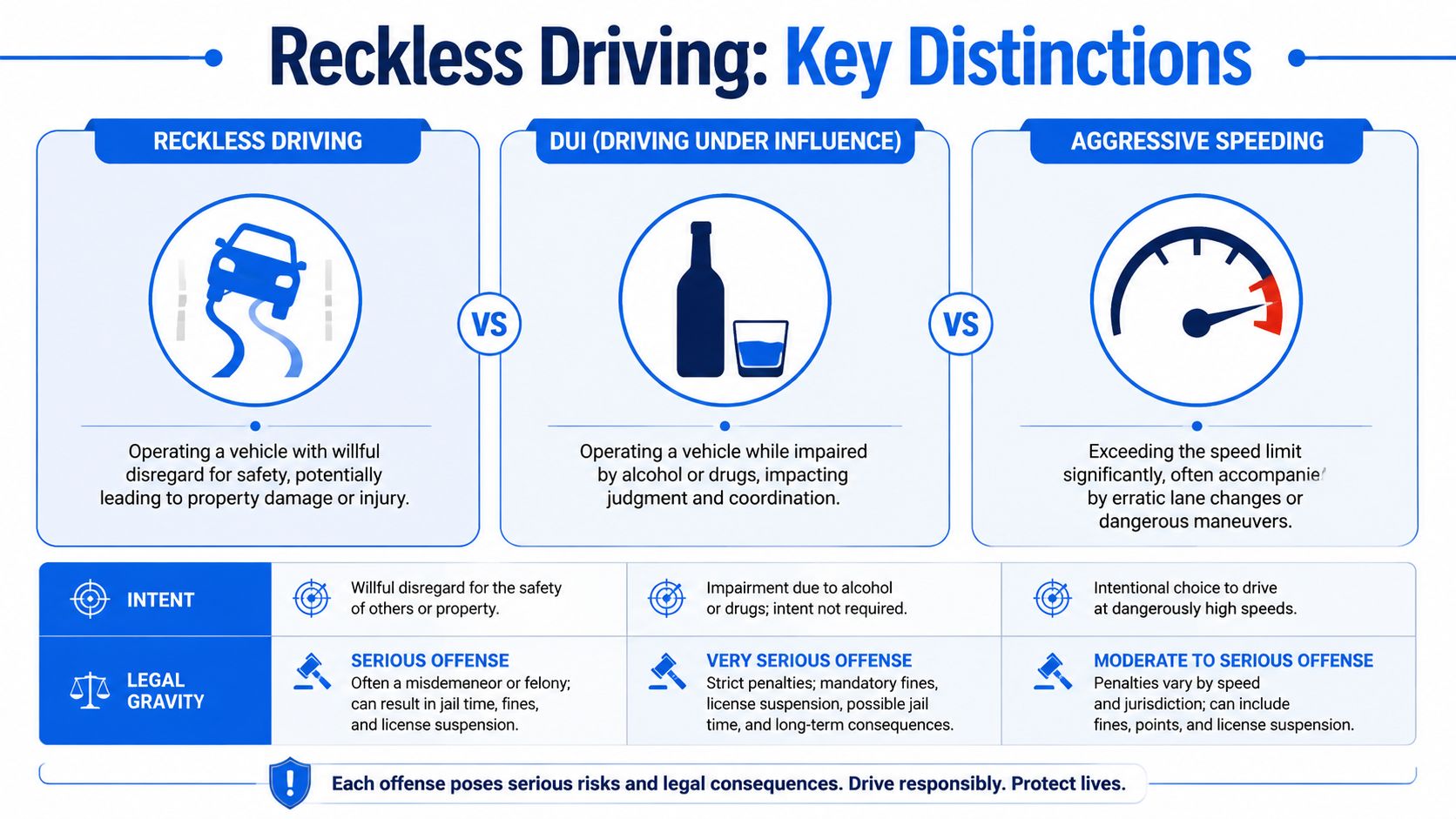
Reckless driving versus careless driving
Careless driving is generally treated as a non-criminal traffic infraction. Reckless driving is different. It alleges a criminal level of disregard under Florida Statute § 316.192.
Here is the clean comparison:
Issue | Careless driving | Reckless driving |
|---|---|---|
Legal character | Traffic infraction | Criminal charge |
Mental state | Negligence or poor judgment | Alleged willful or wanton disregard |
Record risk | Serious, but not the same as a criminal conviction | Can create a criminal record |
Defense focus | Whether the driving actually violated traffic standards | Whether facts rise to criminal disregard |
If you need a more focused breakdown, this guide on the difference between careless and reckless driving in Florida is worth reading closely.
Reckless driving versus DUI
A DUI case is built around alleged impairment from alcohol or drugs. A reckless driving charge is built around the manner of driving itself. Those are not the same case, even if they can overlap in some situations.
That difference matters because the evidence is different too. In a DUI prosecution, the state may rely on observations, testing, and statements. In a reckless driving case, the prosecution leans heavily on what the officer says your driving looked like.
National data also shows how seriously reckless driving is treated after the worst crashes. It was the most common violation charged to drivers involved in fatal crashes in the United States, accounting for 4.6% of cases, compared with DUI at 2.64%, according to this analysis of fatal crash charging patterns.
Don't assume "it wasn't DUI" means the state sees this as minor. It doesn't.
Aggressive speeding also creates confusion. Speed alone is not always reckless driving, but prosecutors may use high speed plus surrounding behavior to argue criminal disregard. That's why the exact facts matter more than the label used on the roadside.
What Penalties Am I Facing for a Reckless Driving Conviction
If you've been charged under Florida Statute § 316.192, you need to think beyond the first court date. The direct penalties matter. The collateral damage can be even worse.
The court penalties are only the beginning
A reckless driving conviction in Florida can expose you to criminal penalties that you should take seriously. It can also place points on your license and create a record that follows you long after the case is closed. You can review the broader consequences in this explanation of penalties tied to a Florida reckless driving conviction.
What hurts many drivers is not just the punishment announced in court. It's the fact that a criminal traffic conviction changes how everyone else evaluates you. Employers. Background screeners. Insurance companies. Professional licensing boards. Rideshare platforms.
The fallout outside court is often worse
If you drive for Uber or Lyft, this charge can threaten your income immediately. A cited source states that a reckless driving charge can trigger immediate deactivation for Uber and Lyft drivers, leading to an average income loss of $1,200 per month for Florida's 150,000+ gig drivers who depend on app access, as described in this discussion of reckless driving consequences affecting gig drivers.
That issue is not limited to rideshare drivers. Delivery drivers, field technicians, sales professionals, military personnel, and commuters with company vehicle responsibilities can all face employment consequences from a criminal traffic case.
Use this checklist to think clearly about exposure:
Your record: A criminal resolution can appear in future background checks.
Your insurance: Insurers may treat this as a high-risk event and respond harshly.
Your job: If driving is part of your livelihood, your employer may not wait for a second issue.
Your time: Court dates, paperwork, and follow-up create pressure fast.
A reckless driving conviction doesn't end when you pay money. It keeps showing up later.
That is why the goal shouldn't be “just get it over with.” The goal should be protecting your future and fighting for the cleanest possible outcome.
What Are the First Steps to Take After a Reckless Driving Charge
The first day after a reckless driving charge is when people make the mistakes that cost them later. You need to be controlled, quiet, and organized.

Do these things immediately
Start here:
Say less from this point forward: Don't call the officer. Don't email the court with your version. Don't explain the case to anyone except your lawyer.
Write down everything you remember: Time, location, weather, traffic, lane position, what the officer said, what you said, whether there were passengers, and whether there may be cameras nearby.
Preserve digital evidence: Save dashcam clips, app trip logs, GPS history, text timestamps, and vehicle data if available.
Stay off social media: Don't post jokes, rants, explanations, or videos about the stop.
Check your paperwork carefully: Court date, county, charge wording, and any mistakes on the citation all matter.
A lot of clients think they can talk their way out of this. That's usually a mistake. If you need a plain explanation of why silence matters, read never talk to police without a lawyer. The context there is broader than traffic court, but the principle applies here.
Protect the evidence before it disappears
Evidence gets overwritten. Surveillance footage vanishes. Witnesses forget details. Your memory softens. That is why speed matters.
If your case is in Tampa, the practical side of this becomes very real fast. Dates move. Appearances get set. Prosecutors prepare. Cases at the Edgecomb Courthouse don't slow down because you're still deciding whether this is serious.
Here is a short explanation that reinforces the urgency:
After you've secured the basics, your next move is legal review. A lawyer can compare your memory to the citation, identify missing facts, and decide what needs to be obtained immediately.
What Are Common Defenses Against a Reckless Driving Charge
A reckless driving charge is an accusation. It is not a conviction, and it is not self-proving. The state still has to build a case that survives scrutiny.
The state still has to prove the criminal standard
Your defense often starts with the same issue that created the charge in the first place. Subjectivity. The officer may have interpreted your actions as criminally dangerous when the facts support a much weaker conclusion.
Common defense angles can include:
The conduct wasn't criminally reckless: The driving may have been imperfect, abrupt, or even negligent without reaching willful disregard.
The officer's observations are overstated: Distance, angle, lighting, traffic conditions, and divided attention can all weaken the report.
There was a legitimate emergency: Sometimes a driver reacts to avoid immediate danger, not to create it.
Identity or proof problems exist: In some cases, the state struggles to prove who was driving or what exactly happened.
A serious defense is not guesswork. It is document review, video review, witness review, legal analysis, and pressure applied in the right place.
Negotiation is part of a real defense
Many people hear “defense” and think only about trial. That is too narrow. A good defense also includes strategic negotiation based on weaknesses in the state's proof.
A cited source notes that in many jurisdictions, prosecutors are increasingly reducing criminal reckless driving charges to no-point civil infractions like unsafe operation to manage caseloads, and that result is often achieved through attorney negotiation, as discussed in this review of how reckless driving charges can be negotiated down.
Florida procedure is its own system, but the lesson is clear. Prosecutors respond to advantageous positions. They respond to evidentiary weaknesses. They respond when defense counsel is prepared.
For Florida-specific strategy, review this guide on fighting a reckless driving charge in Florida.
Some cases are won by disproving the charge. Others are won by refusing to let the state overcharge weak facts.
That is why you don't walk into court hoping for mercy. You walk in with a defense position.
Why Do I Need a Lawyer and Not an App for This Charge
A reckless driving charge is where automated services break down. Fast.

A criminal case needs judgment not automation
Apps and ticket mills are built for scale. Criminal defense is built on judgment. Those are different things.
When you're facing a reckless driving charge, someone needs to read the report carefully, compare it to the statute, spot what is missing, assess whether the facts support criminal intent, and negotiate from a position of credibility. If your case is in Broward, that work happens in the shadow of the Broward County Judicial Complex, where local practice and prosecutor tendencies matter.
Nationally, 18 out of every 10,000 drivers are convicted of reckless driving, and the disparities between regions are significant, according to this review of reckless driving conviction patterns by state. That matters because local charging culture and enforcement style affect outcomes. You want a defense built around Florida reality, not software prompts.
Direct access to your lawyer matters
If your freedom, record, and livelihood are on the line, you should be able to speak directly with the attorney handling your case. Not a chatbot. Not a case manager. Not a rotating call-center employee reading a script.
That is one reason some Florida drivers choose Ticket Shield, PLLC. It is a lawyer-led defense model where clients communicate directly with their attorney by phone or text instead of being pushed through an automated workflow. If you're weighing options, compare that approach with the issues raised in this article about choosing a local lawyer over apps for serious traffic cases.
Use this standard when you're deciding who handles your case:
Can you reach your actual lawyer directly
Will that lawyer appear and negotiate strategically
Does the service handle criminal traffic cases, not just routine tickets
Are they preparing for the no-points outcome, not just quick disposal
A reckless driving charge needs a human defense. It needs legal judgment, pressure, and accountability.
If you've been charged with reckless driving in Florida, act now. Protect your record. Protect your license. Fight for the No Points outcome with a lawyer-led defense, not an automated service. Visit Ticket Shield, PLLC for a free consultation.