Fight Misdemeanor Reckless Driving Charges
Facing misdemeanor reckless driving in Florida? Understand penalties, court process, & defense options. Our firm protects your record.
Misdemeanor reckless driving in Florida is a criminal charge under Florida Statute 316.192, not a routine ticket. You could face jail, fines, license points, and a lasting record. Your first job is simple: stop treating this like traffic court and start defending it like a crime.
A lot of drivers find out the hard way. The officer walks back to your window. You expect a citation. Instead, you get charged with something that can put you in criminal court.
That shock matters because it changes everything. You are no longer dealing with a minor paperwork problem. You are dealing with a case that can affect your record, your license, your insurance, and your job.
People make expensive mistakes. They pay it. They say too much. They trust an app. They assume the judge will understand. None of that protects you when the State is accusing you of driving with criminal intent.
You need a real defense. You need someone who can read the report, break apart the officer’s conclusions, challenge the evidence, and attack the one element the prosecutor must prove. Intent.
Table of Contents
Introduction You Weren't Just Ticketed You Were Charged
You may still be replaying the stop in your head. Maybe you changed lanes too fast. Maybe you accelerated trying to get around traffic. Maybe the officer said you were weaving, racing, or driving aggressively. What matters now is that the citation says reckless driving, and under Florida Statute 316.192 that means criminal exposure.
At this point, panic starts. People worry about jail. They worry about calling work. They worry about whether they now have a criminal record. Those are the right concerns.
At courthouses across Florida, including the Orange County Courthouse in Orlando, drivers learn very quickly that misdemeanor reckless driving is handled nothing like a normal speeding ticket. The prosecutor isn't just looking at whether you broke a rule. The prosecutor is trying to prove you acted with a criminal level of disregard for safety.
You don't protect yourself by hoping the officer won't show up or by clicking through an automated ticket platform. You protect yourself by forcing the State to prove what it claims.
That is why the first decision matters so much. A criminal traffic case requires legal judgment. It requires someone who can spot a weak report, a bad inference, or a set of facts that support negligence at most, not recklessness.
If you’re talking to a middleman, a chatbot, or a volume-based ticket operation, you’re already behind. A misdemeanor reckless driving charge needs direct attorney analysis. Your freedom, your record, and your license are on the line.
What Qualifies as Misdemeanor Reckless Driving in Florida
Florida law does not call every bad driving decision reckless. That distinction is the center of the case.
Under Florida Statute 316.192, reckless driving is operating a vehicle in willful or wanton disregard for the safety of persons or property. That language is the battleground.
What does Florida law actually say
Willful or wanton disregard for the safety of persons or property.
That standard is higher than simple negligence or carelessness. Florida misdemeanor reckless driving cases require prosecutors to prove that legal distinction, not just point to imperfect driving behavior, as explained in this discussion of the difference between careless and reckless driving.
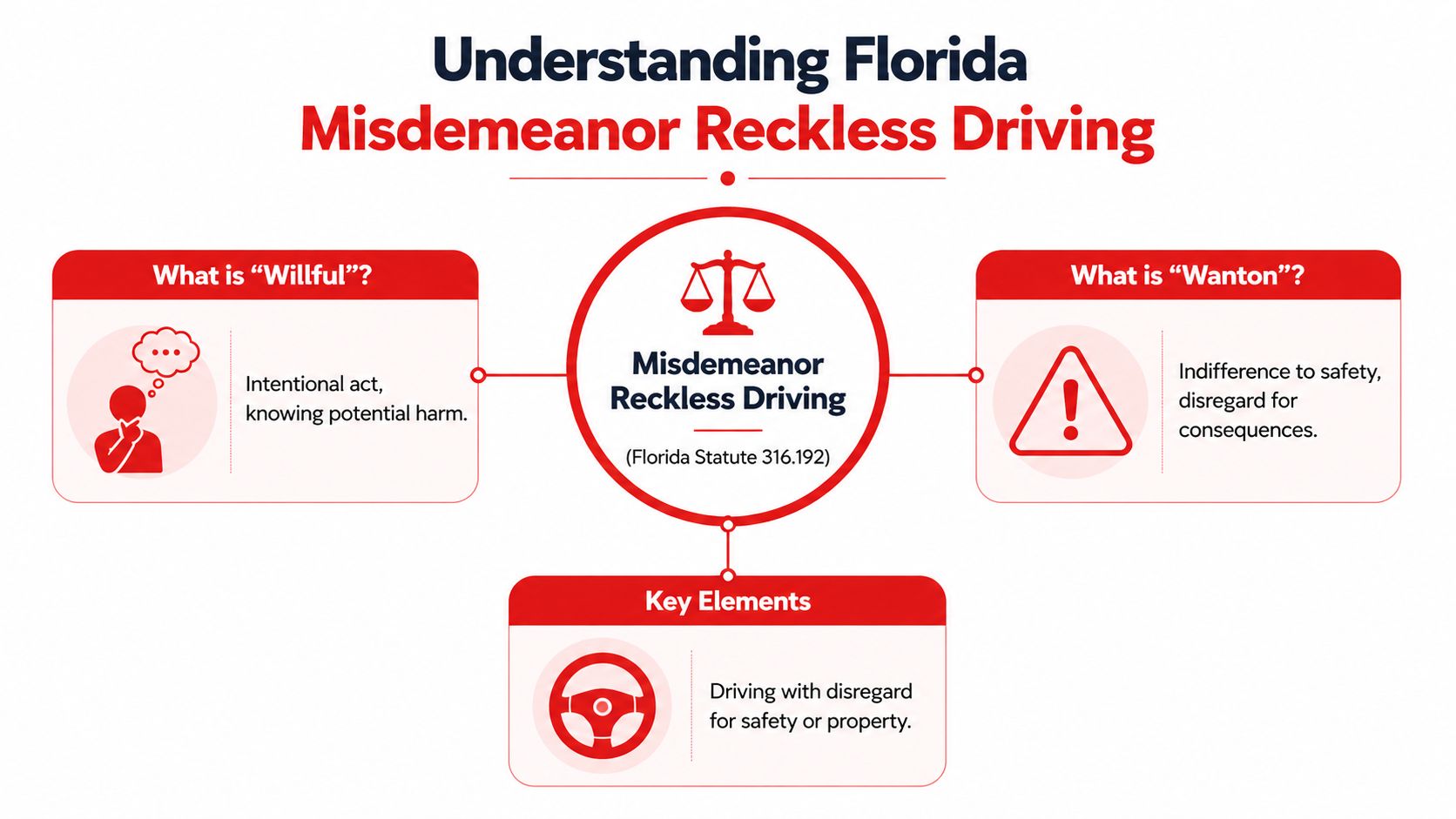
In plain English, the State has to prove more than “you drove badly.” It has to prove you consciously ignored safety. That is why these cases can be fought.
If you want a broader frame on how serious driving conduct gets classified, this explanation on understanding dangerous driving charges is useful because it shows why legal categories matter so much when intent is disputed. For Florida-specific analysis, review Florida reckless driving statute guidance.
How is reckless driving different from careless driving
Careless driving is generally about poor judgment. Reckless driving is about a much harsher accusation. The State is saying you acted with deliberate indifference to safety.
That difference matters in real cases:
Careless driving example: You looked down too long, drifted in your lane, or misjudged distance in traffic.
Reckless driving allegation: The officer claims you were excessively speeding, weaving through traffic, or engaging in conduct that showed disregard for everyone around you.
Automatic reckless conduct: In Florida, fleeing law enforcement in a vehicle is automatically considered reckless driving, which changes the defense because the act itself can establish recklessness under Florida law, as described in Justia’s overview of reckless driving rules.
The most important point is this. The charge is not self-proving. The officer’s label is not the verdict. If the facts support carelessness, confusion, reaction to road conditions, or another non-criminal explanation, the prosecutor’s case can weaken fast.
What Are the Exact Penalties for a Conviction
A misdemeanor reckless driving conviction comes with direct statutory penalties. These are not hypothetical. Judges impose them every day in criminal traffic court, including at the Richard E. Gerstein Justice Building in Miami.
What can the court impose
If you’re convicted of misdemeanor reckless driving in Florida, the consequences can include the following penalties listed in this Florida reckless driving penalties survey:
Jail exposure: Up to 90 days in jail
Fine range: $25 to $500
License points: Four points added to your driving record
Insurance impact: Average premium increases of 20% to 30% after conviction
The same source explains that if points build up too fast, suspension becomes a real risk. It also notes that if the violation causes a crash resulting in death, serious injury, or property damage over $500, mandatory license suspension follows.
Practical rule: If you are thinking about just paying the ticket, stop. Paying a criminal traffic citation can function like giving up your defense and accepting the fallout.
Florida reckless driving penalties at a glance
Penalty Type | First Offense | Second or Subsequent Offense |
|---|---|---|
Jail | Up to 90 days | Penalties can become more severe |
Fine | $25 to $500 | Penalties can become more severe |
License points | Four points | Additional consequences can compound |
Insurance | Average increase of 20% to 30% post-conviction | Ongoing insurance pressure may worsen |
The exact outcome depends on the facts, your history, and the county, but the core point doesn’t change. This is a criminal case with immediate legal and financial consequences.
The Hidden Consequences That Last for Years
The court penalty is only the front end of the damage. The part that wrecks people financially often starts after the hearing is over.
Why the case doesn't end when court ends

A reckless driving conviction follows you in ways most drivers don’t see coming at the roadside stop. Insurance carriers may treat you as a higher-risk driver. Employers may react badly when a criminal traffic offense appears on a background check. Professional opportunities can narrow.
If you drive for a living, the danger gets worse. A conviction can be devastating for gig economy drivers on platforms like Uber and Lyft, which often deactivate accounts after a single serious traffic violation, cutting off income instantly, as discussed in this piece on reckless driving and gig-driver consequences. If your account is your paycheck, that is not a side issue. That is the case.
For some drivers, another hard question follows right behind conviction concerns. Can this ever be cleared later? The answer depends on the outcome, and that’s why it helps to understand when reckless driving may be expunged before you make any rushed decision now.
Who gets hit hardest
Some groups absorb the damage faster than others:
Gig and delivery drivers: A platform suspension can shut off income immediately.
Military and veterans: A criminal traffic case can create problems when clean records matter.
Commuters with high insurance exposure: The monthly cost can keep rising long after the fine is paid.
Drivers with prior points: Another serious mark on the record can put license security at risk.
You don’t measure this case by the fine alone. You measure it by what happens to your income, your mobility, and your options over time.
How Can You Defend Against a Reckless Driving Charge
A reckless driving charge can be defended. That starts with understanding what the State must prove and where the weak points usually sit.

How do you attack the willful and wanton element
The strongest defense in many Florida cases is simple. Challenge the accusation that your conduct was criminally intentional or indifferent.
That can mean arguing:
the driving was careless, not reckless
the officer exaggerated what happened
the road conditions, traffic flow, or surrounding circumstances change how the conduct should be interpreted
there was a non-criminal explanation for what looked bad in a short roadside snapshot
A key legal tactic is to argue down from criminal reckless driving to civil careless driving by challenging the willful disregard element, a nuance that can support dismissal or reduction, as noted in this discussion of criminal traffic charge reductions.
That is legal work. It isn’t form filling. A lawyer has to compare the report to the statute, test whether the facts match the criminal standard, and expose where the officer used conclusions instead of proof.
What other defenses can work
Other defense angles can matter just as much depending on the facts.
Challenge the officer’s observations: Officers often describe speed, lane movement, spacing, or driver behavior in broad terms. Those descriptions can be incomplete or overstated.
Compare the report to available evidence: Dashcam footage, passenger statements, vehicle data, and scene layout can all undermine the State’s version.
Attack the stop or evidence collection: In some cases, the primary fight starts with whether the stop was lawful or whether critical evidence should be excluded. That is where motions practice matters, including motions to suppress evidence.
Address per se reckless allegations carefully: If the accusation involves fleeing law enforcement, Florida treats that conduct as per se reckless driving. The defense then shifts hard toward the underlying facts, identity, vehicle operation, and what occurred.
A lawyer-led defense also means strategy changes as the evidence changes. Ticket Shield, PLLC handles Florida reckless driving defense with direct attorney communication by phone or text, which matters when a case needs immediate review rather than scripted updates from middlemen.
This quick overview helps explain how defense issues unfold in practice:
The officer's opinion is the start of the case. It isn't the end of it.
What Is the Court Process for a Criminal Traffic Case
Criminal traffic court feels intimidating because most drivers have never been through it. The process is manageable once you know what each stage means.
What happens first
The first formal event is usually the arraignment. That is where a plea is entered. In many cases, your attorney can handle this step and protect you from making damaging statements. If you need a quick primer on the first hearing, review what happens at an arraignment hearing.
After that, the case moves into pretrial handling. During this phase, the State turns over evidence, the defense reviews the report, and negotiations begin. It is often at this stage that weak cases start to show cracks.
At places like the Broward County Judicial Complex, these early stages matter because prosecutors often rely heavily on the officer narrative unless the defense forces a closer look.
Where cases are won or reduced
Most of the work happens before trial:
Evidence review
Your lawyer checks the citation, report, video, witness issues, and any factual gaps.Pretrial conferences Negotiation occurs at this stage. A reduction, dismissal path, or non-criminal resolution may be discussed if the facts support it.
Motions
If the stop, evidence, or procedure was flawed, the defense can litigate those issues.Trial or negotiated outcome
If the State won’t offer a fair resolution, the case may proceed to trial.
Criminal traffic court is not a place for improvising. Every statement, deadline, and filing matters.
The good news is that drivers usually feel less overwhelmed once someone takes control of the case and gives them a real plan.
Why You Need a Lawyer and Not an App for a Criminal Charge
A misdemeanor reckless driving case is where automation breaks down. Fast.
Why criminal traffic defense is not automation work
An app can collect your contact information. It can send reminders. It can package a citation for processing. None of that is a defense when the State says you acted with criminal disregard.
A real lawyer does things software can’t do well:
read an officer’s wording and spot where it fails to prove intent
negotiate with a prosecutor who wants a plea
decide whether to push for reduction to a civil offense
identify when motions practice strengthens a position
prepare a client for risks that don’t show up on a payment screen
That difference matters because one of the most important tactics in these cases is reducing criminal reckless driving to civil careless driving by challenging the intent element. That is nuance. It takes legal judgment. It is not checkbox work.
If you’re evaluating representation, practical selection advice can help. This attorney hiring guide from 24-7 Best Bonding is worth reading because it focuses on how to assess counsel when the stakes are criminal, not administrative. For a Florida-specific contrast between direct legal defense and automation, read why a local lawyer beats legal apps.
What to look for before you hire anyone
Don’t get distracted by slick intake systems. Ask harder questions.
Will you speak directly to your attorney by phone or text?
Has the lawyer handled criminal traffic cases under Chapter 316 before?
Who reviews the police report?
Who appears in court or negotiates with the prosecutor?
Is the strategy focused on no points and avoiding a criminal outcome if possible?
If the service can’t give you direct attorney access, it is built for volume, not for defense.
Your First Steps After a Reckless Driving Charge
You need to act quickly, but you also need to act correctly. Start with this checklist.
Do protect your silence: Give required identification information, but don’t explain, argue, or guess. Statements made in stress often become evidence.
Do preserve evidence immediately: Save dashcam footage, text yourself your memory of events, keep receipts, and identify passengers or witnesses before details fade.
Do read the citation carefully: The court date, charge language, and county matter. A criminal traffic case has deadlines that can hurt you if ignored.
Do not post about it: Social media is evidence. Jokes, explanations, and angry comments can all be used against you.
Do not assume paying it is the safe option: In a criminal traffic case, fast payment can create long-term damage.
Do get legal advice early: Early review gives your lawyer the best chance to preserve defenses, request evidence, and shape the case before it hardens.
If you’re weighing cost against risk, broad comparisons can be useful. This article on misdemeanor lawyer costs is outside Florida, but it helps frame the larger point. The actual expense is often the conviction, not the defense.
Your goal right now is simple. Protect the license. Protect the record. Fight for the outcome that avoids points and avoids a criminal stain.
If you’ve been charged with misdemeanor reckless driving in Florida, act now. Visit Ticket Shield, PLLC for a free consultation and focus on the goal that matters most: No Points.