Lawyer for Leaving the Scene of an Accident Defense
Lawyer for leaving the scene of an accident - Charged with leaving the scene? Find a top lawyer for leaving the scene of an accident in 2026. Protect your

If you're accused of leaving the scene, get a lawyer now. In Florida, this can be a misdemeanor or a felony under Chapter 316. Your license, record, insurance, and job can all be at risk before your case is resolved.
Your phone is buzzing. Maybe the other driver called police. Maybe an officer wants you to “come in and explain.” Maybe you panicked, drove off, and now regret every second of it. Maybe you didn't think there was damage. Maybe you stopped nearby and thought that was enough.
People then make the next mistake. They treat this like a routine ticket. It isn't.
A charge for leaving the scene can turn into a criminal case fast. What you say today can become the backbone of the prosecution tomorrow. You need strategy immediately. You need a real lawyer, not an intake team, not a chatbot, not an app that pushes you through a pipeline. If you're trying to figure out whether it's time to talk to counsel, start with a criminal defense attorney consultation and protect yourself before you answer questions.
Table of Contents
You Are Accused of Leaving an Accident Scene What Now
Panic is common. Bad decisions are common too. The state knows that, and prosecutors still file these cases aggressively.
If police contacted you, assume they're building a timeline. They want to lock you into details about where you were, what you felt, what you heard, and why you left. That conversation rarely helps you. It usually helps them.
Why this is not a simple traffic problem
Florida treats leaving the scene under Chapter 316 as more than a moving violation. Depending on what happened, you could be looking at a misdemeanor or a felony. That means possible jail or prison exposure, court appearances, license consequences, and a record that can follow you into employment screening and insurance renewals.
Practical rule: If an officer wants your “side of the story,” the safest answer is that your lawyer will contact them.
You also need to stop trying to solve this by explaining it to everyone around you. Don't text your version to friends. Don't send a long message to the other driver. Don't call your insurance company and freestyle your way through a recorded statement. A rushed explanation can create contradictions that are hard to fix later.
What you should focus on right now
Your job is simple. Protect your rights. Preserve facts. Get counsel involved before the case hardens.
A lawyer for leaving the scene of an accident should immediately look at three things:
The level of alleged harm so the defense can measure whether the state is treating this as property damage, injury, or something worse.
What the state can prove about knowledge, impact, identity, and departure.
What evidence will disappear first including video, witness memory, vehicle condition, and scene details.
That last point matters more than is often understood. These cases often turn on a few minutes of footage, a damage pattern, or a witness who later changes confidence or disappears.
You are not helpless here. But you are on the clock.
What Does Florida Law Say About Leaving an Accident
Florida law imposes a duty to stop after a crash. For many drivers, the key statutes are Florida Statute § 316.061 and Florida Statute § 316.027. Section 316.027 is the one that often drives the fear level up, because it addresses crashes involving injury or death. This is not abstract law. These are the kinds of cases that can move through serious courtrooms like the Richard E. Gerstein Justice Building in Miami.
For a plain-English overview of the charge itself, review leaving the scene of an accident in Florida.
What duty does Florida impose after a crash
The basic duty is straightforward. Stop. Stay where the law requires. Exchange information. If someone is hurt, the duty becomes far more serious.
That's why the first legal question is never “Can I explain this away?” The first question is whether the prosecution will claim the crash involved only property damage or actual injury. That distinction changes the exposure dramatically.
You don't defend this case by talking more. You defend it by forcing the state to prove every required element under the correct statute.
How serious can the charge become
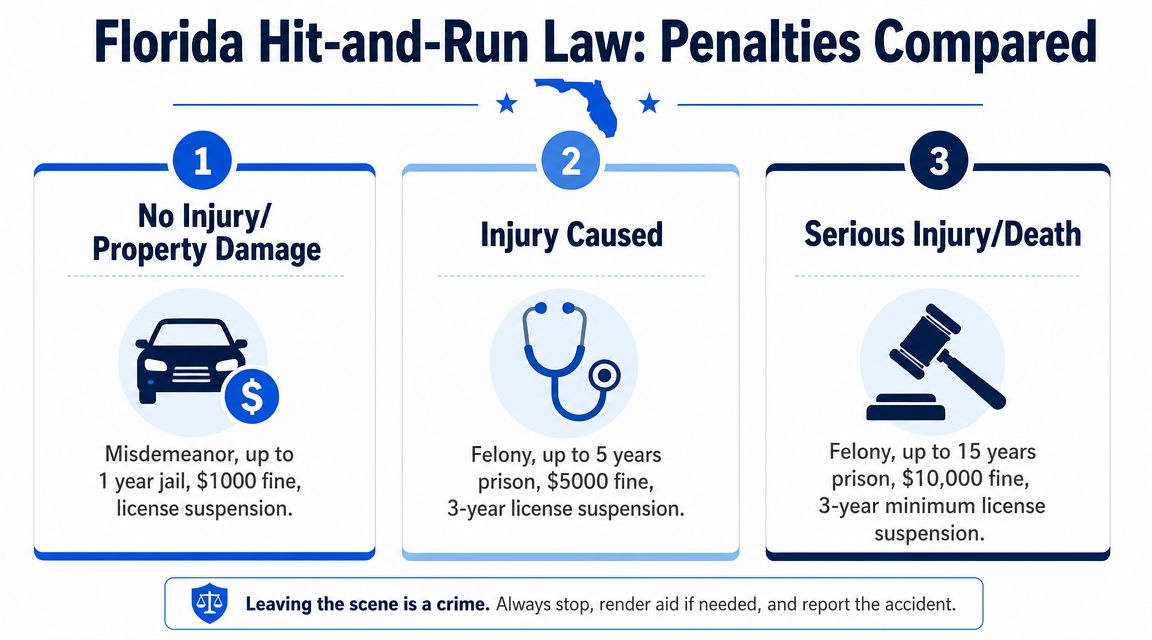
The common breakdown looks like this:
Florida "Leaving the Scene" Penalties at a Glance | Crime Classification | Potential Penalties |
|---|---|---|
Property damage only | Misdemeanor | Up to 1 year in jail, up to a $1,000 fine, and license suspension |
Injury caused | Felony | Up to 5 years in prison, up to a $5,000 fine, and a 3-year license suspension |
Serious injury or death | Felony | Up to 15 years in prison, up to a $10,000 fine, and a 3-year minimum license suspension |
This table captures the practical reality Florida drivers face when a stop-and-remain case escalates. The charge level depends on the alleged harm. The prosecution will often push the facts upward. Your lawyer's job is to test that narrative immediately.
What matters in real defense work is not just the statute number. It's whether the evidence supports the version of events the state wants to sell. Did you know there was contact? Was there actual injury evidence? Did you stop nearby? Did someone else drive the vehicle? Those questions can decide whether a case stays survivable or becomes life-altering.
A lot of people make the mistake of assuming that if there was contact, conviction follows. That's wrong. The state still has to prove the specific offense charged. In a leave-the-scene case, details matter more than impressions.
What Are the Immediate Consequences of a Charge
The punishment doesn't wait for sentencing. It starts as soon as the charge enters your life.
That's why people who search for a lawyer for leaving the scene of an accident are usually feeling pressure from several directions at once. Police are calling. Insurance is asking questions. Work is getting nervous. Family members want answers you shouldn't give yet.

Why the damage starts before conviction
A criminal charge can show up in places you care about before you ever have your day in court. Employers may see it. Licensing boards may ask about it. If your job involves driving, even the accusation can trigger internal review.
Your driving privilege is a separate pressure point. In Florida, you also need to think beyond the courtroom and look at driver license suspension issues. Administrative consequences can create immediate problems with work, family logistics, and basic mobility.
Insurance is another problem people underestimate. Consumer guidance on leave-the-scene fallout highlights a real gap in how drivers think about these cases. The criminal charge is only one layer. The insurance and civil side can move early and hit hard, including coverage disputes, premium spikes, and problems tied to gig work or commercial driving, as discussed in insurance and civil fallout after a leave-the-scene charge.
Who faces the greatest practical risk
Some drivers are especially exposed:
Gig and delivery drivers can face account review or deactivation when an arrest or serious traffic-related charge appears.
Commercially exposed workers may run into employer insurance restrictions even before guilt is established.
Professionals with licensing concerns may have disclosure obligations that need careful handling.
Parents and caregivers can lose basic flexibility if a license issue interrupts daily driving.
A leave-the-scene case is rarely just about fines and jail. It can disrupt how you earn, drive, and insure your life.
This is why a narrow defense is a bad defense. If your lawyer is only thinking about the criminal count and ignoring the license and insurance fallout, you're not fully protected.
How Can You Defend Against a Hit-and-Run Charge
An accusation isn't a conviction. In this type of case, the defense is often stronger than the driver first assumes.
The state still has to prove the right facts against the right person. That sounds obvious. In practice, it's where many cases become vulnerable. If you need a broader overview of offense patterns and defense issues, review these Florida hit-and-run charges.

What the state still has to prove
Many defenses start with the same blunt question. Can the prosecution prove you knowingly left the scene after a qualifying crash?
Possible defense themes include:
Lack of knowledge. If you didn't know there was contact, damage, or injury, that can matter.
Mistaken identity. Vehicle descriptions and witness assumptions are not always reliable.
Compliance dispute. Some cases turn on whether the driver did stop, stopped nearby, or later reported in a way that changes the charge analysis.
Weak injury proof. The state may overstate what happened at the scene.
Causation and timing issues. Damage on a vehicle doesn't always prove when, where, or how contact occurred.
Not every defense wins at trial. Some are strongest in negotiation, where a fast factual investigation can expose enough weakness to reduce the charge or improve the outcome.
The difference between a bad result and a manageable one often comes down to what your lawyer uncovers before the state settles on its theory.
Why early evidence changes cases
These cases are time-sensitive. Very time-sensitive.
From an evidence standpoint, strong hit-and-run defenses are built quickly because scene evidence is time-sensitive. Many business and doorbell surveillance systems overwrite video within days, making prompt requests from your attorney critical to preserving potentially case-winning footage or proving your vehicle was not involved, according to this legal guidance on preserving video evidence in leave-the-scene cases.
That means your lawyer should move fast on:
Nearby surveillance from homes, stores, garages, and intersections
Vehicle photos before repairs or further damage changes the condition
Scene documentation including debris, road layout, and impact points
Witness preservation before memory fades or stories shift
This is also where a lawyer-led practice matters. One option in Florida is Ticket Shield, PLLC, which handles serious traffic-related defense and gives clients direct access to their attorney by phone or text rather than routing the case through middlemen or automated apps. In a case like this, speed and lawyer access matter.
What Are the First Three Steps You Must Take
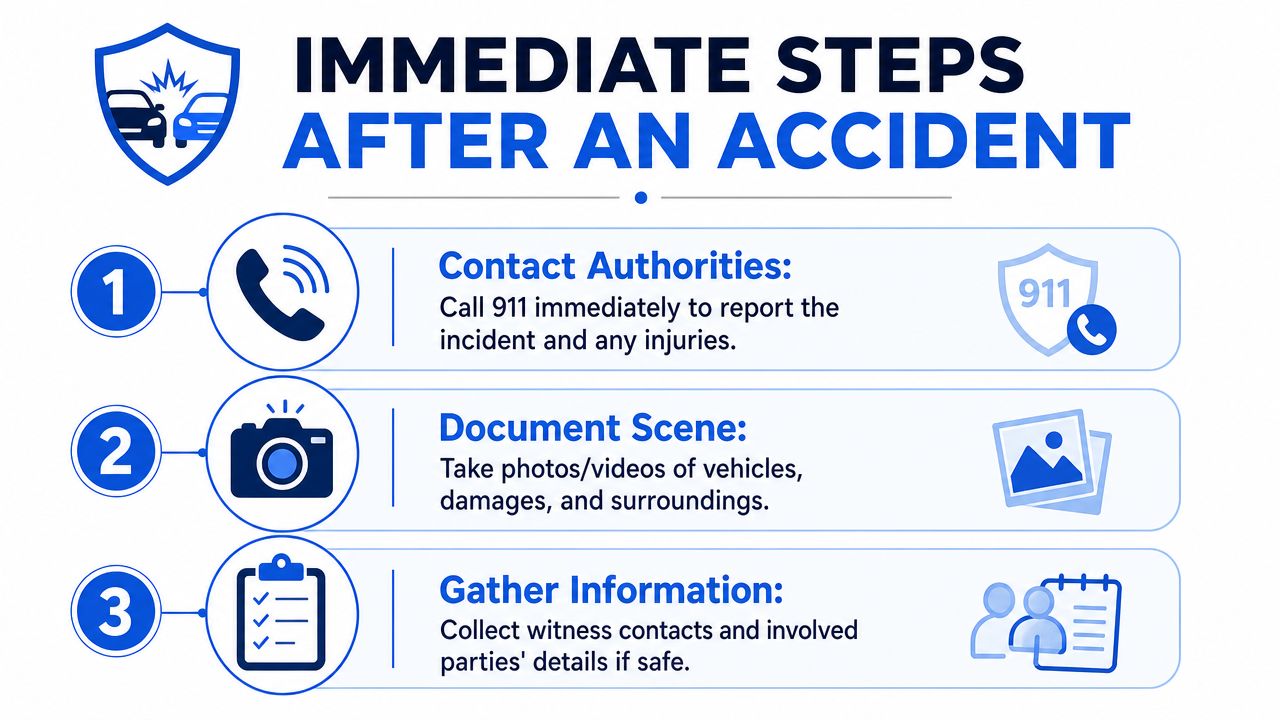
When you're under pressure, simplicity wins. Do these three things. Do them in order.
Immediate Steps to Take
Stop talking about the facts. Don't give a statement to police. Don't give a recorded statement to insurance before legal advice. Don't try to sound cooperative by guessing. If you need to understand the legal duties that apply after a crash, read what Florida requires after a car accident, then let your lawyer handle communication.
Write down everything you remember for your lawyer only. Do it while it's fresh. Time, location, weather, traffic, what you heard, what you felt, whether you stopped, where you went next, who called you, what your car looked like, and whether anyone else had access to it. Keep it private. Don't post it. Don't text it around.
Hire a real attorney immediately. Not a case manager. Not an app. Not a ticket mill where you never know who's making decisions. In a criminal traffic case, you need direct access to the lawyer handling your defense. You should be able to call or text your attorney when police contact you, when the insurer reaches out, or when you learn new facts.
Before you do anything else, watch this quick overview and then act:
If officers already contacted you, don't wait for the “right time” to get help. That time has passed. The right move is immediate intervention.
Protect Your Future with a Dedicated Florida Attorney
A leave-the-scene charge can threaten your record, your license, your insurance, and your income all at once. That's why passive handling is a mistake. If you let the state define the facts before your lawyer gets involved, you give away power you may never recover.
This is especially true in serious courthouses like the Broward County Judicial Complex, Edgecomb Courthouse, or Orange County Courthouse, where traffic-related criminal cases are not treated casually. Judges and prosecutors have seen every excuse. What moves a case is evidence, timing, and disciplined legal strategy.
Why direct access to your lawyer matters
In a crisis, delay hurts. If your call goes to an intake pipeline, a case manager, or an automated system, critical hours can disappear. That's exactly when video gets overwritten, witnesses stop answering, and your own words get used against you.
If English isn't your first language, precision matters even more. Misunderstandings in police contact, court paperwork, or insurance communication can create serious damage. If language access is part of your concern, this guide for legal language access in courts is a useful starting point.
Fast, lawyer-led action protects more than the criminal case. It protects the facts before they disappear.
What a smart response looks like today
A smart response is disciplined. You stop explaining. You preserve your memory. You get counsel involved. Then your lawyer evaluates the charge under Florida's Chapter 316 framework, the available evidence, the license risk, and the insurance fallout as one connected problem.
That is how you protect your future. Not with panic. Not with overexplaining. Not with a service built for volume instead of serious defense.
If you're facing this charge, act now. Visit Ticket Shield, PLLC for a free consultation and fight for the outcome that matters most: No Points.