How to Get Out of Speeding Tickets in Florida
Discover how to get out of speeding tickets in Florida. This guide covers defense strategies, court procedures, and how to protect your driving record.

That little piece of paper an officer hands you can feel like the end of the story, but it’s not. What you do in the moments and days after getting a speeding ticket is what really sets the stage for the final outcome.
The most important thing to understand is that you have options. You don't have to just accept the penalties and pay the fine. Instead, you can contest the citation, which opens the door to negotiation, a reduction of the charge, or even a complete dismissal.
What to Do After Getting a Speeding Ticket
The minutes after a traffic stop, especially in a busy area like Miami-Dade County, can feel stressful and confusing. With a citation sitting on your passenger seat, it's easy to make a rushed decision that ends up costing you a lot more in the long run.
Fortunately, under Florida law, you generally have 30 days to act. That's plenty of time to take a breath and make a smart, informed choice. Your first move is always to remain calm and avoid admitting fault to the officer. The less you say, the better.
Once you’re safely on your way, your focus should shift to the three main paths you can take.
Understanding Your Three Core Choices
Every speeding ticket in Florida forces you to a fork in the road. You’re not just dealing with a one-time fine; this is a situation that can impact your driving record and insurance premiums for years to come. The choice you make inside that 30-day window is everything.
You've got three options:
Pay the Ticket: This is a straight-up admission of guilt. When you pay, you’re accepting the conviction. The points get added to your license, and your insurance company will likely raise your rates.
Elect Traffic School: If you're eligible, you can take a driver improvement course to avoid getting points on your license. The catch? You still have to pay the full fine plus the fees for the school, and you can only use this option a limited number of times in your life.
Contest the Ticket: This means you're pleading not guilty and requiring the state to prove its case in court. It is the only option that gives you a chance at getting the ticket dismissed entirely or knocked down to a lesser offense.
This decision tree gives you a clear visual of the paths you can take after getting a ticket and where each one usually leads.
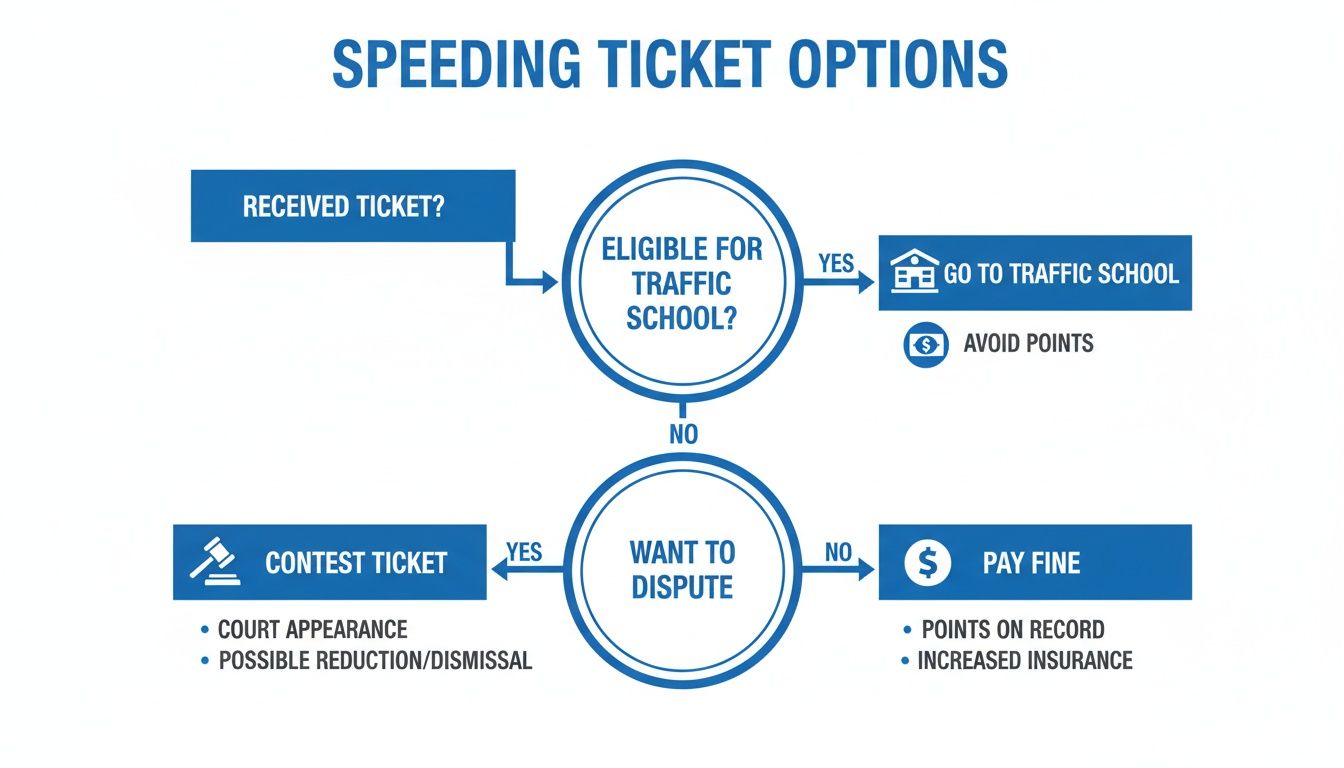
As you can see, fighting the ticket is the only route that can end with a complete dismissal and zero impact on your driving record.
Why Simply Paying Is a Mistake
So many drivers just pay the fine to make it go away, thinking it’s the easiest path. In reality, it's often a costly mistake. A single speeding conviction can put 3 to 4 points onto your Florida driver's license.
To insurance companies, those points are a clear sign that you're a higher-risk driver. That translates directly to rate increases that can affect you for the next three to five years. The initial fine is just the beginning of the financial consequences.
Here’s a quick breakdown of what you're facing with each choice.
Quick Guide to Your Florida Speeding Ticket Options
This table sums up the core choices you have after receiving a speeding ticket in Florida, outlining the key consequences of each path.
Option | What It Means | Impact on Your Record | Key Consideration |
|---|---|---|---|
Pay the Fine | You are pleading guilty and accepting the conviction. | Guaranteed points are added to your license. | This almost always leads to an insurance rate increase. |
Elect Traffic School | You agree to take a course to avoid points. | No points are added, but the violation is still noted. | You still pay the full fine plus school fees, and you have limited lifetime uses. |
Contest the Ticket | You are pleading not guilty and challenging the citation. | Only path that can lead to a full dismissal (no points, no record). | Requires the state to prove its case and opens the door for negotiation. |
The takeaway is clear: contesting the ticket is the only option that gives you a chance to walk away with a clean slate.
Contesting the ticket, on the other hand, requires the state to prove its case against you, and that process creates opportunities. An attorney can review all the evidence, spot procedural errors the officer may have made, and negotiate with the prosecutor—often leading to a much better outcome. To see the immediate fallout in more detail, you can check out our guide on what happens when you get a speeding ticket.
Ultimately, your first move after getting a ticket is to pause and think about the long-term consequences. The decision you make next will determine whether you’re stuck with higher insurance costs and points on your license or if you can keep your driving record clean.
Attorney Advertisement: Please note that this is an advertisement. The information contained here is not legal advice. Past results do not guarantee future outcomes. Our goal is to protect your license and record. Office in Broward.
The True Cost of a Florida Speeding Ticket
That piece of paper an officer hands you might seem like a one-and-done problem. Pay the fine, and it’s over, right? Not even close. The fine printed on that citation is just the opening act. The real financial consequences unfold over the next several years, hitting your wallet in ways you probably didn't see coming.
Think of that fine as just the tip of the iceberg. Once you have a conviction on your record, the consequences ripple outward, creating long-term costs that can easily dwarf that original penalty. It’s critical to stop seeing this as a short-term headache and start treating it like the long-term financial problem it is.
Florida's Point System Explained
The Florida Department of Highway Safety and Motor Vehicles (FLHSMV) tracks your driving history using a point system. It's simple: points are demerits that pile up on your driving record. To insurance companies, these points are red flags signaling risk. The more points you have, the more they assume you're likely to get into an accident, and the more they're going to charge you.
In Florida, speeding violations typically break down like this:
3 Points: For speeding less than 15 mph over the limit.
4 Points: For speeding 15 mph or more over the limit.
4 Points: For any moving violation that causes a crash.
6 Points: For leaving the scene of a crash with damage over $50.
These points don't just disappear. They stick to your record for at least 36 months. If you accumulate too many in a short time—like 12 points within 12 months—you are facing a license suspension.
From Points to Premiums: The Insurance Hike
This is where the real financial damage kicks in. A single speeding ticket conviction can trigger a significant increase in your auto insurance premiums. Insurers check driving records all the time, and when they spot new points, they may adjust your rates at the next renewal.
Even a minor three-point ticket can make your rates jump by 20% or more. For an average Florida driver, that could mean hundreds of extra dollars every single year, for up to five years.
Here’s a real-world example: A driver in Hillsborough County gets a ticket for going 16 mph over the speed limit. That’s a 4-point violation. If their annual premium was $2,000, a 25% rate hike means they may now pay an extra $500 per year. Over three years, that's $1,500 in extra insurance costs—all on top of the original fine and court fees.
The Hidden Financial Drain
The issues don't stop with insurance hikes. A conviction, especially for a serious speeding offense, brings on other financial consequences that aren't so obvious at first.
Loss of Safe Driver Discounts: Most insurance companies offer a discount for keeping a clean record. One conviction is usually all it takes to lose it, making that rate increase even more impactful.
Impact on Employment: If your job requires you to drive—and this is especially true if you hold a Commercial Driver's License (CDL)—a speeding ticket can put your employment at risk.
Future Violations: With points already on your license, any future ticket carries much higher stakes. You're that much closer to a license suspension, and the system is far less forgiving.
It’s also important to remember the bigger picture. In 2023, speeding was a contributing factor in 29% of all traffic fatalities in the United States. Fighting a ticket isn't just about your finances; it's about being part of a larger commitment to keeping our roads safe.
Common Defenses That Can Be Used for a Speeding Ticket
It’s a common and costly mistake to think a speeding ticket is a done deal the moment the officer hands it to you. Many drivers just assume the officer's word is final and their only choice is to pay up and take the hit. But that’s not how the system works.
The state—represented by the officer who wrote the ticket—carries the burden of proof. It’s on them to prove you were speeding, and they have to do it with solid, legally sound evidence.
This is where your opportunity lies. An attorney who handles traffic matters knows every citation has potential weak spots. From the radar gun used to clock you to the smallest details on the ticket itself, several legal defenses can turn a case in your favor. A dismissal or reduction is often more achievable than you think.
Questioning the Speed Measurement Device
The heart of any speeding case is how your speed was measured. In Florida, police mostly use radar, laser (LIDAR), or pacing, and each method has strict rules and known vulnerabilities that can be challenged.
An attorney's first move is to investigate the device. Was it properly calibrated? Are the maintenance and certification records for that specific unit up to date? If the agency can’t produce this paperwork, the case may be dismissed.
It goes beyond just maintenance, though. How the device was used in the field is just as important. Radar guns, for instance, can give inaccurate readings if they aren't operated correctly.
Operator Training: The officer must be certified to use that specific model of radar or laser.
Environmental Factors: Was it raining heavily? Was traffic dense? Even a large truck passing by can throw off a radar signal and cause a false reading.
Targeting Errors: How can the officer prove the gun clocked your car and not the one right next to you in a pack of traffic?
These aren't just technicalities; they’re the foundation of the state's case. If reasonable doubt can be created about the accuracy of the speed reading, the whole ticket is in jeopardy.
Challenging Officer Training and Procedure
It’s not enough for the equipment to be in perfect shape. The officer using it must be properly trained and follow procedure. Any slip-up can create a powerful defense.
Take "pacing," for example, where an officer matches your speed with their patrol car. To make that stick, they have to prove their own speedometer was recently calibrated and that they held a steady distance behind you for a specific amount of time. That can be difficult to prove in court.
A common scenario in Palm Beach County involves citations issued on busy stretches of I-95. An attorney might challenge whether the officer could have accurately paced a single vehicle in dense, fast-moving traffic without interference from other cars changing lanes.
Plus, every detail on the ticket itself must be accurate. A major clerical error—like citing the wrong law, getting the location completely wrong, or misidentifying your car—can be grounds for dismissal. A simple typo might be excused, but a critical mistake can harm the officer's credibility and the ticket’s validity. The chances of getting a speeding ticket dismissed often come down to these procedural details most people would never think to question.
Identifying Issues with the Traffic Stop
The defense starts before the officer even points the radar gun. Every traffic stop has to be legally justified. An officer can’t pull you over on a hunch; they need a reasonable, articulable suspicion that you broke a specific traffic law.
An attorney will dig into the circumstances of the stop itself. Was your vehicle clearly identifiable? Did the officer have an unobstructed view? Sometimes, the reason for the stop is much weaker than it seems on the surface.
Ultimately, addressing a speeding ticket involves an understanding of Florida traffic law, police procedures, and the rules of evidence. By scrutinizing every single part of the state’s case, an attorney can find the leverage needed to negotiate a dismissal, get the charge reduced to a non-moving violation (which means no points), or handle the case for you in court.
How to Navigate the Broward County Court Process
The idea of stepping into a courtroom can be unsettling, especially when your driving record and insurance rates are on the line. But dealing with a speeding ticket in the Broward County court system doesn't have to be a nightmare.
Understanding the process, knowing what to expect, and being prepared can make all the difference.
When you decide to contest a ticket, a court date is set. This isn’t some dramatic trial scene from a movie; it's usually a much more straightforward affair held at a Broward County Clerk of Courts location, like the Central Courthouse in Fort Lauderdale or one of the regional courthouses in Plantation, Deerfield Beach, or Hollywood.
Your first appearance is typically a pre-trial hearing or an arraignment. This is where you'll formally enter your plea, which is a critical decision point in your case.
Entering Your Plea: Not Guilty vs. No Contest
This is a fork in the road, and the path you choose matters immensely. "No contest" (or nolo contendere) might sound like a safe middle ground, but it's essentially an admission of guilt without verbally saying the words. The result is the same: you'll be found guilty, get the points, and have to pay the fine.
Pleading "not guilty" is the only way to preserve all of your rights and require the state to actually prove its case against you. It's the essential first step if you're aiming for a dismissal or a reduction of the charge. It signals to the court that you intend to challenge the ticket.
Preparing for Your Court Date
Proper preparation shows respect for the court and can influence how your case is perceived. While you don’t need an elaborate presentation, having your documents in order is a must.
Here’s what you should bring:
Your Copy of the Ticket: This is the core document of the entire case.
Your Driver's License: You'll need it for basic identification.
Any Supporting Evidence: This could be anything from photos and diagrams to records that support your defense.
Courtroom etiquette is also crucial. Dress professionally—think business casual. Address the judge as "Your Honor," speak clearly and respectfully, and never interrupt. These small details contribute to the overall impression you make.
The Role of Pre-Trial Negotiations
In many Broward County traffic cases, the most important conversations happen long before you ever step into the courtroom. This is where having an attorney becomes a game-changer. Before a trial, your attorney gets the chance to speak directly with the prosecutor or the law enforcement officer.
The goal here is simple: find a resolution that works for both sides. For the state, it means avoiding a time-consuming trial. For you, it’s a golden opportunity to secure a much better outcome.
A common strategy is negotiating a plea down to a lesser, non-moving violation. For example, your attorney might arrange for a speeding charge to be amended to something like "faulty equipment." This is a beneficial outcome because non-moving violations carry no points, which means your insurance rates are protected.
This negotiation phase is often where the battle is won. An attorney who is familiar with the Broward County prosecutors and local court procedures knows which arguments are most persuasive and what kind of deals are actually on the table. We've seen many positive outcomes, like in this case study about a dismissed speeding ticket in Broward County, FL.
This inside knowledge is key to knowing how to get out of speeding tickets without the risk and uncertainty of a full trial. While past results do not guarantee future outcomes, our primary goal is always to protect your driving record.
Why Hiring a Traffic Attorney Is a Smart Move

While you have every right to represent yourself in traffic court, deciding to go it alone can be a costly mistake. Bringing in a professional who handles traffic tickets every single day can lead to a better, more convenient outcome. The legal system has its own language, unwritten rules, and procedures, and an attorney who handles traffic tickets is fluent in all of them.
This isn't just about having someone speak for you. It’s about using their experience to shield your license, your record, and your finances. A good attorney can spot weaknesses in the state's case that you would never see, negotiate effectively with prosecutors, and navigate the entire process with the kind of efficiency that only comes from experience.
Leveraging Local Courtroom Knowledge
One of the biggest advantages an attorney brings to the table is their familiarity with the local court system. Florida's 67 counties each have their own courthouses, judges, and prosecuting attorneys—and every one of them has distinct tendencies and ways of doing things. An attorney who regularly practices in a specific county, like Miami-Dade or Broward, knows these nuances inside and out.
This local knowledge is a powerful tool. A local attorney knows:
Which arguments a particular judge finds persuasive.
What kind of deals a specific prosecutor is likely to accept.
The procedural quirks of that courthouse that can be used to your advantage.
This insider's perspective allows them to build a strategy tailored not just to your case, but to the very courtroom where it will be heard. Our practice focuses on traffic and DUI defense across Florida, giving us the broad experience needed to handle cases effectively, no matter the jurisdiction.
The Power of Professional Negotiation
For most drivers, the goal is simple: avoid points on your license and keep your insurance rates from going through the roof. This is where an attorney's negotiation skills become invaluable. They can often communicate with the prosecutor or officer before a hearing to work out a deal.
The most common goal is getting the speeding charge amended to a non-moving violation, like "faulty equipment." This is a huge win because non-moving violations don't add points to your license. The result? No impact on your insurance premiums. This is an outcome rarely achieved by individuals representing themselves.
An estimated 41 million speeding tickets are issued in the U.S. each year, making it the most frequent moving violation. Given Florida's heavy traffic, drivers here face a significant risk of getting cited, making skilled legal negotiation more critical than ever.
Attorney Advertisement: This is an advertisement. The information on this page does not constitute legal advice. Past results do not guarantee future outcomes. Our goal is to protect your license and record. Office in Broward.
The Ultimate Benefit: Convenience
Perhaps the most underrated benefit of hiring a traffic attorney is the sheer convenience. Fighting a ticket yourself means taking time off work, driving to the courthouse, waiting around for your case to be called, and navigating a stressful and unfamiliar environment.
With an attorney, all that hassle disappears. In most cases, our clients never have to step foot in a courtroom. We handle everything from filing the paperwork to appearing on your behalf, saving you time, stress, and lost wages. This is especially vital for CDL holders or those ticketed for more serious offenses, where the stakes are much higher. For a more detailed breakdown, our article explores the question, do I need a lawyer for a traffic ticket?
Ultimately, hiring an attorney is an investment in a better result. It's about putting a professional in your corner whose only job is to protect your interests and get the best possible outcome for your case.
Answering Your Florida Speeding Ticket Questions
Getting a speeding ticket can leave you with a lot of questions. Below, we've provided straightforward answers to the questions we hear from Florida drivers most often. The goal here is to arm you with the information you need to make a smart decision.
Can I Just Pay The Ticket And Go To Traffic School?
While electing traffic school is an option for some minor tickets, it's rarely the best move. Florida law is strict: you can only use traffic school once every 12 months and just five times in your entire life.
Choosing this path means you're officially admitting guilt. You still have to pay the full fine, plus the cost of the school. For most drivers, especially those with a clean record or a CDL, talking to an attorney first is a much better bet. We often see cases that could lead to a complete dismissal, saving you money and one of your limited traffic school elections.
How Much Does A Speeding Ticket Lawyer In Florida Cost?
The cost really depends on how serious the violation is and which county issued the ticket. But the real question isn't just about the one-time legal fee—it's about weighing that against the long-term financial pain of a ticket.
Those hidden costs add up fast. You've got the initial fine, and then the big one: potentially hundreds or even thousands of dollars in higher insurance premiums over the next several years.
We offer a free consultation to go over your case and give you a clear, flat-fee quote. You'll know the full cost right from the start, so you can make a decision that makes financial sense.
Legal Notice: This content is an Attorney Advertisement. The information provided does not constitute legal advice, and past results do not guarantee future outcomes. Our primary objective is to protect your license and driving record. Prospective clients may not obtain the same or similar results. Office in Broward.
What Happens If I Ignore A Speeding Ticket From Palm Beach County?
Ignoring a speeding ticket anywhere in Florida is one of the worst things you can do. If you miss the deadline, the court may find you guilty by default, add points on your license, and can suspend your driver's license for failing to pay.
Driving with a suspended license is a criminal offense that comes with much bigger problems. On top of that, the court will tack on late fees, making the original fine look tiny in comparison. Whatever you do, don't just ignore it. Always take action.
Can A Lawyer Guarantee My Speeding Ticket Gets Dismissed?
No reputable attorney will ever guarantee a specific outcome. The legal system can be unpredictable, and you should be very skeptical of anyone who promises a "guaranteed dismissal." What an attorney who handles traffic tickets can do is significantly improve your odds of a good result.
Our goal is to get the best possible outcome for you. That could be a full dismissal, a reduction to a non-moving violation to keep points off your record, or minimized fines. While past results don't guarantee future ones, our focus is always on protecting your license and record with skilled legal representation. Knowing how to get out of speeding tickets often starts with understanding the value of having a professional in your corner.
Don't let a speeding ticket put your driving record and insurance rates at risk. The team at Ticket Shield, PLLC is ready to manage the entire process for you. Call us 24/7 for a free consultation to discuss your ticket and find out how we can help.