How to Get Out of a Traffic Ticket in 2026
Learn how to get out of a traffic ticket in Florida. Our expert guide covers fighting tickets, avoiding points, and when to hire a lawyer.

Yes, you can get out of a traffic ticket in Florida, but only if you act fast and make the right first move. Don’t pay it blindly. Protect your record, your insurance, and your license by contesting it strategically.
You’re probably reading this with the ticket still sitting on your kitchen counter, your glove box, or your phone screen. You got pulled over. The officer handed you a citation. Now you want this over with.
That instinct is understandable. It’s also where many drivers make the mistake that costs them far more than the fine.
A traffic ticket in Florida isn’t just a payment issue. It can affect your driving record, your insurance, and, for some drivers, your job. If you drive for work, hold a professional license, or cannot afford points on your record, you need to treat this like a legal problem, not an inconvenience.
Table of Contents
You Received a Ticket, Now What Is Your First Move
Your first move is simple. Don’t pay the ticket.
The moment you pay, you’re usually ending the fight before it starts. In most situations, paying means accepting the violation instead of forcing the state to prove it. If your citation involves a Chapter 316 offense, such as Florida Statute 316.187 for unlawful speed, that decision can follow you long after the fine is gone.
Use this image as the right mental frame for what just happened.

Most drivers never challenge a ticket. Only 5% of drivers who receive traffic tickets contest them in court, according to traffic ticket contest data summarized here. That means the vast majority accept the consequences without testing the case.
Why is paying the wrong first move
A ticket feels small because the paper is small. The consequences aren’t.
You may be dealing with:
Points on your license that stay on your record
Insurance increases that last longer than the fine
Employment issues if you drive for Uber, Lyft, delivery platforms, or any job that checks your motor vehicle record
Accumulating risk if you already have prior citations
Practical rule: A traffic ticket is not “just a ticket” once it can affect your license, your premiums, or your income.
What should you do instead
Take control immediately. Your goal is to preserve options.
Start here:
Read the citation carefully: Check the statute number, court information, and deadline.
Treat the deadline seriously: Florida gives you a limited window to respond. Waiting closes off good options.
Keep the paper and all related records: Don’t lose the citation, envelope, or any receipt.
Decide that your objective is no points: That should be your standard from day one.
If you want to know how to get out of a traffic ticket, stop thinking like a person paying a bill and start thinking like a person defending a record.
What Are Your Immediate Steps After a Traffic Stop
The strongest traffic defenses often begin before you ever step into court. What you say, what you save, and what you document can help or hurt you later.
Use this as your immediate checklist.

What should you avoid saying and doing
Don’t argue roadside. Don’t explain too much. Don’t volunteer admissions.
If the officer asks questions, be polite and brief. A roadside conversation is not where you win your case. It’s where many drivers accidentally hand the state useful statements.
The stop is over quickly. The officer’s notes are not.
You should also understand what signing the citation means. If you’re unsure, review whether you have to sign traffic tickets in Florida. Many drivers confuse a signature with an admission. That confusion leads to bad decisions.
What evidence should you preserve right away
As soon as you can do it safely, document the scene. Don’t rely on memory. Memory gets weaker. Photos don’t.
Take or note:
Road signage: Was the sign faded, blocked, missing, or placed where a driver could easily miss it?
Lane markings: Were they visible and clear?
Weather and lighting: Rain, glare, darkness, and heavy traffic matter.
Your position and the officer’s position: Particularly in speeding cases, sightlines can matter.
Any dashboard footage or phone location history: Save it before it’s overwritten.
Also inspect the ticket itself.
Look for the charged statute: That tells you what the state claims you violated.
Check basic details: Date, time, location, vehicle information, and your identifying information should be accurate.
Calendar your response deadline immediately: Missing it can put you in a weaker position fast.
Your first 24-hour checklist
Store the ticket safely: Paper tickets disappear. Screenshots get buried.
Write your own account: Do it while the facts are still fresh.
Photograph the location: Conditions change. Signs get trimmed or replaced.
Avoid online “fixes” and generic chatbot advice: Florida procedure is local, technical, and full of traps.
Decide early whether you’re contesting: Delay helps the citation, not you.
A calm driver with good records is in a better position than a driver who rushed to pay and hoped for the best.
Should You Pay the Fine or Fight the Ticket
This is the decision that matters most.
Many drivers think paying is cheaper because it ends the immediate problem. That’s short-term thinking. If your goal is to protect your record and finances, paying often makes the problem official instead of making it disappear.
What happens when you pay
When you pay a ticket, you usually stop any chance to challenge the charge. You’re choosing speed over strategy.
That may sound efficient. It isn’t, especially if the ticket puts points on your license or affects your insurance. If you’re trying to figure out whether you should pay the ticket or hire a lawyer, the right question isn’t “What costs less today?” It’s “What protects me from the bigger loss?”
Paying the Fine vs. Contesting with an Attorney
Factor | Paying the Fine (Pleading Guilty) | Contesting with Ticket Shield (Fighting the Charge) |
|---|---|---|
Your legal position | You usually close the door on a defense | You keep your options open |
Points risk | You may take the points tied to the citation | You can pursue dismissal, reduction, or a no-points outcome |
Insurance impact | You absorb the downstream consequences | You fight to reduce or avoid them |
Evidence review | No one pressure-tests the state’s case | A defense can examine errors, records, and proof issues |
Court process | Fast in the moment, costly later | More strategic from the start |
Leverage | You give up negotiation leverage | You preserve leverage for negotiation or trial |
Why fighting is usually the smarter move
There are valid legal ways to get out of a traffic ticket in Florida. That doesn’t mean every ticket disappears. It means many tickets can be reduced, dismissed, or resolved in a way that protects your record better than a rushed payment ever will.
Here’s the practical reality:
The state has the burden of proof: You don’t have to make their case easier.
Officers make mistakes: On observations, paperwork, and procedure.
Equipment can be challenged: Especially in speed cases.
Negotiation matters: A strategically handled case can end differently than a self-handled one.
Paying feels final. Fighting is what creates room for a better result.
If you’re eligible, traffic school can be one route. But it’s not always the right route, and it isn’t a substitute for legal analysis. Some drivers should pursue dismissal. Others should seek a reduced charge. Others may need a specific strategy because of work, prior history, or local court practice.
The key point is this. Don’t confuse “quick” with “smart.”
What Common Defenses Can Win in Florida Courts
A real defense isn’t wishful thinking. It’s targeted pressure on the weakest part of the state’s case.
In Florida traffic court, strong defenses usually come from facts, records, and procedure. You’re not asking for mercy. You’re forcing the government to prove the citation with reliable evidence.
Can you challenge radar or lidar evidence
Yes. In the right case, this is one of the most effective ways to attack a speeding citation.
When properly executed, challenging radar or lidar calibration records can yield a 40-60% dismissal rate, according to this discussion of speed detection challenges. A defense attorney can demand training certificates, tuning fork logs, and certification records tied to the specific device used.
That matters because a speed reading is only as good as the paperwork and procedure behind it.
Common issues include:
Missing calibration records
Incomplete maintenance documentation
Unclear officer training history
Questionable line-of-sight conditions
Positioning problems that affect the reading
If you want a deeper look at strategy, review how to beat a traffic ticket in Florida. The details matter, especially when the citation depends heavily on a machine reading.
What other defenses matter in real cases
Not every winning defense is technical. Some are factual and very human.
A few examples:
Mistake of fact: A sign was blocked by vegetation, unreadable, or placed poorly.
Observation problems: Traffic was dense, the officer’s vantage point was limited, or the identification of your vehicle was shaky.
Clerical and charging errors: The ticket or supporting report may contain defects worth examining.
Necessity-based context: In some cases, what you did may have been a response to an immediate road hazard.
Good traffic defense is specific. It starts with the exact roadway, the exact charge, the exact officer account, and the exact records behind the citation.
This is also where local courtroom experience matters. The same defense theory can be presented poorly or precisely. At a courthouse like the Richard E. Gerstein Justice Building in Miami, details and preparation carry weight. Generic defenses don’t. Focused ones do.
How Does the Florida Court Process Actually Work
Florida traffic court looks intimidating from the outside. It’s more manageable once you understand the path.
The problem is that drivers often make decisions too early because the process feels unfamiliar. That’s when they pay first and ask questions later.
Use this process visual as a reference point.
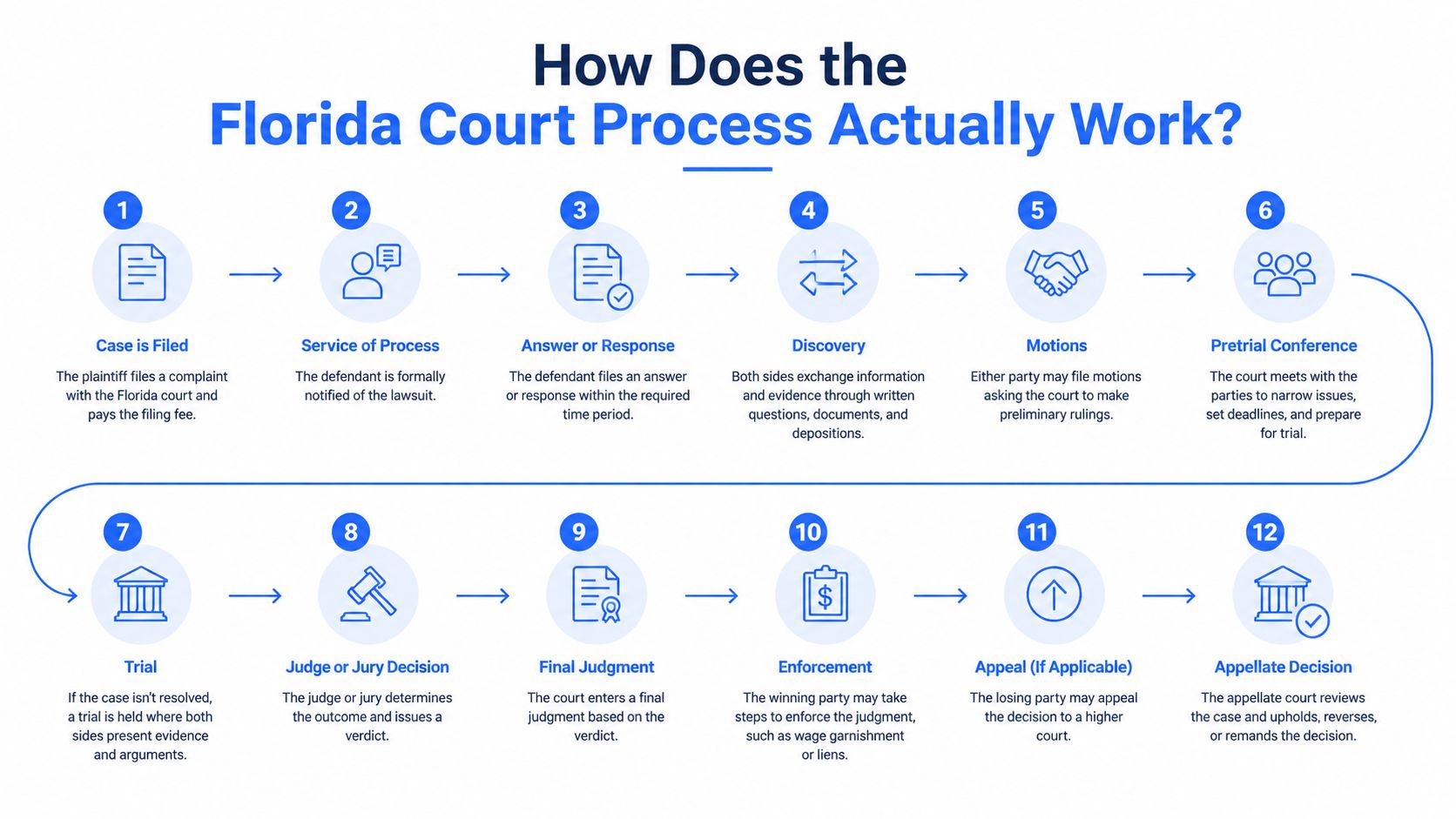
What are your legal options after the ticket
In general, you must act within the response window listed on the citation. One path is paying. Another is electing traffic school if you qualify. The third is contesting the ticket.
For many first-time drivers facing a non-criminal infraction, traffic school may help. In Florida, electing traffic school for a non-criminal infraction can result in the dismissal of points in over 75% of cases for first-time offenders, and that option is mandated by Florida Statute 318.14(9), according to this explanation of Florida traffic school eligibility.
That said, traffic school is not automatic relief in every case. It has limits. It also isn’t always your strongest move.
What happens after you contest the citation
Once you contest, the case moves into the court system. That can include filings, scheduling, negotiation, and, if needed, a hearing. In a county like Orange, that may mean proceedings connected to the Orange County Courthouse.
You don’t need to guess your way through that process. It helps to understand what to expect in traffic court, especially if this is your first citation.
Typical stages include:
Filing the response
Receiving a court setting or next instruction
Reviewing the officer’s allegations and available evidence
Evaluating negotiated options
Preparing for hearing if the case doesn’t resolve earlier
Court procedure rewards people who know the sequence, the deadlines, and the pressure points.
That’s why rushed decisions hurt drivers. A citation may look simple. The process behind it isn’t.
Why Should You Hire Ticket Shield Instead of an App
Traffic defense is not a form fill. It’s not a chatbot script. It’s not a generic upload portal.
If you’re serious about how to get out of a traffic ticket, you need judgment, communication, and local strategy. Apps don’t deliver that. They process. Lawyers defend.
What an app cannot do for you
An automated service can collect your information. It can send reminders. It can package documents.
What it can’t do well is think like a lawyer handling a Florida traffic case in a real courthouse, with a real prosecutor, under real local practices. That gap matters. DIY ticket fights fail in over 80% of cases, while lawyer-led defenses succeed over 90% of the time, according to this discussion of lawyer-led versus self-handled traffic defenses.
You should also understand why choosing a local lawyer over apps changes the quality of the defense. Local knowledge isn’t marketing language. It affects negotiations, expectations, and outcomes.
Why direct attorney access changes outcomes
When a case needs strategy, middlemen get in the way. You need direct answers from a lawyer who can evaluate the citation, the county, and the risk to your record.
At the Broward County Judicial Complex, for example, local practice and negotiation approach matter. So does speed. A driver who can text or call their attorney directly gets actual case guidance, not canned updates.
One Florida option is Ticket Shield, PLLC, a lawyer-led traffic defense firm where clients communicate directly with their attorney by phone or text rather than through chatbots or intake layers. That kind of structure is practical for busy professionals, gig drivers, military members, Spanish-speaking drivers, and anyone who wants the case handled with actual legal judgment.
If your priority is No Points, stop treating this like an online errand. Treat it like a legal defense.
Visit Ticket Shield, PLLC for a free consultation and fight for the result that matters most: No Points.