How to Fight a Reckless Driving Ticket in Florida
Learn how to fight a reckless driving ticket in Florida with practical steps for understanding the charge, building a defense, and navigating the court system.

When you're handed a reckless driving ticket in Florida, the first thing you need to realize is that this isn't just a simple traffic ticket. It’s a criminal offense. Your first moves are critical, and they start with a clear understanding of the law, the potential consequences, and the significant difference between "reckless" and "careless" driving.
Understanding Your Florida Reckless Driving Charge
Getting cited for reckless driving is jarring. Unlike a basic speeding ticket you can handle online, this one comes with a mandatory court appearance and the weight of a criminal charge. Grasping this distinction right away is the most important part of building your defense.
Under Florida Statute 316.192, reckless driving is defined as driving with a “willful or wanton disregard for the safety of persons or property.” That’s a very high legal bar for the state to prove. The prosecutor has to show your actions weren’t just a simple mistake—they have to prove you showed a conscious and intentional indifference to the danger you were creating.
What Does "Willful or Wanton Disregard" Actually Mean?
The words “willful” and “wanton” are the heart of the charge. Willful means you did it on purpose. Wanton means you knew the risks and didn't care about the consequences. It's this combination that turns a bad driving decision into a criminal act.
Think about these real-world examples:
Aggressively weaving in and out of heavy traffic at 90 mph.
Flying through an active school zone at double the speed limit.
Riding someone's bumper so closely and aggressively it becomes threatening.
Street racing on a public road.
These aren't just traffic violations; they demonstrate a state of mind that completely ignores the safety of everyone else on the road. That’s exactly what the law is designed to punish. For a deeper dive, check out our guide explaining in detail what constitutes reckless driving in Florida and its criminal implications.
Reckless Driving Is Not Careless Driving
It's absolutely essential to know the difference between a criminal reckless driving charge and a civil careless driving ticket. They might sound alike, but in the eyes of the law, they are worlds apart.
A careless driving ticket usually means you failed to drive in a "careful and prudent manner"—a much lower standard. Reckless driving is a whole different ballgame. Law enforcement agencies are cracking down on aggressive driving because of its direct link to serious accidents. During campaigns like Operation Safe Driver Week, officers are looking for the exact behaviors that contributed to the 42,795 road fatalities in the U.S. in 2022. This high-stakes focus is why judges and prosecutors take these charges so seriously. You can discover more insights about these traffic safety initiatives on CVSA.org.
Here's a straightforward breakdown of how these two charges stack up.
Reckless Driving vs. Careless Driving in Florida
Aspect | Reckless Driving (Criminal) | Careless Driving (Civil) |
|---|---|---|
Classification | Criminal Misdemeanor | Non-criminal Civil Infraction |
Penalties | Jail time, probation, significant fines | Fines, potential traffic school |
Criminal Record | Creates a permanent criminal record | Does not create a criminal record |
License Points | 4 points | 3 points |
Court Appearance | Mandatory | Often not required |
Insurance Impact | Major premium increase or cancellation | Minor to moderate premium increase |
Key Takeaway: The primary goal when fighting a reckless driving ticket is often to seek a reduction to a less severe offense, such as careless driving, thereby avoiding a criminal record and its cascading consequences.
Because it’s a criminal charge, a reckless driving conviction can haunt you for life, impacting your job prospects, professional licenses, and even where you can live. Our goal is to protect your license and your record. While past results do not guarantee future outcomes, a powerful defense always begins with knowing exactly what you’re up against.
Your First Steps After a Reckless Driving Citation
The flashing lights are gone, but a piece of paper in your hand just turned your day upside down. That ticket isn't just a fine; it's a criminal charge. The clock is ticking, and what you do right now can make all the difference in building your defense.
The single most important thing to do is start documenting everything while the incident is still sharp in your mind. Don't second-guess yourself or leave things out—every detail matters. Your memory is your first and best piece of evidence.
This diagram breaks down the road ahead, showing how a single traffic stop for reckless driving can quickly escalate into serious legal consequences that impact your life for years.
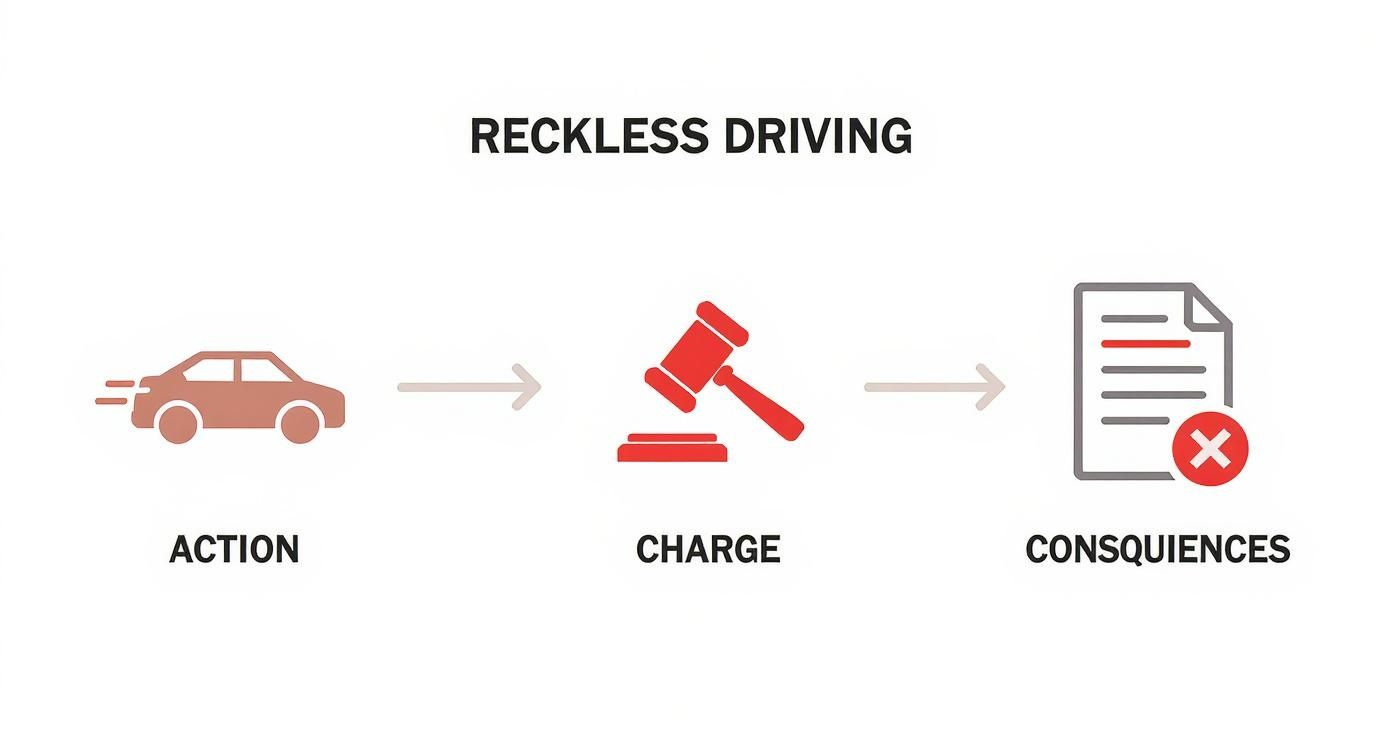
As you can see, a simple accusation kicks off a formal criminal process. It’s a path that can lead to a permanent record and even jail time if you don't handle it correctly from the start.
Document Everything—Immediately
Get a pen and paper or open a note on your phone. Think like an investigator and paint a full picture of what happened.
Start with these crucial details:
Time and Date: Be precise.
Weather: Was it raining? Sunny with a bad glare? Foggy? These conditions matter.
Road Conditions: Note any potholes, construction, faded lane lines, or debris that might have influenced your driving.
Traffic: Was the road packed, or were you the only one around? The context of other cars is huge.
The Conversation: What did the officer say to you? What did you say back? Try to capture the exact words exchanged. This is often where cases are won or lost.
As soon as you can do so safely, grab your phone and take pictures of the scene. Get wide shots of the road, photos of any relevant signs (like speed limits or construction warnings), and close-ups of the road conditions you noted. These images can be powerful tools to counter an officer's story in court.
Understand Your Citation and Critical Deadlines
Look closely at that ticket. In Florida, a reckless driving citation isn't something you can just pay online and forget about. It's a Notice to Appear in criminal court. This is a big deal.
The date listed on your citation is your arraignment—your first mandatory court appearance. If you miss it, a warrant will be issued for your arrest, and your driver's license will be suspended. You or your attorney must be there.
Important Reminder: Submitting information via our website's contact forms does not create an attorney-client relationship. While we hold all communications in strict confidence, our legal representation only starts once we have a signed agreement.
How to Handle Your Initial Plea
At the arraignment, the judge will ask how you plead. Your options are usually guilty, not guilty, or no contest (nolo contendere).
Pleading Guilty or No Contest: This is the end of the line. You're accepting a conviction right then and there. The judge will find you guilty of a criminal offense and move straight to sentencing, which could include hefty fines, probation, or jail.
Pleading Not Guilty: This is the only way to keep your options open and fight the charge. By pleading "not guilty," you're preserving all your legal rights and giving your attorney the time needed to get the evidence from the prosecutor, look for weaknesses in their case, and prepare a real defense.
Entering a "not guilty" plea is the standard first step for anyone who wants to challenge the state's case. It doesn't mean you're being difficult; it means you're being smart. The choices you make in these first few days are absolutely critical. Our practice focuses on traffic and DUI defense across Florida, and our goal is to protect your record and your license. For a free consultation to talk about your specific situation, contact our office.
Building a Strong Defense Strategy
Once the initial shock of that reckless driving ticket fades, it's time to shift gears. You have to stop reacting and start proactively building your case against the state. A successful outcome is not about getting lucky; it's a methodical process of taking apart the prosecutor's evidence and telling a more complete, compelling story.
It all starts with the police report.
This one document is the officer's entire version of events. It's your first—and often best—chance to find the cracks, inconsistencies, and weak spots that will become the pillars of your defense. Your attorney can get this for you through a formal discovery request, along with any other evidence they have, like bodycam or dashcam footage.
Picking Apart the State's Evidence
When you get that police report, don't just read it. Dissect it. Go through it with a fine-tooth comb and compare every word to the detailed notes you took right after the incident. Even the smallest discrepancy can raise doubts about the report's accuracy.
Pay close attention to these areas:
Contradictions: Does the officer's written story clash with video evidence? For instance, did they claim you were "aggressively weaving" when the dashcam shows you made a single lane change to avoid a massive pothole?
Subjective Language: Be on the lookout for opinion-based phrases like "extremely high rate of speed" or "erratic driving." These are just opinions, not measurable facts. A good defense forces the state to back up those claims with hard, objective evidence.
What's Missing: Sometimes what isn't in the report is more powerful than what is. Did the officer forget to mention the torrential rain, bumper-to-bumper traffic, or a broken traffic signal? Omissions like these can completely change the context of your driving.
This critical analysis is central to fighting a reckless driving ticket. It’s all about challenging the official narrative and planting the seeds of reasonable doubt.
Gathering Your Own Proof
The police report is just one side of the coin. To mount a real defense, you need to collect your own evidence that backs up your version of what happened. You have to move fast before crucial proof vanishes forever.
Think bigger than just your own testimony. Independent evidence is far more persuasive in court.
Witnesses: Anyone else in your car? Other drivers who stopped? Their statements could confirm your account and poke holes in the officer’s. It's absolutely critical to get their names and numbers on the spot.
Surveillance Footage: Gas stations, storefronts, traffic cameras, even Ring doorbells. Retrace your route and scout for any cameras that might have caught the incident. You have to request this footage immediately, as many systems tape over themselves every few days.
Dashcam Video: If you had a dashcam—or if a nearby car did—that video is gold. It’s an unbiased, real-time record of exactly what went down.
Attorney Advertisement: This content is for informational purposes only and does not constitute legal advice. Our office is located in Broward, and we handle criminal traffic matters across Florida.
Common Defense Arguments in Florida
Here in Florida, the state has to prove you drove with “willful and wanton disregard for safety.” That’s a very high bar to clear. Because of this, many successful defenses focus on showing that your actions, whatever they were, didn't rise to that extreme level.
You have to remember the context here. Aggressive driving is a massive public safety issue, and that absolutely influences how these cases are prosecuted. Speeding alone was a factor in 28% of all fatal crashes in 2022. Judges know these numbers. You can find more data on aggressive driving behaviors at Geotab.com.
So, how do you build a defense around that? Here are a few common angles.
Questioning the "Willful and Wanton" Standard
The heart of your defense will likely be arguing that your driving, while maybe not perfect, was not intentionally reckless. It’s all about context.
Scenario A (Not Reckless): You briefly cross the center line to swerve around a deer that just jumped into the road. This isn't a willful disregard for safety; it's a split-second, defensive reaction to avoid a collision.
Scenario B (Potentially Reckless): You’re aggressively weaving in and out of lanes in rush hour traffic just to get ahead, making other drivers slam on their brakes. This shows a conscious decision to ignore the danger you’re creating for everyone.
A strong defense works to frame your actions as being much closer to Scenario A. The goal is to show the judge there was a reasonable explanation for what happened—one that falls far short of the criminal standard for reckless driving. While past results do not guarantee future outcomes, our objective is always to present the full picture to protect your license and your record.
Navigating the Florida Court and Hearing Process
Stepping into a Florida courtroom for a criminal charge like reckless driving is nerve-wracking. The formal environment is designed to be serious—the formal language, the rigid procedures, the high stakes. But walking in prepared and knowing what’s coming can make a significant difference.
Think of the court process not as a single event, but as a series of stages. Each one is a chance to work toward a better outcome. The goal isn't just to show up; it’s to navigate each step strategically, from your first appearance to the final resolution.

Understanding the Key Court Appearances
Your case kicks off with the arraignment. This is your first mandatory court date where the judge will formally read the charge against you. This is also where you enter your initial plea. As we’ve covered, pleading "not guilty" is the move that keeps all your options on the table and starts the clock on building your defense.
After the arraignment, your case moves into one or more pre-trial conferences. These are critical meetings between your lawyer, the prosecutor (the State Attorney), and sometimes the judge. This is where most cases are resolved, long before anyone ever sees the inside of a trial courtroom.
The Role of the Judge and Prosecutor
Two people hold most of the power in that courtroom: the judge and the prosecutor.
The Judge: They are the neutral referee. Their job is to make sure the rules are followed, rule on legal arguments (motions), sign off on plea deals, and—if it comes to it—decide the outcome in a bench trial or manage a jury trial.
The State Attorney (Prosecutor): This person represents the State of Florida. Their goal is to prove you're guilty beyond a reasonable doubt. They have the state's evidence and the power to offer plea deals, like reducing the charge.
An experienced traffic attorney knows the local court landscape. They understand how certain judges tend to rule and have working relationships with the prosecutors. That kind of insider knowledge is a massive advantage when it's time to negotiate.
The Art of Pre-Trial Negotiation
The vast majority of criminal traffic cases are resolved through negotiation, not a dramatic trial. This is where having a professional in your corner really pays off. Your attorney will sit down with the prosecutor and pick apart the state's case.
They’ll highlight any weaknesses they found—maybe the police report has inconsistencies, or a witness statement actually helps you, or the evidence just doesn't meet the high "willful and wanton" standard for reckless driving.
Attorney Advertisement: This blog is for informational purposes. Submitting information via our forms does not create an attorney-client relationship. Our office is in Broward, and we handle traffic cases across Florida.
The main goal of negotiation? Get that criminal charge knocked down. A positive outcome is getting a reckless driving misdemeanor amended to a non-criminal, civil ticket like careless driving. That is a significant win because it keeps a criminal conviction off your record for good.
Tips for Courtroom Etiquette
If you have to appear in person, how you present yourself matters. Showing respect for the court can only help your cause.
Dress the Part: Think business casual. No shorts, graphic t-shirts, or hats.
Be Early: Give yourself time for traffic, parking, and security. Walking in late is a bad look.
Address the Judge Correctly: It's always "Your Honor." Stand up when you're speaking to the judge or when they enter the room.
Speak with Respect: When it's your turn to talk, be calm and clear. Never interrupt the judge or the prosecutor.
Keep in mind, traffic enforcement is getting more technical. We're seeing more AI-powered cameras and automated systems that can create complex evidence. Fighting a ticket from one of these systems requires a different strategy, often challenging the tech's calibration or accuracy. You can learn more about trends in automated speed enforcement on elovate.com. This is just another reason why having an attorney who understands the rules of evidence is so critical. Our goal is to protect your license and your record by handling every single phase of this process.
Why You Should Consult a Traffic Defense Attorney
While this guide gives you a solid game plan, a criminal charge like reckless driving isn't something to tackle alone. Think of this information as your pre-game briefing—it helps you understand the field, but it can't replace an experienced coach who knows the local courts, the prosecutors, and the unwritten rules of Florida traffic law.
Trying to handle a criminal case yourself is a significant gamble. The stakes are just too high. We're talking about a permanent criminal record, possible jail time, and losing your license. An experienced attorney does more than just show up for you; they become your advocate, navigating the entire complicated legal maze on your behalf.
When Professional Advice Is Most Critical
If there's one piece of advice to take away, it's this: seek legal help immediately after you get the ticket, long before your first court date (the arraignment).
Getting a lawyer involved early is a game-changer. It allows them to get out in front of the case, preserve crucial evidence, and start building a defense strategy from day one. Waiting until the last minute puts you at a serious disadvantage. An attorney can often file motions, demand evidence from the state, and open negotiations with the prosecutor before you ever have to see the inside of a courtroom.
How to Prepare for Your Consultation
To hit the ground running during your first meeting, pull a few key documents together. Having this info ready helps an attorney quickly size up your situation and spot the strengths and weaknesses of your case.
Here's what to bring:
Your Citation: The actual ticket or a good, clear copy. It has all the critical details, like the statute number, your court date, and the officer's name.
Your Detailed Notes: Bring the notes you took right after the incident. Your memory of what was said, the road conditions, and the weather is invaluable.
Your Driving History: A copy of your driving record gives the attorney context and helps them see the case from the prosecutor's perspective.
Attorney Advertisement: This content is for informational purposes only. Our office is located in Broward, and we handle criminal traffic matters across Florida. Past results do not guarantee future outcomes.
The Tangible Benefits of Legal Representation
Hiring an attorney is an investment in protecting your name and your future. They bring a level of experience and insider knowledge you just can't get from reading articles online. It's also important to know that what you discuss is completely confidential, protected by what's known as attorney-client privilege rules.
A seasoned traffic attorney offers a few key advantages:
Local Court Knowledge: They've been in front of the local judges and prosecutors before. They know their tendencies and how to approach them.
Strategic Negotiations: They know how to talk to the State Attorney's office to get charges reduced—often turning a criminal reckless driving charge into a much less serious civil ticket.
Evidence Analysis: They are trained to pick apart police reports, bodycam footage, and other evidence to find the weak spots—inconsistencies or mistakes that can be used to your advantage.
In the end, facing a criminal charge is incredibly stressful. People often wonder, "Do I need a lawyer for a traffic ticket?" When the charge is reckless driving, the answer is a resounding yes. A dedicated attorney has one goal: getting you the best possible result to keep your record clean and your life moving forward.
Your Top Questions About Reckless Driving Tickets, Answered
Getting hit with a reckless driving charge in Florida can feel overwhelming. A million questions probably start racing through your mind. To cut through the noise, here are straight answers to the questions we hear most often from people in your exact situation.
Think of this as your starting point for understanding what you're up against and how to start planning your defense. Every case has its own unique quirks, of course, so while these answers are a great guide, they aren't a substitute for legal advice tailored to your specific circumstances.
Can a Reckless Driving Charge Be Reduced in Florida?
Absolutely. In fact, getting the charge reduced is often the number one goal. Because reckless driving is a criminal misdemeanor, a positive outcome is getting it knocked down to a simple, non-criminal traffic infraction. Think careless driving or improper passing.
Why is this so important? A successful reduction means:
You avoid a permanent criminal record.
You dodge the four points that come with a reckless driving conviction.
You protect your driver’s license from a potential suspension.
Whether a prosecutor is willing to negotiate depends on a few key things: the specific details of what happened, how strong their evidence is (or isn't), your driving record, and even the local State Attorney's policies. An attorney who knows the local courts can size up these factors and build a strong case for a reduction on your behalf.
Important Note: Our goal is to protect your license and record. However, it's essential to understand that past results do not guarantee future outcomes in any legal matter.
What Are the Long-Term Consequences of a Reckless Driving Conviction?
A reckless driving conviction is much more than just a fine. It’s a criminal offense that creates a permanent record, and the fallout can follow you for years.
The most immediate hit is usually to your wallet. If you're worried about the financial sting, you'll definitely want to look into affordable car insurance in Florida, because a conviction can send your premiums through the roof—if your provider doesn't drop you altogether.
But the ripple effects don't stop there. A criminal record can mess with:
Your Job: Many employers run background checks. A criminal conviction could easily disqualify you from a new job or a promotion.
Professional Licenses: If you're a nurse, real estate agent, or hold any other professional license, the licensing board might take action against you.
Security Clearances: A conviction could sink your chances of getting or keeping a security clearance needed for government or military work.
For anyone with a Commercial Driver's License (CDL), a reckless driving conviction is a potential career-killer, often leading to a disqualification. To fully grasp what’s on the line, take a look at our detailed breakdown of the penalties for reckless driving in Florida.
Do I Have to Appear in Court for a Reckless Driving Ticket?
Yes, showing up to court for a reckless driving ticket in Florida is mandatory. This isn't a simple speeding ticket you can just pay online. The citation you were handed is a "Notice to Appear," and that court date is your official arraignment.
Blowing it off is a terrible idea. If you don't show up, the judge will issue a warrant for your arrest on the spot, and the DMV will suspend your license. It’s a guaranteed way to make a bad situation much, much worse.
The good news? You might not have to go yourself. When you hire an attorney, they can usually appear in court for you for most, if not all, of the hearings. This is a huge relief, saving you from missing work or traveling to the courthouse, all while a professional handles the legal heavy lifting.
At Ticket Shield, PLLC, we handle criminal traffic matters across all 67 counties in Florida. Our practice focuses on protecting your record and driving privileges. If you are facing a reckless driving charge, don't wait. Call us 24/7 for a free and confidential consultation about your case at https://www.ticketshield.com.