
Florida Traffic Lawyer: Protect Your License and Record
Hire a Florida traffic lawyer to fight speeding, red-light, and DUI tickets. Learn how Ticket Shield protects your license, insurance, and driving record.

You're on the shoulder of the road, blinking hazards in traffic, staring at a citation you didn't ask for and don't want to think about. The officer is gone. Your phone is already telling you to keep moving. Don't. A Florida traffic ticket is not a nuisance. It's a threat to your license, your insurance, and, if you drive for work, your income.
A florida traffic lawyer matters because the ticket is only the first hit. The damage comes later, when points stack, insurance notices arrive, and an employer, contractor platform, or licensing office starts asking questions. If you handle this the wrong way, you may spend far more than the fine and still end up with the same conviction on your record.
Table of Contents
The Hidden Cost of a Florida Traffic Ticket
You get pulled over on I-95 or the Turnpike, and the officer hands you a ticket that looks manageable at first glance. That is the trap. The fine is the smallest part of the problem, because a guilty plea can trigger points, school requirements, and a record that follows you long after the stop is over.
The stakes are even higher if you drive for a living. A courier, rideshare driver, delivery worker, or CDL holder can lose work fast when a citation turns into a licensing problem, an employer background check issue, or a deactivation review.
Florida's enforcement volume is large enough to keep this problem everywhere. State law enforcement agencies wrote more than 744,000 speeding tickets in 2024, and a statewide analysis found traffic tickets rose for a fourth consecutive year, with 2024 citations up 5.6% year over year, an increase of 155,824 tickets. That court-cost discussion matters, but the hidden cost is the one most drivers miss.
The fine is not the true bill
When you pay quickly, you are usually buying certainty, not savings. You may avoid the hassle of court, but you can lock in consequences that keep costing you through insurance increases, license exposure, and a blemished driving record. For a commuter, a gig worker, or a professional who needs a clean driving history, that is a bad trade.
Practical rule: never treat a citation as a parking ticket with a different name. Traffic offenses can hit your license status, your insurance, and your job screening at the same time.
Do not wait until the deadline is staring you in the face. A Florida traffic lawyer looks at the fallout before you make a move. That means checking whether the allegation can be fought, whether the county is favorable, and whether the case can be resolved without points. It also means preserving video, dashcam footage, witness names, and repair records right away, because the first 72 hours can decide whether you have a real defense or just a payment problem.
Common Florida Traffic Offenses and Penalties
Florida traffic enforcement is not one-size-fits-all. Speeding, red-light allegations, reckless driving, and DUI each create a different kind of damage, and they call for different defense choices. If you lump them together, you give the state an easier path to a bad result.
A ticket is rarely just about the fine. For a commuter, a gig worker, or anyone whose employer checks driving history, the threat is what the citation does to a license, a background check, or a route to work. A single stop can also affect how fast a company, contractor platform, or insurer decides to trust you again.
Speeding and moving violations
Florida's speeding rule sits in Florida Statute 316.187, which is part of Chapter 316 and sets a basic maximum speed limit of 30 mph in an urban district while also giving the Florida Department of Transportation authority to establish maximum speed limits on certain public roads and highways under that statutory framework. That matters because the number on the sign is not always the whole story. The roadway type, the county, and the officer's proof can all change the fight.
Speeding enforcement is also aggressive in volume, and analysts found speeding remains one of the main reasons Florida drivers need defense. Miami-Dade accounted for a significant share of Florida's additional tickets in 2024. If you drive for work, even one citation can be a work problem, not just a court problem.
For a quick way to see how points can affect your record and why a lower-cost ticket can still become a license issue, read this point-system guide.
Red-light and camera cases
Red-light cases are often technical, not emotional. A Florida traffic-law source describes frame-by-frame review of violation footage and inspection of camera calibration records, along with challenges to yellow-light timing, camera positioning, and photographic accuracy. That means the case can turn on device compliance and intersection setup, not just whether the image shows a red signal.
If you get one of these notices, do not toss it aside. The image, the timing sequence, and the paperwork around the camera system can matter more than the accusation language on the notice itself.
Reckless driving and DUI
Reckless driving and DUI are different animals. They can bring heavier consequences, more court involvement, and much more pressure from the state. If the allegation suggests impaired driving, your defense has to start immediately and with discipline, because video, officer observations, and roadside details can matter more than the citation language itself.
That is where careers get hit hard. A reckless or DUI case can trigger employer review, contract loss, CDL risk, or deactivation if you drive for a platform and the system flags your record. The legal case is only part of the problem. The job fallout can begin long before court.

Preserve evidence right away. Save dashcam footage, photos, repair records, texts, and any witness names before they disappear. The first 72 hours after the ticket are when you protect the defense that may decide whether the case stays a citation or turns into a lasting record.
Why Lawyer-Led Defense Beats Automated Apps
A ticket app can take your information. It can't look a prosecutor in the eye, and it can't adjust strategy when the facts shift. That's the difference between an intake form and a defense.
Direct attorney access changes the case
Ticket Shield, PLLC is a lawyer-led firm, which means clients speak directly to their attorney by phone or text, not through middlemen or a chatbot queue. That sounds like a service detail, but in traffic defense it's a real tactical advantage. Your evidence, your county, and your deadline all matter at the same time, and generic automation doesn't adapt well to that.
The market is full of automated legal apps and ticket mills that promise speed. Speed is useful only if the strategy is sound. If you're trying to protect a clean record, you need someone who can spot the weak points in the citation, evaluate venue, and respond to the state with judgment.
A fast intake is not a defense. A real defense starts when an attorney reviews the stop, the paperwork, and the local court reality.
Timing and judgment beat templates
That is why the first move matters so much. A lawyer can tell you whether to preserve video, request records, or push for a resolution that avoids points. A template can't do that.
If you want a quick read on how a lawyer-driven speeding defense differs from a generic intake flow, this traffic-ticket app overview shows the gap clearly. The point is simple, direct communication gives you a better shot at a result that fits your case, and traffic cases need that kind of attention.
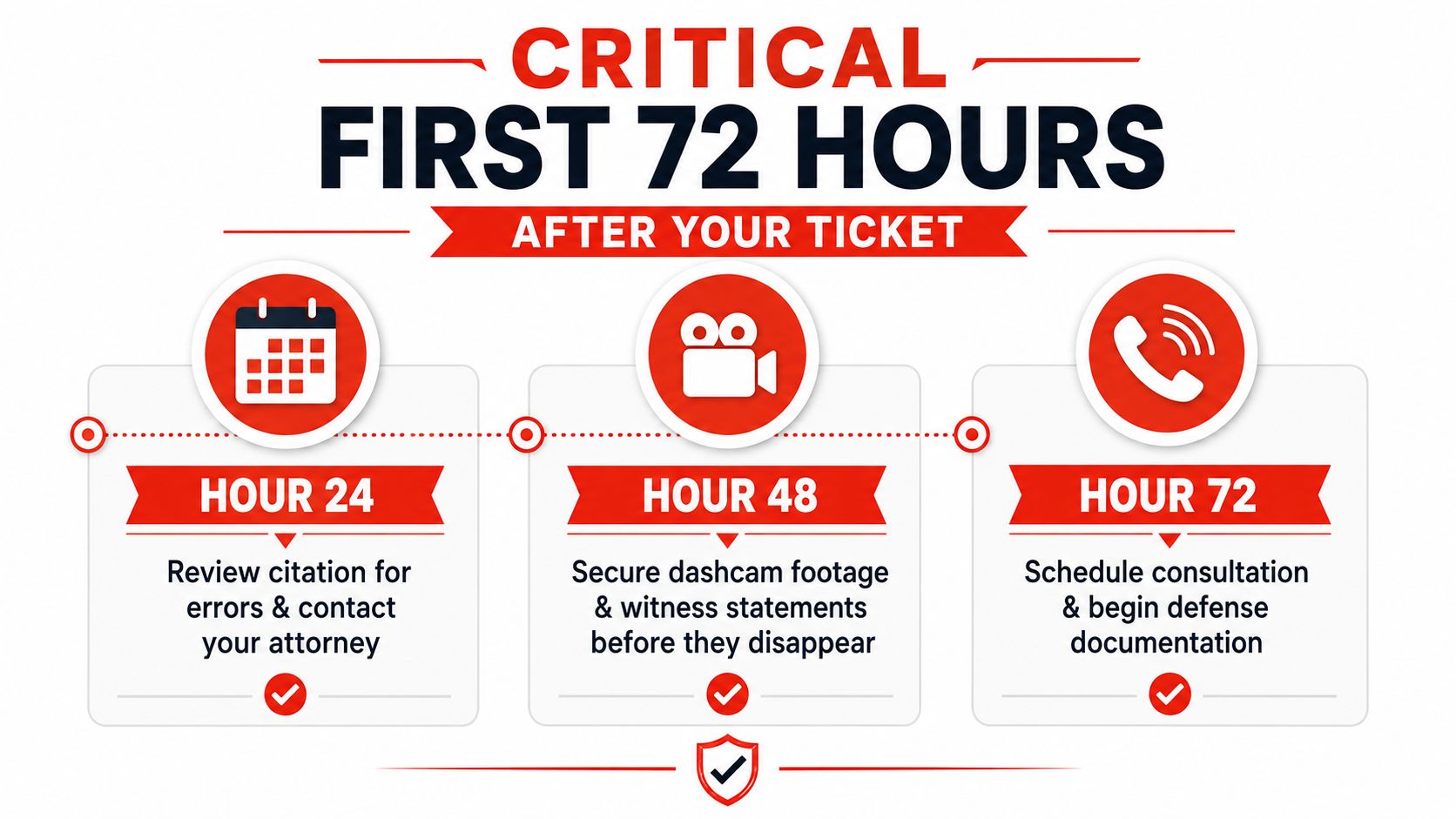
Critical First 72 Hours After Your Ticket
The first three days decide more than people want to admit. Dashcam files get overwritten. Witnesses forget details. Photos vanish from your phone roll. If you wait, you're not “taking your time,” you're losing evidence.
Save the proof before it disappears
Start with the scene. Photograph the intersection, lane markings, signs, traffic signals, weather, and anything else that may help show what the officer could or could not see. If the case involved a camera or an officer's observation, those details can become the backbone of your defense.
Then save your dashcam footage immediately. If anyone was in the car with you, write down their name and contact information while the event is still fresh. If you made a delivery, were driving for work, or were on a job route, document that too, because the practical impact may matter later.
Focus on what can actually be challenged
Some citations are stronger on paper than others. Camera-based red-light cases can turn on calibration and footage review, while stop-and-observation cases can turn on what the officer really saw from the road position they chose. That's why preservation is not optional.
The traffic-defense guidance on early evidence retention is right about one thing, scene evidence gathered immediately can matter more than any argument made weeks later. You should keep photos, vehicle records, dashcam footage, and witness information before anyone else controls the narrative. For practical post-stop preservation ideas, this defense checklist is consistent with what matters most in the field.
Move before the court file hardens
Do not wait to “see what happens.” By the time the citation feels serious, the evidence may already be gone. That is why the first call should be to a defense lawyer who understands traffic procedure, not to an app that only sends reminders.
Do this immediately: save the images, export the video, write the names, and stop posting about the stop on social media. Loose talk can create problems you never needed.
County-Specific Defense Strategies in Florida
Florida traffic court does not run on one script. The same citation can draw a different response depending on the county, the judge, and the way that courthouse handles filings and hearings. A statewide approach leaves too much to chance.
The numbers tell the story
A statewide review of 403,226 Florida traffic offense cases across 66 counties from 2023 to 2025 found a 45.4% guilty rate, a 4.1% dismissal rate, and 34.7% of cases with adjudication withheld. Convicted defendants received an average sentence of 2.9 months and an average fine of $300. Those figures show how much depends on how the case is handled, not just what the citation says. The statewide court review makes the venue issue impossible to ignore.
County results also move in different directions. In 2024 Miami-Dade traffic courts, 55% of non-criminal moving-violation cases were dismissed, while Broward saw 31% dismissed and Palm Beach only 18% dismissed. That gap is not trivia. The same stop can lead to very different practical results depending on where it is filed.
Florida County Traffic Court Dismissal Rates 2024 | Dismissal Rate | Key Courthouse |
|---|---|---|
Miami-Dade | 55% | Richard E. Gerstein Justice Building |
Broward | 31% | Broward County Judicial Complex |
Palm Beach | 18% | Main Judicial Center |
Hillsborough | Not provided in verified data | Edgecomb Courthouse |
Orange | Not provided in verified data | Orange County Courthouse |
Duval | Not provided in verified data | Duval County Courthouse |
Local familiarity matters because each courthouse handles continuances, dismissals, and withheld adjudication differently. A lawyer who knows those habits gives you a tactical edge, not a talking point.
Venue strategy is the point
If your case is in Miami-Dade, Broward, Palm Beach, Hillsborough, Orange, or Duval, the courthouse itself belongs in the defense plan. You want counsel that knows the room, the procedure, and the pressure points that matter. Generic advice does little in a courtroom that rewards precision.
For a broader view of how traffic counsel should handle these cases, this overview of traffic ticket lawyers explains the kind of venue-focused work that makes a difference.
How Ticket Shield Protects Your Livelihood
A ticket can cost you a lot more than a day in court if you drive for a living. Gig workers, CDL drivers, and professionals are not just worried about fines. They're worried about being shut out of work.
Your job can be the real casualty
A single violation can trigger Uber, Lyft, or DoorDash account problems, threaten commercial-driver status, or fail an employer background check. That is why the question is never just “Can I fight it?” The question is, “Can I keep working?”
Traffic-defense content often stops at the citation. That's not enough for someone whose income depends on being behind the wheel. A better strategy starts with job-impact analysis, then builds the defense around preserving eligibility and reducing record damage. For the broader traffic-defense services view, this overview of traffic ticket lawyers fits the point.
Work-focused defense requires a different lens
Ticket Shield, PLLC handles the case with the goal of protecting the driver's ability to stay active, licensed, and employed. That means pushing for dismissals, withheld adjudication, and outcomes that avoid the kind of record problem that follows you into screening and renewals. If your livelihood depends on driving, that's the standard that matters.

If you're also managing driver documentation for licensing or renewal, keep your vision paperwork straight too. The resource on Florida license renewal vision test is useful if your broader concern is staying compliant and avoiding preventable delays.
The value here is simple. You don't want a ticket that turns into a lost gig account, a CDL headache, or a background-check issue. You want a defense that protects the work, not just the docket.
Your Path to No Points and Case Dismissal
If you want the cleanest possible outcome, act like the case matters now, because it does. The right move is to get the file reviewed fast, keep the evidence intact, and let an attorney push the case toward dismissal or a no-points result where possible.
What a serious defense looks like
A direct attorney model is the right fit for this kind of case. You want the person handling your matter to know the courthouse, the procedure, and the pressure points, not to route you through a call center. You also want transparent pricing and a process that doesn't waste your time.
For many Florida drivers, a practical resource like traffic-ticket dismissal guidance helps frame what success should look like. Ticket Shield, PLLC offers that kind of defense with 25+ years of experience, former prosecutors in the mix, and a process designed to keep clients out of court in most cases. The firm says over 99% of clients never appear in court, which is exactly the kind of convenience people need when work and family are already pulling hard.
Choose the result that protects your future
You do not need a lecture. You need a plan. The plan should protect your record, reduce the odds of points, and keep your life from getting tangled up in one citation.
If the violation affects your license, your insurance, or your livelihood, handle it like it matters. Speak with a lawyer who does traffic defense all day, not a platform that hands you generic steps and hopes for the best.
Visit Ticket Shield, PLLC now for a free consultation, and fight for No Points on your license before the ticket turns into a record problem.
