
Fine for Driving With an Expired License in FL?
Worried about the fine for driving with an expired license in Florida? Learn the penalties, how it affects your record, and how a real lawyer can protect you.
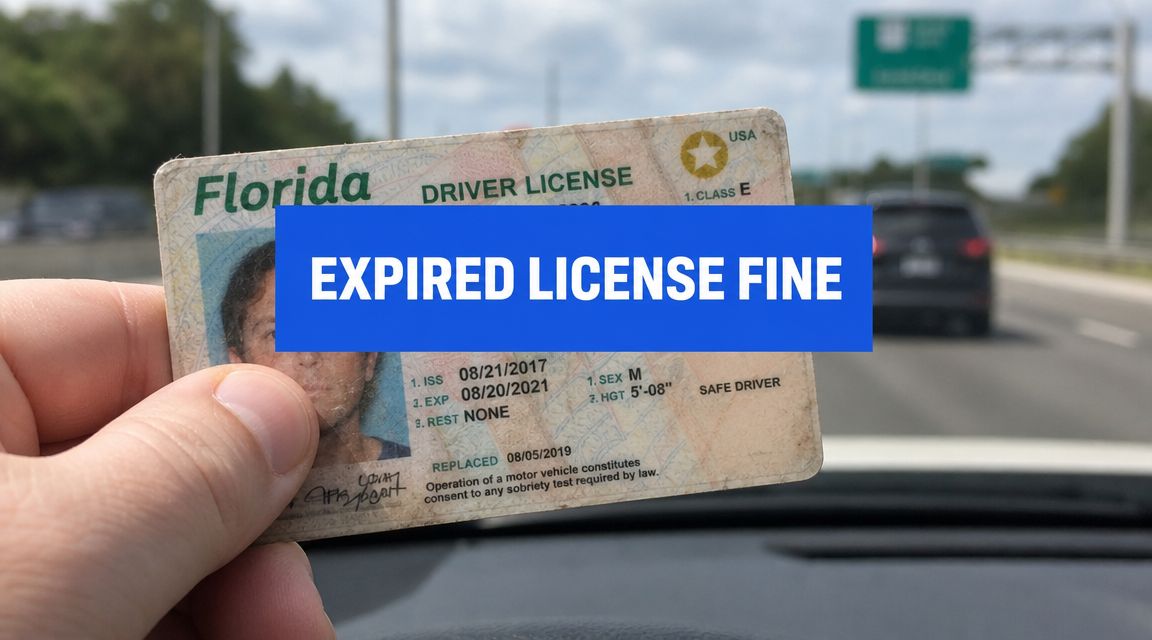
If your Florida license expired less than 6 months ago, it's usually a non-criminal ticket. If it expired more than 6 months ago, you could face a misdemeanor, up to a $500 fine, and up to 60 days in jail. Timing matters immediately.
You're probably reading this after a traffic stop, with a citation in your hand, wondering whether this is just a fine for driving with an expired license or something that can follow you much longer.
The short answer is simple. In Florida, the date matters more than most drivers realize. A short lapse is often handled like a traffic citation. A longer lapse can turn into a criminal case. That's not a technicality. It changes how you should respond, what court risk you face, and how aggressively you need to protect your record.
Florida traffic law isn't forgiving when you ignore small paperwork problems. Chapter 316 governs much of Florida traffic enforcement, and once a stop starts under a traffic code issue, officers often uncover other problems quickly. If you're holding this ticket now, your job is not to guess. Your job is to avoid points, avoid a record problem, and avoid paying more than you need to.
Table of Contents
You've Been Pulled Over What Happens Now
The stop is over. The officer handed you a ticket. Now you're replaying the conversation and looking at your license date.
Don't treat this like a harmless clerical mistake. In Florida, an expired license case can stay small or get much worse depending on how long the license has been expired and how you handle the citation in the next few days.
Your first priority is control. Not panic. Not guessing. Control.
Immediate Steps to Take
Check the expiration date today: The exact gap between expiration and the traffic stop is one of the first things that will shape your risk.
Do not just pay online without thinking: Paying can close off defense options and lock in consequences you may have avoided.
Gather your documents: Keep the ticket, your current license status, any renewal paperwork, and any receipt or temporary proof together.
Review a practical post-ticket checklist: Start with this guide on what to do when you get a ticket.
Get legal advice before your court deadline: The wrong move is often made early, when drivers assume this is routine.
Urgent rule: If you don't know whether your license was expired more or less than 6 months, you don't yet know how serious your case is.
Many drivers get burned by automated apps and volume-based ticket services. They push you through a form. They give generic updates. They treat your case like data entry.
You need a lawyer to look at the stop, the timing, the charging language, and the court handling your file. If your case is headed into a courthouse like the Orange County Courthouse or the Richard E. Gerstein Justice Building, local handling matters. So does speed.
Is an Expired License a Crime in Florida
Florida draws a hard line based on one fact. How long your license has been expired.
Under Florida Statute 322.065, driving with a license expired for 6 months or less is a non-criminal infraction. However, if the expiration exceeds 6 months, the offense is reclassified and can be charged as a second-degree misdemeanor.
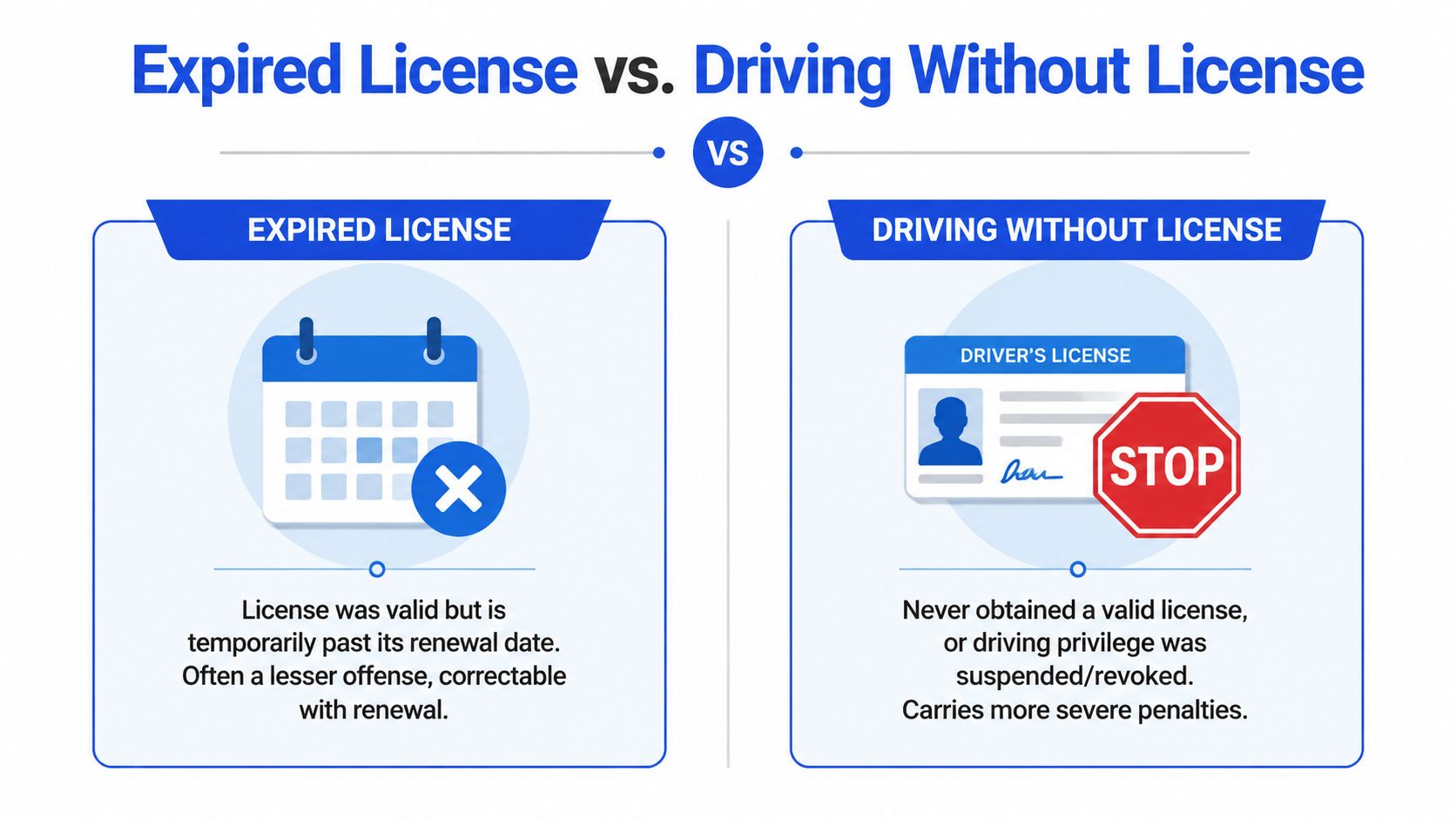
Why the date on your license controls the case
This is the turning point that matters more than the officer's tone, more than what happened during the stop, and more than what you hoped the ticket meant.
If your license expired 6 months ago or less, Florida treats it as a non-criminal traffic matter. Once it passes 6 months, the exposure can move into misdemeanor territory.
That's why I tell drivers to stop asking only, “What's the fine for driving with an expired license?” The better question is, “How is my case classified today?”
A non-criminal infraction is still a problem. A misdemeanor is a different category of problem entirely. It can affect court strategy, background concerns, and the pressure you face to resolve the case quickly.
Why this distinction changes your defense
The defense approach for a short expiration and a long expiration isn't the same. It shouldn't be handled the same way either.
If your case involves a recent expiration, the goal is usually damage control and a clean outcome if possible. If your case crossed the 6-month mark, the goal becomes broader. You need to protect your record and limit criminal exposure.
For a broader look at how Florida treats license-validity issues, read what qualifies as no valid driver's license in Florida.
Here's the practical point. Drivers often look at the card in their wallet and think expired means expired. Florida law does not see it that way. Florida separates temporary lapse from something more serious, and your legal response has to match that distinction.
What Are the Actual Fines and Penalties
You want the exact number. Fair enough.
For a shorter lapse in Florida, reported penalties can reach up to $250. For a license expired over 6 months, noncommercial driving without a valid license can be treated as a misdemeanor punishable by up to 60 days in jail and a $500 fine, plus court costs, according to Florida traffic defense guidance on expired license penalties.
What you may pay for a shorter lapse
If your license expired recently, many drivers assume they'll just pay a modest citation and move on. That's too simplistic.
The posted fine is only part of the problem. Court costs and administrative charges can push the total higher than drivers expect. If your goal is to protect your finances, you need to know the full exposure, not just the line item on the ticket.
A quick starting point is understanding how much court cost for a traffic ticket can affect the total amount due.
What happens after the 6 month mark
Once the case moves past the 6-month threshold, the risk changes from payment to prosecution. That's the part many people miss.
You're no longer dealing only with a traffic-style headache. You may be dealing with a misdemeanor case that can require a more deliberate court response, especially if there are other issues tied to the stop.
Here's a short breakdown:
License status at stop | Likely treatment in Florida | Main risk |
|---|---|---|
Expired 6 months or less | Non-criminal infraction | Fine, costs, record concerns |
Expired more than 6 months | Can be charged as misdemeanor | Criminal court exposure, higher financial risk |
A short explanation from a Florida attorney may help if you want to hear how these cases are usually framed in practice:
Bottom line: The fine for driving with an expired license in Florida can start as a ticket-level problem and become a criminal-level problem based on time alone.
How Does This Impact Your Record and Insurance
The ticket amount gets your attention first. It shouldn't be your only concern.
The bigger issue is what this case can do to your driving record, your insurance situation, and your ability to keep moving without interruption. Florida isn't one of the states that treats this as an issue you can casually shrug off. A national comparison notes that Florida can impose up to a $500 fine and 60 days in jail for an expired license, which is why state-specific handling matters so much, as described in this state-by-state penalty review.
Why the fine is rarely the real problem
A ticket can be paid once. A record problem can keep costing you.
If you drive for work, any mark tied to license validity can create immediate stress with employers, delivery platforms, or background reviews. Even when the case looks minor at first, the wrong resolution can create consequences that last far longer than the original stop.
Insurance concerns often surface at the worst possible time. If you're already dealing with a crash, you should also understand what to do after a car accident so you don't make a second expensive mistake while trying to solve the first one.
Why drivers with income on the line need a strategy
Gig workers, commuters, and professionals with tight schedules can't afford a casual approach to this kind of ticket. A rideshare or delivery driver doesn't just risk a court payment. That driver risks lost work and account trouble while the case is unresolved.
If part of your goal is keeping the case from affecting your premiums more than necessary, review practical guidance on lower insurance rates after a traffic ticket.
A fast payment can feel efficient. It can also become the most expensive decision in the case if it hurts your record.
What Are Your Strategic Options Now
You have three realistic paths. They are not equal.
If your case is set near the Edgecomb Courthouse in Tampa or another busy Florida traffic court, the choice you make now shapes everything that follows. Convenience should not be your decision standard. Risk should be.
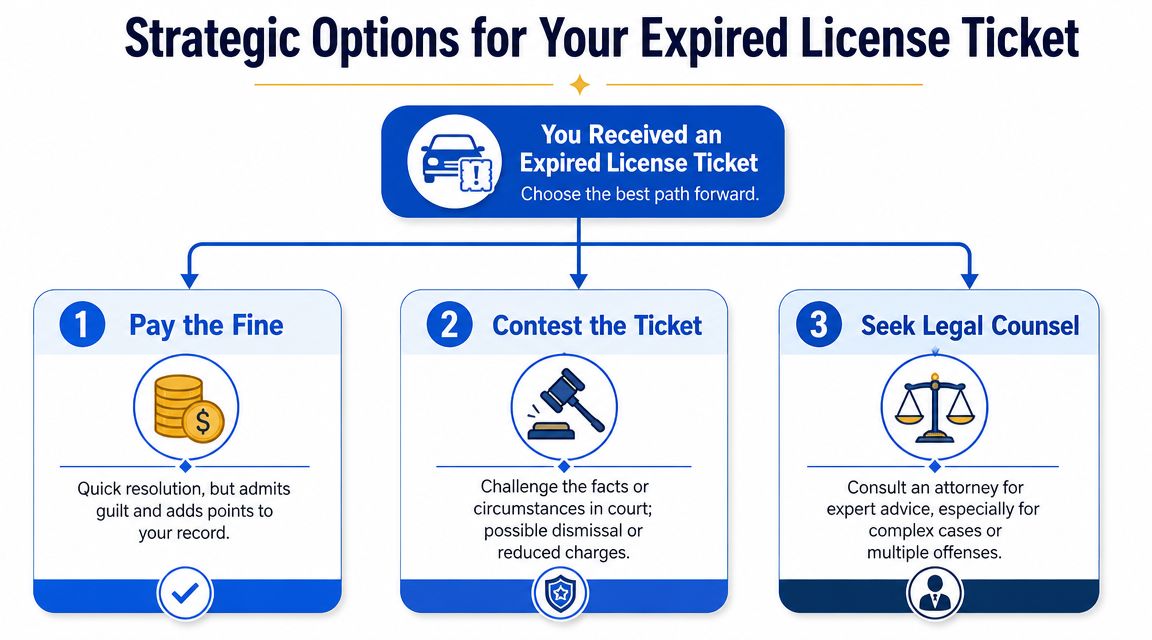
Option one paying it
This is what the court system prefers you'll do. It's fast. It's simple. It closes the file.
It also removes an advantage. You may be accepting consequences without testing whether the charge classification, paperwork, timing, or disposition could have been handled better. If your record matters, this is often the weakest option.
Option two handling court yourself
Some drivers think they can show up, explain that they renewed, and ask the judge for a break. Sometimes that works out. Sometimes it doesn't.
Court is not just about whether you seem responsible. It's about how the charge is written, how the prosecutor views the case, whether your documents fix the problem cleanly, and whether there is room for reduction or dismissal. Self-representation can work against you when you don't know what arguments matter and which ones don't.
Option three hiring counsel early
This is the strategic path when you want to protect your license and finances instead of hoping for mercy.
A lawyer can evaluate whether the expiration period was charged correctly, whether fast renewal helps the negotiation posture, and whether your case should be positioned for a no-points outcome. That's especially important if the stop involved anything beyond the license issue itself.
Here's a practical comparison:
Pay the ticket: Fast resolution, but little control over the outcome.
Appear on your own: More control than paying, but you carry the legal burden.
Hire counsel: You get case analysis, court strategy, and advocacy built around your record.
One Florida option is Ticket Shield, PLLC, a lawyer-led traffic defense firm that handles these cases statewide and allows clients to communicate directly with their attorney by phone or text.
Practical advice: If there is any chance your expiration crossed the 6-month line, treat the case like it needs legal review immediately.
Why a Real Lawyer Beats an Automated App
An automated app is built for volume. Your case is not.
That matters most when the issue looks simple on the surface but has legal traps underneath it. Expired-license cases are exactly that kind of case. A recent lapse may be a ticket problem. A longer lapse may create criminal exposure. A form-driven service won't always spot the difference early enough to protect you properly.
A form can't spot courtroom risk
This is why lawyer review matters. In some jurisdictions outside Florida, expired-license cases can trigger severe penalties. For example, Nevada treats driving on an expired license as driving without a valid license, which can be a misdemeanor punishable by up to 6 months in jail and/or up to $1,000 in fines, according to this Nevada expired-license discussion. The point isn't Nevada. The point is that automated systems often miss how quickly a “simple” license issue can become a serious legal one.
Florida has its own pressure points. Prosecutors, calendars, courthouse practices, and local expectations matter. If your file lands in a courtroom at the Broward County Judicial Complex, the strategy should fit that reality, not a generic workflow built for every ticket in every county.
Direct access to your attorney matters
You should be able to ask direct questions and get direct answers from a lawyer, not from a chatbot, a call center, or a case manager reading notes on a screen.
That's the difference between legal defense and ticket processing. A real attorney can tell you whether the charging language is a problem, whether your renewal timing helps, whether your appearance may be waived, and whether the case should be pushed or resolved.
If you're weighing that choice, read why choosing a local lawyer over apps matters in Florida traffic cases.
Automated services manage tickets. Lawyers defend people.
Frequently Asked Questions About Expired License Tickets
If I renew my license does the ticket disappear
No. Renewal helps. It does not automatically erase the citation.
It may improve how the case is presented and resolved, especially if the expiration was recent. But you still need to address the ticket itself. Ignoring the citation because you renewed is a mistake.
Can this show up on a background check
If the case stays in non-criminal infraction territory, the concern is different than if it crosses into misdemeanor territory. Once a case is charged criminally, background implications become much more serious.
That's why the timing of the expiration matters so much. The legal category of the case can matter more than the original reason for the stop.
Should I just pay and move on
Usually, no. Not until you understand exactly what you're admitting and what result you're locking in.
Paying may be the easiest step today. It may also be the step that costs you the most later if your record, insurance, or work depends on a cleaner outcome.
What should I do first
Start with the documents. Confirm the expiration date. Confirm whether you've renewed. Confirm your court deadline. Then get legal advice before making a plea decision.
Is the goal just to reduce the fine
No. The smarter goal is broader. You want to protect your record, limit financial fallout, and pursue a no points result whenever the facts and court posture allow it.
If you just got cited for an expired license in Florida, don't hand your case to a chatbot or a middleman. Get real legal advice from a lawyer who can assess the 6-month issue, protect your record, and fight for the No Points outcome. Visit TicketShield.com for a free consultation.
