Driving a unregistered vehicle: Driving Unregistered Vehicle
Caught driving a unregistered vehicle in Florida? Understand FL penalties & defense options. Our attorneys protect your record. Free consult now.

TL;DR: Driving an unregistered vehicle in Florida can trigger more than a ticket. You may face impoundment, a criminal charge if the lapse is severe, and long-term insurance trouble. Don’t pay it. Move fast and defend it strategically.
You saw the lights. Then you looked at your tag and felt your stomach drop.
That reaction is normal. So is the mistake drivers make next. They treat this like a paperwork ticket and pay it to get it over with.
That’s the wrong move.
In Florida, a registration case can start as an administrative problem and turn into a record problem, a towing problem, and in some situations a criminal problem. If the stop also led to questions about your license, insurance, or prior history, the risk goes up fast.
Florida traffic enforcement also sits inside a broader legal framework under Chapter 316, which governs traffic control and roadway enforcement. Your registration charge may be tied to a stop conducted under those roadway enforcement rules, even though the registration requirement itself comes from Florida Statute 320.02. That distinction matters because a smart defense looks at both the registration allegation and the legality of the stop.
Table of Contents
What Are the Full Consequences of an Unregistered Vehicle Ticket
You Were Pulled Over What Happens Now
You’re on a Florida road. Maybe headed home. Maybe headed to a delivery. Maybe trying to make it to work on time. Then an officer gets behind you, the lights come on, and the stop turns into a citation for driving an unregistered vehicle.
Your first instinct is usually to minimize it. Don’t.

This is common, but common doesn’t mean harmless. Nearly 17 million vehicles on U.S. roads started 2025 with expired registration tags, and the average lag was about four months, according to CARFAX data reported in June 2025.
Why this stop matters immediately
A registration stop often opens the door to more scrutiny. The officer may check your license, insurance, address, prior history, and the vehicle record. What looked like one citation can turn into several issues in a matter of minutes.
That matters because the moment you’re cited, every decision afterward counts. What you say. What you fix. What you pay. What you admit.
Practical rule: Paying the citation may feel efficient, but it can also lock you into the state’s version of events.
What drivers usually get wrong
Some drivers apologize and start explaining. Some argue roadside. Some rush to pay the fine online the same night. Some renew the registration first and assume that ends the case.
None of those steps is a legal strategy.
If you’re in this position now, slow down and protect the record first. Read the citation carefully. Check the exact offense listed. Confirm the date, time, tag information, and officer notes. Then review a practical guide on what to do when you get a ticket before you make the next move.
What your goal should be
Your goal isn’t just “fix the tag.” Your goal is broader.
Protect your license: Don’t let a small issue grow into a bigger one.
Protect your insurance: Convictions can outlast the roadside stop.
Protect your time: Court, towing, and paperwork cost more than most drivers expect.
Protect your record: That matters for employment, professional licensing, and security-sensitive work.
If you’ve been cited for driving an unregistered vehicle, treat it like a legal problem now. That’s how you keep it from becoming a much more expensive one later.
What Is the Legal Definition of This Offense in Florida
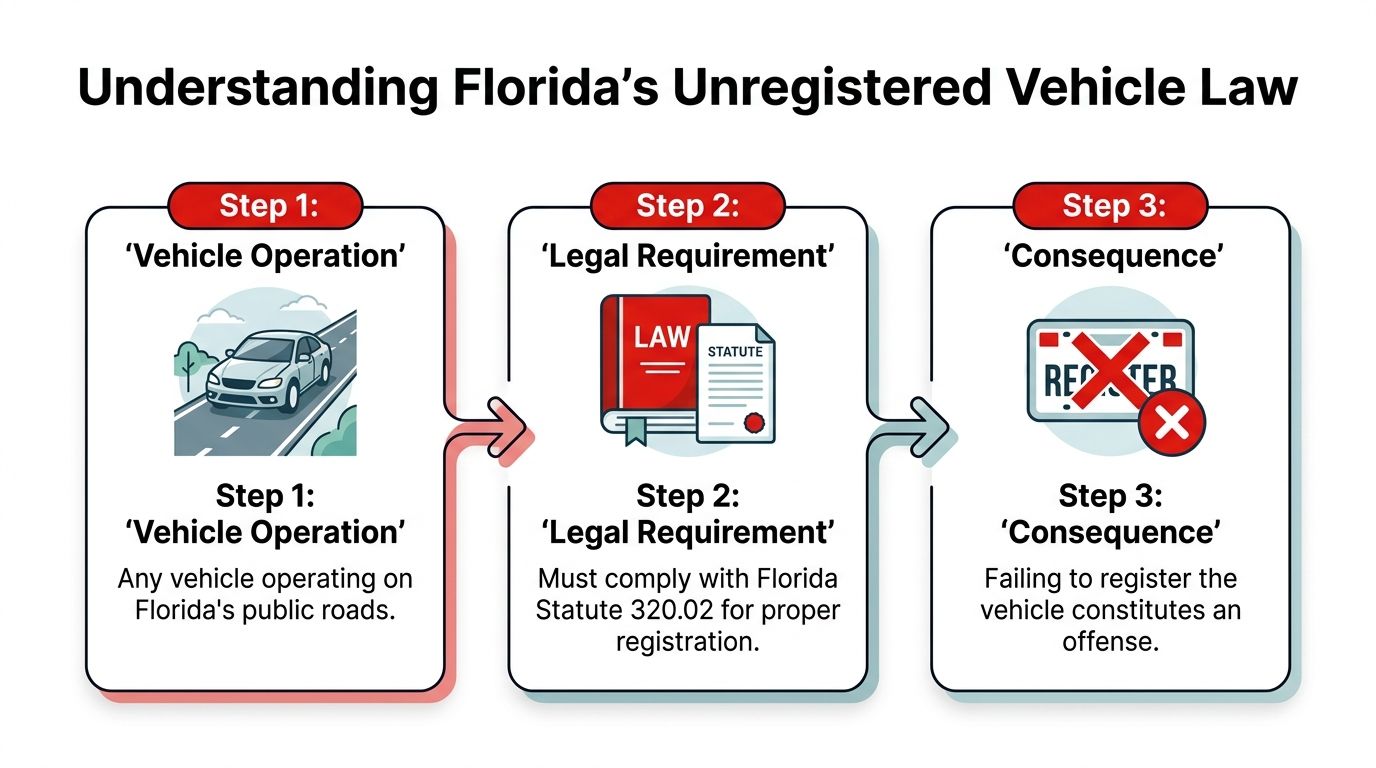
The starting point is simple. If you drive on Florida’s public roads, the vehicle must be properly registered.
Under Florida Statute 320.02, the state says that operating a motor vehicle on public roads without proper registration is an offense. Florida roadway enforcement still happens in the broader world of Chapter 316, because that chapter governs traffic stops, roadway regulation, and officer authority during routine traffic enforcement.
What law controls the charge
For this specific offense, Florida Statute 320.02 is the statute you need to know. The state doesn’t have to prove you were dangerous. It doesn’t have to prove you caused a crash. It focuses on whether the vehicle was being operated on a public road without valid registration compliance.
That sounds narrow, but don’t underestimate it. Narrow charges can still create a serious disadvantage for you if you respond carelessly.
If your citation or criminal paperwork mentions a registration-related offense, review a focused explanation of a Florida no registration criminal citation.
When does it become more serious
Drivers often get blindsided at this point.
A lot of people think expired registration always stays in ticket territory. It doesn’t. Allowing a vehicle registration to expire beyond six months in Florida can potentially result in criminal charges, escalating the offense from a simple traffic infraction to a misdemeanor, as explained in this discussion of whether driving an unregistered vehicle is a crime in Florida.
At the Edgecomb Courthouse in Tampa, prosecutors and judges don’t care whether you thought it was “just tags.” They care about the age of the lapse, your history, the paperwork, and whether the state can frame this as repeat noncompliance.
What the state still has to prove
A citation is not self-proving. The state still has work to do.
A lawyer reviews whether:
Issue | Why it matters |
|---|---|
Public roadway operation | The state must tie the vehicle use to a place covered by the law. |
Actual registration status | Database errors, clerical mistakes, and timing issues happen. |
Identity of the driver | Ownership and operation are not always the same thing. |
Charge level | If the state is pushing the case upward, the timeline and prior history matter. |
Where the weaknesses usually are
Registration cases are often built on assumptions. Officers rely on records. Records rely on updates. Updates can lag. A recent renewal, sale, address change, transfer issue, or administrative mismatch can change how the case should be charged or resolved.
A stop for driving an unregistered vehicle may look simple on paper, but simple cases are often where procedural mistakes hide.
Civil problem versus criminal exposure
You need to know which lane your case is in.
Traffic infraction territory: The state treats it like a standard ticket.
Criminal territory: The state alleges facts that push it into misdemeanor treatment.
Mixed-risk cases: The citation itself looks minor, but your history or timing creates exposure.
That distinction changes everything. It affects what you should say, what you should fix, whether you should appear, and how aggressively the defense should push early.
If your case is anywhere near the six-month line, stop handling it like a routine DMV problem. It’s not.
What Are the Full Consequences of an Unregistered Vehicle Ticket
The number printed on the ticket is rarely the actual price.
The true cost usually shows up after the stop, when you’re stranded, paying to retrieve the car, dealing with paperwork, and trying to keep the issue from bleeding into your insurance and record.
Why the ticket amount is not the primary problem
A registration citation hits drivers in layers. The first layer is the fine. The second layer is what happens around it. Lost time from work. Missed deliveries. Court logistics. Registration reinstatement. Insurance headaches.
If your response is sloppy, those layers pile up fast.
At the Broward County Judicial Complex, drivers often learn this the hard way. They walk in thinking they’re there over a tag issue. They walk out realizing the true fight was about avoiding collateral damage.
How an impound turns a bad day into a real expense
The most painful consequence is often the tow.
In Florida, vehicle impoundment is probable for registrations expired over 30 days, and release can require full registration, proof of insurance, towing costs of $150 to $500+, storage at about $50 per day, plus administrative fees, with totals often over $1,000 for a short hold, based on this discussion of driving an unregistered vehicle and impound consequences.
That means the stop can immediately create a transportation problem and a cash problem.
If your vehicle has already been taken, this plain-english guide on when a car is impounded by police is a useful overview of the practical fallout drivers deal with after a tow.
Why this can follow you after court
A lot of drivers focus only on getting the car back or renewing the tag. That’s too narrow.
An unresolved or mishandled registration case can affect:
Insurance underwriting: Carriers may view a conviction as part of a broader compliance pattern.
Work status: Delivery and rideshare drivers may face account issues.
Professional records: Some employers don’t care why the citation happened. They care that it appears.
Future stops: A prior registration history can shape how the next stop unfolds.
You should also understand the broader penalty picture before making decisions. This overview of the penalty for expired registration is worth reading before you pay anything.
What people regret most
It usually isn’t fighting the case. It’s failing to fight it soon enough.
Drivers regret:
Paying before checking defenses
Letting storage fees run while they wait
Assuming renewal automatically fixes court
Ignoring the citation deadline
Treating the case like a DMV errand
Hard truth: The state’s process is built for efficiency, not for protecting you from avoidable damage.
If you’re dealing with driving an unregistered vehicle, your job is to stop the consequences from multiplying. That requires speed and a plan. Not wishful thinking.
What Are Your Immediate Steps After Being Cited
You don’t need panic. You need order.
The first hours after the citation are when drivers either preserve their defenses or accidentally weaken them.

What to do in the first 24 hours
Start with the paperwork. Not your memory.
Read the citation line by line. Confirm the exact charge, the date, the location, the officer’s name, and any notes about expiration or registration status. A small error can matter later.
Then gather every document connected to the vehicle. Registration receipt. Renewal notice. Insurance card. Title or purchase paperwork if the car was recently acquired. Any screen confirmation from a DMV transaction. If you moved recently, pull address-change documents too.
Use this time to learn how to interpret the paper in your hand. This guide on how to read a traffic citation helps drivers catch details they’d otherwise miss.
Immediate steps to take
Photograph the citation: Save clear images of both sides.
Save vehicle documents: Put digital copies in one folder.
Write a timeline: Note when you renewed, moved, purchased, or changed insurance.
Check your tag and sticker: Photograph what was on the vehicle that day.
Track deadlines: Court and payment dates matter even if you plan to contest.
What not to do
Don’t write a roadside essay in the margin of the ticket. Don’t email random explanations to the court. Don’t assume an online payment is harmless.
Most important, don’t make admissions you can’t take back. “I knew it was expired.” “I forgot for months.” “I was just trying to risk it one more week.” Those statements don’t help you.
Keep your explanations private until a lawyer reviews the facts and the paperwork.
What documents help your defense
Different cases turn on different records. The strongest file usually includes more than the registration itself.
Look for:
Document | Why it can matter |
|---|---|
Renewal proof | Shows prompt compliance or timing issues |
Proof of purchase | Helps if the vehicle was recently acquired |
Insurance proof | Important for release and broader compliance questions |
Address change records | Useful if notices went to the wrong location |
Screenshots of online transactions | Helps when processing timing is disputed |
A short video can also help you understand how citation handling works before you make a costly mistake.
If you’re serious about protecting the outcome, treat the first day like evidence preservation. That’s what it is.
What Are Your Strongest Legal Defenses
A ticket is an accusation. It is not the finish line.
The right defense depends on the stop, the record, the timing, and what the state can prove. The strongest cases often come from details automated services ignore.
Can the stop itself be challenged
Start with the stop.
If the officer claimed the tag was expired, what exactly did the officer observe? Was there a valid basis for the traffic stop? Was the information current? Was the plate or sticker read correctly? Was there any confusion involving the vehicle, plate transfer, or database update?
A traffic court file may look clean from a distance and still have weak points. If the stop was shaky, the case may be shakier than the citation suggests.
At the Richard E. Gerstein Justice Building in Miami, these details matter because prosecutors respond differently when the defense can point to an actual evidentiary problem instead of a generic plea for mercy.
Can fast compliance help resolve the case
Sometimes the smartest move is controlled compliance.
If you corrected the registration quickly after the stop, that can support a resolution argument. Not every court handles that the same way, and not every prosecutor gives it the same weight. But proof that you fixed the issue promptly can change negotiations.
That only works if it’s framed correctly.
A rushed payment without strategy can hurt.
A documented correction presented properly can help.
Timing, paperwork, and the exact charge level all matter.
Why crash risk arguments often fail
This is a point many drivers never hear.
Drivers of unregistered cars crash more frequently not because of the registration status, but because they’re more likely to have suspended licenses and prior violations. Prosecutors cannot credibly argue crash risk based solely on expired tags, according to this analysis on the crash risk of an unregistered vehicle.
That distinction is powerful.
If your record is otherwise clean, the state should not be allowed to smuggle in a public-safety narrative that the actual charge does not support. Registration status is an administrative issue. It is not automatic proof that you were driving dangerously.
The defense should separate the paperwork lapse from any unsupported claim that you’re a threat on the road.
Other defense angles lawyers look for
A strategic defense can also examine:
Clerical mismatch: The record may not reflect the precise status on the date of stop.
Recent purchase or transfer issues: Ownership paperwork can complicate what the state assumes.
Notice and timing problems: Administrative delay can matter.
Charge selection: The offense level may be overstated.
Driver versus owner issues: The person cited and the person responsible are not always the same.
What an effective defense sounds like
An effective defense isn’t “my client is sorry.” It’s sharper than that.
It sounds like this: the stop needs scrutiny, the records need verification, the charge level must match the facts, the correction happened promptly, and the state cannot inflate an administrative lapse into a false danger narrative.
That is how you fight driving an unregistered vehicle intelligently. Not emotionally. Not passively. Precisely.
Why Choose a Lawyer Instead of an Automated App
Many drivers make their second mistake at this stage.
The first mistake was letting the registration lapse. The second is handing the case to an app, a chatbot, or a volume-based ticket mill that treats your file like a transaction.

Why direct attorney access matters
When your case involves record protection, possible criminal escalation, or a tow-related mess, you need a lawyer who can evaluate facts and make judgment calls.
That means direct communication. Phone or text with your attorney. Real answers. Real strategy. No middleman rewriting your problem into canned intake notes.
At the Orange County Courthouse, no app walks into court and reads the room. No software negotiates nuance. No chatbot argues why your fast correction matters more than the state’s paperwork assumptions.
If you want a side-by-side explanation, review why choosing a local lawyer over apps changes the quality of the defense.
What apps and ticket mills miss
Automated systems are built for uniformity. Registration cases are not uniform.
Drivers of unregistered vehicles are often assumed to be high-risk, but this is a correlation, not causation. A skilled attorney can argue this nuance, pointing out that many such drivers have clean records, a defense that automated systems are not equipped to handle, as discussed in this piece on the crash risk of an unregistered vehicle.
That’s the whole point. The defense often lives in the nuance.
Was the stop valid?
Was the database current?
Did you renew immediately?
Is the state overcharging the facts?
Does your clean history undercut the state’s narrative?
A lawyer-led service like Ticket Shield, PLLC handles Florida registration and proof-of-insurance cases with direct attorney communication by phone or text. That matters when the details decide the outcome.
You do not need software that processes tickets. You need a lawyer who can make arguments.
Frequently Asked Questions for Florida Drivers
Can I just renew the registration and make this go away
No. Renewing may help. It does not automatically erase the citation.
You still have a court or citation problem unless the case is formally resolved. Fix the registration, but don’t assume the legal issue disappears on its own.
Will this hurt a gig driver
It can.
If you drive for deliveries or rideshare, a citation can create business problems even before court ends. Platform policies can be less forgiving than traffic court. If your car was towed, you also lose immediate earning ability.
Handle the legal side and the record side together. Don’t focus only on getting back on the road for one day.
What if I am military or need a clean record
Then you should treat this seriously from the start.
Military members, contractors, and people in clearance-sensitive work often care less about the fine and more about the record, appearance, and any criminal escalation. A registration case that looks minor to someone else may carry professional consequences for you.
Do I have to go to court
Not always.
Many Florida traffic matters can be handled without the driver appearing, depending on the charge, county, and posture of the case. But don’t assume. A criminally charged case or a specially set hearing may require closer handling.
That’s another reason not to rely on generic online advice. The answer depends on your paperwork, your county, and the exact level of the charge.
What if my record is otherwise clean
That helps. It does not mean you should handle it casually.
A clean record strengthens a defense that this was an administrative lapse, not a dangerous-driving case. It can also support a better resolution posture. But you still need to preserve that clean record by responding correctly.
Is driving an unregistered vehicle the same as driving without a license
No. They are different offenses.
That said, officers often examine both during the same stop. If your registration issue exposed another issue with your license or insurance, the case needs tighter handling and faster legal review.
What is the biggest mistake Florida drivers make after this ticket
Paying first and asking questions later.
That feels efficient. It often isn’t. Once you admit the case through payment, many of the smarter defense options narrow or disappear.
What should I bring to a lawyer right away
Bring everything.
That includes the ticket, registration paperwork, proof of renewal if you completed it, proof of insurance, purchase or transfer documents, impound paperwork if the car was towed, and any notes about what the officer said during the stop.
The more complete the file, the more precise the defense.
If you want to protect your record, avoid points, and get a lawyer-led strategy instead of a chatbot script, go to TicketShield.com for a free consultation. Your goal is No Points. Start there.