Criminal Defense Lawyer Tampa FL: Protect Your Future
Arrested? A criminal defense lawyer Tampa FL protects your rights & record. Get expert legal help now for court processes & choosing an attorney.
If you were just arrested in Tampa, get a defense lawyer now. The first hours matter. In DUI cases, you may have only 10 days to protect your license. Fast action can protect your record, your job, and your ability to drive.
You're probably reading this with your phone in your hand, trying to figure out what happens next. You may have just bonded out. You may still be replaying the stop, the questions, the ride to jail, or the paperwork they handed you. Right now, you need clarity, not theory.
A criminal charge in Tampa can move fast. So can the damage if you wait. Your license, your court dates, your job, your insurance, and your record can all be affected before you feel like you've caught your breath. If your case involves driving, the risk gets even bigger because Florida treats some traffic-related offenses as criminal matters under Chapter 316, including reckless driving under Florida Statute 316.192.
Table of Contents
Why Do You Need a Criminal Defense Lawyer in Tampa Now
You get out of jail, check your paperwork, and realize the case is already moving without you. Reports are being finalized. The prosecutor is building a file. If your arrest involved driving, your license may be at risk before you ever step into a courtroom.
That is why you hire counsel now, not after the first hearing.
Waiting gives the State an advantage. You forget details. A witness stops answering calls. You misread a court date. You say too much to a friend, a family member, or an insurance company, and that statement gets repeated in the worst possible way. In DUI and other driving-related cases, the first 10 days can matter as much as the next 10 months because license problems start fast and are harder to reverse after a deadline passes.
A good criminal defense lawyer in Tampa, FL does more than appear beside you in court. The lawyer should get control of the timeline, protect your driving privileges, review the arrest papers immediately, and block you from making mistakes that damage your case. If the lawyer is hard to reach, hands you off to staff, or treats your case like a file number, that is a problem from day one.
Why a dedicated Tampa lawyer matters
Tampa criminal cases move through local judges, local prosecutors, and local court routines. That matters. A lawyer who regularly handles criminal cases here knows how quickly issues can surface around bond conditions, arraignment settings, violations, and license-related fallout tied to an arrest.
It also matters who handles your case. A direct-contact lawyer gives you answers fast, tells you what to do today, and spots problems before they get worse. A high-volume ticket service often does the opposite. You get delays, generic advice, and very little strategy beyond showing up and processing paperwork. That approach is dangerous if your job depends on driving or if one bad decision in the first week creates long-term consequences.
If you want a clearer picture of the attorney's job after an arrest, read this guide on what a criminal defense lawyer does. For a separate perspective on defense representation, the Gonzalez & Waddington defense lawyers page is also a worthwhile reference.
Hire the lawyer who will answer the phone, read every page of your paperwork, and act inside the first 10 days. That decision can protect your license, your record, and your room to fight the case.
What Are the Immediate Steps to Take After an Arrest
Start with control. Not panic. Not explanations. Control.
If your arrest involved a DUI, the first legal crisis may be your license, not the courtroom. In Florida DUI cases, you have only 10 days to request a formal review hearing after a sworn report or license suspension notice, as noted by All Criminal Defense Law. Miss that deadline and you can face automatic license suspension.

What should you do first
Use this checklist immediately after release:
Stay silent about the facts: Give officers your identifying information if required, but don't try to talk your way out of the case after the arrest. Explanations made under stress often become evidence.
Read every paper you were given: Your bond paperwork, notice to appear, court date, and any license-related notice all matter. Put them in one folder and photograph them.
Write down the timeline: Record where you were, who you spoke to, what you were asked, what tests were requested, and what you remember about the stop or arrest.
Protect your phone records and messages: Don't delete texts, call logs, rideshare receipts, or photos. Sometimes they help. Sometimes they hurt. Your lawyer decides what matters.
Track the 10-day DUI license deadline: If your case involves DUI, treat the administrative side as urgent. Don't assume the criminal court date handles it.
Show up and stay compliant: If bond conditions apply, follow them exactly. A simple violation can turn a manageable case into a custody problem.
What should you avoid doing
The bad decisions usually happen after release, not during booking.
Don't post online: Social posts, jokes, comments, and "your side of the story" can all be used against you.
Don't contact an alleged victim or witness: Even if you think you can smooth things over, you can make the situation worse.
Don't rely on automated apps or ticket mills: A serious arrest is not a customer service workflow. You need legal judgment, not a chatbot and a case number.
Don't assume a dismissed criminal count automatically fixes your license issue: The DMV side can move on its own track.
Don't miss the first call to a lawyer: Fast legal advice changes what happens next.
Your first mistake doesn't have to become your permanent record. Your second mistake is waiting.
If your arrest was for DUI, this breakdown of what happens after a DUI arrest can help you understand the immediate sequence. Then act on it.
What Charges Does a Criminal Defense Lawyer Handle
Many people search for a criminal defense lawyer Tampa FL because of a DUI and then realize the exposure is wider than they thought. That's common. Criminal defense in Tampa isn't limited to one type of allegation or one courthouse routine.
Local firms publicly position themselves across felony, misdemeanor, DUI, drug, theft, federal, and traffic cases, as shown by Scriven Law Firm's Tampa criminal defense materials. That broad mix matters because one arrest can trigger several tracks at once. A driving stop can become a DUI case, a suspended-license issue, a resisting allegation, or a search-and-seizure fight.
Traffic crimes are not minor just because a car was involved
Florida drivers often make a dangerous assumption. They think a traffic-based charge is "just a ticket." That isn't always true.
Under Florida Statute 316.192, reckless driving is a criminal offense. So are several other driving-related allegations under Chapter 316 depending on the facts. If the accusation involves a collision, injury, fleeing, suspended status, or impaired driving, you are no longer dealing with a routine citation problem. You are dealing with criminal exposure.
A traffic stop can turn into a criminal case in minutes. That's why traffic-defense experience matters in criminal defense.
Common categories a defense lawyer handles in Tampa
A serious Tampa defense practice usually covers charges such as:
DUI and alcohol-related driving cases: These often carry both criminal and license consequences.
Reckless driving and serious traffic crimes: Chapter 316 matters can affect your record, driving privilege, and employment.
Drug allegations: Possession, paraphernalia, and more serious accusations can start with a vehicle search.
Theft and fraud charges: Shoplifting, credit-related accusations, and property crimes can create long-term background check problems.
Violent crime allegations: Battery, domestic allegations, and confrontation-based charges often depend on witness credibility.
Federal matters: Some investigations move outside county court entirely.
Why breadth matters to your defense
You don't want a lawyer who only knows one lane. You want one who understands how a Tampa arrest can spread into multiple legal problems. A DUI may also threaten your license. A reckless driving allegation may affect insurance and employment. A theft charge can follow you on every job application.
That is why experienced counsel looks beyond the caption on the arrest report. Their role is to protect the whole person. Your liberty, your record, your driver's license, and your future.
How Does the Tampa Criminal Court Process Work
You get arrested on a Friday night. By Monday, you are worried about court, your job, and whether you can still drive. In Tampa, the court process starts fast, and the first 10 days matter more than clients expect. If your license is at risk, waiting to "see what happens" is a mistake. You need a lawyer who handles the criminal case and the driver's license problem at the same time, not a volume operation that treats you like another file.
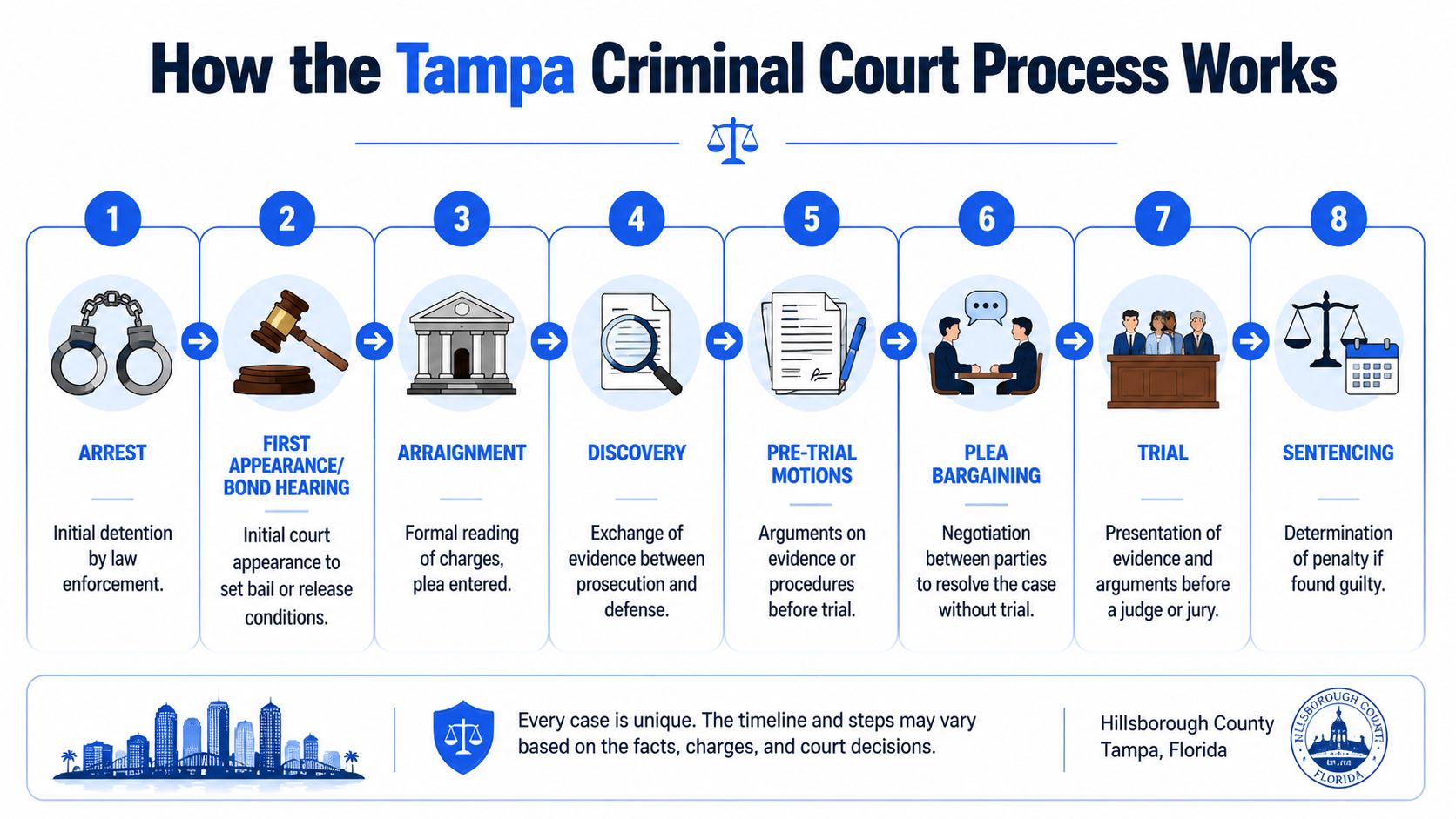
Most Tampa criminal cases run through the Hillsborough County system, often centered around the Edgecomb Courthouse and related court operations. Local presence matters. A lawyer who is regularly in that courthouse can file quickly, appear quickly, and deal with problems before they grow.
What happens right after arrest
The first event is usually your first appearance, sometimes called a bond hearing. The court addresses release conditions, bond, and restrictions on your conduct. Those conditions can affect where you go, who you contact, and how you live while the case is pending.
Next comes arraignment. That is the formal reading of the charge and the entry of a plea. If you want a plain-English explanation of that stage, read this guide on what happens at an arraignment hearing.
Do not treat these first settings like routine paperwork. Early dates shape the rest of the case.
What your lawyer should be doing during the first 10 days
A serious defense lawyer gets to work immediately. That means securing police reports, body camera footage, dashcam video, witness names, 911 calls, and any other evidence that can disappear or get harder to obtain with time.
If your case involves driving, the license issue needs attention now, not later. In many Tampa arrests, the criminal charge and the license problem move on separate tracks. One court date does not protect the other. That is why direct access to your lawyer matters. A ticket mill may file the basic paperwork and move on. A dedicated attorney should explain the deadlines, tell you what must be requested immediately, and make sure the court strategy does not undercut the license strategy.
What happens before trial
Most strong results are built before trial. Your lawyer reviews the evidence for weaknesses and files motions that attack the State's case where it is vulnerable.
That may include the legality of the stop, the basis for a search, the accuracy of witness identification, the handling of statements, or defects in testing procedures. In a driving-related case, those issues often decide whether the prosecutor has a case worth pursuing or a case with real proof problems.
Pretrial hearings matter. Plea discussions matter. Evidence review matters.
A good lawyer does not wait for a final court date to start defending you. The work starts in the records, the videos, the deadlines, and the motions filed early enough to matter.
Does every Tampa criminal case go to trial
No. Many cases end through dismissal, diversion, reduction of charges, or another negotiated resolution. Some cases should be tried because the State's evidence is weak, the police violated your rights, or the offer on the table is unacceptable.
The point is simple. The outcome usually turns on what your lawyer does long before anyone picks a jury. If you have been arrested in Tampa, focus on the first 10 days, especially if your license is in danger. Hire a lawyer you can reach, one who knows the courthouse, handles the criminal case and license exposure together, and takes action before early mistakes lock in avoidable damage.
How Do You Choose the Right Tampa Attorney
Choosing counsel is not about picking the first name you see online. It is about deciding who will protect you when the State already has a head start.
Tampa criminal defense fees also show why this choice matters. A Tampa-area criminal defense page states that newer lawyers may charge $1,000 to $1,500 for some matters, experienced lawyers may charge $100,000 to $1,000,000 for serious cases, and typical criminal retainers range from $5,000 to $10,000 as a flat fee before extra expenses, according to The FL Law Firm's Hillsborough criminal defense page. That range tells you the market is heavily segmented by seriousness, exposure, and attorney experience.
What should you ask before hiring anyone
Ask direct questions. If the lawyer gets vague, keep looking.
Who will handle my case: You need the name of the lawyer, not the brand name of the intake system.
How often do I speak directly with my attorney: If access is filtered through staff, you need to know that now.
Have you handled my kind of charge in Hillsborough County: Local familiarity matters.
What is the immediate plan for my license, court date, and evidence preservation: Strategy starts now, not later.
Is the fee flat or open-ended: You need clarity before you sign.
DIY defense vs professional representation
Here is the practical comparison.
Factor | Handling It Yourself | Hiring an Experienced Attorney |
|---|---|---|
Case evaluation | You react to paperwork as it arrives | The lawyer identifies risks early and prioritizes them |
Court procedure | You learn by trial and error | The lawyer already knows the sequence and pressure points |
Statements and admissions | You may say too much | Counsel controls communication |
License protection | Deadlines are easy to miss | The lawyer addresses urgent administrative issues fast |
Negotiation | You lack leverage and context | The lawyer can challenge, negotiate, and narrow exposure |
Long-term damage | You may focus only on today's fine | Counsel focuses on your record, driving privilege, and future |
What to avoid when you're scared
Fear makes people hire the wrong type of help. Some services operate like volume systems. They push cases through with middlemen, forms, and minimal lawyer contact. That may work for simple administrative tasks. It is a poor fit for a criminal arrest.
You need a lawyer-led defense. Not an automated app. Not a ticket mill. Not a chat funnel.
If you can't reach the lawyer before you hire the firm, don't expect meaningful access after you pay.
Before you commit, review what a serious first meeting should include in a criminal defense attorney consultation. Then choose the attorney who treats your case like a legal problem to solve, not a file to process.
Why Is Ticket Shield Your Strongest Defense
When your case threatens your ability to drive, work, and stay out of deeper trouble, communication matters as much as strategy. You need to know who is handling your case, what the next move is, and how fast that move can be made.
In Tampa and Hillsborough County, proximity to the main courthouse matters because it reduces friction for appearances and last-minute client needs in time-sensitive cases, as noted by this Tampa criminal defense office location overview. That kind of operational reality matters in real life, not just on a website.
What makes a protective defense model different
A protective defense model is simple. You speak directly with your lawyer by phone or text. You get legal advice from an attorney, not a chatbot, call-center layer, or intake middleman. That matters when facts shift, deadlines tighten, or a license issue has to be addressed now.
Ticket Shield's firm overview describes a Florida lawyer-led model focused on traffic, DUI, and related criminal defense matters. That kind of structure fits drivers who need direct answers quickly, especially when the case touches Chapter 316 charges, DUI exposure, or license protection.
Why direct attorney access matters after an arrest
The days right after arrest are messy. You may have bond conditions. You may have paperwork you don't understand. You may have a job that depends on driving. In that moment, delays inside the law firm can hurt you almost as much as delays in court.
Here is what you should insist on from any firm you hire:
Direct communication: You should know how to reach your lawyer.
Immediate triage: License issues, court dates, and compliance problems should be addressed first.
Florida-specific traffic crime knowledge: Chapter 316 cases need focused attention.
Clear guidance: You should know what to do next, what not to do, and why.
You don't need a lot of promises. You need clean judgment, fast action, and a lawyer who treats your record and license like priorities from day one.
If you were arrested in Tampa and your goal is No Points and real protection for your license and record, visit Ticket Shield, PLLC for a free consultation.