Florida: Contesting a Speeding Fine & Protect Record
Contesting a speeding fine in Florida? Learn the process, your options, and how to protect your record from points & insurance hikes.

Don't just pay a Florida speeding ticket. Paying closes the case against you, but it also removes your ability to negotiate. Contesting a speeding fine is how you fight for dismissal, reduced consequences, and the strongest shot at keeping points off your record.
You're probably reading this with the ticket still sitting on your kitchen counter, in your console, or in a photo on your phone. You want to know one thing. Should you fight it, or just get it over with?
Fight it.
If you were cited under Florida Statute 316.183, the state is accusing you of driving at an unlawful speed. That accusation affects more than a single payment. It can follow you into your insurance bill, your driving record, and in some jobs, your livelihood. If you drive for work, travel constantly, or just can't afford a mark on your record, this is not a small problem.
The mistake I see all the time is simple. Drivers treat the citation like a bill. It isn't. It's a legal charge.
Table of Contents
Why You Must Challenge Your Florida Speeding Ticket
A Florida speeding ticket feels routine because police write them every day. That's exactly why drivers get lulled into bad decisions. They pay fast, move on, and only later realize the case was never just about the amount printed on the citation.
Under Florida Statute 316.183, the issue is unlawful speed. Once you treat that allegation like a simple invoice, you give up the chance to test the state's proof, force a review of the paperwork, and push for a result that protects your record.

Why paying is the wrong first move
Paying a ticket is fast. It is not strategic.
One traffic-safety source says only about 5% of drivers who receive traffic tickets contest them, which means the majority accept the citation. The same source explains that once a ticket is challenged, the citation gets reviewed for missing or incorrect details. Read that closely in this traffic-ticket contest data. That review matters because details like location, speed, and method of detection can become pressure points in the defense.
Practical rule: The moment you contest the ticket, you stop acting like a customer paying a bill and start acting like a defendant making the state prove its case.
That shift changes everything. It forces attention onto the officer's documentation, the stop itself, and whether the state can carry the case cleanly from start to finish.
Why contesting creates leverage
Most drivers focus on the fine because it's visible. The bigger damage often shows up later. Insurance is where many people get hit hardest, which is why you should review the insurance impact after a Florida speeding ticket before deciding to pay and move on.
Contesting a speeding fine provides advantages that paying never will. It opens the door to dismissal arguments, negotiation, and record protection. It also lets your lawyer examine whether the state can prove the speed reading, the conditions, and the citation details well enough to justify a conviction.
If you care about a clean record, don't ask, “How much is this ticket?” Ask, “How do I keep this from becoming part of my driving history?”
What Are Your Immediate Options After a Speeding Ticket
The citation gives you choices. Only one of them is built to protect your record.
Florida drivers usually look at the ticket and think they have two practical paths. Pay it or take a class. There is a third path, and it's the one that preserves your defense. You plead not guilty and contest the charge.
What happens if you pay
Paying is the simplest option administratively. It is also the option that ends your ability to dispute immediately.
Once you pay, you're not fighting the allegation anymore. You're accepting the case outcome. If your goal is no points, no conviction, or a reduced result, paying doesn't advance that goal.
Is traffic school the safe option
Traffic school can sound harmless because it looks procedural and contained. For some drivers, it may be available and useful. But many people choose it without asking the more important question: does it produce the result I want?
If your real objective is to avoid long-term record damage, traffic school is not automatically the answer. It also takes time, has eligibility limits, and doesn't replace a legal defense. Drivers often choose it because they want certainty. What they really need is case strategy.
A better starting point is to read this guide on what to do when you get a ticket, then decide based on your record, your work situation, and the facts of the stop.
How do you plead not guilty the right way
If you want to contest the speeding fine, act quickly and carefully. Deadlines matter.
Use this immediate checklist:
Read the citation fully: Confirm the court information, response deadline, and the statute listed on the ticket.
Choose the contested path: You are preserving your right to fight the case, not asking for mercy.
Notify the clerk properly: Tell the clerk you are pleading not guilty and want a hearing.
Keep proof of your filing: Save confirmations, screenshots, emails, or stamped copies.
Do not freelance your explanation: Don't write a long emotional statement. Preserve facts for your defense.
If you're calling or filing on your own, keep the wording plain:
“I am entering a not guilty plea and requesting a court hearing to contest this speeding citation.”
That's enough. You do not need to argue the whole case at that moment.
Your first job is preserving the fight. Your second job is making sure the defense gets built correctly.
How Do You Build a Strong Defense Case
Strong cases usually start with simple evidence that drivers fail to preserve. By the time they call a lawyer, the scene has changed, the sign is gone, or the video has been overwritten.
Don't make that mistake.
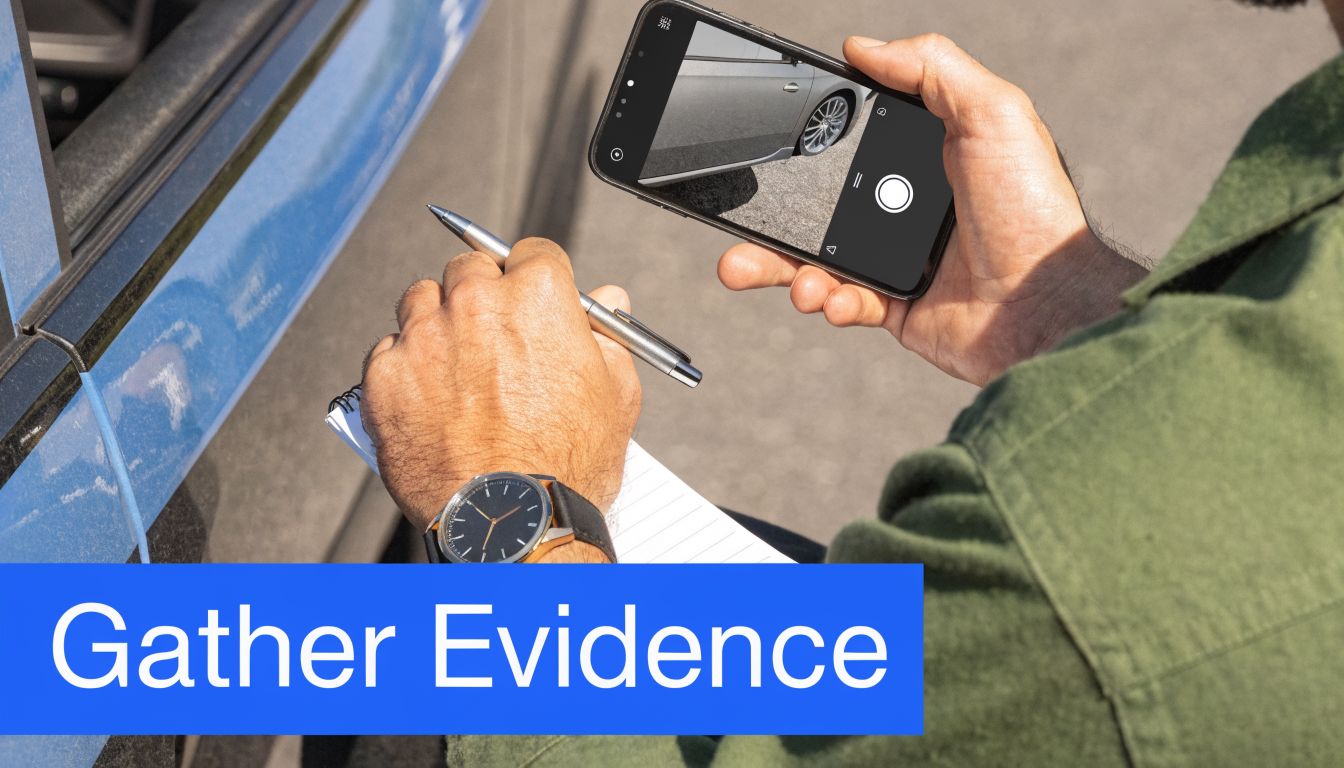
What evidence should you gather first
Start with what you can control right now. A useful defense file often includes:
Photos of the roadway: Get the lane layout, curves, intersections, and the officer's likely vantage point.
Sign visibility images: If a speed-limit sign was blocked, faded, oddly placed, or easy to miss, document it.
Dashcam footage: Save it immediately so it isn't deleted or recorded over.
GPS or trip logs: These can help lock down route, timing, and location.
Your own notes: Write what happened while it's still fresh. Traffic conditions, weather, where the officer was parked, and what was said.
Vehicle records: If relevant, keep maintenance records and anything bearing on your vehicle's systems.
A speed case is often won by small details. The officer says one thing. Your objective evidence says another, or at least makes the state's version less clean.
How your lawyer uses that evidence
A defense attorney doesn't collect evidence just to create a thicker file. Each item should serve a legal purpose.
Road photos can show visibility problems. Dashcam footage can challenge position, pacing, or identification. GPS data can create timing issues. Sign photos can raise doubt about notice. Technical records can support broader arguments about reliability.
If radar or lidar was used, understanding the device matters. This explanation of how radar speed guns work helps you see why training, operation, and reliability become real issues in court.
Good evidence doesn't need to prove perfection. It needs to create doubt about whether the state's version is reliable.
Later in the process, your lawyer may also seek records tied to the speed-reading method and the officer's handling of the stop. That is where many self-represented drivers run out of room. They gather photos, but they don't know how to turn those photos into a defense theory.
This short walkthrough is worth watching because it reinforces the point that traffic cases are built on specifics, not on generalized denial.
What Are Common Legal Defenses to a Speeding Ticket
A good defense is not “I wasn't speeding.” That's usually too thin by itself. A good defense attacks the state's proof from the exact point where it is weakest.
That can mean the speed reading. It can mean the officer's ability to observe your vehicle correctly. It can mean citation errors. It can also mean the surrounding circumstances made the allegation less reliable than it first appears.
Can you challenge the speed reading
Yes, and in many cases you should.
Speeding allegations often depend on a specific measurement method. If that method was radar, lidar, pacing, or visual estimation, each one raises different issues. The legal guide discussed in the verified materials notes that speeding defenses often turn on the type of law and the method used to measure speed. That matters because your defense has to target the actual proof the state plans to offer, not some generic complaint.
A useful challenge may focus on:
Calibration and maintenance: Was the device shown to be accurate?
Operation: Was it used correctly under the circumstances?
Identification: Did the officer isolate your vehicle cleanly in traffic?
Environment: Could angle, traffic density, weather, or roadside conditions affect reliability?
Can you challenge the officer's observations
Absolutely. Officers make observations under pressure, often in moving traffic and from imperfect vantage points.
If your photos, video, or roadway layout show line-of-sight problems, poor positioning, or heavy surrounding traffic, that can matter. If the officer was parked in a place where visual confirmation was difficult, your lawyer should press that issue.
The state doesn't win because an officer wrote a ticket. The state wins only if the proof holds up when someone tests it.
That's why details from the scene matter. They aren't just background. They're the raw material for reasonable doubt.
Can errors on the citation help you
Yes. Not every mistake kills a ticket, but every mistake deserves review.
Location, time, vehicle details, alleged speed, and other entries should be examined closely. When drivers contest a citation, that scrutiny begins. Some errors are clerical and harmless. Others can undercut reliability or expose a sloppy case.
This is also where the financial side becomes real. The real cost is often the insurance impact. NerdWallet notes that drivers can choose to fight, negotiate, or opt to pay, and that higher insurance premiums are a likely result of paying a speeding ticket and accepting the record hit. It also frames the practical question the right way: whether the potential savings from dismissal outweigh the costs and risks of the challenge. You can review that directly in NerdWallet's guide on whether to fight, negotiate, or pay a speeding ticket.
If an emergency or necessity played a role, that should also be analyzed carefully. But don't assume a strong reason automatically becomes a legal defense. It has to be framed properly, supported with facts, and presented strategically.
What Happens in Court and What Are The Possible Outcomes
Most drivers dread court because they don't know what the process looks like. The uncertainty is often worse than the hearing itself.
At the Orange County Courthouse in Orlando, and in traffic courtrooms across Florida, these cases typically move faster than people expect. They are still legal proceedings. The judge, prosecutor, and officer are working through a docket. Your case needs to be prepared, concise, and positioned for the best available outcome.
What does a Florida traffic court hearing look like
If you have a lawyer, you often won't be carrying the burden of figuring out every step alone. That matters because traffic court rewards preparation, not improvisation.
A typical progression may include:
Case review before court: Your attorney studies the citation, statute, and any available evidence.
Pre-hearing negotiation: Some favorable outcomes are reached through discussion before the matter is called.
Officer-based proof: The state presents the basis for the stop and the speed allegation.
Defense challenge: Your lawyer tests the measurement method, observations, records, and legal sufficiency.
Judge's ruling or negotiated resolution: The court either decides the issue or accepts an agreed result.
For drivers who want a fuller picture of appearances and scheduling, this article on going to court for a speeding ticket is a practical starting point.
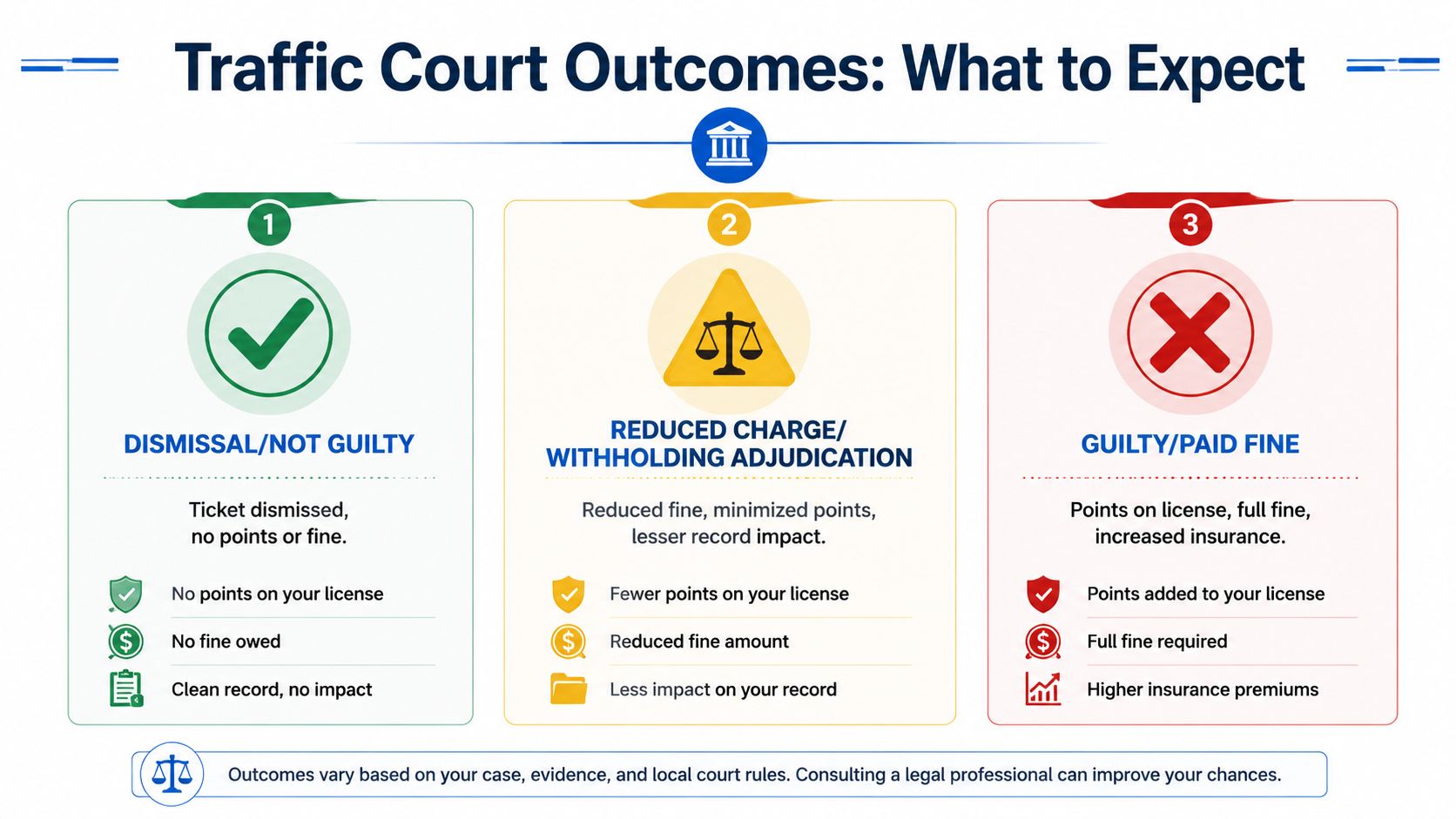
What outcomes should you actually expect
Not every contested ticket ends the same way. That's why strategy matters.
Here's the clean comparison clients need:
Outcome | Points on License | Reports to Insurance | Long-Term Cost |
|---|---|---|---|
Dismissal or not guilty | None | Least likely to create a ticket-based record issue | Lowest likely long-term exposure |
Reduced charge or withholding adjudication | Often limited or avoided depending on result | Reduced impact compared with a conviction | More controlled than a straight loss |
Guilty or paid fine | Risk of points | More likely to affect premiums | Highest likely long-term exposure |
A successful outcome doesn't always mean a dramatic trial win. Sometimes it means dismissal. Sometimes it means a reduction that protects your record far better than a straight conviction would. Sometimes it means a withhold that avoids the worst licensing consequences.
Court is not just about winning or losing. It's about preventing the worst result and pushing the case toward the safest outcome available.
That's the piece drivers miss when they try to handle these matters like routine paperwork.
Why Should You Hire a Lawyer Instead of Using an App
You get a speeding ticket, download an app that promises a quick fix, answer a few canned questions, and assume the problem is handled. Then a deadline gets missed, a defense point never reaches the lawyer who appears in court, or nobody appears at all with the facts that could have protected your record.
That is how drivers lose cases they could have fought intelligently.
A speeding ticket is a legal case, not a tech task. It takes judgment, timing, and direct communication. Someone has to read the citation, test the officer's account against the facts, spot weaknesses, and adjust strategy if the court or prosecutor changes position. An app does not do that. A high-volume ticket service usually does not do it well either.

Why direct attorney access matters
You need the lawyer handling your case to hear your facts directly.
At Ticket Shield, PLLC, you speak with your attorney by phone or text. No call center. No chatbot. No relay chain where your questions pass through staff who are not making legal decisions. That matters because traffic cases often turn on one detail a driver remembers later, such as a blocked speed-limit sign, heavy traffic that made pacing unreliable, or an officer positioned where visibility was poor.
Those details are easy to lose in an automated intake system. They are much harder to miss when the attorney handling your case is the same person hearing your version of events and deciding what to argue.
What goes wrong with automated ticket services
Apps sell speed. Your case needs attention.
Automated services are built to move files, not to protect a specific driver's record. They rely on standard forms, standard workflows, and limited communication. That creates real risk in a speeding case, where the right move may be challenging the stop, pressing a proof issue, or negotiating for a result that avoids the worst consequences.
An app cannot question an officer in court. It cannot make judgment calls in real time. It cannot tell the difference between a case that should be pushed toward dismissal and one that should be resolved through a reduction that better protects your license and insurance.
A lawyer can.
If you want a closer look at the difference between personal representation and assembly-line app defense, start there. The short version is simple. Your ticket is not just a fine. It is a threat to your driving record, your insurance costs, and in some cases your ability to keep driving without added problems.
If your goal is No Points, act now. A real lawyer should review the ticket before you make a decision that hurts your record. Visit Ticket Shield, PLLC for a free consultation and protect your license, your insurance, and your driving record.