Beat Speeding Ticket Florida: 2026 Guide
Don't just pay! Learn to beat speeding ticket Florida. Our 2026 guide covers evidence, defenses, and court strategies to fight your ticket.

Yes. You can beat a speeding ticket in Florida, but only if you treat it like a legal case, not a bill. Don't pay it. Force the state to prove speed, equipment accuracy, and officer compliance under Florida law.
You saw the lights. You pulled over. The officer handed you a citation, and now you're staring at a deadline.
Most drivers make the same mistake. They look at the fine, not the fallout. In Florida, a speeding ticket under Florida Statute 316.187 is not just a payment issue. It's a record issue. It's a points issue. It's an insurance issue. If you drive for work, it's an income issue too.
Paying the ticket is the fastest way to lose options. It closes off defenses before anyone checks the radar history, officer training, or the paperwork errors that often decide these cases.
Florida enforcement is getting harder, not softer. Speeding tickets in Florida surged 29% from 2024 to 2025, rising from 744,000 to nearly 1 million statewide, according to Florida Highway Safety and Motor Vehicles data in this Florida speeding enforcement trend report.
Table of Contents
You Just Got a Speeding Ticket What Now
You are on the shoulder, the officer walks away, and the citation is in your hand. The next decision matters more than the stop itself.
Do not pay the ticket.
Paying closes the case as a conviction. You give up the chance to challenge the officer's method, the device used to measure speed, and mistakes in the paperwork. Drivers who handle this casually usually realize the cost too late, after points, higher insurance, or a preventable court problem is already on the record.
Why the ticket matters more than it looks
A speeding citation is a formal traffic case under Chapter 316, including Statute 316.187. The state still has to prove what happened, how your speed was measured, and whether the officer followed the required process.
That is where self-representation usually falls apart.
Many drivers focus on whether they were stopped. A lawyer focuses on whether the state can prove the stop with admissible, reliable evidence. Those are not the same question. Radar and LIDAR cases often turn on calibration records, training history, visual estimation, pacing details, location accuracy, and what the citation says versus what the officer can prove in court.
If you want to understand the document before you make a mistake, review this guide on how to read a Florida traffic citation.
What you should do in the next 30 days
Treat the response deadline like a hard legal deadline, because it is.
Your job right now is to protect every defense option:
Read the citation line by line: Check the statute, alleged speed, posted speed, location, and vehicle information.
Calendar the deadline immediately: Missing it can create a second problem that is harder to fix than the ticket itself.
Decide early whether to contest it: Delay helps the prosecution, not you.
Preserve the basics: Keep the citation, note what the officer said, and do not make statements that box you into a weak defense later.
What drivers get wrong
Many drivers make one critical mistake. They assume the case is simple because the ticket looks simple.
It is not simple. A speeding case can be attacked on proof, procedure, and documentation. If the measuring device records are missing, the officer's account is inconsistent, the pacing details are thin, or the citation contains material errors, the case may be weaker than it appears. Unrepresented drivers often miss those openings because they argue fairness instead of evidence.
If you are trying to beat a speeding ticket in Florida, ask the right question from the start. Can the state prove this case cleanly, with proper records and a credible foundation for the speed reading. That is the question a lawyer builds around, and it is the question that gives you the best chance at a dismissal or a result that protects your record.
What Are Your Immediate First Steps After Getting a Ticket
The first 48 hours matter. Evidence disappears fast. Memory gets worse fast too.
Start with your own file. Build it before the court builds one against you.
What should you document right away
Write down what happened while it's still fresh.
Include:
The exact location: Road name, lane, direction of travel, nearby intersections, and posted speed limit signs.
Traffic conditions: Heavy traffic, passing trucks, merging vehicles, or anything that could affect a radar or LIDAR reading.
Officer position: Where the patrol car was parked and the angle from which the speed was allegedly measured.
Weather and visibility: Rain, glare, darkness, obstructions, and road construction matter.
Your recollection: What you said, what the officer said, and whether pacing, radar, or LIDAR was mentioned.
Take photos if you can do it safely later. Focus on signs, sight lines, lane conditions, and anything that shows poor visibility or confusing roadway layout.
If you need help understanding what's on the citation itself, review this guide on how to read a Florida traffic citation.
What should you avoid saying or doing
Don't talk yourself into a conviction.
Avoid these mistakes:
Don't admit fault: Not to the officer, not online, not in a message thread.
Don't post about it: Social media creates evidence you don't control.
Don't throw away the ticket envelope or papers: Keep everything together.
Don't call the clerk asking how to pay before you assess defenses: That mindset pushes you toward the wrong outcome.
You are not trying to explain yourself. You are trying to preserve a defense.
What should you preserve for your lawyer
Save anything objective.
That includes:
Dashcam footage: Pull and back it up immediately.
Phone location history if useful: It can help establish route timing.
Photos of the scene: Especially signs, road markings, and obstructions.
Any witness names: Passengers matter. So do third-party observers.
Notes about construction or work zones: Sign placement and worker presence can become critical.
Later in the process, many drivers also benefit from understanding what traffic court feels like before they commit to a solo defense. This short video gives a practical look at that reality:
Your emergency checklist
Use this right now:
Photograph the scene: Do it as soon as practical.
Back up video: Don't leave dashcam files on a card that overwrites itself.
Create a timeline: Stop, officer contact, statements, and release.
Store documents in one folder: Ticket, notes, photos, insurance card copy, registration copy.
Talk to counsel before you decide anything final: Early strategy is stronger than cleanup later.
Should You Pay the Ticket Fight It Yourself or Hire a Lawyer
You are standing in a courthouse hallway with a ticket in your hand, the docket is moving fast, and the officer already knows the routine. If you walk in alone and argue that you were only keeping up with traffic, you are walking into the wrong fight.
You have three choices after a Florida speeding ticket. Pay it. Fight it yourself. Hire a lawyer and force the state to prove the case with admissible evidence.
The first option is fast. The third option is the one that protects you.
What happens if you just pay
Paying the ticket is a guilty plea in practical terms. You close the file, but you also give up every defense tied to the stop, the speed reading, the officer's paperwork, and the state's proof.
That matters more than drivers realize. A paid ticket can mean points, insurance consequences, and a record that follows you longer than the few minutes it took to make the payment.
If you drive for work, carry commercial responsibilities, or already have prior citations, paying is usually the most expensive "easy" choice.
Why fighting it yourself usually fails
Traffic court does not reward sincerity. It rewards preparation, timing, and valid objections.
Self-represented drivers usually miss the issues that win these cases. They do not request the right records. They do not know how to challenge radar or LIDAR foundation. They do not spot gaps in officer training documents or calibration history. They often ask questions that help the officer clean up weak testimony.
That is a significant danger. You can have a defensible ticket and still lose because you presented the case like a conversation instead of a legal challenge.
Court staff cannot coach you through that. The judge will not build your defense for you.
Why hiring a lawyer is the strategic move
A traffic lawyer approaches the case from the pressure points that matter. Was the device properly maintained. Can the officer lay the foundation for the speed reading. Are the records complete. Did the stop and citation process comply with the rules the court expects the state to meet.
Those are the defenses drivers miss when they represent themselves.
A lawyer also knows the local court's pace, the prosecutor's tendencies, and which defects are worth pressing hard. That changes outcomes. Some cases should be pushed toward dismissal. Others should be negotiated toward a reduction or a result that avoids points if the facts allow it.
If you are deciding between convenience and protection, review this breakdown of paying a ticket versus hiring a lawyer in Florida.
Your Three Options After a Florida Speeding Ticket
Outcome | Pay the Ticket (Plead Guilty) | Fight It Yourself (Pro Se) | Hire a Traffic Attorney |
|---|---|---|---|
Case posture | You accept the citation | You challenge it alone | You challenge it with legal strategy |
Chance to test radar or LIDAR evidence | None | Limited by your knowledge and timing | Stronger, because counsel can use discovery and procedural objections |
Court stress | Lower at first, higher later if points affect your record | High | Often lower because counsel handles the process |
Risk of procedural mistakes | Immediate guilty plea ends defenses | High | Lower |
Best possible outcome | Quick closure only | Dismissal or reduction if you execute well | Dismissal, reduction, or no-point resolution where the facts support it |
Paying gets the case off your desk. Hiring a lawyer gives you the best chance to keep the ticket from damaging your record.
How Do You Build a Winning Defense Strategy
A winning defense starts with one principle. The state has the burden. Your lawyer's job is to make the state carry it.
That is where most self-represented drivers fail. They argue about needing to get to work or keeping up with traffic. None of that attacks the evidence.
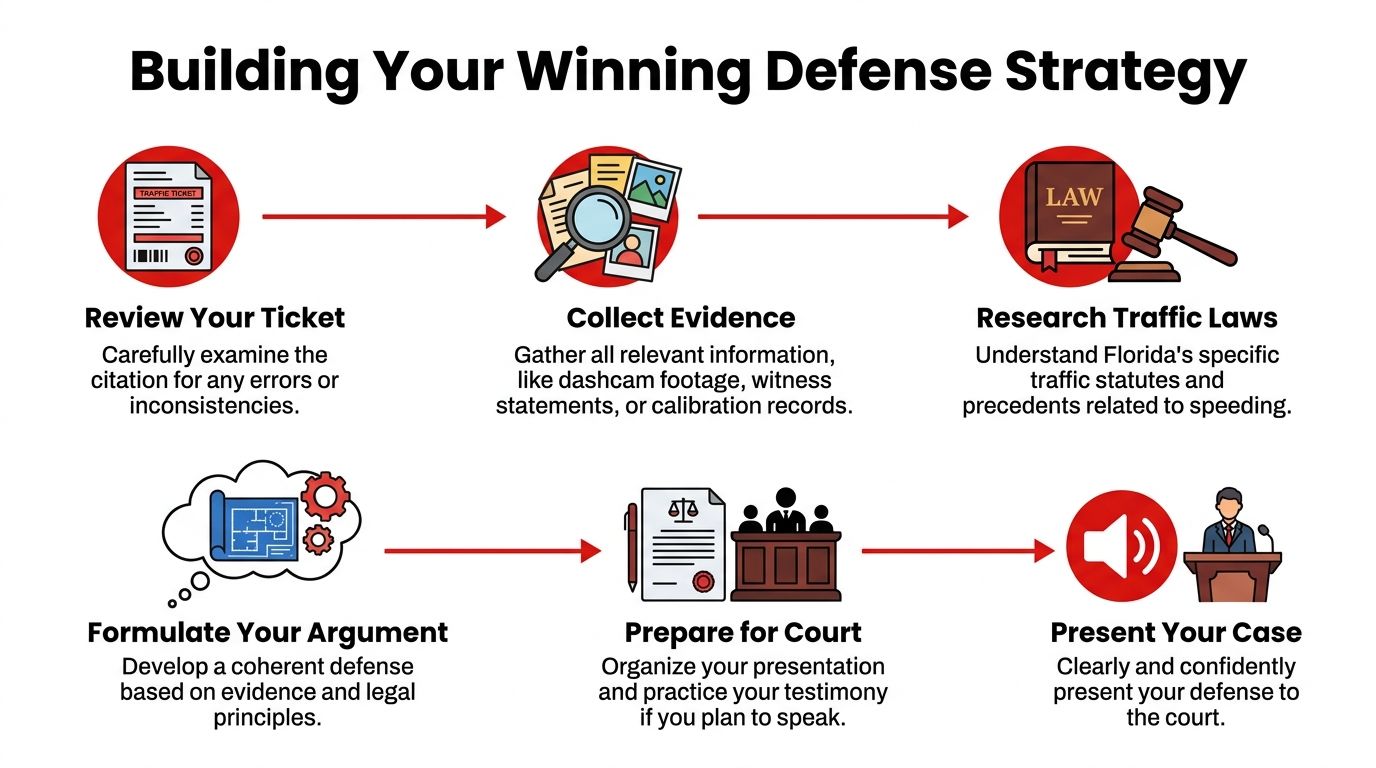
How does discovery expose weak evidence
In Florida, the technical fight often starts with the records behind the stop.
To challenge radar or LIDAR properly, an attorney should file discovery requests for device maintenance logs, calibration certificates, and officer training records required under F.S. 316.1905. If those records show non-compliance with annual certification, the reading may be inadmissible, and that issue appears in up to 20% of cases in some urban jurisdictions, according to this Florida radar and LIDAR defense guide.
That is not small-print trivia. That is often the case.
What technical defenses matter
The strongest defenses are usually procedural or evidentiary.
Common examples include:
Calibration problems: If the device wasn't properly maintained or certified, the reading may be vulnerable.
Training gaps: The officer must be properly trained on the device used.
Cosine angle issues: Radar angle can distort speed readings.
Interference from surrounding traffic: Multi-vehicle traffic can undermine certainty about your vehicle being measured.
Pacing defects: If pacing was used, the patrol vehicle's speedometer certification can matter.
Visual estimation weaknesses: The officer's line of sight and conditions matter more than many drivers realize.
This is why the phrase beat speeding ticket florida shouldn't mean "show up and tell your story." It should mean "force disclosure, test compliance, and attack weak proof."
What driver evidence can strengthen the case
Your evidence doesn't replace legal analysis. It supports it.
Useful material can include:
Dashcam footage
Scene photographs
Photos of obstructed or missing signs
Maps or diagrams showing sight lines
Witness statements
Notes about traffic density
Sometimes a case turns on something very ordinary. A cluster of vehicles near the target area. A blocked speed sign. A roadway angle that makes clean LIDAR targeting questionable.
A good defense is built from records, not hope.
How lawyers structure the challenge
A methodical lawyer often works in this order:
Review the citation for defects
Enter the not guilty posture
Demand discovery
Audit the device and officer records
Compare those records to the officer's allegations
Use your photos or video to pressure the weak points
If you want a practical explanation of what that process can look like in a real speeding case, review how to fight a speeding ticket in Florida.
What defenses are often missed
Drivers miss the boring parts. Those are often the winning parts.
They miss dates. They miss certification lapses. They miss whether the officer identified the technology used. They miss whether traffic conditions made the reading less reliable. They miss whether the paperwork supports the testimony.
That is why evidence-based defense beats improvised storytelling.
What Should You Expect in a Florida Traffic Court
A Florida traffic courtroom moves fast. If you've never been in one, the pace can push you into a bad decision.
At Tampa's Edgecomb Courthouse, that pressure is familiar. Cases are called. Officers rotate in and out. Judges expect efficiency. If you aren't ready, the system doesn't slow down for you.
What a hearing day looks like at Edgecomb Courthouse
You arrive. You check the docket. You wait with a room full of other drivers who also thought they would "just explain what happened."
Then the hearing starts.
The judge manages the calendar. The officer or prosecutor presents the state's side. If you contested the citation, you have to respond with something better than frustration. You need facts, objections, and a clear understanding of what evidence should or should not be considered.
If you want a preview of that process, this article on going to court for a speeding ticket in Florida is worth reviewing before you decide to handle it alone.
What goes wrong for unrepresented drivers
Most solo drivers make one of these errors:
They plead too quickly: Pressure in the courtroom leads to bad decisions.
They don't challenge the foundation for radar evidence: They assume the machine speaks for itself.
They ask the officer open-ended questions: That often helps the state.
They focus on excuses instead of proof: Judges hear that all day.
They don't preserve objections: Once missed, that advantage is gone.
Court rewards preparation. It doesn't reward panic.
Why work zone tickets are more dangerous
Work zone cases deserve special attention.
Recent Florida legislation doubled fines and mandated 4 points for speeding in work zones, and a key defense under Statute 316.187(11) is proving no workers were present or signage was inadequate, as described in this Florida work zone speeding defense article.
That means photos matter. Diagrams matter. Witness accounts matter. If the state is claiming a work zone enhancement, the details need to be checked carefully.
What a lawyer changes in this setting
A lawyer changes the posture of the case.
Instead of you reacting in a crowded courtroom, counsel can shape the issues in advance, narrow what the state can rely on, and handle the hearing without handing the prosecutor easy admissions. In many cases, that's the difference between damage control and record protection.
Why Is a Lawyer Better Than an Automated Ticket App
An automated app can collect information. It cannot practice judgment.
That distinction matters most when the facts are messy, the records are incomplete, or the stakes go beyond a simple fine.
What apps and ticket mills don't do
They don't stand in court and make specific evidentiary arguments.
They don't audit calibration records with a lawyer's eye. They don't text you back as counsel responsible for your case. They don't adapt strategy because you're a rideshare driver, a CDL holder, or someone facing employer scrutiny.
They process. That's not the same as defending.
For example, for gig economy drivers in Florida, a single speeding ticket can trigger immediate account deactivation, and lawyer-led defenses that secure dismissal or reduction to a non-moving violation can help prevent reporting to platforms like Uber and Lyft, according to this Florida gig driver speeding ticket analysis.
An app can't appreciate what that means for your livelihood. A lawyer can.
Why direct lawyer access changes outcomes
A lawyer-led model is important here.
With Ticket Shield, PLLC, you speak directly with your attorney by phone or text. Not a chatbot. Not a call-center layer. Not a middleman who forwards notes. That matters because traffic cases often turn on specific facts that don't fit neatly into a form.
If you're comparing real representation against automated services, read why a local lawyer beats ticket apps for Florida drivers.
What real legal defense looks like
Real defense means someone asks questions an app won't ask:
Was the officer using radar, LIDAR, or pacing?
Was the device documentation current?
Was traffic too dense for clean targeting?
Was the stop in a work zone with proper signage?
Will this ticket threaten your job, clearance, or driving-based income?
Those questions shape outcomes. Generic automation doesn't.
Frequently Asked Questions About Florida Speeding Tickets
Can I just elect to go to traffic school
Traffic school isn't the same as beating the ticket.
It may help some drivers avoid points, but it doesn't deliver the same result as a dismissal. If your goal is a clean record and maximum protection, a full defense is usually the better first analysis.
What happens if I have a CDL
The consequences are more significant. A speeding conviction can affect your commercial driving privileges and your job.
If you hold a CDL, don't treat the case like a routine citation. Fight it aggressively and early.
How long do I have to respond to the ticket
You have a specific deadline to respond to a Florida traffic citation. Miss that window and you create a separate problem for your license status.
Handle it immediately. Delay helps no one but the state.
If my ticket is dismissed do I still have to pay anything
If the case is dismissed outright, you generally avoid the fine tied to the citation itself, though county-level court costs can sometimes still be an issue. The main point is this. A dismissal is the cleanest outcome because it protects your record from the conviction you were facing.
Can I beat a speeding ticket in Florida without going to court myself
Often, yes. In many Florida traffic matters, a lawyer can appear for you so you don't have to spend the day in court.
That matters if you're working, traveling, on duty, or don't want to risk handling a legal hearing alone.
If you want a real shot at No Points, act now. Visit Ticket Shield, PLLC for a free consultation and get direct access to a Florida attorney who can fight your speeding ticket strategically.