
Date

You saw the lights. Your stomach dropped. The officer walked up, asked for your license, and handed you a citation that now feels bigger than a simple ticket.
It is bigger.
A Florida speeding ticket can affect your driving record, your insurance, your work, and your negotiating position in court. For speeding ticket defense in Florida, the first thing you need is a clear plan. The second is direct legal strategy, not an app, not a chatbot, and not a case processor who never tries your issue like it matters.
Table of Contents
You Got a Florida Speeding Ticket Now What
Why this ticket deserves immediate attention
Why direct attorney access matters
What Should I Do Immediately After Getting a Ticket
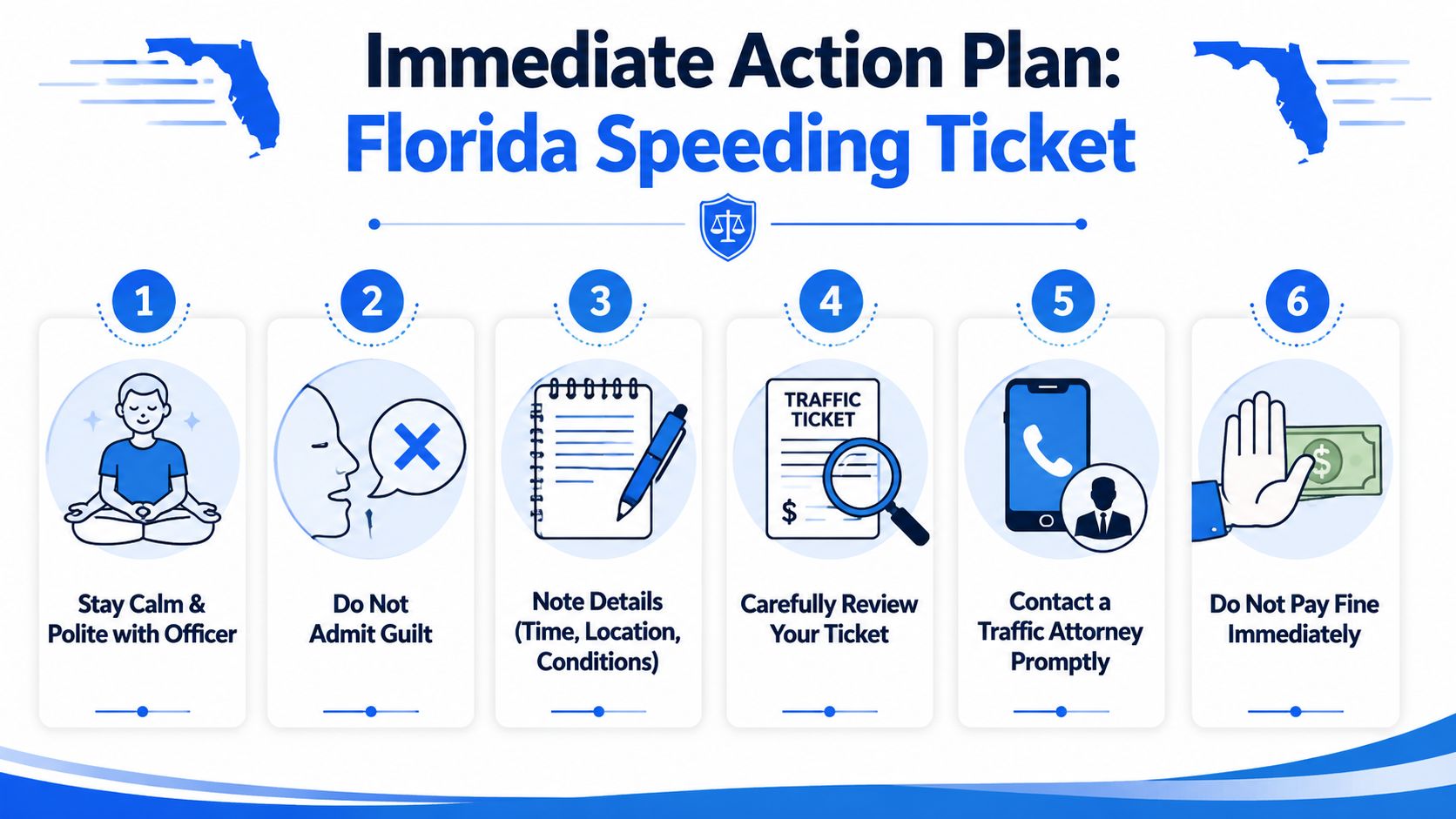
What you must do in the first days
What you should not do
How Does the Florida Traffic Court Process Work
What are your real options
Which path usually protects you better
What Are Common Speeding Ticket Defenses in Florida
How lawyers challenge the speed reading
Why the officer and paperwork both matter
Why Is a Strategic Defense Critical for Your Record
What points can do to your license
Why some drivers face higher stakes than others
Why a lawyer-led model changes the result
Frequently Asked Questions About Florida Speeding Tickets
Will a speeding ticket show up on a background check
Can any lawyer promise a dismissal
Will I have to go to court myself
You Got a Florida Speeding Ticket Now What
TL;DR: Don't pay it. Act fast. A Florida speeding ticket can put points on your license and limit your defense options. The smart move is to preserve evidence, challenge the citation under Florida traffic law, and speak directly with a lawyer who handles these cases.
You were driving. Then the lights hit your mirror. A few minutes later, you were holding a citation and trying to decode what comes next.
Start with this rule. Don't treat a speeding ticket like a parking receipt. In Florida, speeding is governed under Chapter 316, and Florida Statute 316.187 is one of the core provisions tied to unlawful speed. That matters because your case will turn on legal proof, not your frustration, not the officer's confidence, and not what an app guesses based on your ZIP code.
Why this ticket deserves immediate attention
Florida's enforcement environment is aggressive and getting busier. Newly reported statewide data says speeding tickets jumped 29% from 2024 to 2025, from about 744,000 citations to almost 1 million, and Miami-Dade County alone rose 159% to 243,222 tickets according to reported Florida traffic enforcement data.
That tells you two things. First, you are not dealing with a rare event. Second, courts are processing a high volume of cases, which makes precision matter. In places like the Richard E. Gerstein Justice Building in Miami, speed and familiarity with local procedure can shape how efficiently a defense gets built and presented.
Practical rule: The moment you get cited, your case becomes a document case. The paper, the location, the timing, and the officer's proof all matter.
If you need a basic first-response checklist before doing anything else, review what to do when you get a ticket.
Why direct attorney access matters
At this point, drivers make a costly mistake. They assume every defense service works the same. It doesn't.
Some systems run like intake funnels. You upload your ticket, get generic updates, and never talk to the lawyer responsible for your case. That model may move files. It does not protect drivers well when facts need quick review, evidence needs preserving, or court strategy needs adjusting.
A lawyer-led model is different. You should be able to ask direct questions, send photos by text, and get an answer from your attorney, not a middleman. That's not a luxury. In speeding ticket defense in Florida, it's a strategic advantage because traffic cases often turn on small factual defects and short deadlines.
What Should I Do Immediately After Getting a Ticket
Your first job is simple. Preserve options.
You generally have 30 days from the citation date to respond, and paying the ticket is treated as an admission of guilt that waives your right to fight it, according to Florida guidance on responding to a traffic citation.
What you must do in the first days
Handle this like evidence, not annoyance.
Read the ticket carefully. Check the date, time, location, statute reference, officer information, vehicle description, and any written notes. Small errors don't always end a case, but they can matter. If you need help decoding the form, use this guide on how to read a traffic citation.
Save your dashcam footage immediately. Don't assume it will stay stored. Many systems overwrite fast. If your footage shows traffic flow, lane position, signage, weather, or the stop itself, preserve it now.
Photograph the scene. Get the speed limit signs, intersections, lane markings, visibility, curves, obstructions, school-zone indicators, and the exact area where the officer says you were clocked.
Write down what happened. Do it while the details are fresh. Note traffic density, weather, whether you changed lanes, where the officer was positioned, and what the officer said about radar, laser, pacing, or visual estimate.
Request legal review early. A defense lawyer can spot issues you won't. A wrong location, a bad description, unclear signage, or a shaky pacing claim often matters more than a broad claim that you “weren't speeding.”
The drivers who protect themselves best are the ones who document first and argue later.
What you should not do
Drivers hurt their own cases every day. Usually by moving too fast.
Don't pay first and ask questions later. Once you pay, you usually give up the right to contest.
Don't ignore the deadline. Miss the response window and your options narrow fast.
Don't post about it online. That includes joking admissions, screenshots, and “I was only keeping up with traffic” comments.
Don't contact the court casually for legal advice. Clerks process paperwork. They don't build your defense.
Don't rely on a generic denial. “I disagree” is not a defense. Documents, photos, footage, and procedural defects are.
How Does the Florida Traffic Court Process Work
Most drivers get overwhelmed because they think the court process is mysterious. It isn't. It's procedural. Once you understand the three main paths, the decision gets easier.
What are your real options
You generally face three practical choices after a Florida speeding ticket.
Action | Points Assessed | Insurance Impact | Long-Term Risk |
|---|---|---|---|
Pay the ticket | You accept the citation and the case is no longer contested | You leave the record consequence in place, which can affect how insurers view the violation | You give up your chance to challenge the stop, the proof, and the paperwork |
Elect traffic school | This may limit some consequences depending on the case, but it is not a full defense strategy | It may reduce some fallout, but it does not attack the officer's evidence | It can still leave you with a record of the event and doesn't fit every driver's goals |
Contest the ticket | You pursue a result that may reduce or avoid points if the case is handled well | A better legal outcome can better protect your record | It takes strategy, evidence review, and proper court handling |
That's the clean version. The practical version is harsher. Paying may feel convenient, but convenience is expensive when a citation has weaknesses that nobody bothered to test.
For a fuller walkthrough of hearings, scheduling, and what usually happens on the court date, review what to expect in traffic court.
Which path usually protects you better
If your goal is to protect your record, contesting the ticket is usually the serious option. Not because every ticket gets dismissed. Not because every officer makes a mistake. Because paying closes the door before anyone checks whether the state can prove the case cleanly.
Traffic court rewards preparation. The side with the better documents usually has the stronger day.
That is especially true in high-volume courtrooms. Judges and hearing officers move through calendars efficiently. Drivers who show up with no organized defense often lose advantage before they speak. Drivers with a structured challenge to the citation, the method of speed measurement, or the evidentiary foundation create room for negotiation and, in the right case, dismissal or reduction.
What Are Common Speeding Ticket Defenses in Florida
A speeding case is not won by saying, “I don't think I was going that fast.” It's won by forcing the state to prove exactly how your speed was measured and whether that proof holds up.

How lawyers challenge the speed reading
Florida speeding defenses often begin with the measurement method. The officer may claim visual estimation, pacing, radar, laser, or aircraft. Each method has its own proof problems.
For radar and laser, one Florida defense guide states the devices must be professionally calibrated every six months and checked at the beginning and end of the officer's shift. If those records are missing or weak, that can become a central defense issue, as explained in this overview of common speeding ticket defenses in Florida.
That means your lawyer isn't just asking, “Was there a radar gun?” The actual questions are more technical:
Was the device properly maintained?
Do the calibration logs exist?
Were shift checks documented?
Did the officer use the device correctly?
Does the paperwork match the citation and hearing date?
If you want a plain-English explanation of how these devices work and where they can fail, this guide on how radar speed guns work is useful.
Why the officer and paperwork both matter
Other methods create different openings.
Pacing cases
In pacing, the defense can challenge whether the officer maintained the required observation conditions. One Florida guide says the officer should maintain a specified distance for at least 2/10ths of a mile. That's not abstract. A lawyer can compare that claim against dashcam footage, road layout, traffic conditions, and sight lines.
Aircraft cases
Aircraft enforcement sounds intimidating. It isn't untouchable. The same defense guide notes that the defense can require both the aircraft officer and the ground officer to appear. If one is absent, dismissal may become possible.
Visual estimation cases
Visual estimate cases often depend heavily on officer training, vantage point, traffic density, and line of sight. A lawyer may test whether the estimate was reliable in that specific roadway setting, not in theory.
A speeding ticket is only as solid as the state's proof chain. Break the chain, and the case changes.
Why Is a Strategic Defense Critical for Your Record
This is the part drivers underestimate. They focus on the fine and ignore the record.
That's backward.
What points can do to your license
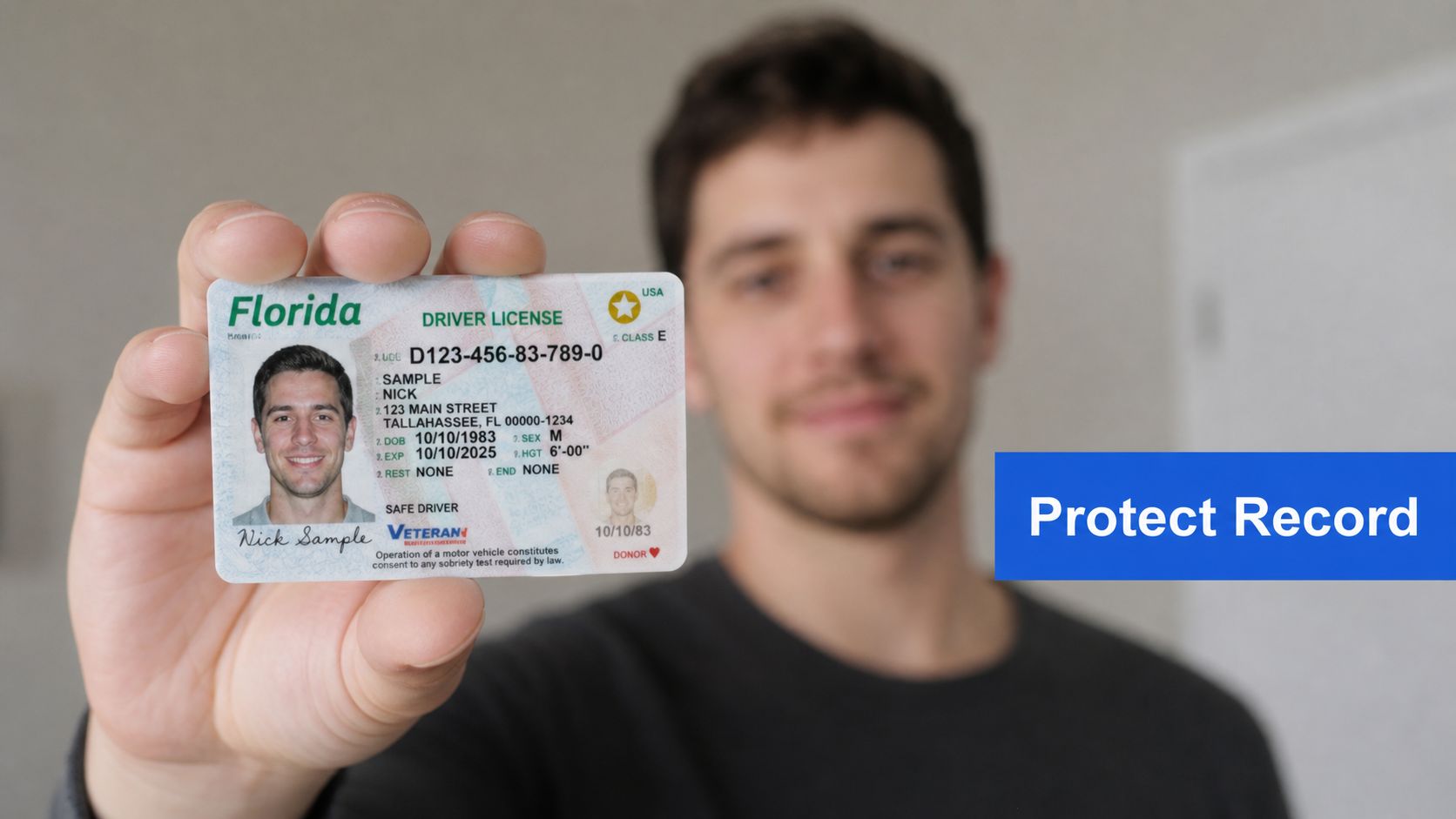
A single speeding conviction in Florida can place 3 points on your license, or 4 points if the speed exceeded the limit by more than 15 mph, and too many points can lead to mandatory driver school and license suspension according to Florida speeding ticket and point guidance.
That's why the right defense goal is usually not “make this annoying thing go away.” It's protect the record. A point reduction, a non-moving resolution where available, or a dismissal can matter far more than the face value of the ticket.
Why some drivers face higher stakes than others
Some people can absorb a ticket easier than others. Many can't.
If you drive for rideshare or delivery work, a single citation can trigger account trouble even before the long-term legal consequences fully play out. The business reality is brutal. Platforms don't always wait for your nuanced explanation. They react to the violation.
If you're in the military, hold a sensitive professional role, or go through recurring screenings, your concern is often broader than points. You care about visibility, record cleanliness, and whether a pending matter creates noise you now have to explain.
That's why drivers in these categories need a defense that starts immediately and stays focused. Delay helps nobody.
Here's a short explanation of why records matter and how legal handling affects outcomes:
Why a lawyer-led model changes the result
To be direct: Automated apps and ticket mills are built for volume. Your case is not volume to you.
A speeding defense often turns on timing, local practice, evidence requests, officer appearance issues, and small factual details that don't fit neatly into automated intake forms. If you're routed through support staff and canned updates, your defense becomes generic fast.
A lawyer-led service gives you something more useful. Communication with the attorney handling the matter. That means you can send scene photos, explain the roadway, ask about court posture, and get a strategic answer instead of a customer-service answer.
One option in Florida is Ticket Shield, PLLC, which handles traffic defense statewide with direct attorney communication by phone or text. That structure matters because it removes the middleman and keeps case analysis closer to the facts.
You're not hiring software. You're retaining judgment.
Frequently Asked Questions About Florida Speeding Tickets
The final questions are usually the ones drivers are embarrassed to ask. Ask them anyway. These are the questions that affect jobs, clearances, and peace of mind.
Will a speeding ticket show up on a background check
Sometimes the confusion comes from mixing up public court records and private screening algorithms.
A pending or dismissed traffic case may exist in public records, but that does not automatically mean every private employer screening report will treat it the same way. The distinction is critical, especially for professionals and military personnel. A dismissed case is not the same as a conviction, and a pending case is not always surfaced the same way by every screening system.
That's why generic internet answers on this topic are often sloppy. They flatten a nuanced issue into a yes-or-no answer that isn't responsible. If this is your concern, your lawyer should address both the court record side and the practical employment-screening side.
Can any lawyer promise a dismissal
No. A serious lawyer won't guarantee an outcome.
What a lawyer can do is identify the pressure points in the case, preserve evidence correctly, challenge the state's proof, and pursue the result that best protects your record. Anyone selling certainty in a traffic case before reviewing the citation, county practice, and proof method is selling confidence, not analysis.
Will I have to go to court myself
Often, drivers want one thing. Handle this for me.
In many Florida traffic cases, counsel can appear and manage much of the process without turning it into a disruption for you. The exact answer depends on the court, the type of citation, and the posture of the case. But if your schedule matters, ask that question early and get a direct answer from the lawyer handling your file.
If you're also weighing cost against long-term exposure, this breakdown of what it costs to fight a traffic ticket helps frame the decision realistically.
One more point. If you've ever wondered why law firms invest in clear answers to specific legal questions, this piece on strategies for legal search visibility gives useful context on how people find legal help when they need it fast.
If your goal is No Points, don't guess, don't pay blindly, and don't let your case disappear into an automated system. Visit Ticket Shield, PLLC for a free consultation and get a lawyer-led plan to fight your Florida speeding ticket and protect your record.
