¿Valen la pena los abogados de multas de tránsito en Florida? Una guía de costos
¿Valen la pena los abogados de multas de tránsito en Florida? Vea el cálculo real de costo-beneficio, los riesgos de puntos y los casos en los que un abogado se paga solo.

Traffic ticket lawyers in Florida are usually worth hiring the moment a citation threatens points, insurance increases, or license suspension. A single moving violation can raise premiums by about 20% or more for three to five years, which can dwarf a typical attorney fee.
You're holding a Florida citation, staring at the fine, and wondering whether paying it is easier than fighting it. That instinct can cost more than expected. The key question isn't whether the ticket is affordable today. It's whether a conviction will create a three-to-five-year cost stack involving insurance, points, court charges, and license consequences.
Florida drivers often accept citations without challenging them. One major industry source reports that only 5% of Americans contest traffic tickets, while approximately one in five drivers has received a ticket in the past five years, and more than two-thirds of those tickets involve speeding. Americans may waste as much as $7.5 billion annually on traffic fines, according to coverage of the broader traffic-ticket economics.
Paying can be reasonable for a minor infraction with no points, no insurance exposure, and no licensing risk. But once the citation threatens your record or livelihood, treating it as a simple bill is a financial mistake.
Table of Contents
What Your Florida Ticket Will Cost Over Three to Five Years
A Florida citation can look manageable when you focus on the printed fine. That view leaves out the costs that follow a conviction. The better question is, what will this ticket cost over the next three to five years?
Calculate the full stack: the fine, clerk's court costs and surcharges, points on your driving record, possible insurance increases, and the risk that another citation leads to suspension. If you drive for work, hold a commercial license, or rely on a clean motor vehicle record, the consequences can reach your income.
Automated ticket mills often sell convenience through a form and limited updates. A lawyer-led defense should give you a direct phone contact, explain the available options, and make the trade-off clear before you decide. Compare that service with the cost of accepting a conviction, not only with the fee quoted at intake.
Practical rule: Compare the attorney's fee with the total cost of a conviction, not just the number printed on the citation.
Florida's point system makes record protection important. The Florida Department of Highway Safety and Motor Vehicles states that 12 points within 12 months triggers a 30-day suspension, 18 points within 18 months triggers a three-month suspension, and 24 points within 36 months triggers a one-year suspension. Points remain on the driving record for at least five years from the conviction or disposition date, according to Florida's official points and suspension guidance.
Insurance can become the quiet, recurring bill. A single speeding conviction can increase premiums by about 20% or more, with the increase commonly lasting three to five years. One example estimates that a driver paying roughly $1,800 annually could face an additional $468 per year after a 26% increase, or approximately $1,400 over three years, as explained in this explanation of traffic-ticket insurance costs.
Before paying, answer three questions:
Will points threaten your record? Check your current Florida driving history.
Will higher premiums affect your household? Ask your insurer how a conviction could change renewal pricing.
Does driving support your income? Consider employment requirements, commercial driving eligibility, and client-facing work.
Use this Florida traffic-ticket decision guide for a direct comparison. If the ticket can affect insurance or your license, the fine is the smallest number in the equation.
What a Florida Traffic Ticket Lawyer Actually Does
Florida traffic defense starts with the citation process established by Chapter 316. Florida Statute 316.650 governs uniform traffic citations and their use in the enforcement system, as shown in the official statutory text. A traffic attorney works within that framework to identify a defensible resolution, not just to send a form letter.
The lawyer first reviews the citation, the alleged speed or conduct, the court, the deadline, and your driving history. Depending on the charge, counsel may examine the officer's observations, training records, speed-measurement evidence, calibration documentation, and other materials relevant to the State's case.
What happens after you retain counsel
A Florida attorney can enter the case, communicate with the court or prosecutor, and negotiate for a reduction, dismissal, or other disposition that limits record damage. In eligible matters, the lawyer may also appear for you, so you don't lose work hours sitting in a courtroom.
The result you want isn't merely a lower fine. It may be no points, a non-moving disposition, a reduced charge, or a resolution that protects your license. The available outcome depends on the citation, the evidence, your history, and the local court process.
A lawyer-led practice should also tell you who is handling the case. You should know the attorney's name, how to reach the firm, what the fee covers, and what outcome the lawyer is pursuing. Direct communication matters when a deadline changes or the prosecutor offers a resolution that affects your record.
Lawyer-led service versus automated ticket handling
Automated apps and ticket mills often place a corporate answering service or chatbot between you and the lawyer. That model may be adequate for document routing, but it doesn't give you meaningful legal advice when the citation threatens your work or license.
Ticket Shield, PLLC describes a lawyer-led model in which clients communicate directly with their attorney by phone or text. The distinction is practical: you're discussing your facts with counsel rather than trying to extract a case-specific answer from an automated system.
For a candid explanation of the attorney's role, review this guide to Florida traffic-ticket attorneys. Ask what the lawyer will investigate, whether the attorney appears for you, and whether the representation includes negotiations through final disposition.
The Hidden Cost Stack Behind a Single Citation
The cost-stack model is simple. A conviction can include the fine, government-imposed costs, points, insurance increases, and licensing consequences. Those layers don't arrive on one invoice, which is why drivers underestimate them.
The verified data supports using a three-to-five-year comparison, but it doesn't establish every specific Florida fine, surcharge, point assignment, or premium scenario listed in some online examples. Don't rely on an invented fixed total. Obtain the exact amount from the clerk, your insurer, and the Florida driving record before deciding.
Cost Layer | Year 1 | Years 2-3 | Total |
|---|---|---|---|
Citation fine | Exact amount on citation | None unless additional charges apply | Citation amount |
Court costs and surcharges | Confirm with clerk | None unless ordered or unpaid | Clerk's confirmed amount |
Insurance impact | Ask insurer after disposition | Review renewal impact over the remaining period | Insurer's actual estimate |
Points and license risk | Review FLHSMV record | Monitor accumulation and suspension thresholds | Depends on record and disposition |
The insurance layer often controls the decision. A cited industry estimate says a basic traffic attorney may charge approximately $150 to $500, while a conviction can raise premiums by about 20% or more for three to five years, as discussed in this traffic-ticket cost analysis. That doesn't guarantee a particular premium increase, but it shows why comparing the fee only with the fine is incomplete.
Florida's suspension thresholds turn a manageable ticket into a record problem when you already have points. A new conviction can move you closer to 12 points in 12 months, 18 points in 18 months, or 24 points in 36 months, with the corresponding suspensions described by FLHSMV. The record also retains points for at least five years from conviction or disposition.
Find your break-even point
Your break-even calculation should use real figures:
Get the exact attorney fee.
Confirm the fine and court charges with the clerk.
Ask your insurer for the expected renewal effect of the conviction.
Check your current points and suspension exposure.
Add the financial value of keeping your license and job eligibility.
If the expected insurance increase over the relevant period exceeds the legal fee, hiring counsel is financially rational before considering lost work time or suspension risk. Florida traffic-ticket cost guidance can help you organize those figures, but your lawyer and insurer must assess your actual case.
Paying the Ticket vs Hiring a Lawyer in Florida
Paying the ticket is fast. It also may resolve the case in a way that leaves you with points, a conviction, and an insurance problem. Hiring a lawyer costs money upfront, but it gives you a chance to change the disposition before those consequences attach.
Cost Factor | Pay the Ticket | Hire a Lawyer |
|---|---|---|
Immediate payment | Fine and applicable court charges | Legal fee plus government charges that remain due |
Record effect | Conviction may add points | Counsel seeks dismissal, reduction, or a no-points outcome when available |
Insurance | You absorb the insurer's underwriting decision | You may avoid the conviction that triggers the increase |
Court time | You handle deadlines and appearances | Attorney may handle eligible appearances for you |
License risk | Existing points remain part of the calculation | Counsel focuses on preventing additional record damage |
Communication | You manage the case yourself | You receive case-specific legal guidance |
Independent legal guidance recommends comparing the legal fee with the compounded three-to-five-year cost of premiums, court charges, and point-related penalties. This analysis of whether contesting a ticket is worthwhile also explains why representation becomes more valuable when a citation threatens a license, commercial driving, or substantial insurance increases.
For a clean-record driver facing a low-level citation with no meaningful point or insurance risk, self-representation may be reasonable. That's the narrow case where paying or handling the matter yourself can make sense.
Use point exposure as the trigger
Your decision should change when the ticket could push you toward suspension, affect a CDL, or create a serious employment problem. A driver near Florida's 12, 18, or 24-point thresholds shouldn't treat the case as routine.
The lawyer path also isn't a promise of dismissal. It's a decision to pay for legal analysis, negotiation, and record protection. The useful question is whether that protection is worth more than the fee. In many higher-risk cases, it is.
Read this Florida comparison of paying a ticket versus hiring counsel before you choose the fastest option. The ticket face value is only the first line of the calculation.
When a Lawyer Pays for Itself by Scenario
Not every citation justifies representation. The right answer depends on the charge, your existing record, your insurance exposure, and what you need your license to do.
A minor speeding citation may be manageable without counsel when your record is clean and the disposition carries no meaningful downstream risk. That calculation changes quickly if you already have points or depend on driving for income.
Speed and point exposure
Florida's dangerous excessive speeding statute, Section 316.1922, defines dangerous excessive speeding as driving 50 mph or more above the posted speed limit. A first conviction can bring up to 30 days in jail or a $500 fine, or both. A second or subsequent conviction can bring up to 90 days in jail or a $1,000 fine, or both. If the later violation occurs within five years of a prior conviction, the license must be revoked for at least 180 days but no more than one year, according to the official statutory language.
That isn't a pay-and-forget citation. You need counsel.
A reckless-driving allegation also deserves prompt legal review because it can affect points, insurance, and employment. A lawyer may challenge the evidence or negotiate a less damaging resolution, depending on the facts.
Work-dependent drivers
Commercial drivers face even greater consequences. A conviction can affect employment, insurance, and commercial driving eligibility, so the fee should be compared with the value of preserving your livelihood.
Gig drivers face a similar practical issue. Companies may review motor vehicle records, and even a minor point can create a work problem when your income depends on remaining eligible to drive.
Military members should tell counsel about their status and any service-related consequences. A Florida lawyer can evaluate the civilian traffic case and explain how the disposition may affect your broader situation.
The contrarian rule is clear: a small ticket can justify a lawyer when the record matters more than the fine. A larger-looking fine may not justify counsel if it carries no points, no insurance impact, and no license risk. Get the actual exposure before choosing.
Common Myths That Cost Florida Drivers More
Florida drivers often make the wrong decision because they evaluate the citation at the payment screen instead of looking at the record and insurance consequences.
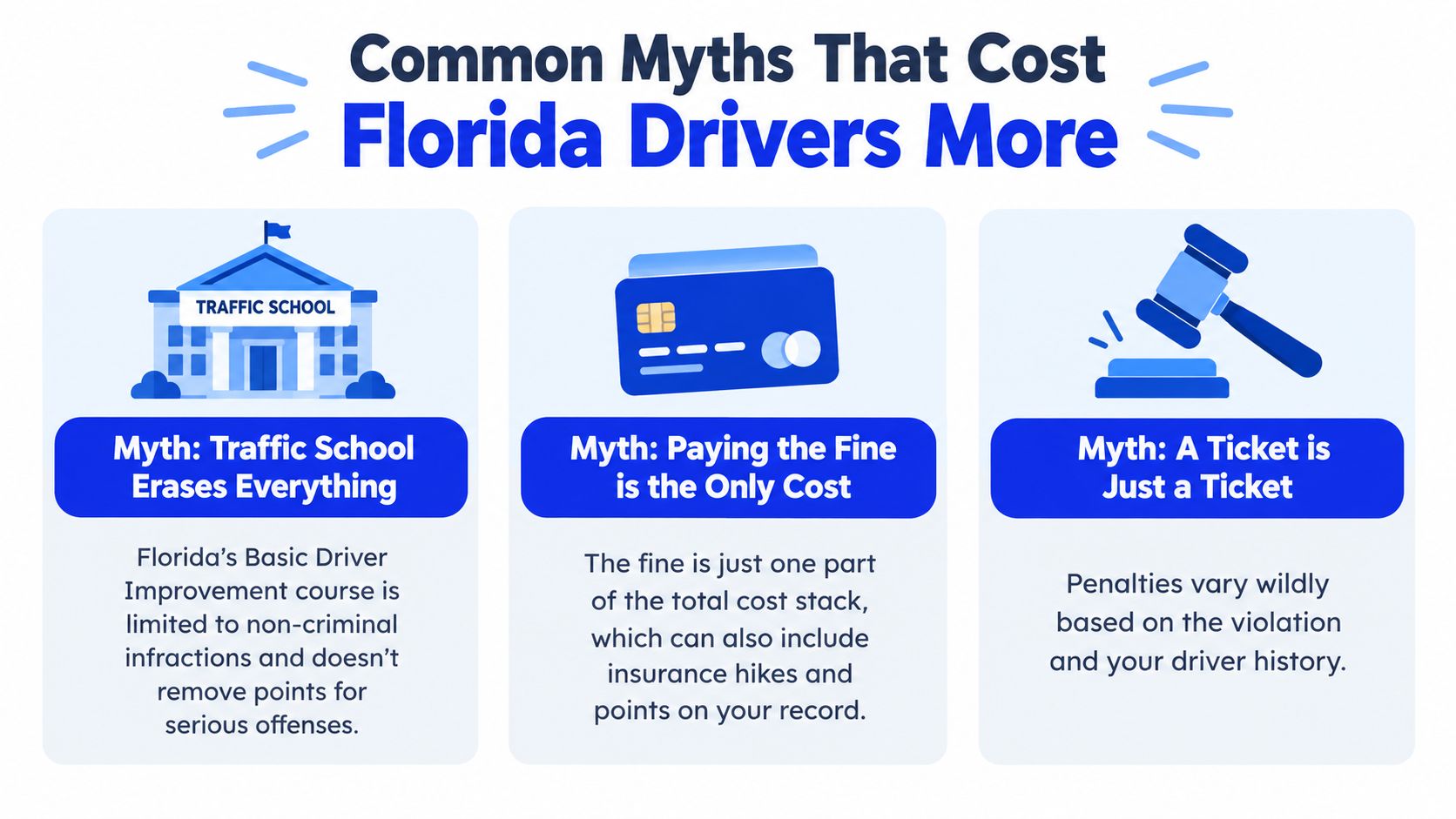
Myth one, traffic school erases everything
Florida's basic driver improvement option may be useful in an eligible case, but it doesn't automatically erase every consequence. Before paying, confirm eligibility, the effect on your record, and whether the citation or your history creates restrictions.
Myth two, paying is always cheaper
Paying may be cheaper on day one. It can become more expensive after an insurer reviews the conviction at renewal and adjusts your premium. This analysis of fighting a speeding ticket recommends comparing the total cost of the conviction, including the fine, court costs, points, and insurance, with the attorney fee.
Myth three, an app is the same as a lawyer
An automated service may transmit documents, but it isn't a substitute for a Florida-licensed attorney who can analyze evidence, communicate with the prosecution, and advise you about license risk. Ask whether you can speak directly with the lawyer assigned to your case.
The cheapest option on the day you receive a ticket can be the most expensive option over the life of the conviction.
A direct lawyer relationship matters when your facts don't fit a script. Review the difference between a traffic lawyer and an app before handing over your citation and personal information.
Your 60-Second Decision Checklist and Next Steps
You can make a preliminary decision quickly. Answer each question truthfully, then act on the highest-risk “yes.”
Does the citation threaten points? If yes, check your current FLHSMV record and compare the possible record impact with the attorney fee.
Could the new points move you toward suspension? Florida's thresholds are 12 points within 12 months, 18 within 18 months, and 24 within 36 months, so a driver with existing points should seek legal advice.
Could the charge affect your insurance? If yes, ask your insurer for a conviction estimate and compare the multi-year exposure with representation.
Does the charge involve dangerous excessive speeding? If the alleged speed meets Section 316.1922's definition, contact a lawyer immediately.
Do you hold a CDL or drive for work? Treat the case as employment-related, not merely personal.
Do you have prior violations? A clean record and a record near suspension require different decisions.
Are you considering traffic school? Confirm eligibility before paying or electing an option, and don't assume it removes existing points.
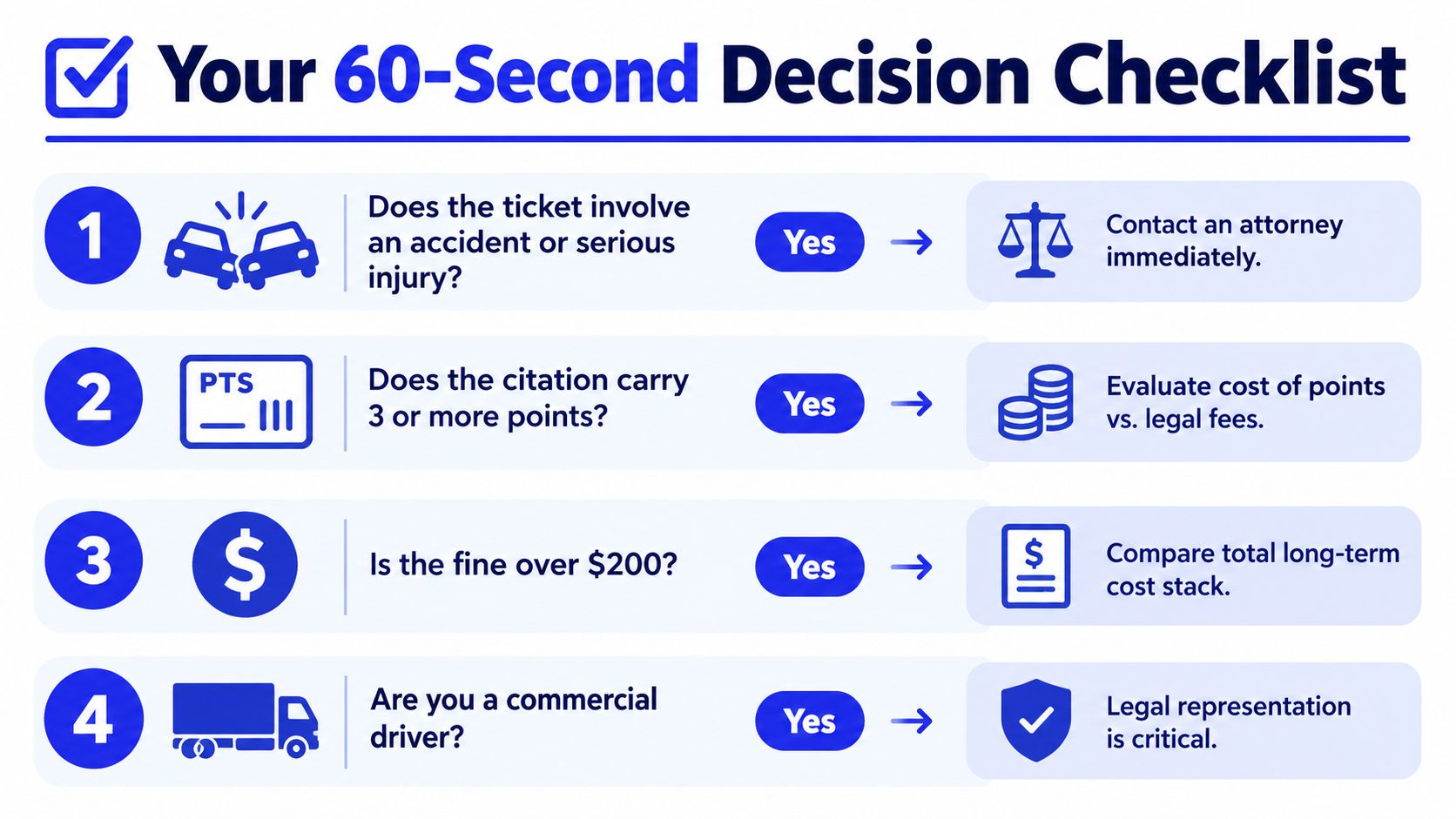
Start with four tasks: pull your driving record, photograph every page of the citation, note the response deadline and court date, and gather your insurance and employment information. A Florida attorney can then assess the actual cost stack instead of guessing from the fine.
The intake process should be direct. Upload the citation, ask for the flat fee and included services, and tell the lawyer that your priority is No Points on your license.
Florida Traffic Ticket Lawyer Questions Answered
Can an out-of-state driver hire a Florida lawyer?
Yes. An out-of-state driver can retain Florida counsel for a Florida citation. The conviction may still be reported to the home state and affect the driver's record or insurance, so paying without advice can be risky.
How quickly must I respond?
Florida traffic cases have response deadlines. Confirm the deadline on the citation and with the clerk or attorney immediately. Missing the applicable period can produce additional consequences, so don't wait until the last day.
What happens if I ignore the ticket?
Ignoring a citation can lead to a default conviction, additional fees, license suspension, and possible enforcement action. Florida Statute 318.15 addresses failures to comply with civil traffic penalties. Treat the citation as an active legal matter.
Do I have to appear in court?
For an eligible non-criminal matter, your lawyer may be able to appear for you or handle the case without your personal appearance. Bring the citation, your driving record if available, insurance information, and a clear account of what happened to the first attorney meeting.
Ticket Shield, PLLC provides Florida traffic-ticket representation with a lawyer-led intake, direct attorney communication by phone or text, and a focus on protecting your license and pursuing No Points when the facts and law allow. Visit Ticket Shield, PLLC for a free consultation and have an attorney evaluate the full cost of your citation before you pay.