Ubicaciones y fechas límite del Tribunal de Tráfico del Condado de Broward
Ubicaciones de los tribunales de tránsito del condado de Broward, días de audiencias, opciones de 30 días y cómo disputar una multa sin acumular puntos.

Broward recorded 68,812 civil-traffic-infraction filings handled by a judge or hearing officer in fiscal year 2021–22, according to the Florida Courts Statistical Reference Guide. That's hearing-related workload, not a count of every ticket issued in the county. Your citation deserves individual attention, because paying the balance, resolving the court case, and protecting your license are different tasks.
Table of Contents
Broward Traffic Court at a Glance
Broward County traffic court isn't a single payment window. Civil traffic matters operate within Florida's Seventeenth Judicial Circuit, with separate courthouse calendars and case-specific appearance instructions. Your first job isn't finding the nearest courthouse. It's identifying what you received and what response the court requires.
Start with the citation in your hand. Read the charge, issue date, citation number, and instructions. Don't choose a payment option because it looks easier than reading the rest of the page.
The courthouse structure matters before you make travel plans.

Separate the case from the license
A court record answers what happened to your citation. Your driving record answers what the state recorded against your license. If a suspension already exists, reinstatement introduces another set of requirements.
Those records should agree, but you shouldn't assume that completing one task completes all the others. A receipt proves you paid something. It doesn't necessarily prove that your chosen election was recorded correctly or that you're legally cleared to drive.
Protective rule: Decide what result you need before you decide which button to press.
Keep these documents together from the start:
The original citation. Preserve a readable copy of both sides, including instructions and the violation statute.
Every court notice. Keep the envelope or electronic delivery record with the notice.
Your license information. Identify your license class and any existing restriction or suspension.
Your case confirmations. Save submissions, receipts, course documents, and correspondence in one folder.
Local representation should mean direct accountability
Ticket Shield, PLLC is based in Broward and has handled thousands of Florida traffic cases. We treat local familiarity as a reason to be precise about your assignment, not a reason to assume every case follows the same calendar.
You should know who is reviewing your citation and who will answer when something doesn't match. An app can accept an upload. That isn't the same service as speaking with the attorney responsible for your case.
Bring the paperwork before you make an irreversible choice. A useful review starts with the actual charge and your driving record, not a generic promise that every ticket can be handled the same way.
Courthouse Locations and Hearing Days
Broward civil infraction hearing days by courthouse
Facility | Usual hearing days |
|---|---|
Central | Wednesdays and Thursdays |
North | Mondays, Thursdays, and Fridays |
South | Mondays, Tuesdays, Wednesdays, and Fridays |
West | Monday through Friday |
The Seventeenth Judicial Circuit traffic program identifies these courthouse calendars and usual hearing days. Your official notice controls your assignment, including the facility, courtroom, hearing date, and appearance requirements.
Don't drive to a generic Broward courthouse address copied from a search result. A correct building name doesn't establish that your case is scheduled there. A familiar weekday doesn't establish your hearing date.
Match the notice to your case
Compare the citation number on the hearing notice with the citation you're trying to resolve. Then check the defendant's name, facility, room, date, time, and any instructions about how to appear.
If the notice conflicts with the usual calendar, contact the clerk through the official channels identified on the notice. Ask for confirmation of the assignment. Keep a record of the answer rather than relying on your memory of a telephone conversation.
Use a preparation checklist before traveling:
Confirm the destination. Take the address and contact information from the official notice or the court channels it identifies.
Check the appearance method. Don't assume that a prior remote appearance means your next hearing is remote.
Read submission instructions. Evidence that exists on your phone still needs to be presented in a form the court can consider.
Resolve representation questions. Confirm whether your attorney will appear and whether the court requires you personally.
Ticket Shield, PLLC has a physical office in Broward County, Florida. That local presence doesn't replace your notice. We still verify the assignment for the individual case.
Bring evidence that answers the charge
Preparation means more than carrying the ticket. Bring the hearing notice, relevant photographs, registration or insurance documents when applicable, proof of correction, and receipts associated with the case.
Use our guide to what to bring to traffic court to organize the materials. Give your attorney readable copies before the appearance, not a collection of unexplained screenshots at the last moment.
Preserve original photographs and files. Add a short description identifying what each item shows and why it matters. Don't edit a photograph in a way that removes context your attorney needs to evaluate.
Arriving at a courthouse isn't the same as appearing for your assigned case.
If you discover a scheduling problem, act before the hearing. Don't assume that a message left with an answering service changes the court's instructions. Get a clear answer about what has been filed, what the court has approved, and what you still need to do.
The objective is straightforward: reach the correct proceeding with the correct evidence and a clear understanding of your responsibility to appear.
Civil Parking and Criminal Traffic Tracks
Broward traffic paperwork can send you down three different tracks: a civil moving citation, a parking citation, or a criminal traffic charge. Read the document before you pay. Using the wrong response process can leave the actual obligation unresolved.
Florida's Chapter 316 sets traffic rules. For example, section 316.183 addresses unlawful speed. Read the statute printed on your citation instead of relying only on the officer's description. The Florida Legislature's Chapter 316 statutory framework also includes provisions on school speed zones and school-zone speed-detection enforcement.
Identify the document before choosing the response
Document type | What you need to identify | Mistake to avoid |
|---|---|---|
Civil moving citation | The violation, available elections, and response instructions | Paying before reviewing record consequences |
Parking citation | The issuing authority and its payment or hearing instructions | Applying moving-citation procedures |
Criminal traffic paperwork | The charge, court date, and appearance requirements | Assuming a civil payment resolves the charge |
A civil moving citation generally offers choices for resolving the alleged infraction. Make your decision based on eligibility, evidence, and possible license consequences.
Parking citations follow a separate process. If you contest one, focus your evidence on the allegation: where the vehicle was parked, what signs were visible, whether you had authorization, and what your documents establish. Take photographs that show the location and its context, and keep them with the citation.
Criminal paperwork needs a separate legal review
A criminal traffic charge can involve required appearances and consequences beyond a civil fine. An online balance does not tell you whether you must appear. Review the charging paperwork with an attorney before assuming an online election is available. For information about Florida traffic criminal defense, see Ticket Shield's practice area.
If release paperwork also includes a bond obligation, treat that as separate from the traffic case's final disposition, and ask your attorney how it affects your next steps. For information about paying a Miami-Dade DUI bond, consult the linked resource.
The distinction is practical: paying a civil penalty, contesting a parking allegation, and responding to criminal process require different decisions. Send your attorney the complete paperwork, including attachments, so the review starts with the correct track.
Pay Course or Hearing Compared Side by Side
Three ways to resolve a Broward civil citation
Option | Deadline | Record result | Limits |
|---|---|---|---|
Pay the civil penalty | Ordinarily 30 calendar days from the citation | Treated as a conviction; points may be assessed | Waives the hearing; confirm the disposition before paying |
Elect basic driver improvement | Within the election deadline, before the course, with clerk notice and the election fee | Eligible completion can produce an 18% reduction in the applicable penalty, withheld adjudication, and no points | Criminal cases excluded; commercial-driver restrictions; specified major-speeding exclusions; prior-election limits |
Request a hearing | Ordinarily 30 calendar days from the citation | You contest before a judge, magistrate, or hearing officer | A finding that the violation occurred may result in a penalty and required course |
The Florida Department of Highway Safety and Motor Vehicles traffic-citation guide identifies the three principal options, the ordinary 30-day response period, payment's conviction consequences, and the eligible course election's 18% reduction. Don't confuse a convenient payment screen with advice about which outcome protects you.
Use this comparison to separate speed of processing from protection of your record.

Payment is a legal choice
Paying can feel like administrative housekeeping. It isn't merely that. You're selecting a disposition with consequences that can extend beyond the amount collected.
Before paying, ask whether the violation carries points and whether an eligible alternative better serves your situation. If you already have a vulnerable driving record, speed shouldn't be your deciding factor.
Don't let an automated reminder make that choice for you. A reminder can tell you that action is due. It can't replace an attorney's evaluation of the charge and your record.
A course requires eligibility and follow-through
An approved course can be useful when the election is available and properly completed. But enrolling in a class doesn't, by itself, establish that the clerk accepted your election.
Distinguish the election from the course purchase. You need the court process and the course-completion process to line up. Keep proof of both, and read every completion instruction.
A hearing serves a different purpose. It gives you a forum to contest the allegation, present a defense, and seek an appropriate disposition. It doesn't guarantee dismissal or a no-points result.
This video provides additional context for evaluating your response.
The decision should follow the evidence. Give your attorney the citation, relevant photographs, and a clear account of what happened. Identify facts you know personally and separate them from assumptions.
Don't buy certainty from anyone who hasn't reviewed your case. A responsible defense begins with an assessment of available options, not a promise that the same election works for every driver.
Make Your Election Before Day 30
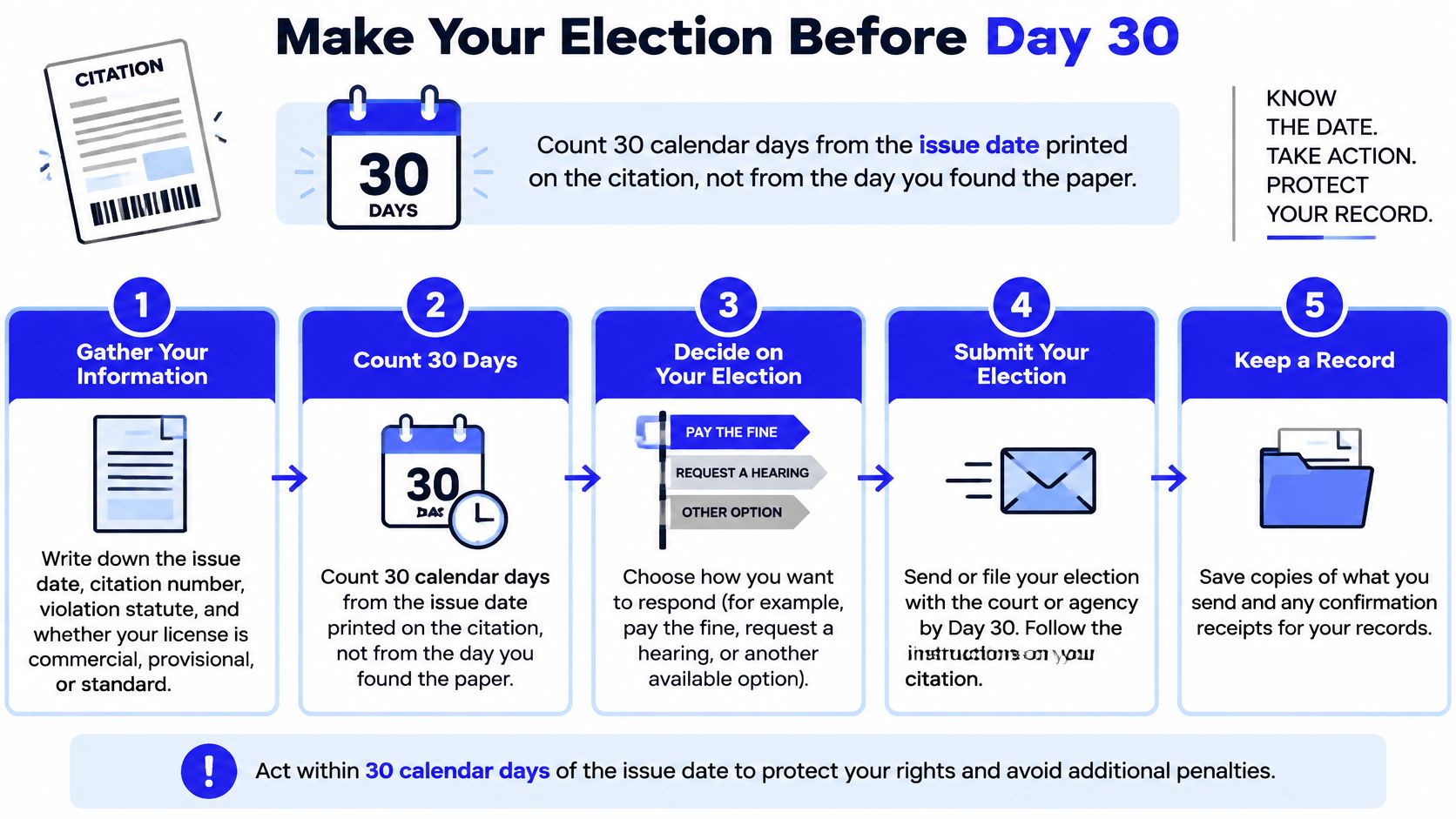
For a Broward civil traffic infraction, the Broward clerk information page explains the general 30-calendar-day response requirement, while identifying course restrictions that include five lifetime elections, generally one election in a 12-month period, and specified exclusions involving speed 30 mph or more above the limit. Check eligibility before you commit to a response.
Don't count from the day you remembered the ticket. Use the issue date printed on the citation and confirm the applicable deadline for that document.
Follow the paperwork in order
Record the identifying information. Write down the issue date, citation number, violation statute, and license class. Photograph the citation while it's still readable.
Confirm the case type. Verify that you're handling a civil moving citation. Don't use its response process for parking or criminal paperwork.
Check course eligibility. Review prior elections, commercial-license restrictions, and the charged violation. Don't rely on a course seller to decide the court's eligibility question.
Make the course election properly. If that's your chosen route, notify the clerk and pay the applicable election fee before taking the course. Save the recorded election.
Submit a hearing request when contesting. Keep proof of submission and review the later hearing notice carefully. Don't assume requesting a hearing identifies your courtroom immediately.
Read the disposition before paying. Understand the admission and hearing waiver attached to payment. Our explanation of paying a Florida traffic ticket can help you recognize that decision.
Verify the clerk's recorded election. Compare the case entry with the option you selected. Save receipts and confirmations, and contact your attorney promptly if the record doesn't match.
Use the visual checklist to keep the response process organized.
Confirm who must attend
Ticket Shield's traffic ticket defense is designed so clients don't have to go to court. That doesn't mean you should disregard a notice without confirming your attorney's instructions.
In most Florida careless driving cases, the attorney can appear for the client, so the client usually doesn't have to attend. A crash causing death or serious bodily injury is the exception.
Ask a direct question: Am I personally required to appear in this case? Get the answer from the lawyer responsible for the representation, based on your actual paperwork.
Keep preparing even when your attorney will appear. Send relevant photographs, correction documents, registration or insurance records, and any correspondence before the hearing. Representation works better when your lawyer receives the evidence early enough to assess it.
An election isn't complete because you intended to make it. Finish by checking the clerk's recorded election against your confirmation.
How Each Election Hits Points and Insurance
A no-points result is a record outcome, not a description of how little you paid. Follow the final disposition into your driving record before treating the matter as closed.
The FLHSMV driver-improvement FAQ explains that eligible course completion results in withheld adjudication and no points for that violation. Florida's qualifying insurance protection generally prevents an insurer from adding premium, canceling, or issuing nonrenewal solely because of an infraction with withheld adjudication and no points, subject to the statutory crash-related exception.
Read the actual disposition
Withheld adjudication means you weren't adjudicated guilty of that violation. It doesn't mean the citation never existed, and it doesn't justify telling an insurer that nothing happened without reading the question being asked.
A hearing result also requires careful reading. The court's decision may address the charge, a penalty, adjudication, or a course requirement. Don't compress all of that into a vague statement that the lawyer handled it.
Use the disposition to answer specific questions:
Was adjudication withheld? Look for the recorded result, not an assumption based on the amount due.
Were points assessed? Review the state driving record after the disposition is processed.
Is another obligation open? Identify any remaining course, payment, or compliance requirement.
Does the record match the order? Preserve the court document if a correction needs to be requested.
Our guide to Florida's points system, tickets, licenses, and insurance explains how those separate consequences relate. Use your own record when evaluating risk, not another driver's account of what happened with a similar ticket.
Insurance protection has boundaries
Don't mistake a statutory limitation tied to a qualifying disposition for a guarantee that your entire premium will remain unchanged. Your policy, other claims, other violations, and the insurer's stated reason still matter.
If a premium notice arrives, compare the stated reason with the court disposition. Keep the notice and policy documents together. An unsupported assumption about the cause won't help you challenge an error.
Record check: Compare the court's disposition, the adjudication entry, and the state driving record before you close your file.
The protective approach is to verify, not guess. If the court ordered a qualifying result but the record appears inconsistent, send both documents to your attorney. A readable court order and a current record provide a useful starting point for resolving the discrepancy.
Clear a Court Suspension Before You Drive
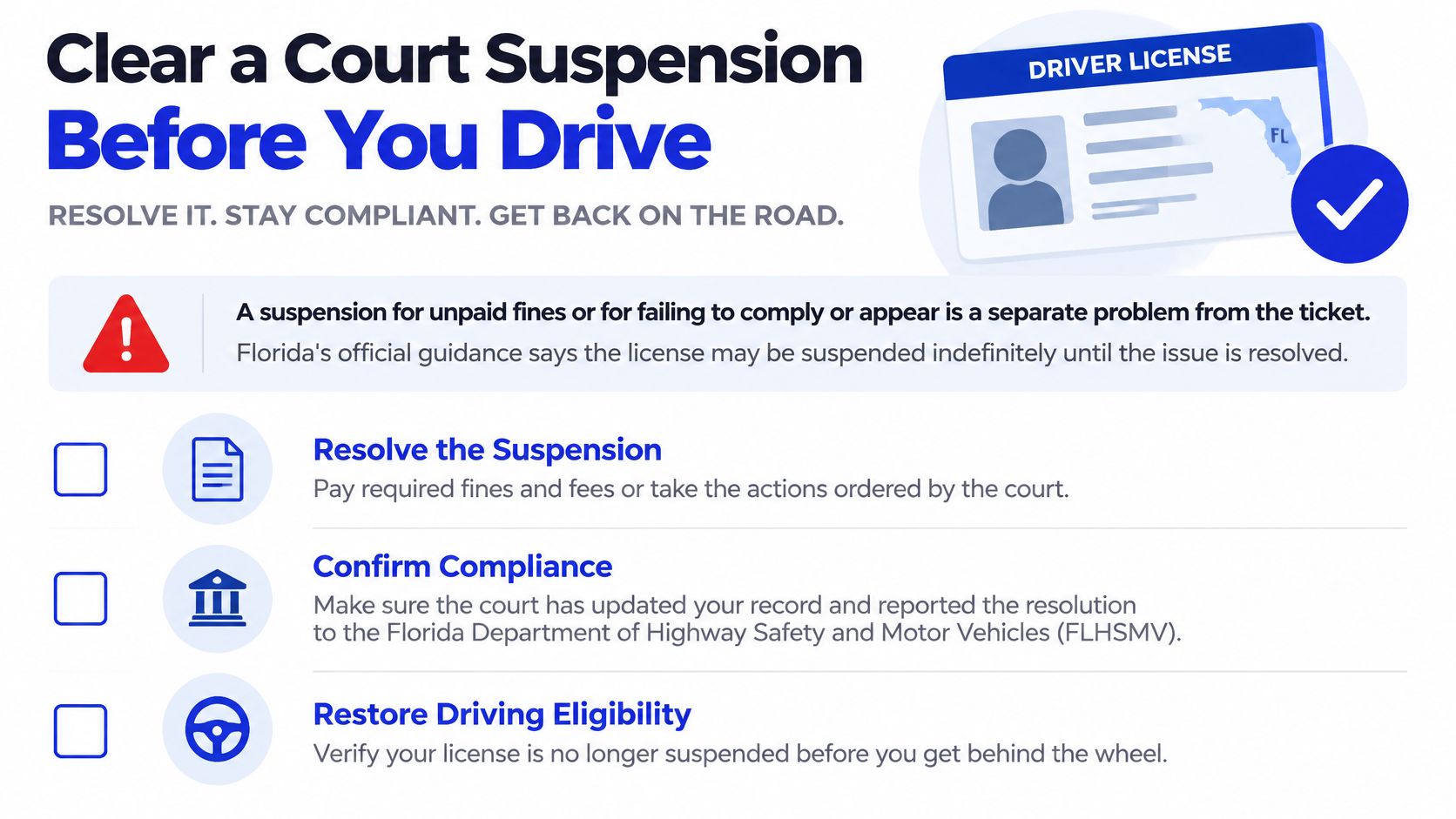
Case paid is not license reinstated. The FLHSMV court-suspension guidance says failure to pay or comply with a summons can produce an indefinite suspension and identifies a $60 reinstatement fee for court suspensions after court requirements are met.
Resolve the court obligation, verify the electronic clearance, and complete the applicable reinstatement requirement. Don't drive during the gap because you have a payment receipt.
Complete the reinstatement chain
Satisfy the issuing court. Identify the case and the precise reason for the suspension. Resolve what that court requires.
Verify the electronic update. Confirm that the county's clearance has reached FLHSMV. A court receipt doesn't establish that transmission is complete.
Finish reinstatement and check status. Pay the applicable fee and confirm your license status before driving.
Use this checklist to keep court compliance separate from restored driving eligibility.
Address affordability without assuming clearance
Florida Statute 322.245 provides qualifying routes involving payments currently due under a payment plan, a written payment agreement, or court-ordered relief, and requires clerks to establish Driver License Reinstatement Days. Eligible relief can include reductions or waivers of certain non-court fees or costs, but the statutory reinstatement fee remains required.
Ask whether your specific suspension qualifies and what certification the clerk must provide. Starting payments alone doesn't establish that you're cleared.
Point suspensions require separate attention. The FLHSMV points guide states that points remain on the record for at least five years from the conviction's disposition date and lists failure to stop for a school bus as a four-point violation, with an election potentially available for withheld adjudication.
For practical help identifying unresolved obligations, review our guidance on a suspended license in Florida. Check for cases in every issuing county and for unrelated restrictions.
Don't assume that clearing a Broward case clears every hold. Verify the final status with FLHSMV and retain proof of reinstatement before getting behind the wheel.
Have Your Ticket Case Reviewed Aimed at No Points
Four Broward courthouse calendars mean your citation's court assignment matters. So does the outcome: paying a fine does not automatically mean your license is clear or that your record has no points.
Ticket Shield, PLLC is a lawyer-led Florida traffic defense firm. A licensed attorney handles your case from start to finish, and you can communicate directly with that attorney by phone or text. That gives you a person to call or text, rather than an automated app or an answering service.
Put an attorney between you and the avoidable mistake
Ask who is responsible for your case, how you can reach that attorney, and what you need to do while the case is pending. Bring the citation and any hearing or suspension notice, along with correspondence and proof of any payment or election.
Use your case review to ask focused questions:
Available defenses. What does the citation allege, and what evidence could challenge it?
Record protection. Which route best supports avoiding a conviction and points?
Appearance responsibility. Does your case require you to attend?
Existing restrictions. Does a suspension or another unresolved case require separate action?
Ticket Shield's traffic ticket defense attorneys start at $39.99. Call (561) 821-6189 to have your ticket case reviewed.
Act while you still have a meaningful choice
The goal is No Points, pursued through a strategy suited to your charge and evidence. No lawyer can promise that result before reviewing the case. If you have already paid or made an election, have the recorded outcome reviewed rather than assuming the matter is finished.
Get a case review before choosing a route that may be difficult to reverse. Call Ticket Shield, PLLC at (561) 821-6189 to discuss your ticket case. Traffic ticket defense attorneys start at $39.99.