Tribunal de Tránsito de Florida: Proteja su Licencia 2026
¿Se enfrenta a un tribunal de tránsito en Florida? Conozca sus opciones, sanciones y cómo proteger su licencia. Evite puntos con ayuda legal experta en 2026.

Es probable que esté mirando la multa en el asiento de su acompañante, recordando la detención de tráfico en su cabeza y preguntándose si se trata solo de una multa molesta o del comienzo de algo peor.
Es peor si lo maneja con ligereza.
Una multa de tránsito en Florida es un evento legal. Pone en juego inmediatamente su licencia, su perfil de seguro y su historial de manejo. Si conduce para Uber, Lyft, DoorDash o cualquier otra plataforma, un solo error puede afectar sus ingresos. Si tiene una autorización de seguridad o necesita un historial limpio para trabajar, esto no es un problema de papeleo. Es un problema de riesgo.
El error que veo todo el tiempo es simple. Los conductores asumen que tienen tiempo. Asumen que pagar es inofensivo. Asumen que una aplicación puede «encargarse de ello». Esa mentalidad perjudica a las personas en los tribunales de tránsito de Florida.
Antes de hacer cualquier cosa, lea qué hacer cuando recibe una multa en Florida. Luego siga leyendo, porque la próxima decisión que tome es importante.
Índice de contenido
Lo que realmente sucede dentro de un tribunal de tránsito de Florida
Cómo los puntos conducen a la suspensión de la licencia y al aumento de seguros
Los peligros de las aplicaciones automatizadas frente a un abogado real
El momento en que una multa llega a su parabrisas
En el momento en que el oficial le entrega esa multa, el reloj empieza a correr.
La mayoría de los conductores todavía tratan la multa como si fuera una factura. No lo es. Es el comienzo de un proceso controlado por la corte dentro del sistema de Florida y, si responde de la manera equivocada, puede encadenarse a un daño que era evitable. Ese daño suele aparecer más tarde, cuando su aseguradora revisa su historial o cuando su empleador ve lo que sucedió.
Tampoco se le da crédito por tener «buenas intenciones». Al tribunal de tránsito de Florida no le importa que usted nunca haya tenido problemas antes, que llegara tarde al trabajo o que la carretera pareciera vacía. Lo que importa es lo que se presenta, lo que se impugna y lo que se preserva antes de que venzan los plazos.
Regla práctica: Si recibió una multa en Florida, actúe como si hubiera entrado en un caso legal, porque así es.
Los conductores a menudo me hacen una primera pregunta equivocada. Preguntan: «¿De cuánto es la multa?». La mejor pregunta es: «¿Qué le pasa a mi historial si elijo la opción equivocada?».
Esa es la perspectiva correcta. Una multa pagada puede perseguirlo por más tiempo que la detención misma. Perder un plazo puede quitarle las opciones que tenía el primer día. Una respuesta descuidada puede convertir una multa manejable en un problema con su licencia.
Este es mi consejo directo:
No pague primero: Pagar puede parecer eficiente, pero equivale a rendirse.
No espere a «ver qué pasa»: La demora ayuda al proceso judicial, no a usted.
No confíe en la promesa genérica de una aplicación: Un flujo de trabajo predeterminado no es un criterio legal.
Obtenga asesoría legal lo antes posible: La defensa más sólida suele comenzar antes de la fecha de la audiencia.
Los conductores de Florida se meten en problemas porque actúan demasiado tarde, no porque la multa fuera imposible de disputar. Por eso el tiempo importa más de lo que comúnmente se cree.
Lo que realmente sucede dentro de un tribunal de tránsito de Florida
El tribunal de tránsito de Florida parece más pequeño que un tribunal penal, pero se mueve más rápido y castiga la duda con mayor severidad.
La mayoría de los asuntos de tránsito se manejan en audiencias informales. Según esta descripción general de las audiencias del tribunal de tránsito de Florida, estas audiencias constituyen la gran mayoría de los procedimientos, duran entre 10 y 15 minutos por acusado, y el juez suele decidir el caso inmediatamente después de escuchar al oficial y al abogado o conductor. No hay jurado. No hay largas declaraciones de apertura. No hay espacio para tratar de entender qué hacer mientras está allí de pie.
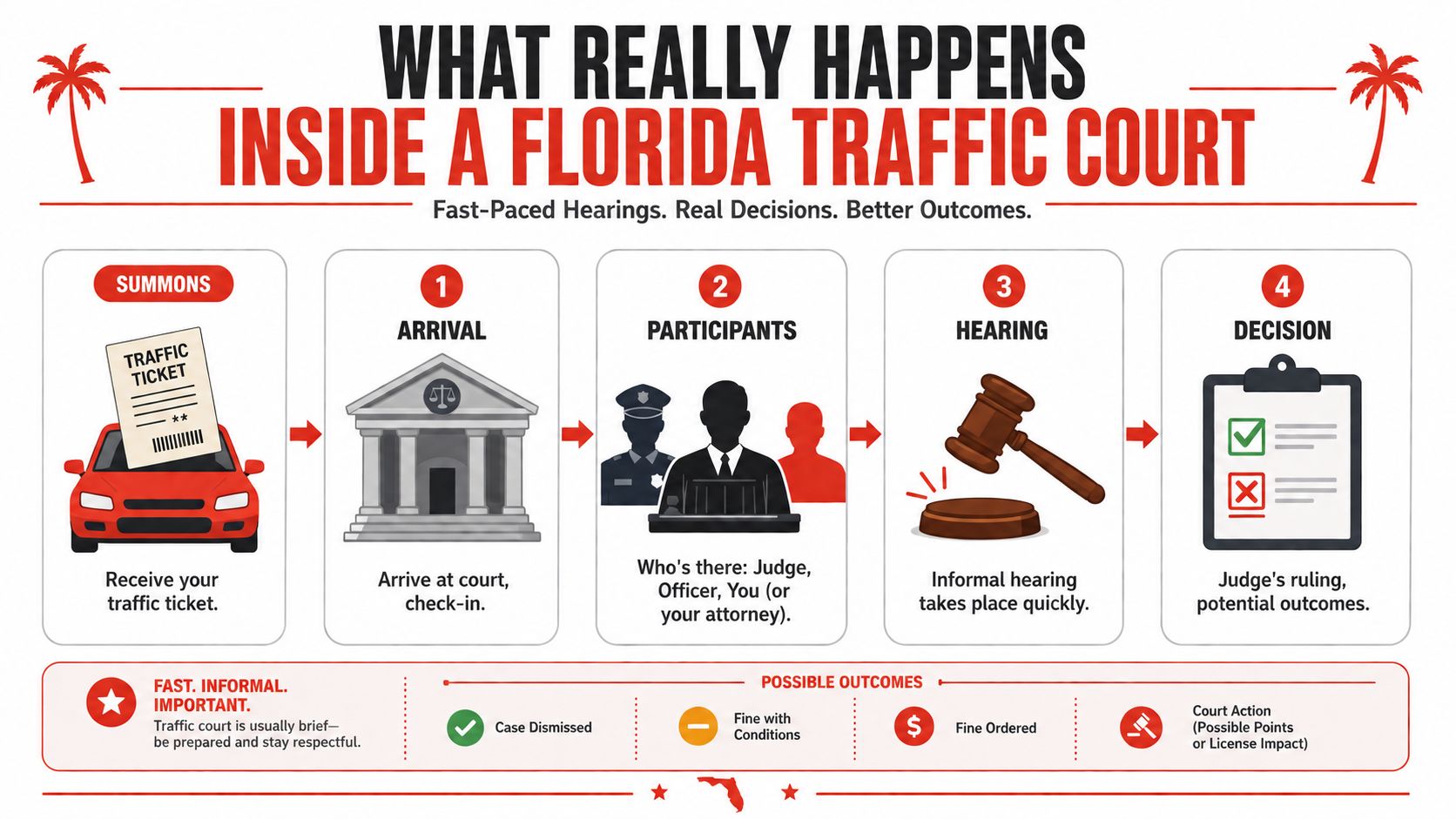
Si desea una vista previa más completa del proceso judicial, revise qué esperar en el tribunal de tránsito.
Por qué la audiencia avanza tan rápido
El juez tiene un método de trabajo. El oficial tiene un informe. Usted tiene una oportunidad para presentar una defensa clara.
Esa breve ventana de audiencia lo cambia todo. Significa que el trabajo principal se realiza antes del tribunal. Un conductor que se presenta con la esperanza de «explicar» las cosas por lo general se entera demasiado tarde de que una explicación no es una estrategia. El oficial ofrece su testimonio. El juez evalúa la relevancia legal. Luego viene el fallo.
Contar con representación experimentada es de gran importancia. No porque el tribunal de tránsito sea dramático, sino porque es acelerado. Un abogado que ya revisó la multa, evaluó los hechos y presionó para obtener un resultado favorable antes de la audiencia comienza desde una posición mucho más sólida que un conductor que se presenta sin preparación alguna.
Lo que el juez realmente está decidiendo
El juez no está allí para recompensar el esfuerzo. El juez está decidiendo si la multa se mantiene, si se aplica una mitigación y si hay un mejor resultado legal disponible bajo las circunstancias.
Eso puede incluir resultados que no lleguen a la desestimación. A veces, la victoria consiste en evitar el resultado que daña su historial. A veces, consiste en forzar la conversación adecuada antes de la audiencia en lugar de apostar durante ella.
Cuando una audiencia dura solo minutos, su preparación tiene que hablar por sí sola antes de ingresar a la sala del tribunal.
El peligro de ir solo es simple. Puede pensar que se está defendiendo, pero en la práctica está reaccionando ante un sistema que ya conoce el proceso mejor que usted.
Sus tres opciones y el plazo de 30 días
Florida le ofrece opciones después de una multa de tránsito. Lo que no le da es tiempo ilimitado.
Las multas de tránsito en Florida requieren un plazo de respuesta de 30 días a partir de la fecha de emisión. Durante ese período, debe tomar medidas como pagar, elegir la escuela de tránsito, demostrar la validez de la licencia o del seguro cuando corresponda, o solicitar una audiencia. Si no hace nada, las consecuencias pueden incluir cargos adicionales, la suspensión de la licencia y la pérdida de opciones de mitigación, como se describe en esta explicación sobre el plazo de las multas en Florida.
Ese plazo es la trampa. Los conductores piensan que es solo una fecha administrativa. No lo es. Es el punto en el que su poder disminuye.
Lo que realmente significa cada opción
Tiene tres caminos prácticos.
El primero es pagar la multa. Eso se siente rápido. También cierra la puerta a impugnar el cargo. Para muchos conductores, esa es la peor opción porque pone fin al caso sin proteger el historial.
El segundo es elegir la escuela de tránsito, si califica. En el sistema judicial estatal, elegir un curso de Mejoramiento Básico del Conductor dentro del plazo establecido genera una reducción automática del 18 % en la multa penal civil conforme a los datos y procedimientos de tránsito del tribunal de primera instancia de Florida. Eso puede ser útil. Pero no es una solución universal y puede no servir a los conductores que necesitan una defensa individualizada.
El tercero es contratar a un abogado para impugnar la multa. Esa opción preserva la oportunidad de buscar un resultado que proteja su historial de manera más efectiva que una decisión apresurada por cuenta propia. Si su caso involucra una multa de comparecencia obligatoria, esa urgencia se vuelve aún más grave.
Para asuntos de procedimiento local, especialmente si su caso se encuentra en el noreste de Florida, revise los requisitos del tribunal de tránsito de Jacksonville.
Comparación de sus opciones para multas de tránsito en Florida
Comparación de sus opciones para multas de tránsito en Florida
Factor | Opción 1: Pagar la multa (declararse culpable) | Opción 2: Elegir la escuela de tránsito | Opción 3: Contratar a un abogado para luchar |
|---|---|---|---|
Rapidez | Resolución inmediata más rápida | Por lo general sencillo si califica | Requiere acción legal rápida antes del plazo |
Control sobre el resultado | Muy poco una vez pagada | Limitado a la vía escolar | Máxima oportunidad para una defensa estratégica |
Protección del historial | Por lo general la opción más débil | Puede ayudar a algunos conductores a evitar consecuencias más graves en su historial | Se enfoca directamente en proteger el historial |
Participación de la corte | Mínima ahora, posibles consecuencias más adelante | Los pasos administrativos deben gestionarse correctamente | El abogado puede encargarse de las solicitudes y de la estrategia judicial |
Mejor opción para | Conductores que aceptan el resultado | Conductores que son aptos y se sienten cómodos usando esa opción | Conductores que necesitan una defensa seria, especialmente por riesgo laboral |
Peligro principal | Puede renunciar a defensas sin darse cuenta | Podría no ser la opción adecuada para un caso de alto riesgo | Esperar demasiado para contratar un abogado debilita su posición |
Mucha gente quiere una respuesta sencilla. Aquí está. Si proteger su licencia de conducir importa, pagar la multa suele ser el instinto equivocado. Si su trabajo depende de un historial limpio, la demora es una imprudencia.
Cargos comunes y su costo real
Algunas multas parecen menores porque el costo impreso parece manejable. Esa es exactamente la razón por la que los conductores las subestiman.

El problema legal no es solo lo que pasó en la carretera. Es cómo se clasifica la infracción, qué dice el estatuto y si usted crea un historial permanente al manejarlo mal.
El exceso de velocidad es más técnico de lo que los conductores creen
El Estatuto de Florida 316.183(2) establece el límite máximo de velocidad en 30 millas por hora en distritos comerciales o residenciales y 55 millas por hora en otros lugares, a menos que un condado o municipio establezca legalmente un límite menor, como se indica en el texto del Estatuto de Florida 316.183.
Esto es importante porque muchos conductores se defienden basándose en sus recuerdos en lugar de la zona señalizada y el estatuto vigente. Eso no es una defensa. Es una suposición.
Las multas por exceso de velocidad en Florida también están divididas por niveles. Según el cronograma verificado, superar la velocidad permitida de 6 a 9 mph conlleva una multa de $25; de 10 a 14 mph, de $100; de 15 a 19 mph, de $150; de 20 a 29 mph, de $175; y 30 mph o más conlleva una multa de $250, de acuerdo con este resumen de niveles de multas por exceso de velocidad en Florida.
La cantidad registrada aún no cuenta toda la historia. El principal problema es lo que la multa puede desencadenar más allá del costo en papel.
Las zonas escolares y de construcción se vuelven costosas rápidamente
Las zonas escolares son lugares donde resolver las cosas a la ligera se convierte en algo costoso.
Según el Estatuto de Florida 318.18, el exceso de velocidad de hasta 5 mph en una zona de la escuela legalmente señalizada es de $50. Más de 5 mph en una zona escolar o en un cruce escolar designado duplica el monto por violación de tránsito estándar, y los datos verificados indican que la cantidad es de $120 para el rango de 6 a 9 mph, como se muestra en el Estatuto de Florida 318.18.
Las zonas de construcción también pueden duplicar la multa por exceso de velocidad correspondiente de acuerdo con el resumen de citaciones verificado ya señalado anteriormente.
Este breve video ofrece información útil sobre cómo se perciben estos casos en la práctica.
La lección es simple. Los conductores se centran en el importe de la multa. Los tribunales se enfocan en la infracción. Las aseguradoras y los empleadores se centran en el historial resultante.
Cómo los puntos conducen a la suspensión de la licencia y al aumento de seguros
Una sola infracción rara vez se queda aislada. Se une al resto de su historial de conducción.
Es por eso que el objetivo principal en un tribunal de tránsito de Florida no es simplemente «salir del apuro». Es evitar el tipo de resultado que genera una carga en su historial y le da al estado, a su aseguradora o a su empleador una razón para tratarlo como un conductor de mayor riesgo.
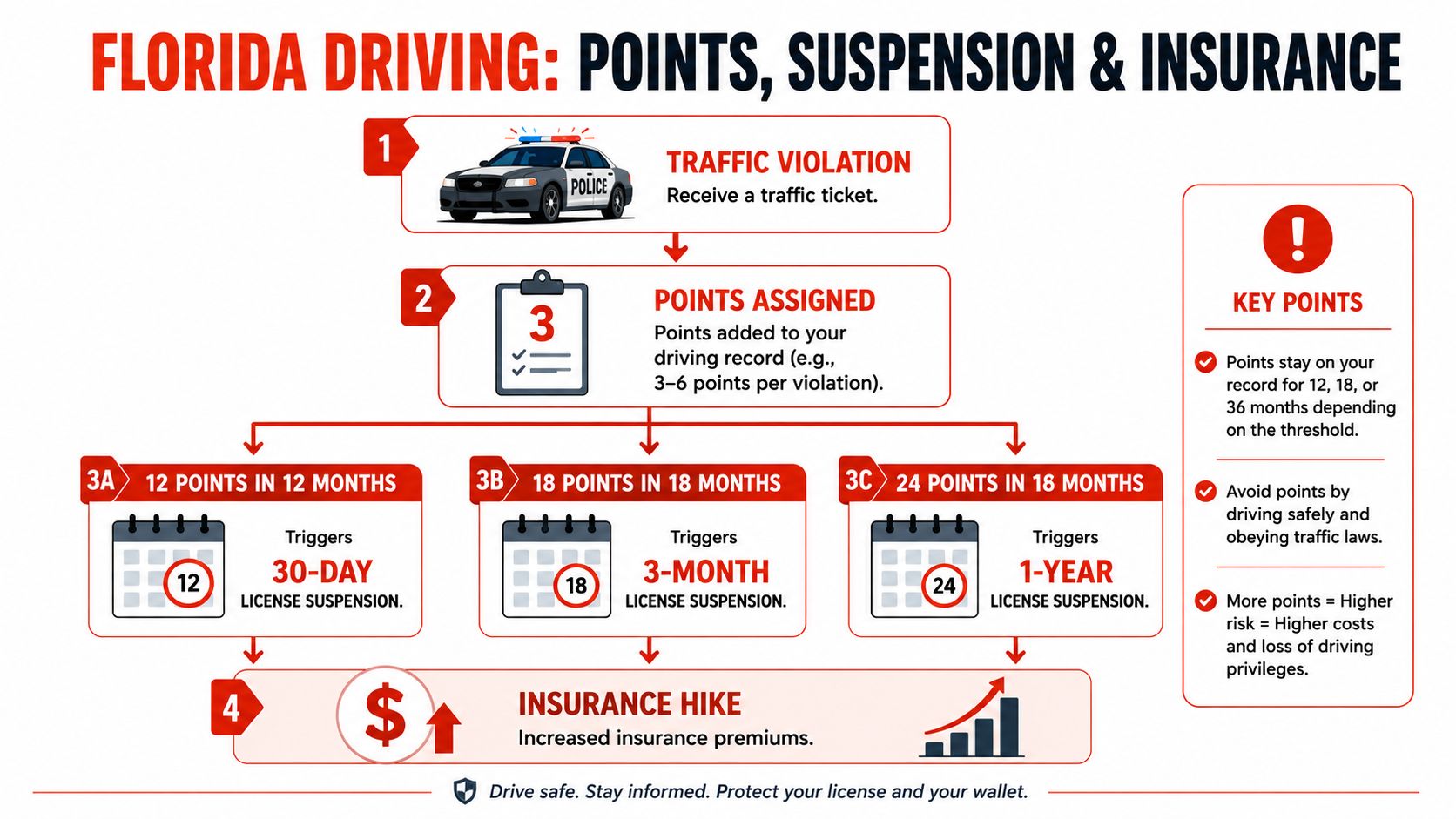
Si necesita una guía práctica sobre cómo funciona el sistema de registro, lea sistema de puntos de multas de tránsito de Florida.
El resultado que debería llamar su atención
Los datos de tránsito del estado de Florida le brindan una imagen mucho más realista que los rumores populares de los conductores.
Basado en 403,226 casos de infracciones de tránsito procesados en 66 condados de Florida entre 2023 y 2025, la tasa de emisión de fallos de culpabilidad fue del 45.4%, mientras que la emisión de fallos se suspendió en el 34.7% de los casos. La tasa de desestimación fue del 4.1%, y la sanción financiera promedio impuesta a los acusados condenados fue de $300 con una duración promedio de la sentencia de 2.9 meses, de acuerdo con los datos de casos de infracciones de tránsito del estado de Florida.
Esa cifra de fallo suspendido de culpabilidad es importante. Le indica que un resultado favorable sin condena no es una fantasía. Es una realidad práctica dentro de la corte de tránsito de Florida.
Una defensa inteligente no busca solo la desestimación. También lucha por obtener resultados que mantengan una condena formal fuera de su historial.
Por qué un fallo de culpabilidad perjudica por más tiempo que la multa
Una vez que el caso termina en un fallo de culpabilidad, ha creado un problema en su historial, no simplemente ha resuelto una multa.
Florida también opera a través de un sistema judicial unificado a nivel estatal que cubre los 67 condados, y el registro estatal de multas y puntos de licencia es mantenido por el FLHSMV, como se refleja en la información del sistema de tribunales de primera instancia citada anteriormente. Eso significa que su resultado no se queda a nivel local en ningún sentido práctico. Sigue a su licencia de conducir.
La conclusión es directa. Si su objetivo es proteger sus privilegios de conducción, debería preocuparse menos por terminar el caso rápidamente y más por terminarlo correctamente.
Los peligros de las aplicaciones automatizadas frente a un abogado real
Una aplicación de multas de tránsito le ofrece comodidad. Lo que a menudo le entrega es distanciamiento.
Sube una foto de la multa de tránsito, recibe actualizaciones estandarizadas y espera que alguien haya tomado una decisión legal real en algún momento del proceso. Ese modelo puede sonar moderno, pero es peligroso cuando un resultado adverso puede afectar su trabajo, su historial o su licencia de conducir.
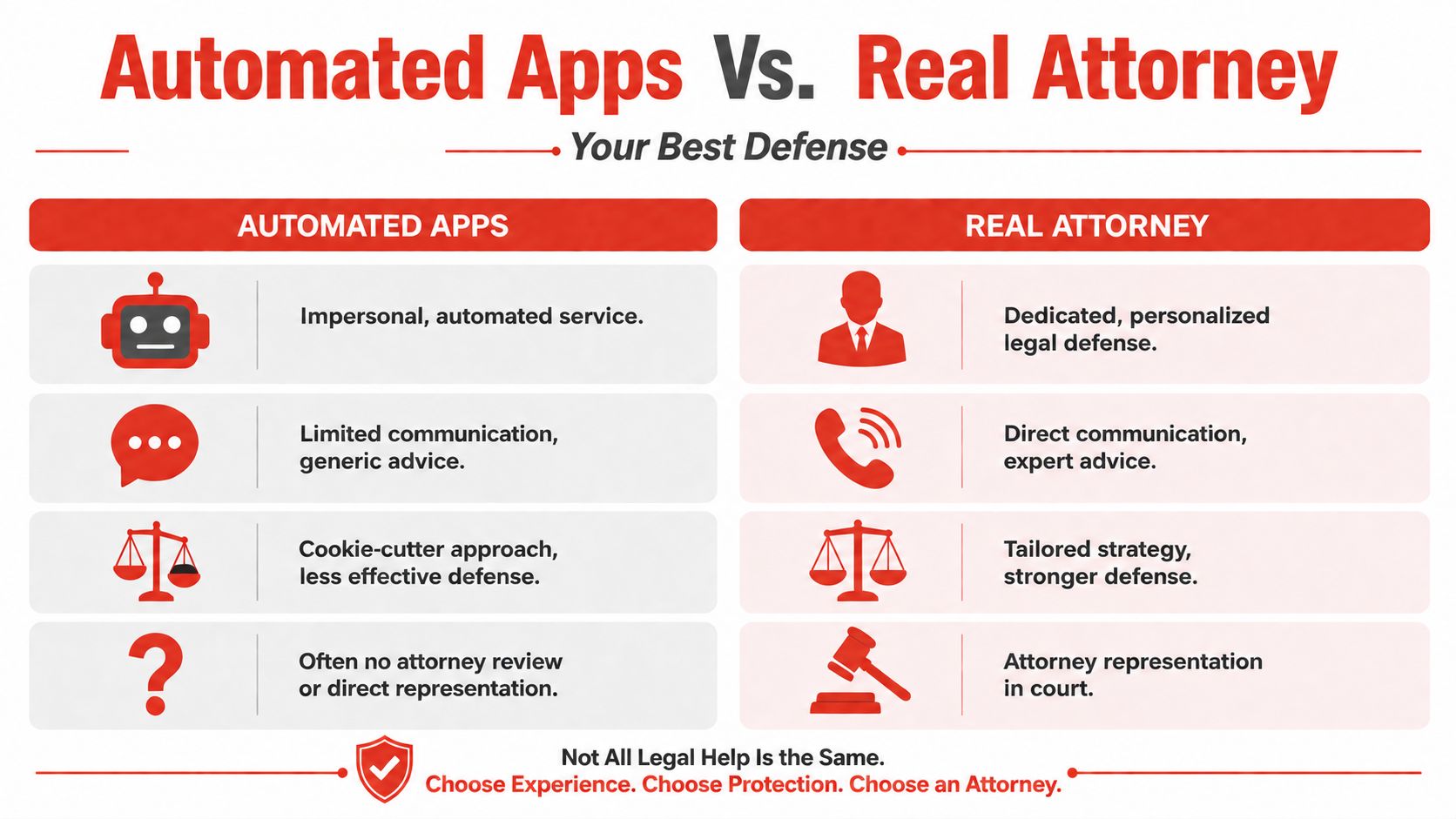
Si desea una explicación detallada de este problema, lea por qué muchos conductores eligen un abogado local en lugar de aplicaciones de multas.
Quiénes resultan más perjudicados por los servicios genéricos de multas
Algunos conductores pueden soportar un mal resultado. Otros no.
Para conductores de aplicaciones de transporte o personal militar, el plazo de impugnación de 30 días no se trata solo de evitar una multa. La guía verificada establece que es la última oportunidad para evitar que un solo punto cause la desactivación de la cuenta o problemas con la autorización de seguridad, y ese riesgo es algo que los servicios automatizados a menudo pasan por alto, como se señala en la guía de multas de tránsito de Florida de FLHSMV.
Esa es exactamente la razón por la que el procesamiento genérico no es suficiente para conductores con mucho en juego. Una respuesta de tipo «única para todos» ignora la pregunta que más importa. «¿Qué le pasará si esto sale mal?».
Si su sustento depende de mantener activa su elegibilidad para conducir, necesita una estrategia de verdad. Si su historial afecta su autorización de seguridad, necesita un juicio jurídico directo. Si su tiempo es limitado y su riesgo es alto, la falta de atención personalizada no es una ventaja. Es una debilidad.
«Solo necesito que alguien se encargue de ello» es comprensible. Pero si ese alguien es un flujo de trabajo computarizado en lugar de un abogado, es posible que no sepa qué se pasó por alto hasta que sea demasiado tarde.
Para los abogados que manejan cuestiones de evidencia y testigos en otros contextos, la preparación remota confiable también importa. Herramientas como la plataforma para deposiciones de AONMeetings demuestran la gran medida en que el trabajo legal profesional depende de una comunicación clara y controlada, en lugar de una automatización genérica.
El acceso directo al abogado cambia la estrategia
Llegados a este punto, la diferencia se vuelve práctica.
Un despacho dirigido por abogados debería permitirle hablar directamente con su abogado por teléfono o mensaje de texto. Eso importa porque la defensa de tránsito no es solo presentar papeles. Se trata de saber si conduce comercialmente, si su empleador revisa su historial, si ya utilizó la escuela de tránsito, si la infracción requiere corte y si la versión del oficial deja margen para impugnar el caso o buscar un mejor resultado.
Ticket Shield, PLLC es una opción en Florida construida en torno a ese modelo de atención directa por parte de un abogado. Los clientes se comunican con su abogado por teléfono o mensaje de texto, en lugar de ser canalizados a través de intermediarios o solamente mediante un chat de admisión. En un caso con plazos determinantes, ese tipo de acceso no es superficial. Cambia la rapidez con la que se toman las decisiones.
Las aplicaciones automatizadas están diseñadas para operar a gran escala. Su defensa debe estar diseñada para protegerle a usted.
Su próximo paso para proteger su historial de manejo
A estas alturas, el patrón debería estar claro.
Una multa de tránsito en Florida no es una interrupción menor. Es un problema legal con plazos establecidos. Si decide mal, puede renunciar a defensas, desencadenar daños en su historial y generar consecuencias que duren más que la detención misma.
No necesita más demoras. No necesita un panel genérico. Necesita un plan de defensa diseñado en función de su riesgo real.
Si su caso pertenece a un tribunal de tránsito de Florida, actúe antes de que el plazo rígido le controle. Obtenga asesoramiento claro. Conserve sus opciones. Presione para obtener el resultado que proteja su historial en lugar de simplemente cerrar el expediente.
El paso correcto suele ser el que los conductores posponen. Hable con un abogado real a tiempo, antes de que se programe la audiencia, antes de tomar una decisión equivocada y antes de que un problema prevenible se vuelva permanente.
Visite Ticket Shield, PLLC ahora para una consulta gratuita y un plan directo para proteger su historial y luchar por Cero Puntos en su licencia.