Guía para pagar multas de tránsito en Florida y evitar puntos
Aprenda cómo pagar una multa de tránsito de Florida en línea, por correo o en persona, cumplir con los plazos, evitar puntos y decidir cuándo luchar con Ticket Shield.

You're probably staring at a Florida citation right now, wondering whether to just pay it online and move on. That instinct is understandable. It's also where many drivers make the expensive mistake.
A Florida traffic ticket often looks like a simple bill. It isn't. In many cases, payment closes the case, but it also locks in consequences that can follow your license and your insurance long after the clerk processes your card. If your record is already carrying prior citations, the decision gets more serious fast.
Table of Contents
What Paying Your Florida Traffic Ticket Really Means
You get stopped in Orange County on the way home, pull up the ticket that night, and pay it before bed just to be done with it. The clerk takes your money. Your case closes. Then the points hit, your insurance carrier sees the violation at renewal, and a quick online payment turns into a much more expensive decision.
Under FLHSMV traffic citation guidance, paying a Florida traffic citation usually means you accept the civil penalty and resolve the case through the clerk in the county where the stop happened. That sounds administrative. It is also a legal decision.
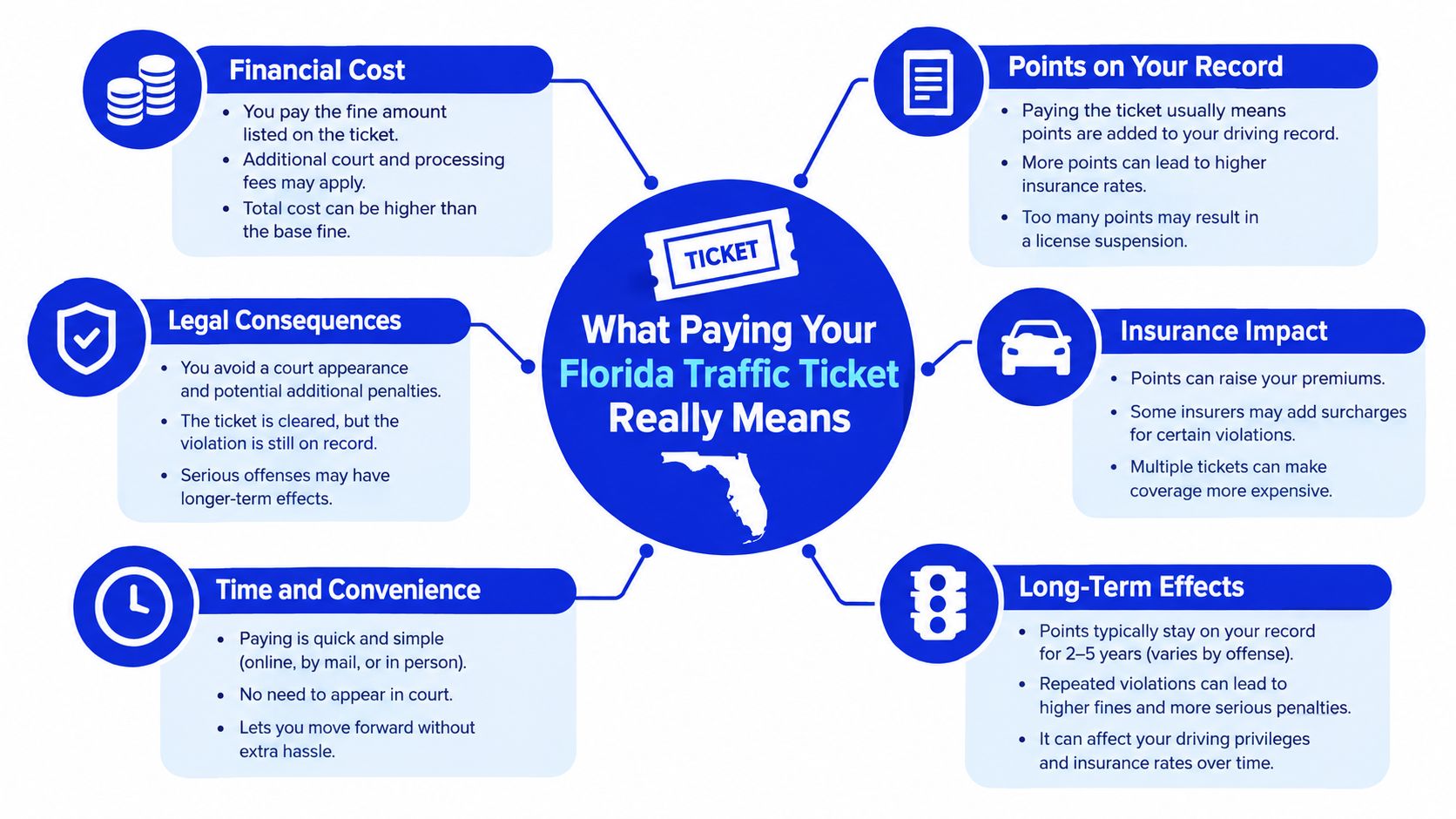
Payment often functions like a guilty plea
Drivers across Florida make the same mistake. They treat a citation like a utility bill instead of a record problem.
For many moving violations, payment closes the case in a way that can place points on your license. That matters more in some counties than others. In high-insurance counties and counties where local procedures may offer alternatives worth exploring, a fast payment can be the worst option. If your stop happened in Miami-Dade, Broward, Palm Beach, Hillsborough, Orange, or Duval, do not assume paying is the safe move. Review the county process first, and review your prior record before you do anything.
Florida assigns points for many common violations, including speeding, red-light violations, reckless driving, and passing a stopped school bus, as listed in the state point schedule on the same FLHSMV guidance above. If your goal is protecting your record, start with practical ways to avoid penalty points in Florida.
One statute deserves your attention if the ticket involves speed. Florida Statute 316.187 covers unlawful speed. Once you pay a Chapter 316 citation without checking the point consequences, you can damage your driving record for the sake of convenience.
My rule: If the ticket can add points, the fine is rarely the main problem.
The posted fine can be the cheapest part of the case
Points put you closer to suspension. Under Florida Statute 322.27, too many points within set time periods can trigger a suspension. That is where payment hurts people with prior tickets, CDL issues, or already-fragile driving records.
Here is the decision framework I want you to use. If the citation is nonmoving and carries no points, payment may be perfectly reasonable. If it is a moving violation, happened in a county with procedures you have not checked, or lands on top of earlier citations, treat payment as a plea decision, not a banking transaction.
Protect the license first. The clerk only processes the payment. You live with the record.
How to Pay Your Florida Traffic Ticket Without Mistakes
You are about to click “pay,” and the clerk's system will treat that click like a plea decision. If you already decided payment is the right move, do it carefully. A wrong county, wrong ticket number, or missed deadline can turn a simple payment into a delinquent case.
A statewide starting point is the Florida Clerks guidance on paying traffic tickets. Florida drivers generally must act within 30 calendar days of the citation by paying, electing traffic school if allowed, or contesting.
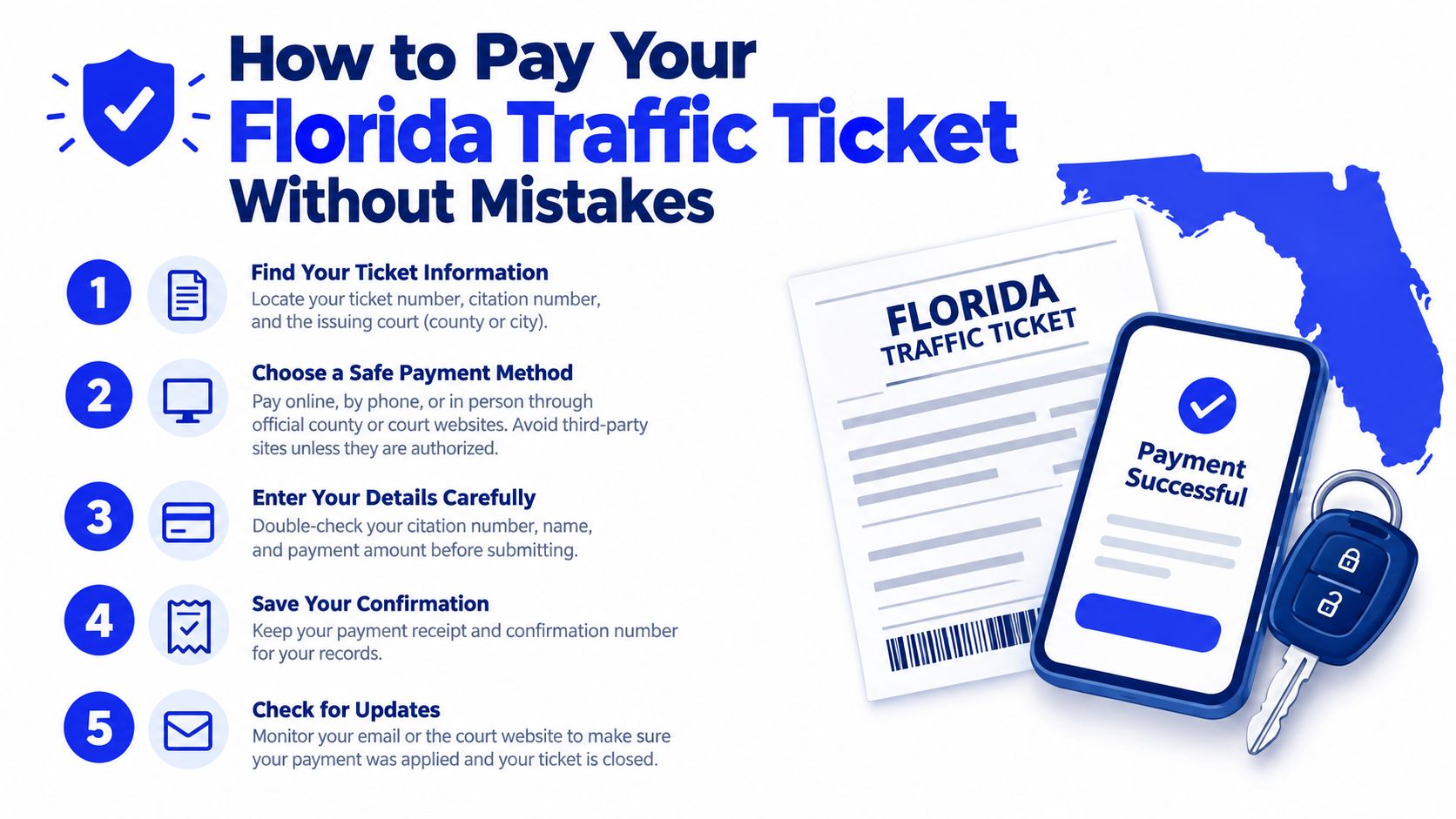
What to gather before you pay
Do not open a payment portal first. Get the facts first.
You need:
Your citation number. The clerk usually cannot pull the case without it.
The county where the stop happened. You pay that county clerk, not your home county.
The citation type. Some tickets can be paid. Some require a court appearance.
Your deadline. Online access can disappear once the case becomes late.
The outcome you want. Fast payment is a bad choice if the ticket adds points and you have a weak record already.
If you need help locating the citation details, start with where to find your Florida speeding ticket number.
My advice: verify the county, verify the ticket status, then decide whether payment still makes sense.
Online, mail, phone, and in-person payment
Online payment is usually the cleanest option. Use the official county clerk portal only, enter the citation exactly as written, and save the final confirmation page and receipt number. A screenshot of an unpaid cart proves nothing.
Mail is riskier. Some counties treat payment as late unless it is received by the deadline, not merely mailed by the deadline. If you are close on time, do not trust the postal clock with your license record.
In-person payment gives you the most control when timing is tight or the online status looks wrong. You can confirm the amount due, confirm the case is payable, and get proof that the clerk received it. Phone payment can work too, but check afterward that the case posted.
This short video covers the process from a practical angle.
The safest workflow
Use this order:
Confirm the ticket is payable. If the citation requires court, stop there.
Check the county clerk's official instructions. Counties handle operations differently.
Enter the citation exactly. One wrong digit can attach payment problems to the wrong case or no case at all.
Save proof immediately. Keep the receipt, confirmation number, and payment date.
Verify the case posted. A card charge without a posted case result is not good enough.
Convenience gets drivers in trouble. Accuracy protects you.
County Rules Deadlines and Fees That Catch Drivers Off Guard
You pay what looks like a routine ticket on day 30, then learn the county counted it late, added fees, or required a separate filing you never made. That is how drivers turn a payable citation into a bigger problem. In Florida, county clerk rules control the process, and small local differences can cost you money and damage your record faster than the ticket itself.
County differences change the risk
Alachua County gives drivers 30 days to satisfy the citation, and a payment made after that window triggers an additional $23 late fee, according to Alachua County traffic citation payment instructions. Alachua also allows several payment methods, but the deadline still controls. If you wait, the county gets more expensive before your insurance company ever gets involved.
Hillsborough County is different. The clerk gives drivers an automatic 60-day period to pay or complete the required option, and the clerk also states you cannot request an extension. If you cannot comply in time, you must request a hearing instead, based on Hillsborough Clerk traffic payment rules.
Duval has its own traps. The Duval County Clerk traffic citations page states that online and phone payments carry a 3.5% non-refundable service fee. Duval also requires payment or election within 30 calendar days and, for some compliance-based cases, requires an affidavit and fee if you cannot produce the needed proof in the ordinary way. Those are not minor clerical details. They affect what it costs to close the case and whether paying quickly is even your best move.
Florida County Payment Rules Compared
County Detail | Rule |
|---|---|
Alachua County | Pay within 30 days. After 30 days, a $23 late fee applies. |
Hillsborough County | Automatic 60-day compliance window. No extension requests. If you can't comply, request a court hearing. |
Duval County | Credit-card payments carry a 3.5% non-refundable service fee. Payment or election is due within 30 calendar days. Some matters require an affidavit and added fee if compliance proof is missing. |
Why this should affect your decision
County procedure changes more than convenience. It changes the cost of a guilty plea.
A higher fine does not always mean you should just pay and move on. Palm Beach County, for example, lists a $356 civil penalty for 30+ mph over the limit in payable cases, and fine schedules across Florida often rise sharply with speed. Review a practical breakdown of common Florida traffic ticket costs, then compare that amount to the long-term price of points and insurance increases.
Use a simple county-based framework:
Alachua: Act early. The late fee hits fast.
Hillsborough: Use the longer window carefully. More time does not make payment safer if a conviction will hurt your record.
Duval: Check fees and document requirements before you submit anything. A card payment and a guilty plea can become more expensive than expected.
Clerks process payments. They do not protect your license. If paying the ticket would put points on a record that is already crowded, the county deadline matters, but the conviction matters more.
Should You Pay Contest or Seek Alternatives
The question isn't “How do I pay?” It's “Should I pay at all?”
If this is your first citation and the point consequences are manageable, payment may be the cleanest route. If you already have prior tickets, payment can be the wrong move because it stacks one more conviction onto a record that may already be too close to trouble.
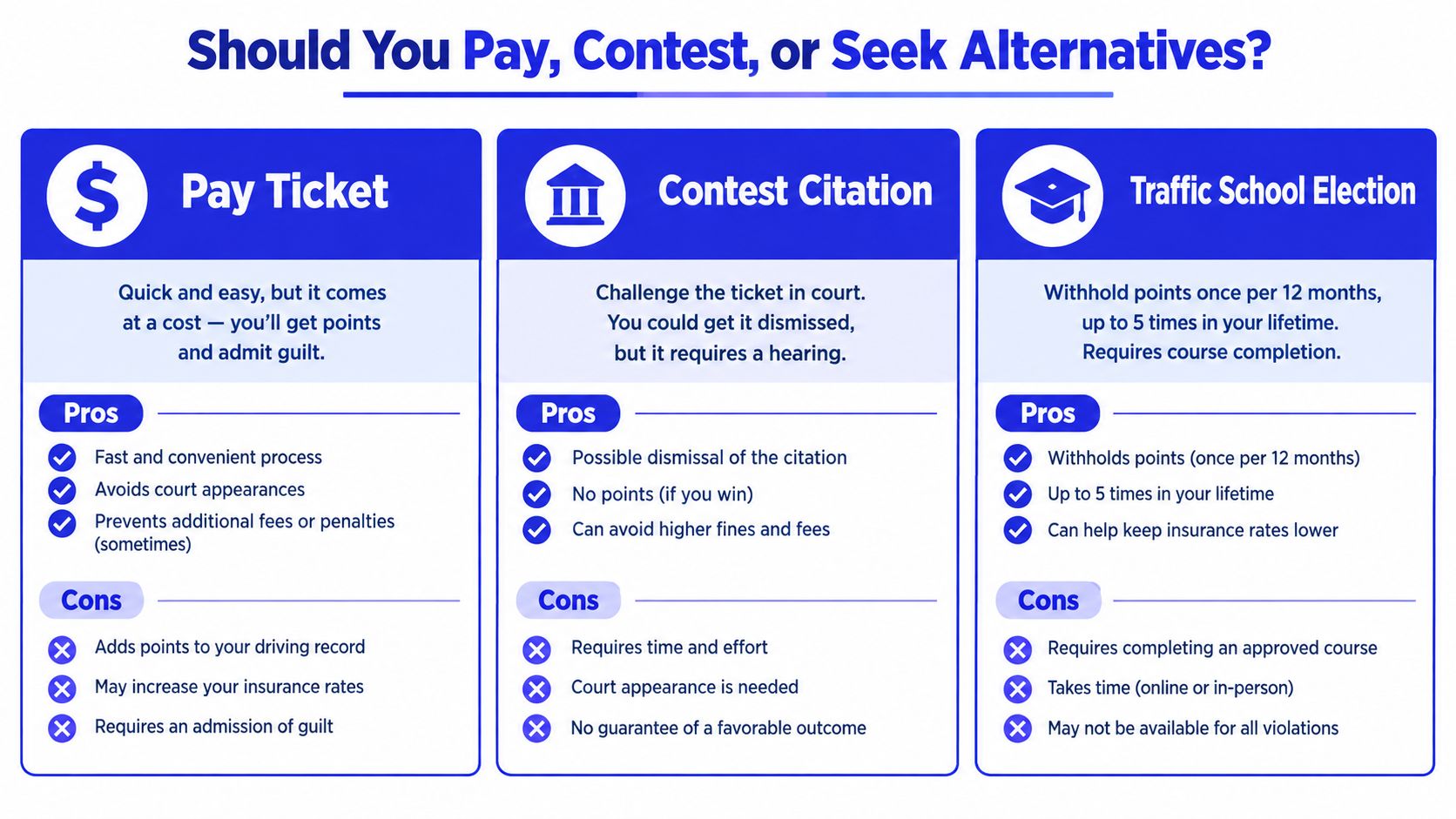
When paying makes sense
Paying is about closure and convenience. It ends the citation quickly. But convenience is only a good trade if the added record consequence won't hurt you more than the civil penalty.
Florida's official driver-license suspension page repeats the same point thresholds that matter to your risk analysis. 12 points in 12 months means 30 days, 18 points in 18 months means 3 months, and 24 points in 36 months means 1 year, according to the FLHSMV points and suspensions chart.
When you should slow down and fight
Contest the citation, or at least get legal advice first, if any of these apply:
You already have prior points. One more payable ticket may move you into suspension range.
Your job depends on driving. A fast payment can create a much bigger employment problem.
The facts are disputable. You shouldn't plead through payment if the stop or charge can be challenged.
The posted amount looks low, but the collateral risk is high. Insurance and license status are often the cost.
Decision test: If the ticket affects your livelihood, your existing point total, or your ability to keep driving legally, don't treat online payment as the default.
Alternatives worth considering
Some drivers may be eligible to elect traffic school instead of paying and accepting the standard outcome. Others may need a hearing or a payment arrangement because full payment isn't realistic by the deadline. Those choices depend on the ticket, the county, and your record.
If you want a plain-English comparison of the tradeoffs, review paying a ticket versus hiring a lawyer in Florida. One practical option is Ticket Shield, PLLC, which handles Florida citations statewide and lets clients communicate directly with an attorney by phone or text rather than through a middleman or automated app.
The short version is simple. If your record is clean, payment might be acceptable. If your record is already exposed, paying can be the expensive choice.
Special Situations That Change Your Payment Strategy
You pay the ticket, assume the problem is over, and then find out your license is still blocked, your home state got the report, or a separate compliance issue is still sitting on your record. That is common in Florida. Payment closes the citation. It does not automatically fix the reason you were exposed in the first place.
If your license is already suspended
Paying a new ticket while your license is suspended can be the wrong first move. You need to identify the suspension reason, any court hold, and what Florida requires for reinstatement before you send money.
Florida's official driver handbook warns that if your license has been suspended for 30 days or more, law enforcement can seize your license plate, as stated in the Florida Driver Handbook. That changes the risk immediately.
Handle the suspension first, or at least at the same time. A receipt does not restore driving privileges.
If you live out of state or just moved
Out-of-state drivers make a costly mistake here. They treat online payment like a simple fine and ignore what gets reported back to their licensing state.
Florida cases can follow you home through interstate reporting systems and licensing records. If you recently moved, the problem can get messier because your address, registration, insurance, or license status may not match across agencies. The Florida Highway Safety and Motor Vehicles traffic citations page is a better starting point than private ticket sites because it explains the state process and points you to county handling rules.
If you live outside Florida, check three things before paying: where the case is pending, whether your home state will record the outcome, and whether the citation is tied to another issue such as no valid license, registration, or insurance proof.
If the ticket started as one problem and turned into three
Some tickets are not really about speeding or a rolling stop anymore. They become a license-status problem, a proof-of-insurance problem, or a failure-to-comply problem because the deadline passed and nobody fixed the underlying issue.
Florida warns that failing to pay or appear can lead to added driver-privilege consequences, according to State of Florida driving privilege guidance. Once that happens, payment strategy changes. You are no longer deciding only how to dispose of a citation. You are deciding how to stop more damage to your record.
Act early. If your status is already fragile, the safe move is to get the full picture before you pay.
Protect Your Record and Get Your Free Consultation Today
A Florida traffic ticket pay decision should never be automatic. Sometimes payment is the practical move. Sometimes it's a guilty plea in all but name, and it can do more damage to your license than the fine itself.
You've seen the pattern. County deadlines are strict. Mailing rules can be unforgiving. A ticket that looks manageable can become a licensing problem if your record already has prior exposure. That's why direct legal judgment matters more than a chatbot flow or a corporate intake script.
Automated apps and ticket mills are built for volume. You get forms, middlemen, and canned responses. A lawyer-led Florida defense approach gives you something different. You can get direct attorney access by phone or text, a real assessment of whether payment helps or hurts, and a strategy focused on keeping your record clear.
If you need a starting point, read how a Florida traffic ticket lawyer free consultation works. Then act quickly. Delays help the system, not you.
The goal is not merely to pay the ticket. The goal is to protect your license, your insurance profile, and your ability to keep driving.
Visit Ticket Shield, PLLC now for a free consultation before you pay a Florida traffic ticket that could put points on your record. You'll speak with a lawyer-led Florida defense team focused on the outcome that matters most: No Points on your license.